Humanoid Robots: What They Are, Why They Overheat, and Where They Work
At NASA's Johnson Space Center, operators running the Valkyrie humanoid watch its actuator temperatures. When the legs or torso get too hot, the work stops until they cool. Not the battery — the metal. The humanoid form was copied from a body that sweats. No commercial humanoid does.

Humanoid Robots: What They Are, Why They Overheat, and Where They Work
At NASA's Johnson Space Center, operating the Valkyrie humanoid requires an operator to monitor the thermal state of its electric actuators continuously. When the torso or leg actuators reach unsafe temperatures, operations are postponed until they cool back within limits — a constraint documented in NASA JSC research on thermal recovery in multi-limbed robots. Not the battery. The metal.
Humanoid robots are usually explained as a battery problem, and the two-to-four-hour runtime figure is the number that circulates. Battery is the visible limit. Heat is the binding one, and it arrives first.
What Is a Humanoid Robot?
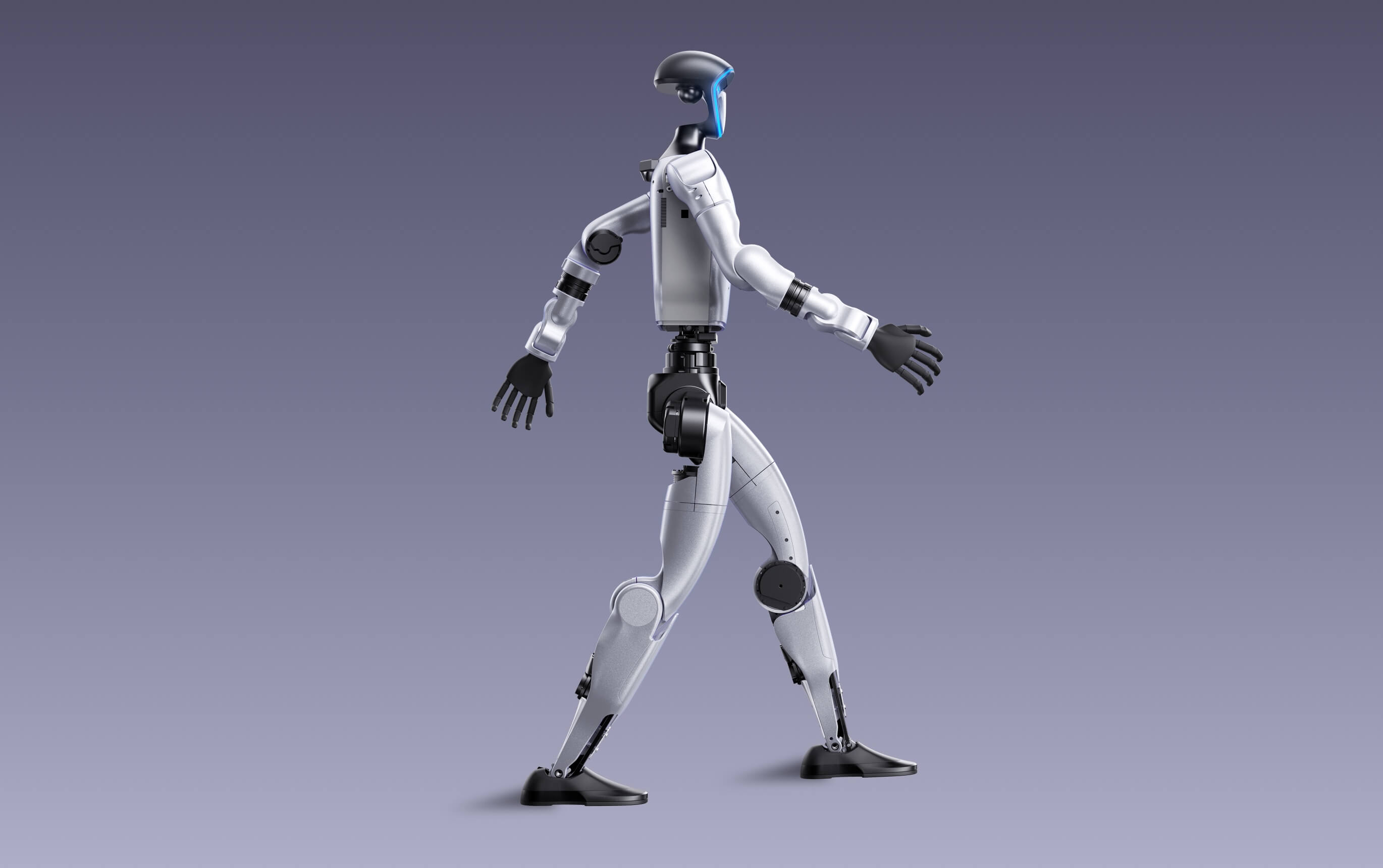
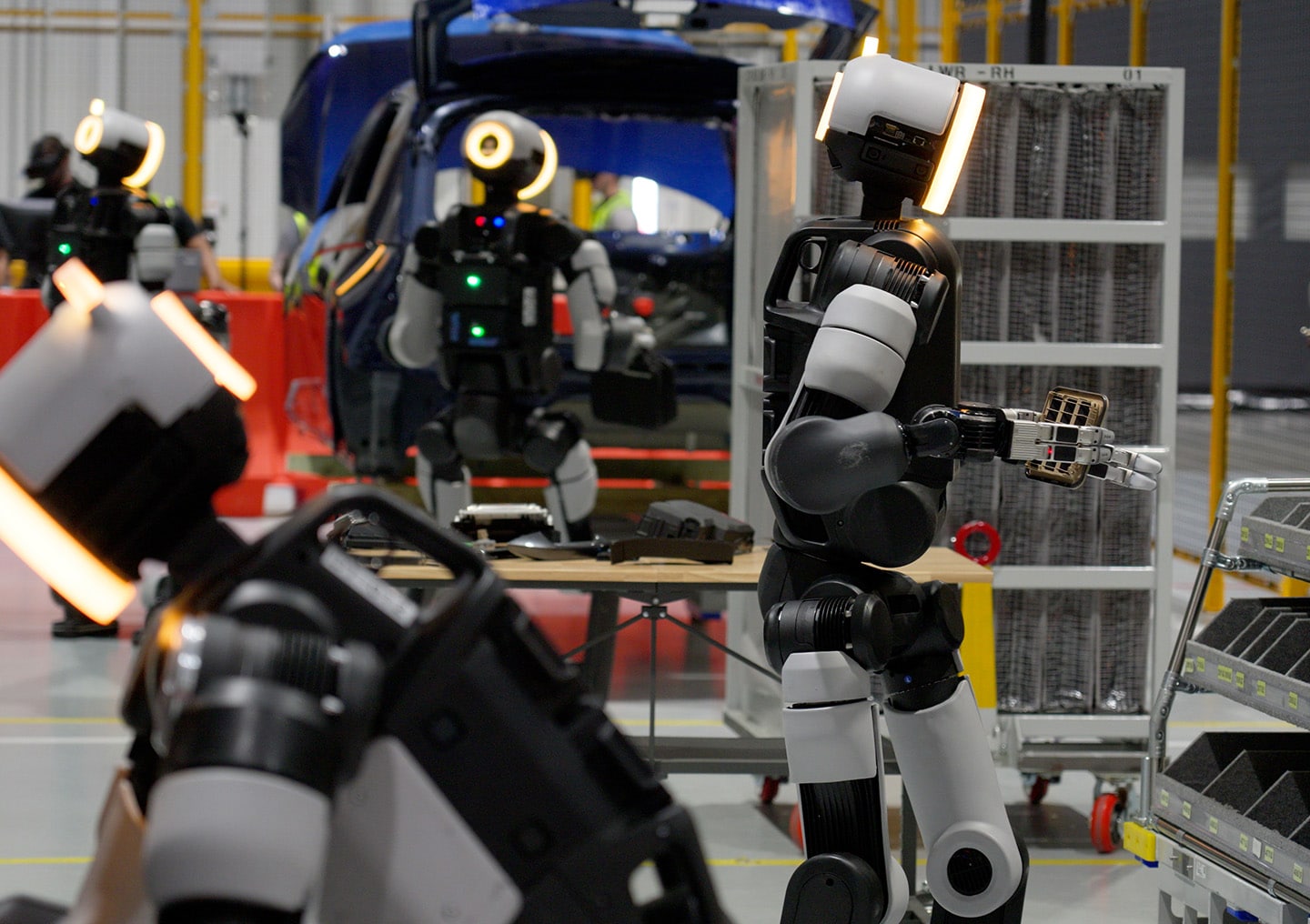
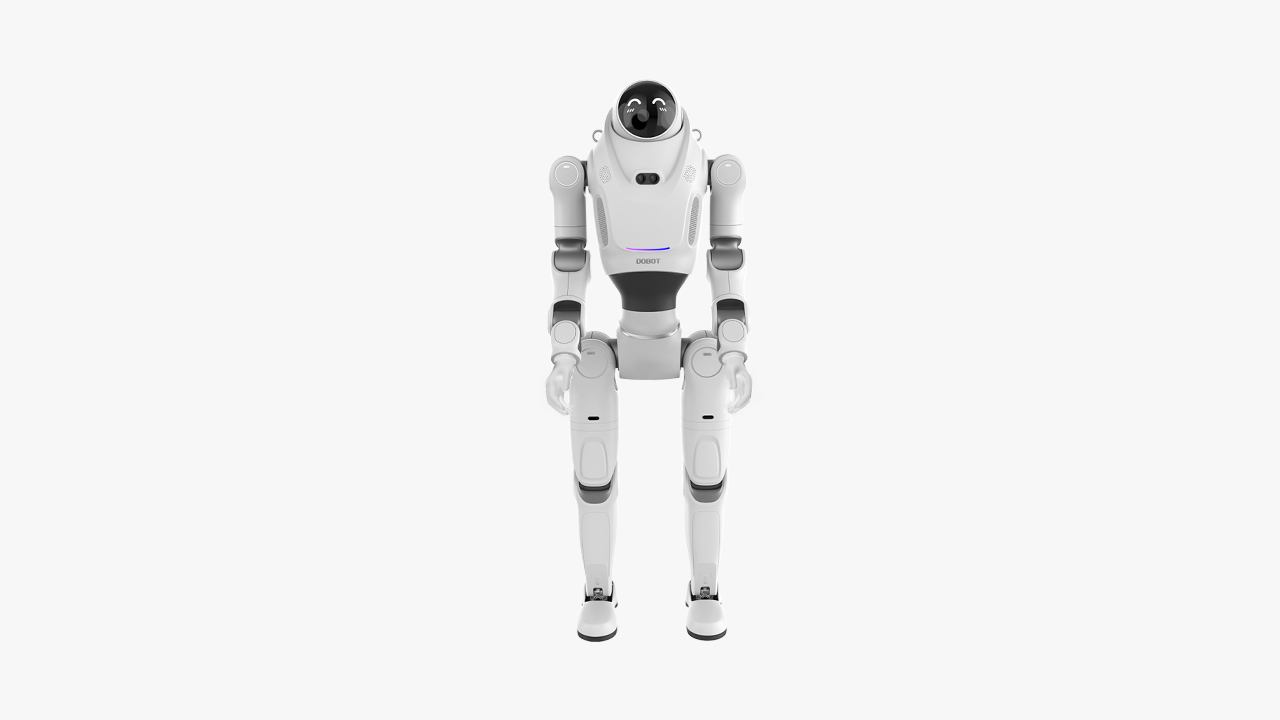
A humanoid robot is a robot built with a human body plan — two legs, two arms, a torso, and a head — so it can work in spaces designed for people. Most carry 30 or more powered joints. Commercial deployments in 2026 concentrate on tote movement, material transfer, and inspection.
A humanoid robot is a machine built to the human body plan so that it fits environments laid out for human bodies. It matters now because platforms from Figure AI, Agility Robotics, UBTECH, Unitree, and Tesla have moved from demonstration into paid pilot work, with Chinese firms accounting for more than 80% of global installations in 2025 per Counterpoint Research. For an operations lead, the practical consequence is that the form factor's advantages and its limits both follow from the same decision — copying a shape optimised for a biological system.
Each of those 30-plus joints is a brushless motor paired with a harmonic or cycloidal gearbox, and PatSnap's April 2026 engineering analysis names actuator reliability under sustained industrial duty cycles as the primary mechanical bottleneck preventing large-scale deployment. Harmonic drives deliver high gear ratios in compact packages, which suits joint-level integration, but their flex-spline components are subject to fatigue failure under exactly the cyclical loading that walking and repetitive lifting produce.
Why Heat Binds Before the Battery Does
Evolution solved sustained physical work in a compact upright frame using evaporative cooling. Human skin leaks water, the water carries heat away as it evaporates, and the structural material underneath does not need to conduct heat at all. That subsystem was the one part of the reference design not copied — though researchers recognise the omission, with work on autonomic perspiration in 3D-printed hydrogel actuators published in Science Robotics in 2020.
Without it, a humanoid dumps heat through metal and air, inside an envelope with limited surface area. GlobalSpec's September 2025 analysis records operating temperatures reaching 50°C during high-performance tasks, with efficiency and reliability falling as temperature derating engages, and notes that the compact form limits dissipation surface area to the point where active cooling becomes necessary — itself another power draw.
Why do humanoid robots overheat?
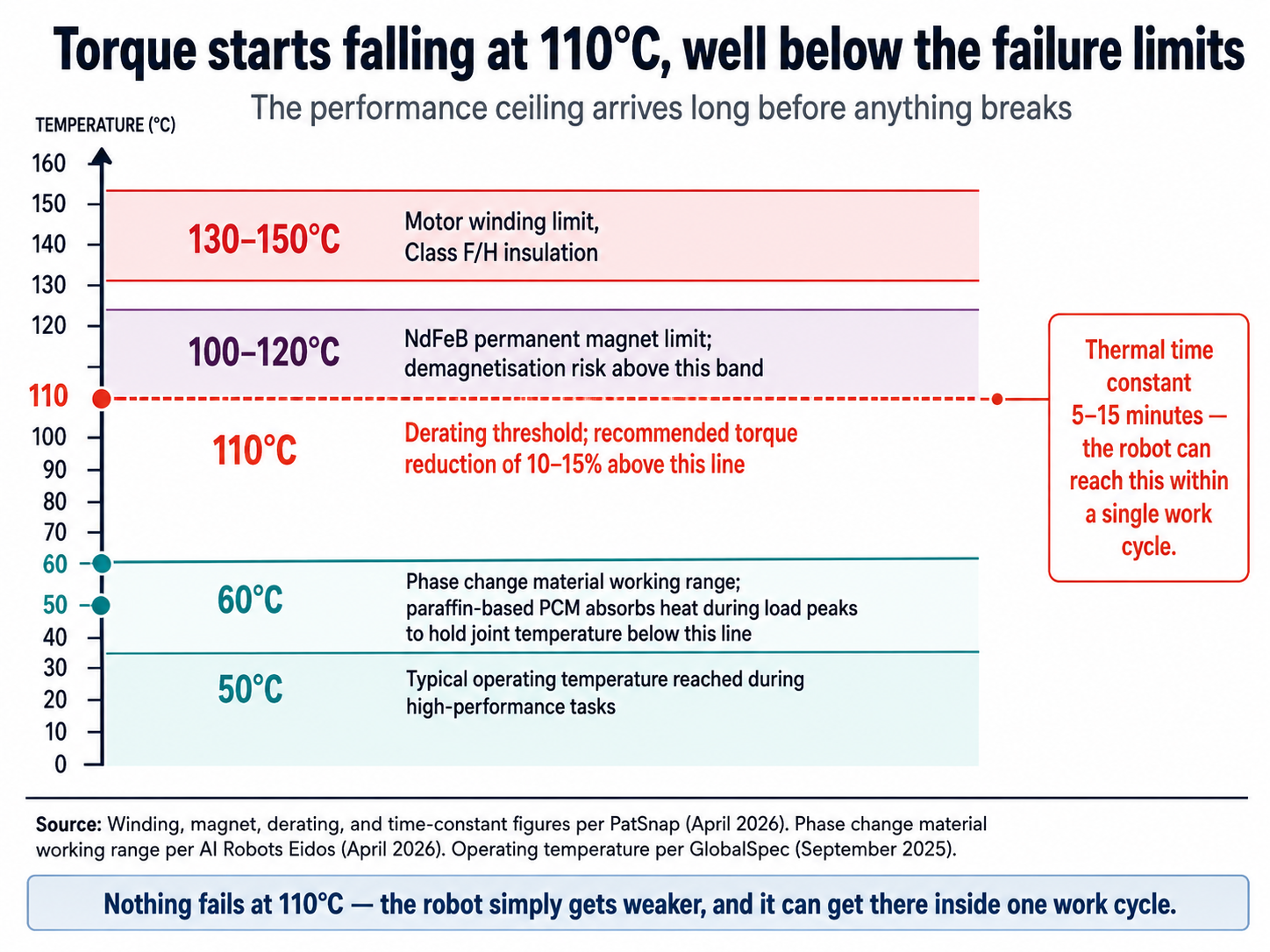
Humanoid robots overheat because their actuators generate resistive and frictional heat inside a densely packed human-shaped envelope with limited surface area for dissipation. Motor windings are typically limited to 130–150°C and NdFeB magnets to 100–120°C, with a recommended torque derating of 10–15% above 110°C on a thermal time constant of five to fifteen minutes, according to actuator engineering analysis published by PatSnap in April 2026. NASA Johnson Space Center research documents operators postponing Valkyrie humanoid operations until torso and leg actuator temperatures return within safe limits.
Torque is cut by 10 to 15% once winding temperature passes 110°C, and Figure 1 sets out where that threshold sits against the magnet, insulation, and phase-change limits it has to respect.
The Materials Trap: Light and Cool Pull Opposite Ways
Every gram of limb mass costs torque to accelerate, battery to move, and heat to produce — so lightweighting is the central engineering pursuit in humanoid design. Tesla's Optimus Gen 2 arrived 10 kg lighter and 30% faster than its predecessor with PEEK cited as a key enabler, and magnesium alloy as a core structural material.
The substitution works on mass. Magnesium sits at roughly 1.8 g/cm³ against aluminium's 2.63 to 2.85, and the density-against-thermal-behaviour comparison in Figure 2 shows the pattern that follows from choosing on mass alone.
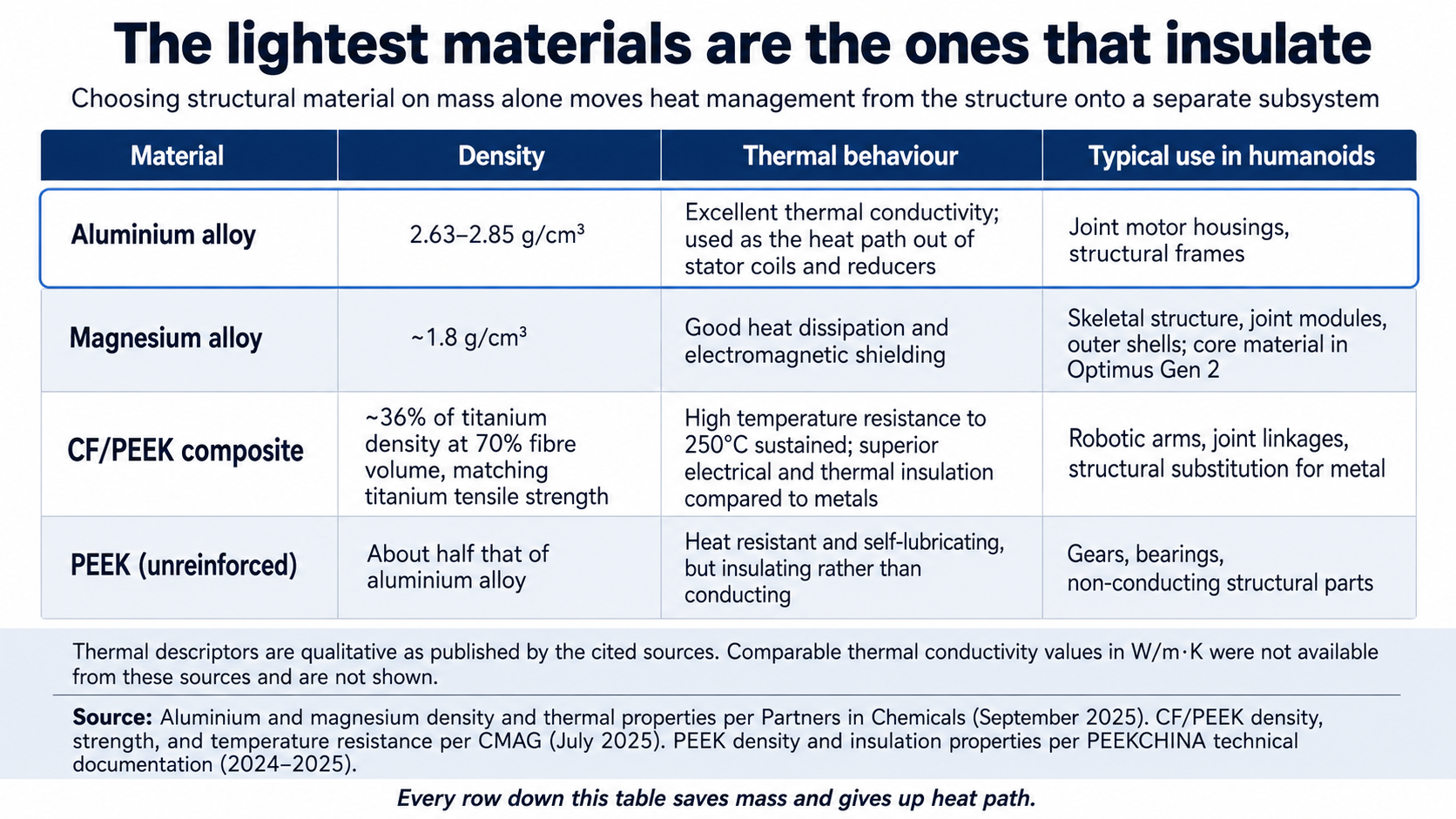
Designers respond by moving thermal management out of the structure and into dedicated subsystems. AI Robots Eidos documented in April 2026 the techniques now standard: aluminium alloy housings retained specifically at the motor, graphite sheets and high-conductivity composites embedded within metal housings, and paraffin-based phase change materials in joints that absorb heat during load peaks and release it as load drops, holding temperature below 60°C. Each addition returns mass to a machine that just spent engineering effort removing it.
The lighter it gets, the hotter it runs.
What Humanoid Robots Actually Do in 2026
Agility's Digit has moved more than 100,000 totes at a GXO facility under a robots-as-a-service contract, and the split between proven and unproven tasks in Figure 3 tracks sustained torque demand almost exactly.
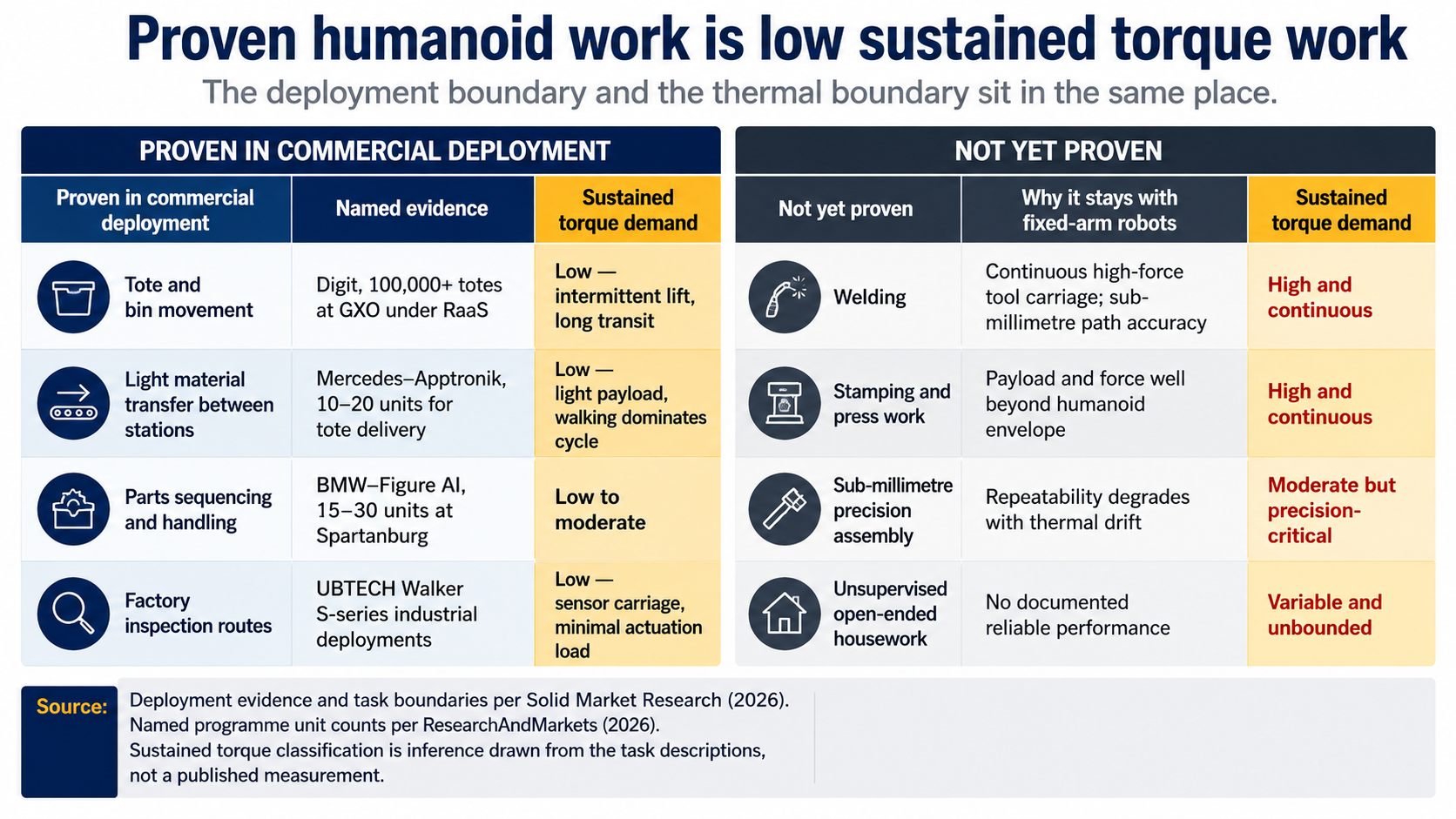
The sustained-torque classification in Figure 3 is inference rather than published measurement, and worth flagging as such — no manufacturer publishes joint temperature under production load. But the correlation is difficult to explain any other way. Walking a tote across a warehouse is mostly transit; the actuators cycle and recover. Holding a welding torch against a seam is continuous high current through the same winding with no recovery interval, which is exactly the condition the derating threshold exists to prevent.
UBTECH's approach to the endurance question is instructive precisely because it sidesteps rather than solves. The Walker S2 swaps its own battery in about three minutes, marketed as enabling round-the-clock industrial use. That addresses stored energy. It does not address a joint that has been at 110°C for twenty minutes.
Whether the Thermal Ceiling Is a Phase or a Floor
The engineering-progress position: cooling techniques are improving measurably
Liquid-cooled electric actuators are not theoretical. The DARPA Robotics Challenge humanoids SCHAFT and JAXON were built with them specifically to improve heat dissipation, as documented in published research on viscoelastic liquid-cooled actuators. Phase change materials now hold joint temperatures below 60°C through load peaks. Graphite sheets and high-conductivity composites are being embedded in aluminium housings, and dedicated DC fan cooling is being designed into humanoid enclosures.
The materials trajectory supports the case too. CMAG's July 2025 analysis records magnesium alloy delivering 11% weight reduction alongside 10% energy savings in industrial robots — a rare instance where the mass and thermal objectives moved together rather than against each other. Treating the current thermal ceiling as fixed would misread a field that is improving on this axis every product generation.
The structural-limit position: every cooling fix returns mass to the machine
PatSnap's April 2026 assessment names actuator reliability under sustained industrial duty cycles as the primary mechanical bottleneck preventing large-scale humanoid deployment — not perception, not planning, not manipulation software. A full-body platform carries 30 or more degrees of freedom, each required to deliver precise repeatable torque across thousands of operating hours without drift.
Every technique in the progress case adds something back: a liquid loop needs a pump, a reservoir, and lines; phase change material is mass that must then be carried and accelerated; a fan draws power from the same battery that limits runtime. The constraint moves outward. It does not dissolve, because it is a consequence of packaging a power-dense machine into a shape chosen for a biological system that cools itself by a mechanism the machine does not have.
Both readings are compatible on the evidence. The duty cycle will lengthen, and the deployment boundary in Figure 3 will move — the disagreement is about slope, not direction. What would settle it is a figure no manufacturer currently publishes: sustained torque output across a full eight-hour shift at plant ambient temperature, measured rather than demonstrated. Until a humanoid platform discloses that number, the thermal ceiling is being managed rather than beaten, and the embodiment gap in humanoid robotics runs through the joint housing as much as through the software.
This development reinforces:
- How AI Robots Work: The pillar covering the physical mechanisms behind robot capability, including why hardware constraints rather than product categories set what a machine can sustain.
- Humanoid Robots vs Traditional Automation: Why the Comparison Is the Wrong Question: The deployment boundary described here gives the physical reason behind the task-fit argument made there.
- Degrees of Freedom in Robotics: What Robot Axes Mean and Whether More Is Better: A humanoid carries 30 or more powered joints, and every one of them is a heat source as well as a degree of freedom.
The operators at Johnson Space Center are not watching a gauge because Valkyrie is an old machine. They are watching it because a motor that produces torque produces heat in proportion, and no amount of software changes that ratio. Every humanoid built since has faced the same arithmetic and answered it the same way — aluminium at the motor, polymer everywhere else, phase change wax in the joints, and a duty cycle that ends when the metal says so. The deployment record reads exactly as that constraint predicts: totes and inspection routes, not welding seams. Somewhere in a materials lab there is a hydrogel actuator that sweats, published in Science Robotics in 2020 and still not in a product. The company that gets that into a shipping humanoid will not be selling a better robot. It will be selling a longer shift.
Frequently asked questions
1. What is a humanoid robot?
A humanoid robot is a machine built to the human body plan — two legs, two arms, a torso, and a head — so it can operate in spaces designed for people. Most carry 30 or more powered joints, each combining a brushless motor with a harmonic or cycloidal gearbox. As of 2026, commercial platforms include Figure 03, Agility's Digit, UBTECH's Walker S2, Unitree's G1 and H2, and Tesla's Optimus.
2. How long can a humanoid robot work before recharging?
Published runtimes for platforms including Figure 01 and UBTECH's Walker S2 sit at two to four hours per charge, according to GlobalSpec (September 2025). Battery is not the only limit — joint actuators can reach their torque derating threshold within a single work cycle, since the thermal time constant runs five to fifteen minutes. UBTECH's Walker S2 addresses stored energy by swapping its own battery in about three minutes.
3. Why do humanoid robots get so hot?
Motor windings generate resistive heat and gearboxes generate friction heat, inside a densely packed human-shaped envelope with limited surface area for dissipation. Operating temperatures reach 50°C during high-performance tasks per GlobalSpec (September 2025). Torque derating of 10 to 15% is recommended above 110°C, with winding limits at 130–150°C and NdFeB magnet limits at 100–120°C, per PatSnap actuator engineering analysis (April 2026).
4. What materials are humanoid robots made of?
Aluminium alloy, magnesium alloy, carbon-fibre composites, and high-performance polymers including PEEK. Aluminium is retained at joint motor housings for its thermal conductivity; magnesium at roughly 1.8 g/cm³ is used for skeletal structure and shells and is a core material in Tesla's Optimus Gen 2. CF/PEEK at 70% fibre volume matches titanium tensile strength at about 36% of its density, per CMAG (July 2025), but insulates where metal conducts.
5. What are humanoid robots used for right now?
Tote and bin movement in warehouse logistics, light material transfer between stations, parts sequencing, and inspection routes. Agility's Digit has moved more than 100,000 totes at a GXO facility under a robots-as-a-service contract and completed a year-long pilot at a Toyota plant. Named programmes include BMW–Figure AI at 15–30 units, Mercedes–Apptronik at 10–20 units, and BYD–UBTECH at 100–200 units.
6. Can humanoid robots do housework?
No humanoid currently performs open-ended housework reliably without supervision, according to deployment analysis published by Solid Market Research (2026). Consumer platforms including 1X's NEO have demonstrated laundry folding and shelf organisation, but many systems combine autonomy with teleoperation, controlled environments, or tightly scoped workflows. Verified commercial work remains concentrated in warehouse and factory tasks.
7. How much does a humanoid robot cost?
Manufacturer-published prices range from about $13,500 for the Unitree G1 to $100,000 for the Unitree H2 Plus. Industrial platform pricing in the first adoption wave sits between $80,000 and $250,000 according to ResearchAndMarkets (2026). Only Unitree, AgiBot, and UBTECH currently ship in the thousands, with Unitree at 5,500 units and AgiBot at 5,168 in 2025.