Singapore Priced the One Robot Task Nobody Has Solved at US$88,000
A new Singapore robotics contest, backed by Micron and Infineon, just put a price on the one task no humanoid robot has publicly proven it can do: precision maintenance inside a semiconductor process chamber. Why a government-run contest instead of a purchase order is itself the real signal.

A robot walking into a semiconductor factory in Singapore this year will not be asked to carry a box, stack a pallet, or shake a visitor's hand for a demo reel. It will be asked to open a sealed process chamber, remove a component, inspect it, clean a surface inside, put the component back, and close the chamber again, without touching anything it should not touch. Get that sequence wrong inside a real tool and you do not get a support ticket. You get a scrapped wafer lot worth hundreds of thousands of dollars and days of contaminated downtime.
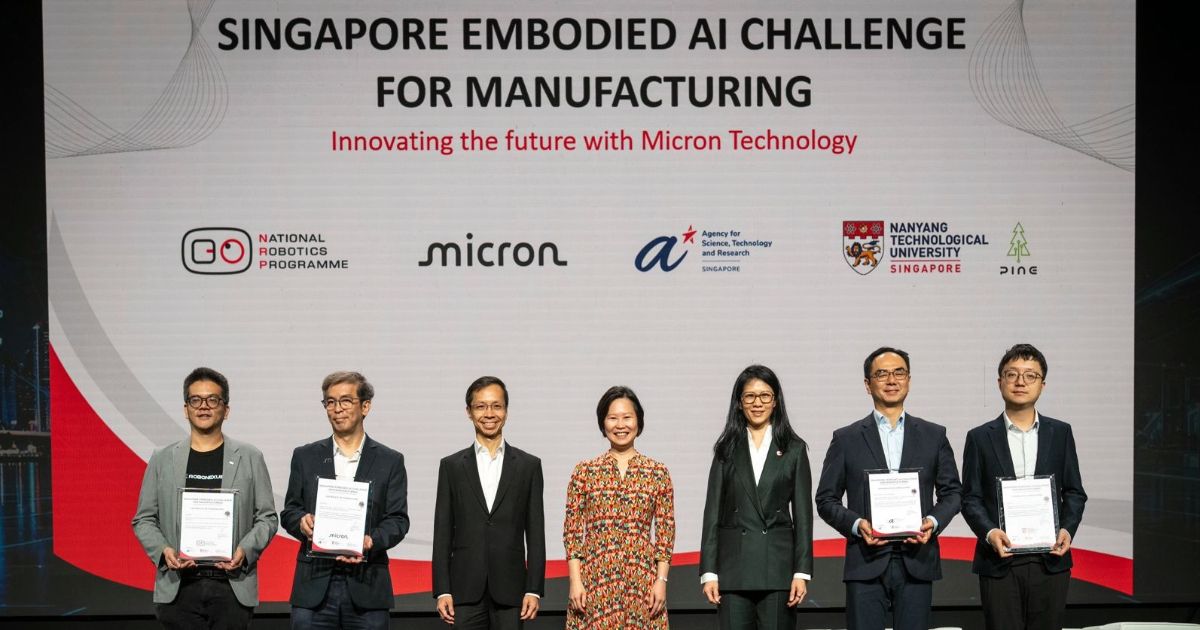
That is the task the National Robotics Programme, the Agency for Science, Technology and Research, NTU's PINE Lab, and the chipmaker Micron Technology put a bounty on, launching the Singapore Embodied AI Challenge for Manufacturing on October 21 with Infineon Technologies as event sponsor. Total prize pool: roughly US$69,000 (S$88,000), with a top prize around US$39,000 (S$50,000), finals set for March 20 next year at a Singapore robotics showcase called RoboSG.
Read the task list again. It is not a warehouse-picking benchmark dressed up in a lab coat. It is preventive maintenance on a semiconductor process tool, reduced to a 3D mock-up chamber that Micron itself built as the test rig. And the fact that this had to become a public competition, with a government agency, two chipmakers, and a university lab all putting their names on it, is more interesting than anything a winning team will demo in March.
The task nobody wants to admit is still unsolved
Humanoid robotics has spent roughly two years racing toward one headline capability after another: walking, running, backflips, folding laundry, stacking shelves. None of that is the hard part of a modern fab. The hard part is everything that happens when a technician has to go inside a tool.
Process chambers in a wafer fab are precision instruments, not storage bins. Components come out torqued to a spec, seated in an exact orientation, often after exposure to residues from etching or deposition steps that make visual inspection and surface cleaning genuinely load-bearing tasks, not cosmetic ones. A human technician doing this work is trained for months and still works under strict procedure sign-offs. Ask a general-purpose humanoid, trained mostly on grasping, walking, and coarse manipulation, to do the same job, and you are asking it to operate at a level of repeatable precision that no public pilot has yet demonstrated.
That is the quiet admission buried in this challenge. Nobody sent out a request for proposals to Figure, Apptronik, or Unitree and asked them to quote a chamber-maintenance contract. A government agency convened a competition instead, open to "teams worldwide," because the honest answer to "who can already do this" appears to be nobody, and the honest way to find out is to make a lot of people try at once.
What has actually been proven, and what has not
Look at where general-purpose humanoids have actually logged hours. Apptronik's Apollo, through a manufacturing pilot with contract electronics maker Jabil, is doing inspection, sorting, kitting, lineside delivery, fixture placement, and sub-assembly: coarse, repeatable, forgiving tasks where a dropped part is an annoyance, not a six-figure loss. Agility Robotics' Digit has logged time in Amazon fulfillment centers moving totes, a task domain built for forgiving tolerances and soft failure modes.
I cannot find a single documented case, from any humanoid maker, of a general-purpose platform performing chamber-level maintenance inside a live or mock semiconductor tool before this challenge existed. That is not proof it has never been attempted privately. It is evidence that, as of today, no vendor has been willing or able to put a public number on it. In an industry that announces pilot programs the way other industries announce product launches, that silence is the data point.
A contest, not a purchase order, is itself the signal
Here is the part worth sitting with: when a chipmaker needs a capability it trusts exists, it buys it. When it needs a capability it is not sure exists anywhere yet, it runs a contest.
Micron did not issue a tender to the usual industrial-robotics vendors and ask for a quote. It built a physical test rig, handed the problem to A*STAR and PINE Lab@NTU to run as an open competition, and invited outside teams, including ones Micron has never worked with, to compete for a prize smaller than a single senior robotics engineer's annual salary. That structure makes sense only if the realistic alternative was "nobody currently sells this," not "somebody sells this at a price we don't like."
There is a real tradeoff hiding in that choice, and it is worth naming rather than glossing over. A contest format surfaces creative approaches cheaply and publicly, but it also risks producing solutions tuned to win a specific mock-up chamber rather than solutions that generalize to the dozens of distinct tool types inside an actual fab. Micron and Infineon get to see a wide field of approaches for the cost of a modest prize purse; they are not committing to buy, license, or deploy anything that shows up on stage in March. The real test of this challenge is not who wins the top prize. It is whether any winning approach is still being talked about eighteen months later, inside an actual production fab rather than a competition booth.
Why Singapore, and why it matters from here
Singapore is not running this contest as a curiosity. Semiconductors account for roughly 6% of the country's GDP on their own, and manufacturing broadly makes up nearly a fifth of it, according to the country's own Economic Development Board. Micron's commitment to the country includes a roughly US$24 billion wafer fabrication facility that broke ground earlier this year, built for output starting in the back half of 2028. A labor-intensive, high-skill maintenance bottleneck inside that kind of capital commitment is not an abstract automation problem. It is a capacity constraint with a dollar figure attached to every day it goes unsolved.
I watch robotics procurement from Manila, where the pitch that actually moves budget is never the one about what a robot can theoretically do. It is the one with a verified task list, a failure rate, and a liability answer. Southeast Asian manufacturers watching this contest are not asking who wins in March. They are asking a narrower, more useful question: does a semiconductor giant trust any team's solution enough to put it inside a real tool with real wafers running through it, and how long after the finals does that actually happen, if it happens at all.
What to watch next
The honest scoreboard here will not be the March ceremony. It will be whatever Micron or Infineon says, or does not say, about deployment a year after that stage photo is taken. A contest can produce a convincing chamber-cleaning demo in a controlled mock-up far more easily than it can produce a system an operations manager is willing to let near a tool that costs more than the building it sits in. Watch for a follow-up contract, a licensing deal, or a second-generation version of the rig built with a real customer's actual process chambers. Until one of those shows up, the honest read on general-purpose humanoid robotics is that it has gotten very good at tasks where mistakes are cheap, and it still has not proven it can handle the ones where mistakes are not.
This analysis reflects the author's own reading of A*STAR's own press release on the Singapore Embodied AI Challenge for Manufacturing, Singapore's Economic Development Board's published industry and GDP figures, Micron Technology's own groundbreaking announcement for its Singapore wafer fab, and public reporting on Apptronik's and Agility Robotics' manufacturing pilots. It is provided for general information purposes only and does not constitute investment, legal, or professional advice.
Hero image credit: Agency for Science, Technology and Research (A*STAR), official photo from the Singapore Embodied AI Challenge for Manufacturing launch event.