Machenta Raised US$40 Million to Bet That Robots Don't Need Your Data
A London startup backed by Imperial College London's robot-learning lab raised a record UK seed round for a model trained entirely in simulation, no real-world data required. The stealth launch is light on the benchmarks that would prove it works.

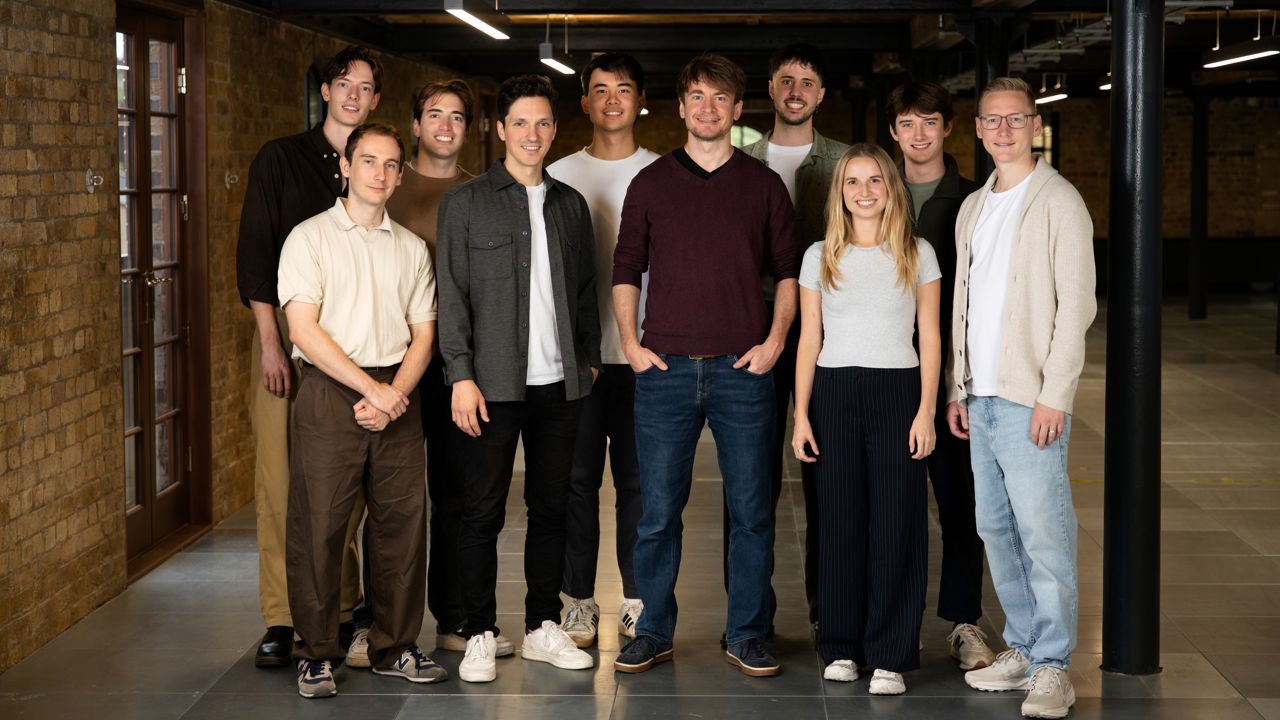
Most robotics seed rounds this year are bets on who can collect real-world robot data the fastest. Machenta, a London startup that came out of stealth on October 27, 2026, just raised US$40 million on the opposite premise: that its robots barely need any.
The company is betting that the industry's defining cost problem, the price of teaching a robot something new, was never really a data problem. That is a bigger claim than the funding number suggests, and right now it rests on a demo reel, not a deployed fleet.
What Machenta Actually Claims
Machenta's own site calls its product "Instant Robot Learning." The pitch, in the company's own words, is a robot foundation model trained entirely in simulation that can watch a task performed once, packaging an item, assembling a part, tidying a shelf, and then carry it out itself, with no further training afterward. The company describes this as something close to "physical vibe coding": you show the robot what you want once, and the model handles the rest.
The round itself is substantial by UK robotics standards: US$40 million, co-led by Creandum and Union Square Ventures, reported as the largest seed raise by a British robotics company to date. It funds a team of roughly a dozen people working out of King's Cross in London.
The founders are not newcomers to the problem. Edward Johns, a professor of robot learning at Imperial College London, has spent six years on the specific question of whether a robot can pick up a new physical skill as quickly as a person does. His PhD student, Vitalis Vosylius, co-founded the company with him. That lineage matters for how to read this raise: investors are not buying a finished product. They are buying a research team's bet, pre-customer and pre-benchmark, that a six-year-old academic question has an answer worth commercializing now.
The Industry It Is Betting Against
Every well-funded humanoid and manipulation program outside Machenta is running the opposite playbook. Teleoperated demonstrations, fleets of operators piloting arms by hand to generate training examples, remain the default way foundation models learn to grasp, place, and manipulate in the real world. That data is expensive to collect, slow to scale, and tied to the specific hardware it was gathered on. One consequence shows up directly in how fast model-training costs climb as humanoid companies iterate through hardware generations, because each new robot body can mean the training data collected for the last one is worth less.
Machenta's bet is a direct rejection of that approach. No teleoperation fleet. No warehouse of human demonstrators. Train the model entirely in computer-generated environments, then let it generalize to a real robot arm from a single shown example at the point of use. If it works at scale, it would remove the single biggest line item in robot foundation-model economics.
If it does not work at scale, it will fail for a specific and well-documented reason, not a mysterious one.
That reason has a name, and it has outlasted a decade of well-funded attempts to solve it.
The Sentence Every Robotics Company Has Tried and Failed to Prove
"Trained entirely in simulation" is one of the hardest sentences in robotics to make true in production. The gap between a physics simulator and a cluttered kitchen counter, a table with sliding paper, a part with unexpected friction, is called the sim-to-real gap, and it has consumed research budgets at every major robotics lab and well-capitalized startup for more than ten years without producing a foundation model that reliably transfers to the full range of real-world contact and deformation a shelf-tidying task actually involves.
Simulators are good at rigid bodies, predictable physics, and tasks that look like the ones they were built to model. They are still bad at soft materials, unpredictable friction, and the thousand small surprises an ordinary room produces. Every company that has promised to solve this at the foundation-model level has, so far, produced a narrower result than the announcement implied: reliable in the training domain, brittle outside it.
None of this means Machenta is wrong. It means the company has chosen the hardest version of the bet rather than an easier one, and the stealth launch has not yet shown the evidence that would distinguish a genuine breakthrough from a well-funded restatement of the same open problem.
What a Stealth Launch Does Not Show You
A funding announcement is not a benchmark. Here is what is missing from Machenta's public materials as of this piece:
- No named customer or pilot deployment.
- No independently verifiable benchmark, success rate, or failure rate on tasks outside the company's own demo video.
- No disclosed valuation for the round.
- No published detail on which robot hardware the model has actually been tested against beyond an early-access form asking prospective users what arms they plan to use.
None of that is unusual for a stealth-stage company, and it is not evidence against the technology. It is evidence that the US$40 million is a bet on a team and a research direction, not a verified product, and that distinction gets lost whenever "largest seed round" becomes the only number anyone repeats.
The investors here are sophisticated enough to know the difference. Creandum and Union Square Ventures have both backed deep-technology bets that took years to prove out. The honest read of this round is not "Machenta solved robot learning." It is "two well-regarded funds think a six-year academic research program, run by the person who ran it, is worth funding at seed-round scale before the product has a single disclosed customer."
What Would Change My Mind
I watch robot-learning claims from Manila with a specific bias: I want to see a named customer, a disclosed failure rate, and a robot arm that is not the one in the company's own promotional video. None of those exist yet for Machenta, and that is not a criticism so much as a description of what stage this company is actually at.
What would be worth watching over the next year is simple to state and hard to fake: a named pilot customer outside Machenta's own walls, a published success rate on tasks the company did not design the demo around, and evidence the model transfers across more than one robot arm. If those show up, the sim-only bet will have done something the rest of the industry's teleoperation-heavy approach has not managed at this price point. If they do not show up within a reasonable window, this seed round will look like the latest instance of a decade-old pattern: a well-credentialed team, a hard problem, and a funding round that outran the proof.
This analysis synthesizes Machenta's own public statements and reported coverage of its funding round as of October 28, 2026, and is provided for general information purposes only; it does not constitute investment, legal, or engineering advice. Hero image courtesy of Machenta.