Apple's Robot Brain Research Threatens the Humanoid Hardware Moat
Apple trained a humanoid control system almost entirely in simulation and ran it on an off-the-shelf Unitree G1, a sign that robot software and robot hardware are becoming separate markets buyers should negotiate accordingly.


Apple's Robot Brain Research Threatens the Humanoid Hardware Moat
Apple does not sell a robot, has never announced a robot, and has given no public indication it intends to compete with Boston Dynamics, Figure or Unitree on hardware. That makes a research paper Apple's AI and machine-learning group posted this month unusually worth a procurement team's attention. Apple's researchers took an off-the-shelf Unitree G1 humanoid, a robot any competitor can buy directly from Unitree's catalog, trained a control system for it almost entirely in simulation, and reported a 91% success rate across 360 real-world trials spread over six physical environments the robot had never seen, mapped or scanned in advance. Apple used no teleoperation data, the human-piloted demonstrations most humanoid-robot companies still depend on to teach a robot new tasks, to reach that number.
The system is called HALO, and the detail that should concern any company that has built its business around proprietary, hardware-locked robot intelligence is where Apple chose to run it. Had Apple built its own robot body to showcase the research, the story would be a hardware announcement. Instead, Apple ran its software on a commodity humanoid any competitor's customer could already own, which is the clearest signal yet that the company developing the control software and the company manufacturing the robot body are becoming two entirely separate markets, the same decoupling that happened to smartphones once a capable operating system became available to any handset maker willing to adopt it.
Training in a World That Does Not Exist
HALO's core engineering bet is that a robot's control system can be trained almost entirely on synthetic data, generated inside software, and still transfer reliably to physical hardware in homes it has never entered. Apple's team built roughly 300 hours of training data across 1,000 procedurally generated simulated homes, using a synthetic-environment tool called Infinigen to construct the houses and a motion-generation tool called Kimodo to populate them with plausible human movement for the robot to learn from. None of those 1,000 homes exist. The six real environments the robot was tested in afterward were deliberately left unscanned and unmapped, meaning the researchers gave the system no advance 3D model of the specific room it would be working in, which is closer to how a robot would actually encounter an unfamiliar customer site than the heavily pre-mapped demo environments most humanoid vendors use for their own marketing videos.
The architecture doing the work underneath that result is split into three layers running at three different speeds, a structure worth understanding because it maps directly onto where a buyer's integration costs and failure points will actually sit. A vision-language model running roughly twice a second turns a spoken instruction into a sequence of subtasks and decides when one subtask has succeeded and the next should begin. A faster planning layer, running about three times a second, takes the robot's current camera view and the active subtask and generates five seconds of whole-body motion at a time, built on a frozen, off-the-shelf language-and-vision encoder rather than one Apple trained from scratch. A third layer, running fifty times a second on the robot's own onboard computer, tracks that plan moment to moment using depth sensing and the robot's internal sense of its own joint positions, outputting commands to all 29 of the G1's joints. Only the first half-second of each five-second plan is ever executed before the system replans, a deliberately short commitment window that lets the robot correct course continuously rather than committing to a motion that might not match what its camera sees a moment later.
The compute bill behind that architecture is worth stating plainly, because it is the real barrier to entry hiding underneath this research rather than the robot hardware itself. Apple trained the planning layer through imitation learning on 64 NVIDIA B200 GPUs, trained the tracking layer separately through reinforcement learning on a smaller cluster of 4 NVIDIA H100 GPUs, and generated the underlying 1,000-home synthetic training corpus on a dedicated bank of 250 H100 GPUs running continuously. That is a compute budget available to a small number of companies on earth, which is the actual moat in this story, not the robot body Apple borrowed off the shelf. A buyer should read this research less as evidence that any well-funded startup can now replicate Apple's result and more as a preview of what the next generation of vendor claims will need to be measured against once that compute becomes more widely accessible.
Where the Number Stops Being Impressive
A 91% single-task success rate across genuinely novel environments is a strong result, and procurement teams evaluating humanoid vendors should treat it as a credible data point precisely because Apple published the failure cases alongside the successes rather than only the highlight reel. Multi-step task sequences, the kind an actual warehouse or hospitality job usually requires rather than a single isolated action, dropped to a 70% average success rate across three tested sequences, and the hardest of those three, a robot bending under an obstacle, walking to a target, then pushing a box, succeeded only 5 times out of 10. That gap between single-action demos and chained real-world tasks is the same gap that has quietly undermined almost every humanoid-robot sales pitch of the past three years: a robot that nails a scripted single task in a press demo is not the same product as one that can string several uncertain steps together reliably enough to run an unattended shift.
The system's other honest limitation matters just as much for anyone thinking about near-term deployment rather than research novelty. HALO still has no tactile sensing, which means a contact-heavy task, anything involving grasping, pushing or manipulating an object that can slip out of the robot's camera view mid-motion, is exactly where the system is weakest, since it has no sense of touch to fall back on when vision alone loses track of what its hands are doing. New physical tasks outside the system's trained repertoire still require a human engineer to write prompts and hand-design motion keyframes, which means HALO today is a strong foundation for building task-specific behaviors quickly, not a robot that can be handed an arbitrary new job with nothing but a spoken instruction. Apple released code and demonstrations alongside the paper but has announced no commercial robot, no product timeline and no licensing plan, so none of this is purchasable yet in any form.
What This Does to a Buyer's Vendor Calculus
The commercial implication is not that Apple is entering the robot business. It is that the two most expensive components of a humanoid robotics program, the physical hardware and the control intelligence running on top of it, are visibly drifting apart as separate markets with separate competitive dynamics, and this research is one more data point in that direction rather than an isolated event. NVIDIA opened its own GR00T 2 robot foundation model to any developer this same month, a separate release built by a separate company for entirely different reasons, but the two announcements land on the same underlying message: the software layer that makes a humanoid robot generally useful, rather than a single-purpose machine running one hand-coded routine, is becoming something a buyer can increasingly expect to find outside whichever hardware vendor they already signed a contract with.
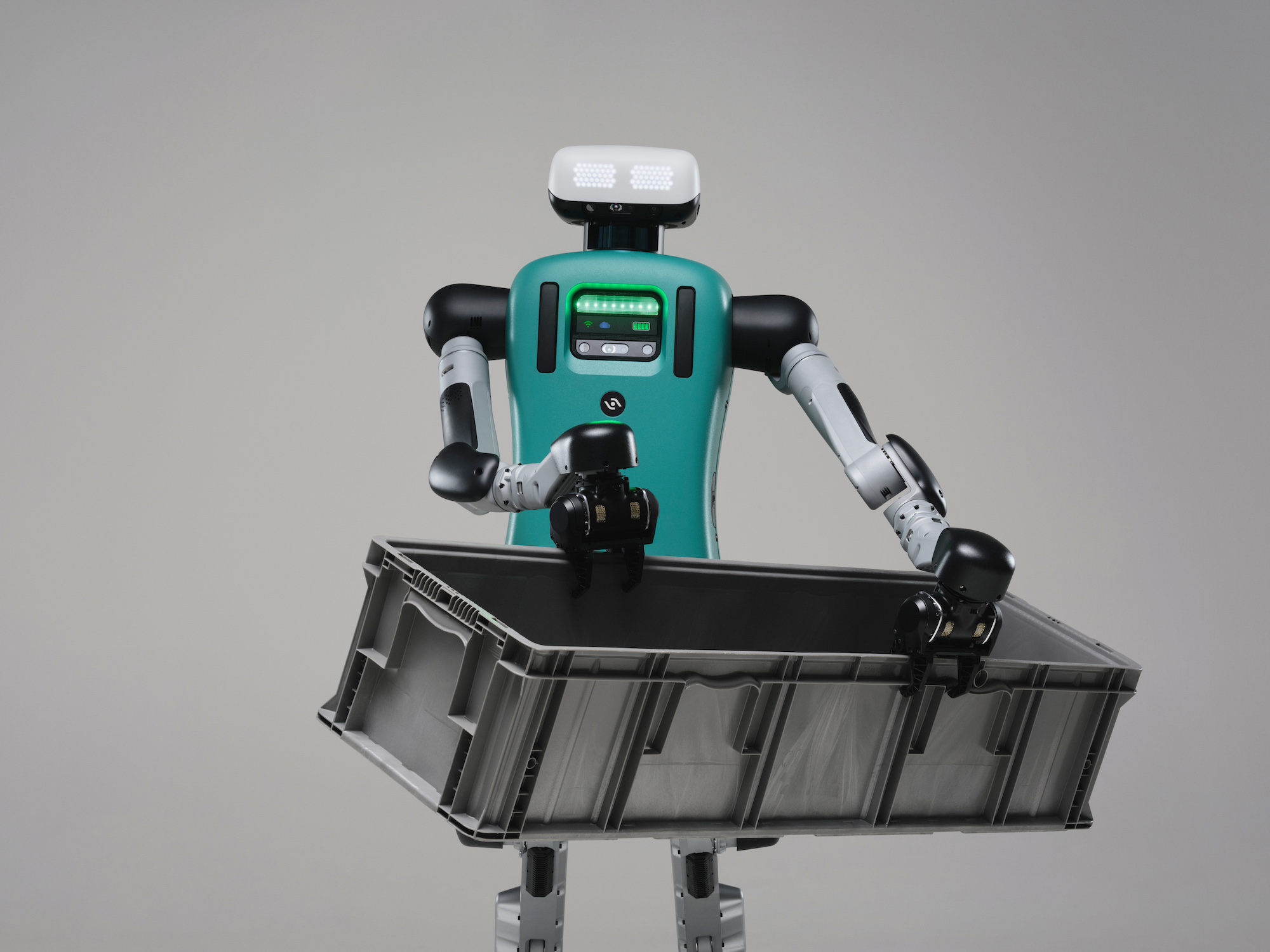
For a procurement team weighing a multi-year humanoid robotics contract today, that trend argues for negotiating software portability into the deal rather than assuming a vendor's current control stack is a permanent feature of the relationship. A hardware vendor whose only real differentiation is proprietary control software built on the same foundational techniques research labs are now publishing openly is a weaker long-term bet than one whose advantage sits in manufacturing quality, service infrastructure, safety certification or the specific industrial integration work a buyer actually needs done. Unitree's position in this particular story is worth noting on its own terms: the fact that Apple's researchers chose Unitree's commodity G1 as their test platform, rather than building custom hardware the way a company like Boston Dynamics or Figure would, reflects how far hardware has already become a commodity layer that outside software teams can simply build on top of without needing the hardware maker's cooperation or custom tooling.
The Capability Gap Buyers Should Actually Track
None of this changes what a buyer needs today, which is a robot that reliably completes a chained, multi-step job in a real facility, not a simulated home. HALO is not that system yet, by its own published numbers, and the honest reading of this research is that the industry has gotten meaningfully better at the single-action generalization problem in the past year while the multi-step reliability problem, the one that actually determines whether a humanoid can run an unsupervised shift, remains substantially unsolved across every lab and vendor publishing results on it, Apple included. The vendor that closes that specific gap first, chained-task reliability in genuinely unmapped environments rather than another incremental single-task benchmark, will be the one worth signing a long-term contract with, and the evidence suggests that vendor is at least as likely to be a software-only research team with no hardware business at all as it is to be one of the established humanoid manufacturers currently commanding premium pricing on the strength of a proprietary stack.
This analysis is for general information purposes only and does not constitute investment, legal, or professional advice. It synthesizes Apple's own published research paper and project materials on the HALO system.