Figure, NVIDIA, and a Beijing Arm Maker Just Built the Same Robot Brain
Rokae's new certification against a Chinese AI chip splits its software into a "big brain" and "small brain" — the same architecture Figure AI and NVIDIA independently published. The industry markets the slow half; the fast half decides whether robots actually work.

Figure, NVIDIA, and a Beijing Arm Maker Just Built the Same Robot Brain
A Beijing robotics company announced, on November 11, that its control software now runs on a Chinese-made chip. Read that sentence again and it sounds like the least interesting story in robotics this week: a compatibility certification, the kind of news that exists to be skimmed past on the way to the next funding round. But buried in Rokae's own description of what it just certified is a sentence worth sitting with, because two other companies, on two other continents, said almost exactly the same thing first, without any of the three citing each other.
Rokae's own filing splits its force-control arms' intelligence into what it calls a "big brain," the large models handling perception, language, and task planning, and a "small brain," a real-time control layer running a one-kilohertz loop with 20-microsecond network jitter and roughly 0.05 newton-meters of force-control precision across a robot's arms, waist, head, and mobile base. That is not Rokae's marketing language reaching for a metaphor. It is, almost word for word, the architecture Figure AI published in February 2025 for its Helix system, and the one NVIDIA's own researchers described in the GR00T N1 paper the following month. Three companies that compete with each other, serve different markets, and had no reason to copy one another's homework all converged on splitting a robot's intelligence into a slow half and a fast half.
That convergence, not any single announcement, is this week's actual story. And the industry is paying attention to the wrong half of it.
Three Companies, One Architecture, Zero Coordination
Figure's Helix, described in the company's own February 2025 release, runs a 7-billion-parameter vision-language model, System 2, at 7 to 9 hertz, reading the scene and a language instruction and compressing both into a single latent signal. That signal feeds an 80-million-parameter System 1, a cross-attention transformer running at 200 hertz, which turns it into continuous wrist, finger, torso, and head commands across 35 degrees of freedom. Figure's own explanation for the split is blunt: "VLM backbones are general, but not fast."
NVIDIA's GR00T N1, published the following month by a team of more than 40 researchers, describes the identical shape without using Figure's vocabulary: a vision-language module, System 2, interpreting the environment, feeding a diffusion-transformer module, System 1, that "generates fluid motor actions in real time." The paper calls the two "tightly coupled and jointly trained end-to-end," which is a careful way of saying the fast half cannot simply bolt onto any slow half; the pairing has to be built together.
Rokae's iNex, certified this week against D-Robotics' Sunrise S600 chip, a domestically produced 560-trillion-operations-per-second part that has been shipping since late 2025 and already runs inside Beijing's state-backed Humanoid Robot Innovation Center's Tiangong platform, is the same shape again: big brain for planning, small brain for the one-kilohertz loop that actually moves the arm. Rokae says the certification compresses integration work that would otherwise take six to nine months, and claims efficiency gains in the 30 to 50 percent range. Those figures are the company's own, unverified by any independent benchmark I can find, and belong in the same category as its claim of shipping more than 10,000 force-control arms to over 80 partners: plausible, unaudited, and worth asking Rokae to substantiate directly rather than repeating as settled fact.
Here is the pattern worth noticing: nobody had to agree on this. The architecture showed up independently because the underlying problem only has one honest answer.
Why the Split Is Not a Choice
A model that can read a kitchen counter, understand "hand me the blue mug," and reason about which object is which needs internet-scale training and a few billion parameters to do it generally. That same model, run at the frequency a robot's limbs actually need to stay balanced and apply the right amount of force, would be too slow by two orders of magnitude. Figure's own 7-to-9-hertz figure for its reasoning layer against 200 hertz for its action layer is not a tuning decision; it is close to the ceiling of what a model that size can do on available hardware, and close to the floor of what a multi-joint arm needs to not drop what it is holding.
So every serious embodied-AI effort ends up building two systems instead of one: something that understands broadly and thinks slowly, and something that reacts narrowly and thinks fast. The first is a language-model problem, and language-model problems are the ones venture capital, GPU vendors, and technology press already know how to cover. The second is a real-time control-systems problem, the kind of work that used to live quietly inside motor-controller firmware and PhD theses on model-predictive control, decades before anyone called it AI.
The Marketing Points at the Wrong Brain
Scroll through the last month of robotics funding and partnership news, including a fair amount of it on this site, and the big brain gets nearly all the attention. Which company's foundation model generalizes to more tasks. Whose robot brain a Korean industrial group is building in-house rather than licensing. Whose model learns a job it was never explicitly shown. Those are legitimate stories, and I have written several of them. But they describe the half of the stack that is, almost by structural necessity, the one every well-funded competitor eventually matches, because it is trained the way every other large model is trained: more data, more compute, published papers, open weights in some cases, and a research community actively racing to replicate whatever the leader just shipped.
The small brain does not get a keynote slide. It gets two paragraphs in a partnership press release, buried under a chip's TOPS rating. A one-kilohertz control loop will never trend on social media. It is also the only part of the stack that has to work every single time, not just in the demo reel. A robot that reasons brilliantly about which part to pick up and then jerks, stalls, or over-torques while picking it up has not shipped a product; it has shipped a video. Rokae's own Wednesday announcement, read carefully, does not include a single number describing how its certified stack performs under a sustained industrial duty cycle, eight hours of real thermal load and electrical noise rather than a bench test. Neither Figure's nor NVIDIA's published material answers that question for their own systems either. All three disclosures describe architecture and bench-level frequency, not field reliability, and a buyer who cannot tell the difference between those two things is the buyer a vendor's PR team is counting on.
What a Buyer Should Actually Be Asking
I read dozens of these filings a week, and the question procurement teams raise most often, which model is smartest, is increasingly the wrong first question. Ask a vendor what its model can plan and you get a demo. Ask what its control loop does on hour eleven of a double shift, and you more often get silence, or a promise to follow up. The more useful diagnostic, for any robot a buyer is actually going to run on a production floor rather than show at a trade fair, is a duty-cycle question: how many continuous hours has this exact control stack run against a real task, with what failure rate, documented by someone other than the vendor's own marketing team.
None of this is an argument that the big brain stops mattering. A robot with a brilliant control loop and a planning model that cannot understand a novel instruction is still a single-task machine wearing an AI label it has not earned. The tradeoff runs the other way too: as D-Robotics, which closed a US$400 million Series C round in September 2026, and chipmakers like it keep producing cheaper domestic alternatives to Nvidia's compute, the pressure on vendors to differentiate shifts further down the stack, into exactly the control-engineering work that is hardest to benchmark publicly and least likely to headline a funding round.
The Fight Nobody Is Covering Yet
Three competitors who had no reason to copy each other arrived at the identical two-system architecture. That is not a branding convergence. That is a constraint the physics of the problem imposed on all three, independently, within about eighteen months of each other. Once an industry agrees, without meaning to, on the shape of the problem, the competitive question stops being which company solved it and starts being who solves the harder, less visible half fastest.
My own bet, reading this pattern from Manila rather than from a Shenzhen trade floor or a Bay Area demo day, is that the next eighteen months of embodied-AI coverage keeps rewarding the big brain anyway, because a foundation-model benchmark produces a number a headline can use, and a control loop's field reliability does not, until the day a widely deployed robot fails publicly enough that someone has to ask why. By then, the companies that spent this quiet period on the boring half of the brain, not the one in Wednesday's press release, will be the ones still running.
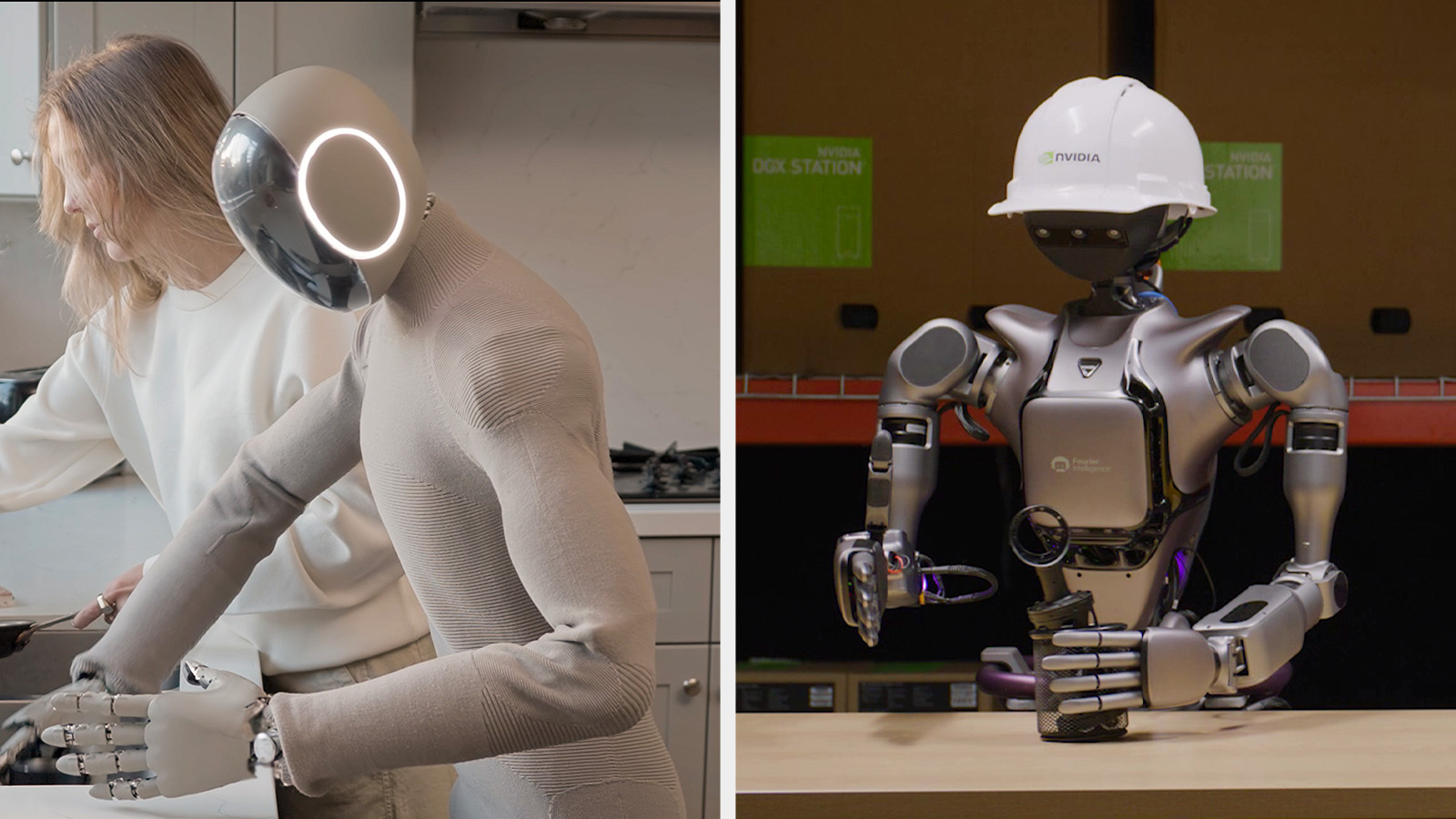
This analysis is for general information purposes only and does not constitute investment, legal, or professional advice. It synthesizes Rokae's own November 11, 2026 product announcement, Figure AI's February 2025 Helix disclosure, and NVIDIA's March 2025 GR00T N1 research paper, current as of publication. Hero photo: NVIDIA, from its GR00T N1 announcement (left: 1X Technologies' NEO; right: Fourier Intelligence's GR-1, shown with an NVIDIA DGX Station).