Degrees of Freedom in Robotics: What Robot Axes Mean and Whether More Is Better
Six is not a design choice. A rigid body in three-dimensional space has exactly six degrees of freedom — three positions, three rotations. That is arithmetic, not engineering preference. A seven-axis robot cannot reach anywhere a six-axis robot cannot. It reaches the same places by different routes. Most buyers paying for the seventh axis think they are buying reach.

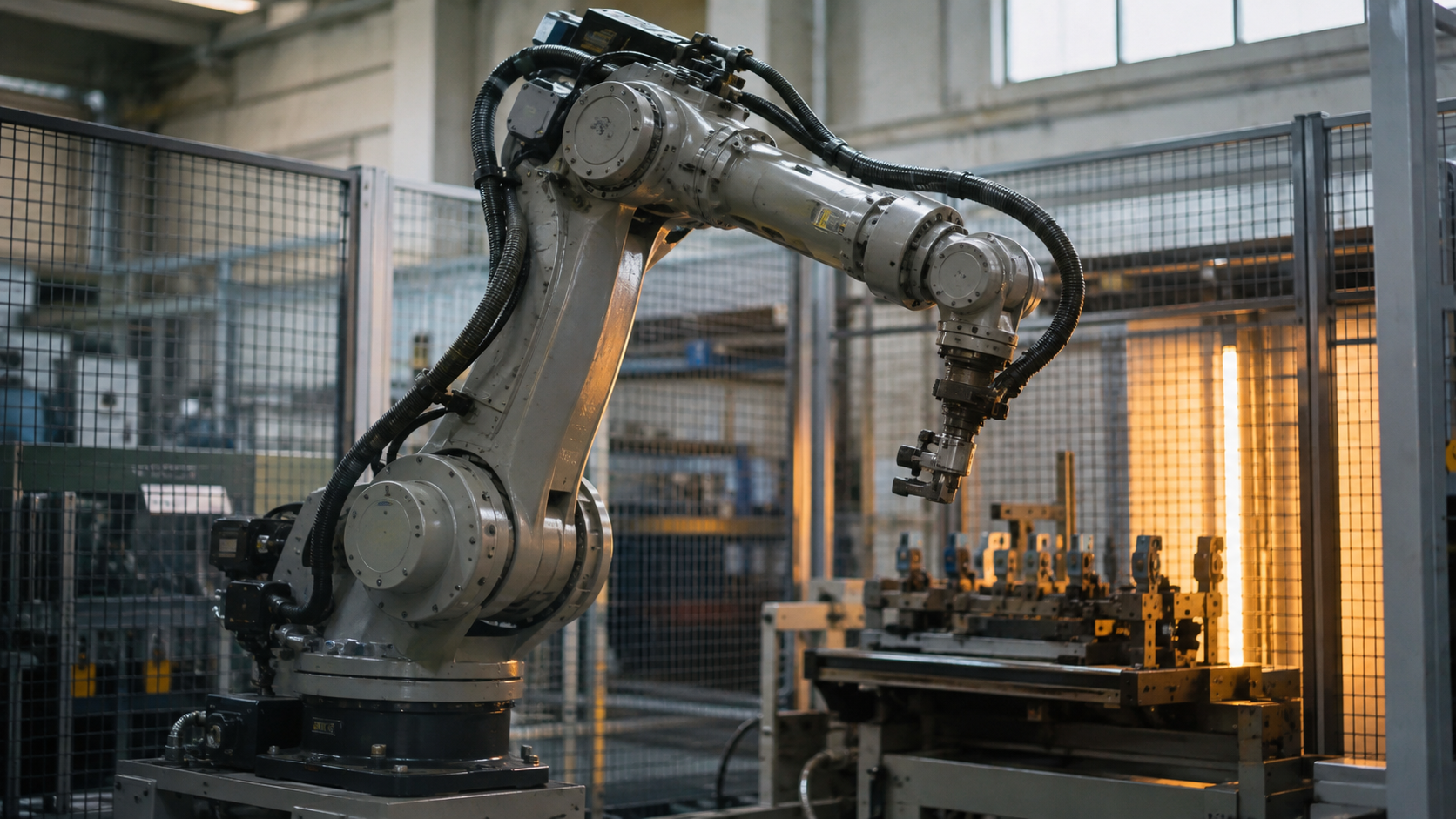
Six is not a design choice. Degrees of freedom in robotics has a hard mathematical ceiling: a rigid body in three-dimensional space can be positioned in three ways and rotated in three ways, and that is the whole set. Six. A seven-axis robot cannot put its tool anywhere a six-axis robot cannot. It gets to the same place by folding its own elbow differently on the way.
That distinction is worth money. The International Federation of Robotics recorded 542,076 industrial robot installations in 2024 in its World Robotics 2025 report, the fourth consecutive year above 500,000 units, against a global operational stock of 4,663,698 machines. A meaningful share of those specifications were chosen by someone comparing axis counts across quotes and assuming the bigger number was the better machine.
What Are Degrees of Freedom in Robotics?
Degrees of freedom in robotics is the number of independent joint movements an arm can make. A rigid body in three-dimensional space has a maximum of six degrees of freedom — three positions and three rotations. Industrial robots typically carry four to seven axes, matched to the task rather than maximised.
Degrees of freedom counts the independent ways a robot's tool can move. It matters now because axis count is the first specification on every quote and the one buyers most often read as a quality rating. For an engineer specifying a cell, understanding what each axis contributes turns a price comparison into a fit assessment.
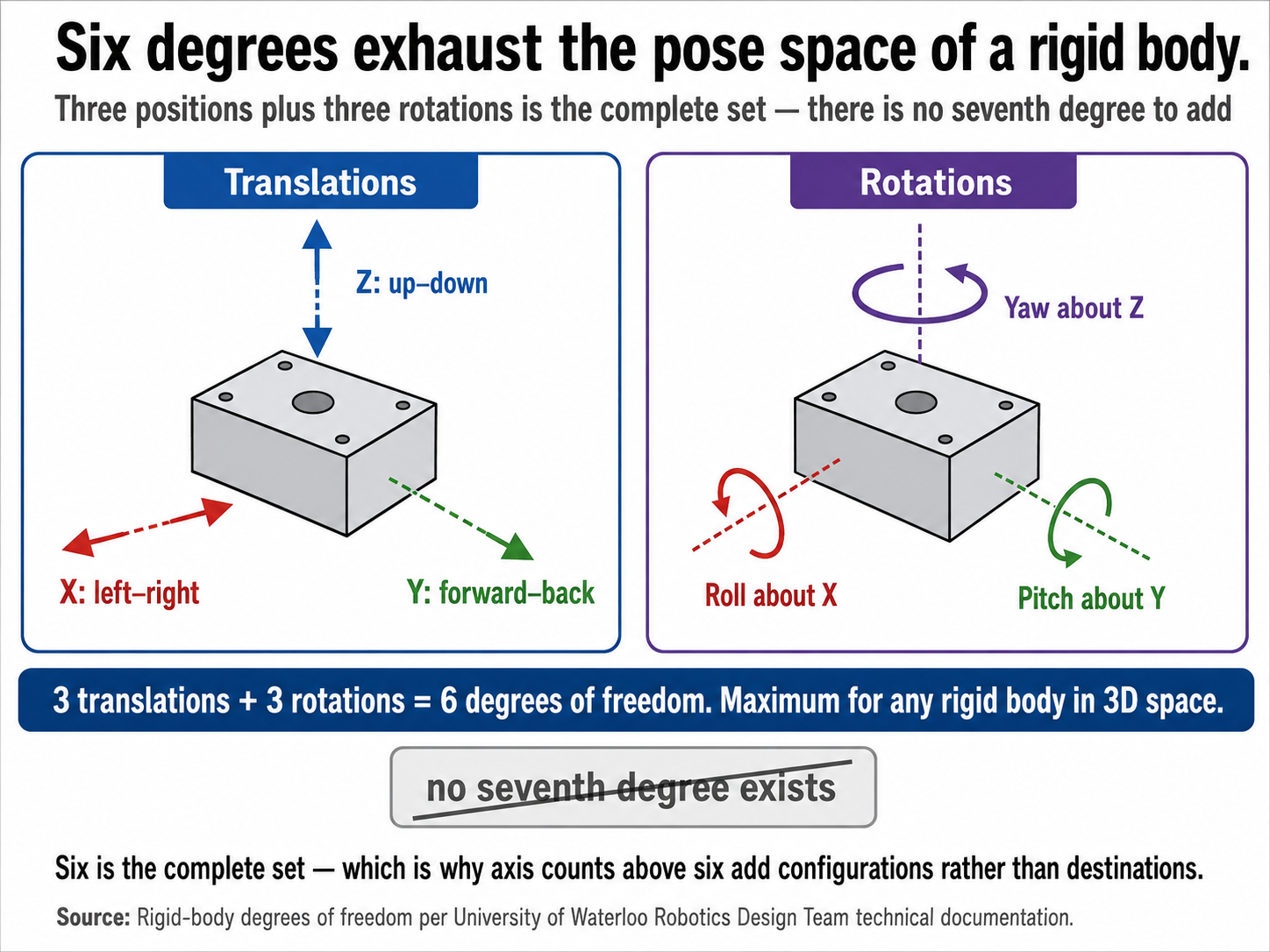
An axis is a powered joint. A six-axis arm has six motors, six gearboxes, and six controlled joints, conventionally arranged as base rotation, shoulder, elbow, and a three-joint wrist. Each one contributes a movement the others cannot produce. Three translations and three rotations exhaust the pose space of a rigid body, as Figure 1 sets out — which is why the sixth axis completes the arm and the seventh cannot extend it.
Why Six Axes Is a Ceiling, Not a Tier
Building more roads between two cities does not create new cities. It creates alternative paths — valuable when one is blocked, worthless when it is not. Robot axes work the same way past six.
The University of Waterloo Robotics Design Team states the constraint directly in its engineering documentation: for arms claiming seven, eight, or nine axes, the end effector still has only six degrees of freedom, because six is the maximum for a rigid body in three-dimensional space. The additional joints are real, powered, and useful. They simply do not extend the set of reachable tool poses.
What they extend is the set of ways to get there. A 2023 analysis of seven-degree-of-freedom revolute manipulators published on arXiv describes the effect precisely: the redundant joint produces a continuum of arm configurations for any given end-effector pose. The tool sits still while the elbow sweeps through an arc of valid positions.
Below six, the arithmetic runs the other way. A four-axis SCARA can position its tool anywhere in a horizontal plane and rotate it about the vertical, but it cannot tilt the tool out of that plane. That is not a defect. It is a deletion, made deliberately, and paid for in speed and stiffness.
More axes buys routes, not destinations.
What Each Axis Configuration Is Actually Built For
Three-axis Cartesian and gantry machines position a tool in X, Y, and Z with fixed orientation. They remain the correct choice for oversized work — aerospace panel handling and windshield installation among them — where the working envelope is rectangular and enormous and the tool never needs to tilt.
Four-axis SCARA arms — the acronym stands for Selective Compliance Assembly Robot Arm — add rotation about the vertical to planar positioning. The geometry is stiff against side loads and soft against any requirement to reach around or underneath a fixture. Standard models complete pick-and-place cycles in 0.3 to 0.5 seconds according to A3, the Association for Advancing Automation, and cost 30 to 50% less than six-axis arms of similar payload and reach. A four-axis SCARA completes a pick-and-place cycle in 0.3 to 0.5 seconds against a six-axis arm's slower planar performance, and the configuration table in Figure 2 sets out what each architecture trades to get there.
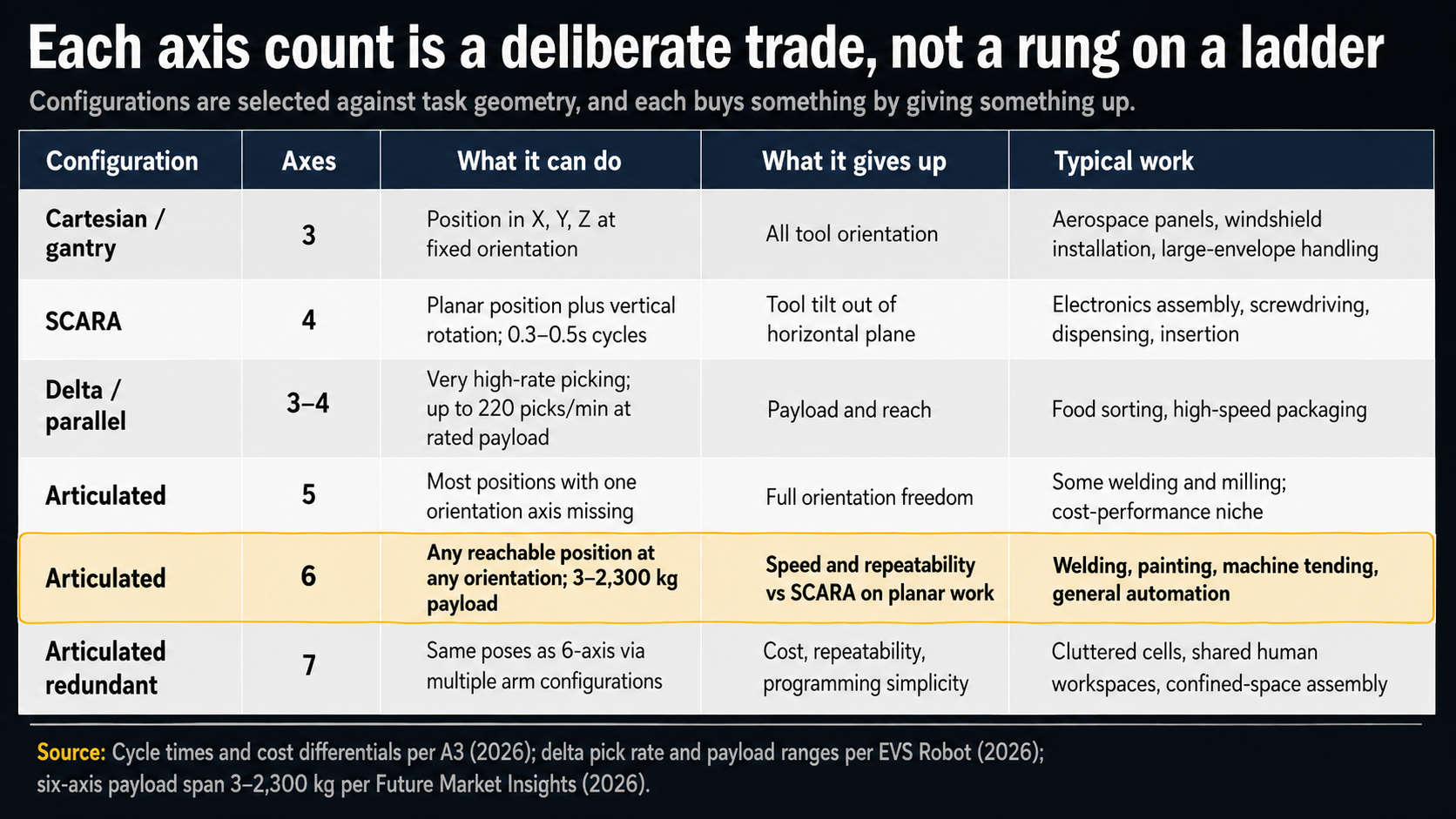
Delta and parallel robots occupy a specialist extreme. EVS Robot documents its delta platform achieving 220 picks per minute at rated payload — a rate serial architectures cannot approach for the same part mass — which is why food sorting and high-speed packaging remain delta territory regardless of what the arm cannot do.
Five-axis arms fill a genuine cost-performance niche for assembly work where tool orientation stays consistent, though they sell in far smaller numbers than either neighbour.
Six-axis articulated arms are the general-purpose default, spanning 3 kg to 2,300 kg payload according to Future Market Insights (2026). Arc welding is the clearest justification: the torch must hold a specific angle to the workpiece across the entire weld path, which requires orientation control the four-axis architecture cannot supply at any price.
What Extra Axes Cost You
The industry sells axis count like horsepower. The repeatability column on the same specification sheet shows the number moving the other way.
Every joint added to a serial arm adds a point where the structure can flex under load. The result is that a four-axis SCARA holds ±0.010–0.020 mm repeatability where a six-axis arm in the same payload class holds ±0.020–0.050 mm — the more capable machine is the less precise one, and the specification sheets have always said so. EVS Robot's technical documentation attributes the gap directly to compliance accumulating across the serial chain of six joints.
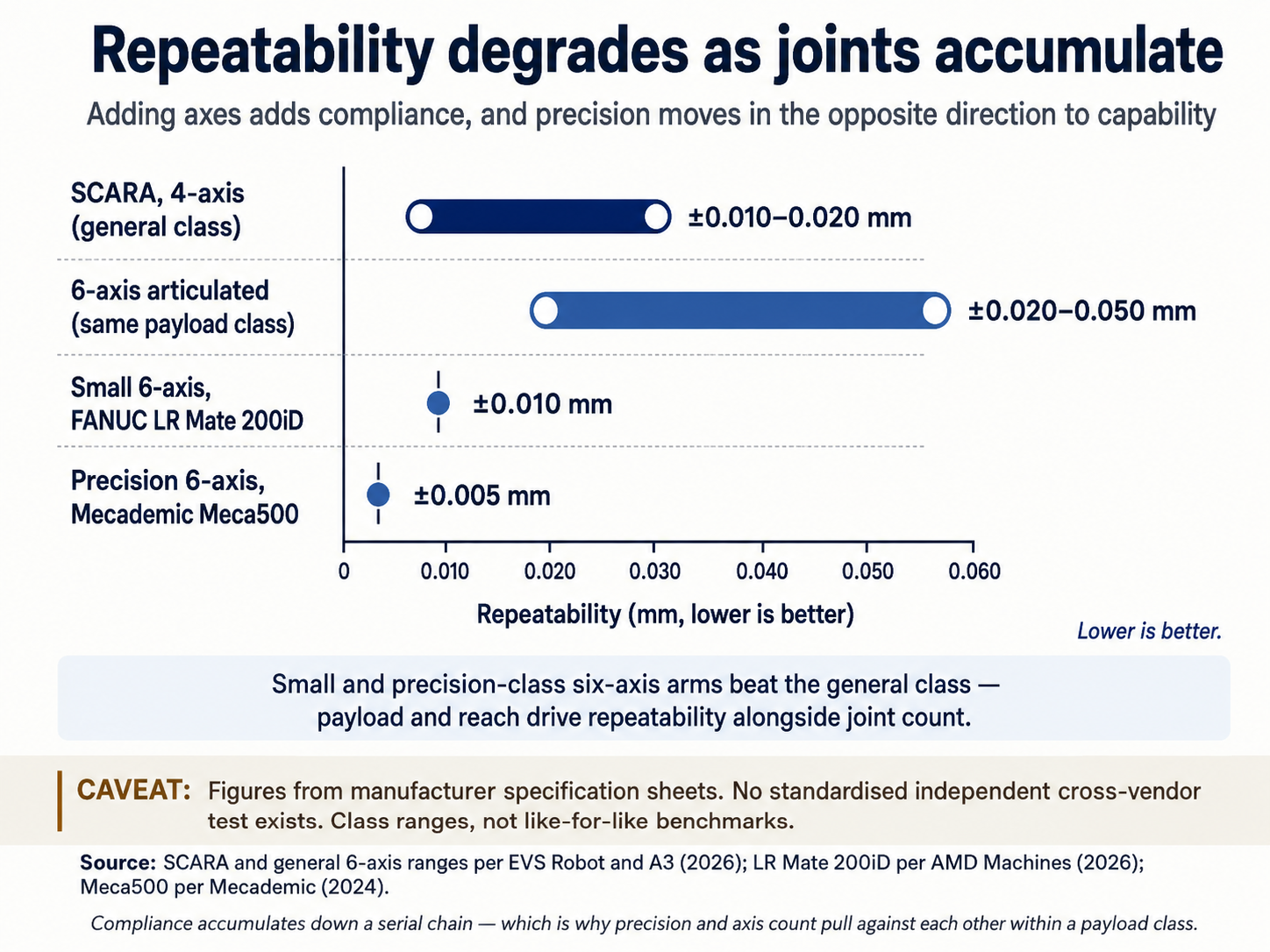
The comparison is not clean, and the chart says so. Payload and reach affect repeatability alongside joint count — Mecademic's six-axis Meca500 achieves ±0.005 mm, matching its own SCARA, because both are small precision machines. No standardised independent test exists across manufacturers, so these are class ranges rather than a benchmark.
Singularities are the second cost, and they are geometric rather than a defect. A singularity is a configuration where the arm loses a degree of freedom because two joint axes align. On a six-axis arm, the wrist singularity occurs when joints four and six become coaxial — that is, when joint five sits at exactly 0 or 180 degrees, per PLC Programming's June 2026 technical breakdown. Every six-axis robot has them. They constrain the paths a controller can plan, and working around them is a programming cost paid on every new part.
The third cost is arithmetic. Inverse kinematics on a six-axis arm produces a finite set of joint solutions for a target pose. On a seven-axis arm it produces an infinite set, and the controller must select one on every move. That is solved technology, but it is not free — in commissioning time, in cycle-time optimisation, and in the difficulty of diagnosing why the arm chose the path it chose.
Where the Seventh Axis Earns Its Keep
The redundancy case: ABB, Rethink, and confined-space work
Seven-axis arms exist because six-axis arms hit walls that have nothing to do with reach. US Patent 4,973,215 documents the underlying problem: most revolute joints on jointed arms provide no more than 180 degrees of rotation, so an arm following a prescribed path can run one joint into its travel limit while the others sit mid-range — and the path stops there, even though the pose was geometrically reachable.
Kinematic redundancy redistributes motion across joints to work around that. The seven-DOF platforms named in the 2023 arXiv analysis — ABB's YuMi, Rethink Robotics' Sawyer and Baxter, and the Space Station Remote Manipulator System — were all built for environments where the arm has to route its own body around something while holding the tool steady. In a shared workcell, the arm reconfigures away from a person's path without interrupting the task.
Is a 7-axis robot better than a 6-axis robot?
No — a seven-axis robot reaches the same poses as a six-axis robot, using different arm configurations to get there. A rigid body in three-dimensional space has a maximum of six degrees of freedom, according to University of Waterloo Robotics Design Team documentation, so the seventh axis adds redundancy rather than reach. It is valuable in cluttered cells and shared human workspaces, where the arm must route around an obstacle while holding tool position, and adds cost and compliance without benefit in open workcells.
The six-axis default, and why the installed base holds it
Articulated robots retained 62.52% of industrial robotics market share in 2025 according to Mordor Intelligence, and the overwhelming majority run six axes. Figures for type share vary substantially between research houses because each defines its segments differently — some measure revenue, others unit installations — so the number is indicative of dominance rather than precise.
That dominance is not conservatism. The seventh axis does not add a destination. It adds a detour. In an open workcell with a clear approach path, a detour option has no value, and the arm has paid for it in a gearbox, a motor, a service interval, and a measure of stiffness.
The variable that separates the two positions is workspace obstruction, not task difficulty. Redundancy pays when the arm must hold a tool pose while routing its own body around a fixture, a shield, a human, or a joint limit. It does not pay when nothing is in the way — which describes most fixed industrial cells, and explains why 62.52% of the market has settled where it has.
This development reinforces:
- How AI Robots Work: The pillar covering robot mechanism, including why hardware architecture follows task requirement rather than capability maximisation.
- AMR vs AGV: The Difference Is Not Intelligence — It Is Who Pays for Change: The same specification error appears in mobile robotics, where buyers compare navigation technology when the operative variable is how often the facility layout changes.
- Humanoid Robots vs Traditional Automation: Why the Comparison Is the Wrong Question: Form factor debates in robotics repeatedly turn on task geometry rather than on which machine is more advanced.
Six is not a rung on a ladder that continues upward. It is the top of that particular ladder, fixed by the fact that a rigid body in three-dimensional space can be moved three ways and turned three ways and no more. Everything below six is a manufacturer deleting capability on purpose to buy speed, stiffness, or floor space — which is why a four-axis SCARA holds tighter repeatability than the six-axis arm that can do more. Everything above six is a manufacturer adding routes to poses the arm could already reach, which is worth paying for when something stands in the way and worth nothing when the path is clear. Of the 542,076 robots installed worldwide in 2024, the ones that will still be earning their keep in 2034 are the ones whose axis count was chosen by looking at the part, the fixture, and the approach angle — before anyone opened a quote.
Frequently asked questions
1. What does DOF mean in robotics?
DOF stands for degrees of freedom — the number of independent ways a robot's tool can move. A rigid body in three-dimensional space has a maximum of six: three translations along the X, Y, and Z axes, and three rotations about them. On a serial robot arm, each powered joint contributes one degree of freedom to the chain.
2. How many axes does a standard industrial robot have?
Six is the standard for general-purpose industrial work. Articulated robots held 62.52% of industrial robotics market share in 2025 according to Mordor Intelligence, with six-axis arms making up the majority. Six-axis platforms span payloads from 3 kg to 2,300 kg per Future Market Insights (2026), covering electronics assembly through automotive body handling.
3. What is the difference between a 6-axis and a 7-axis robot?
A six-axis robot reaches any pose within its envelope using exactly one arm configuration per pose in most cases; a seven-axis robot reaches the same poses using many possible configurations. The seventh joint adds kinematic redundancy, letting the elbow move while the tool stays still. It does not extend reach, because six degrees of freedom is the maximum available to any rigid body.
4. Is more axes better on a robot arm?
No — more axes is better only when the task requires it. Each additional joint adds mechanical compliance to the serial chain, which is why a four-axis SCARA achieves ±0.010–0.020 mm repeatability against ±0.020–0.050 mm for a six-axis arm in the same payload class, per EVS Robot (2026). Extra axes also add cost, service items, and programming difficulty.
5. What is a SCARA robot used for?
SCARA robots handle flat-plane assembly work — pick-and-place, screwdriving, dispensing, and insertion. Their four-axis geometry positions the tool anywhere in a horizontal plane and rotates it about the vertical, but cannot tilt it out of that plane. A3 reports standard models completing pick-and-place cycles in 0.3 to 0.5 seconds at 30 to 50% lower cost than six-axis arms of comparable payload and reach.
6. What is a robot singularity?
A singularity is an arm configuration where a degree of freedom is momentarily lost because two joint axes align. On a six-axis robot, the wrist singularity occurs when joints four and six become coaxial, at joint five positions of exactly 0 or 180 degrees, according to PLC Programming (June 2026). Every six-axis robot has singularities — they are geometric consequences of serial chains, not faults.
7. How many axes do I need for robotic welding?
Arc welding generally requires six axes. The torch must hold a specific angle relative to the workpiece across the entire weld path, which demands independent control of tool orientation at every position — capability a four-axis SCARA cannot provide at any price. Five-axis arms serve some welding applications where orientation stays consistent, but six remains the working standard.