AMR vs AGV: The Difference Is Not Intelligence - It Is Who Pays for Change
Every AMR vendor will tell you AGVs are obsolete. The data does not agree. When Interact Analysis revised its mobile robot forecast in 2025, it cut large-format AMR shipments harder than it cut AGVs. The two technologies are not competing on a ladder of intelligence. They are competing on a single question: how often does your floor plan change? Most buyers are answering the wrong question.

When Interact Analysis revised its mobile robot forecast in May 2025, it cut large-format AMR conveyor shipments by 15 to 20 percent. It trimmed the AGV conveyor forecast from 6 percent compound annual growth to 4 percent. The technology that vendor marketing treats as obsolete took the smaller hit. In 2026, the global autonomous mobile robot market is valued at USD 5.18 billion according to Mordor Intelligence — but the same firm cut its forecast for large-format AMR shipments more sharply than its forecast for AGVs, a detail that complicates the standard account of one technology replacing the other.
The AGV moves the cost of flexibility into the building. The AMR moves it into the robot. Neither eliminates it — and the facility that has not calculated which location is cheaper for its specific layout-change frequency is not making a procurement decision, it is accepting a vendor's.
What Is an Autonomous Mobile Robot (AMR)?
An AGV follows fixed paths defined by physical infrastructure such as magnetic tape, wires, or floor markers, and stops when blocked. An AMR uses onboard sensors and SLAM navigation to map its environment and route around obstacles without infrastructure. The practical difference is that AGVs require facility modification while AMRs require higher per-unit cost.
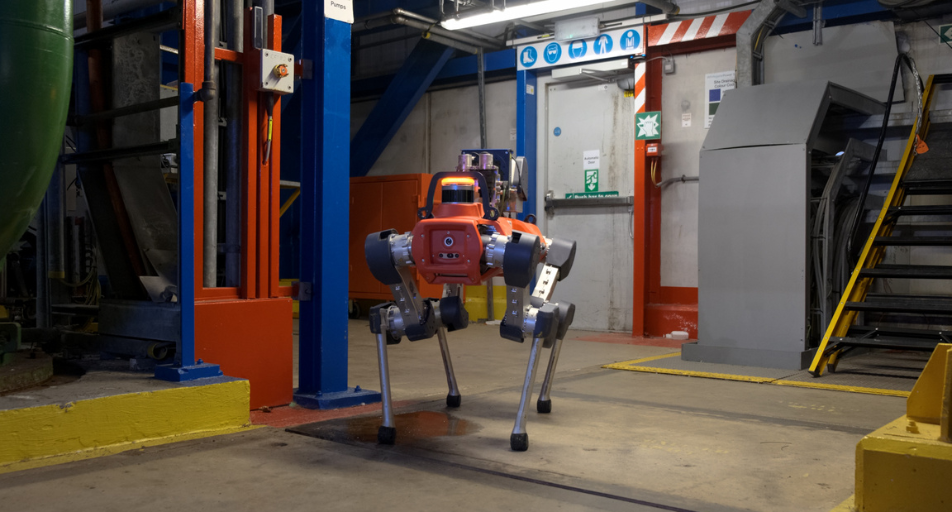
An autonomous mobile robot is a self-guided vehicle that builds and updates a map of its surroundings using onboard LiDAR, cameras, and simultaneous localisation and mapping software. It matters now because labour availability in warehousing has tightened while facility layouts change more frequently than they did a decade ago. For an operations lead, the practical consequence is that an AMR can be deployed into an existing building without cutting the floor or installing guidance hardware.
The distinguishing capability is not autonomy in the abstract. It is that when a pallet is left in the aisle, the AMR routes around it and continues. Everything else follows from that single behavioural difference.
What Is an Automated Guided Vehicle (AGV)?
An automated guided vehicle is a mobile robot that follows predetermined routes defined by physical guidance installed in or on the facility floor — magnetic tape, embedded wire, optical markers, or reflector-based laser triangulation. It matters now because high-volume manufacturing routes have not become less repetitive, and repetition is exactly the condition under which fixed-path economics beat adaptive ones. For a plant manager, the practical consequence is a lower cost per vehicle and a higher deterministic reliability in exchange for a facility that must be physically reworked whenever the route changes.
The category has also moved. As Invio Automation notes in its 2026 buyer framework, many AGVs now add programmed virtual paths and use vision or LiDAR systems with considerably more autonomy than the fixed-line stereotype implies. The boundary between the two categories is a spectrum rather than a wall, which is one reason vendor comparisons rarely survive contact with a real deployment.
Where the Real Difference Lives
The AGV is rail. The AMR is road freight. Nobody argues that trucks made railways obsolete — they argue about which routes carry enough volume to justify laying track.
What is the main difference between an AGV and an AMR?
The main difference is navigation method and infrastructure dependency: AGVs follow predetermined routes using physical guidance installed in the facility, while AMRs use onboard LiDAR, cameras, and SLAM software to map and route independently. According to MarketGrowthReports (2025), AMRs accounted for 65% of total mobile robot installations in 2024 with over 130,000 units deployed globally, though AGVs retain dominance in high-volume fixed-route manufacturing where automotive applications represented 34.63% of AGV revenue in 2025 per Mordor Intelligence (2026).
The building pays, or the robot pays. That is the entire trade, and it explains why the comparison so rarely resolves cleanly. A facility that runs the same three routes for seven years amortises its guidance infrastructure across seven years of throughput. A facility that reconfigures quarterly pays that infrastructure cost every quarter — and pays it in downtime as well as capital.
When AGVs Are the Correct Choice
German automotive plants are the clearest case. According to MarketGrowthReports (2025), more than 55% of automotive OEMs in Germany use AGVs for just-in-sequence part delivery, with deployments reducing transport cycle times by 30% in closed-loop manufacturing setups. Just-in-sequence delivery is the ideal AGV condition: the route is fixed by the assembly line itself, the payload is heavy and consistent, the timing is deterministic, and the layout does not change because changing it would mean rebuilding the line.
Heavy payload transport is the second clear case. Mordor Intelligence (2026) reports that the 1,000-to-2,000 kilogram payload class captured 42.86% of the AGV market in 2025 — the weight range where precision docking matters and where the deterministic repeatability of a fixed path is a safety feature rather than a limitation.
The cost worth naming here is the one that does not appear on the purchase order. Every metre of magnetic tape, every embedded wire, every floor marker is flexibility debt — the accumulated future cost of guidance infrastructure that must be physically reworked every time the operation changes. In a stable automotive line, that debt is never called in. In a facility that reconfigures for seasonal demand, it is called in annually, and it compounds.
When AMRs Are the Correct Choice
Amazon's fulfilment network is the reference deployment at scale. According to Mordor Intelligence (2026), Amazon surpassed one million deployed robots by July 2025 and reduced travel time per pick by 10% through its DeepFleet fleet coordination system. E-commerce fulfilment is the ideal AMR condition: the destination changes with every order, aisle contents shift constantly, and human pickers share the floor.
Asia-Pacific leads the category. Mordor Intelligence (2026) puts the region at 37.12% of global AMR market revenue in 2025, driven by concentrated electronics and e-commerce operations where product mix changes faster than any fixed-path system could accommodate.
Brownfield facilities are the second clear case — buildings that were not designed for automation and where cutting the floor for wire guidance is either prohibitively expensive or structurally impossible. Healthcare adds a third: hospital corridors carry unpredictable human traffic, and a robot that stops dead when a gurney crosses its path is not a working system.
Why Most Large Facilities Run Both
Every AMR vendor's website explains why AGVs are obsolete. Every AGV vendor's website explains why AMRs are unproven. The facilities running the largest mobile robot fleets in the world run both, and have for years.
The AMR case is made most directly by Mobile Industrial Robots, which argues that AMRs are typically more cost-effective because they require no building modification, deploy in weeks, and can return investment in under six months. The argument holds under the conditions MiR sells into. Deployment speed is verifiable, the infrastructure saving is real, and for a facility with an unstable layout the calculation is not close.
The counter-position is put by Invio Automation, whose 2026 framework argues that for stable, heavy, high-precision work the system design logic still points to an AGV — and that the label should follow the system design rather than lead it. That position reflects what integrators find in heavy manufacturing, where takt time and payload precision outrank routing flexibility.
Both positions describe the same reality from opposite ends of a single variable. Interact Analysis data suggests where the balance actually sits: according to its January 2026 analysis, AGV forklifts are projected to generate roughly 33% of total mobile robot revenue by 2030 while accounting for only 14% of shipments — the technology that the market narrative treats as legacy is quietly the highest-value segment in the category. Ash Sharma, VP Research for Robotics and Warehouse Automation at Interact Analysis, attributes this to premium pricing in the forklift segment.
The honest position for a buyer is that the category boundary matters less than the layout-change frequency, and any vendor whose first question is not about that frequency is selling rather than specifying.
This development reinforces:
- Humanoid Robots vs Traditional Automation: Why the Comparison Is the Wrong Question: The same category error appears in humanoid procurement — buyers comparing form factors when the operative variable is task variability.
- Why Robots Struggle With Common Sense — and Why That Matters: The embodiment gap explains why AMR obstacle handling remains the hardest engineering problem in the category rather than a solved feature.
- Who Owns Robot Data: Fleet coordination software of the kind Amazon's DeepFleet represents is where the operational data — and the switching cost — accumulates.
Interact Analysis cut the AMR forecast harder than the AGV forecast in May 2025, and the reason has nothing to do with either technology failing. It is that large-format AMRs were being specified into facilities where the flexibility they offer was never going to be used. According to Interact Analysis (January 2026), only 3% of forklifts shipped globally will be automated by 2030 and just 13% of warehouses will have implemented fulfilment robots — which means the category's real constraint is not choosing between AGV and AMR but that most facilities have chosen neither. The buyers who get this right will be the ones who measured how often their floor plan actually changed before they let anyone show them a robot.
1. What does AMR stand for and what does AGV stand for?
AMR stands for autonomous mobile robot and AGV stands for automated guided vehicle. An AMR uses onboard sensors and mapping software to move independently through a facility, while an AGV follows fixed routes established by physical guidance infrastructure. Both are indoor mobile material-handling robots. According to MarketGrowthReports (2025), more than 200,000 AGV and AMR units were deployed globally in 2024, representing a 25% increase over 2022. The two categories increasingly overlap as AGV manufacturers add vision and LiDAR systems to traditionally fixed-path vehicles.
2. Are AMRs more expensive than AGVs?
AMRs typically cost more per unit than comparable AGVs, but AGVs carry infrastructure installation costs that AMRs do not. The complete comparison requires calculating installation, reconfiguration frequency, and total cost over five to seven years rather than comparing purchase prices. Industry integrators place the crossover point at facilities where layouts change more than annually. Mordor Intelligence (2026) reports the AGV market's largest segment by payload was the 1,000-to-2,000 kilogram class at 42.86% of 2025 sales — heavy-payload applications where AGV unit economics are strongest.
3. Can AGVs and AMRs work together in the same facility?
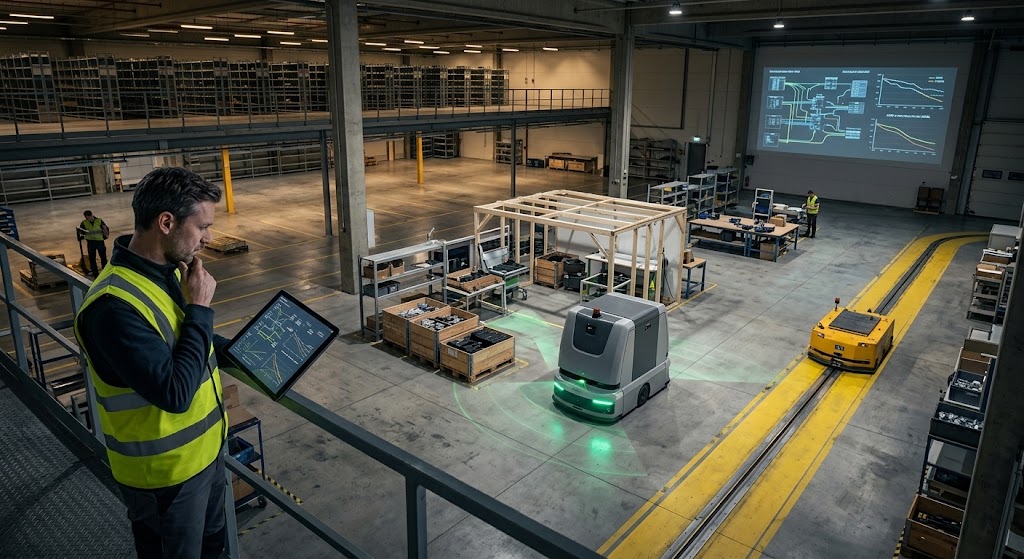
Yes, and large facilities commonly run both. A typical hybrid deployment uses AGVs on stable high-volume backbone routes and AMRs for variable cell-to-cell work that changes with production requirements. Fleet management software has developed specifically to coordinate mixed fleets. According to MarketsandMarkets, the fleet management software market for AGV and AMR systems is projected to grow from USD 1.58 billion in 2025 to USD 5.23 billion in 2032, reflecting how common mixed-fleet coordination has become.
4. Which industries use AGVs and which use AMRs?
Automotive manufacturing is the largest AGV sector, accounting for 34.63% of AGV revenue in 2025 according to Mordor Intelligence (2026), driven by just-in-sequence part delivery on fixed assembly routes. E-commerce fulfilment, healthcare logistics, and electronics manufacturing lean toward AMRs because destinations change constantly. MarketGrowthReports (2025) found that more than 55% of German automotive OEMs use AGVs for just-in-sequence delivery, while Mordor Intelligence (2026) places Asia-Pacific at 37.12% of global AMR revenue, reflecting concentrated electronics and e-commerce operations.
5. How long does it take to deploy AMRs versus AGVs?
AMR deployment typically takes weeks because no facility modification is required, while AGV deployment takes longer because guidance infrastructure must be physically installed before commissioning. Locus Robotics reports deployment timelines of four to six weeks for its picking AMRs. The deployment time difference is one of the most consistently cited advantages in AMR vendor materials, and it is accurate — though it applies to initial installation rather than to ongoing operation, where AGV determinism can produce higher sustained uptime on stable routes.
6. Are AGVs becoming obsolete?
No. According to Interact Analysis (January 2026), AGV forklifts are projected to deliver roughly 33% of total mobile robot revenue by 2030 while contributing only 14% of shipments, making them the highest-value segment in the mobile robot category. The firm's May 2025 forecast revision cut large-format AMR conveyor shipments by 15 to 20% while reducing AGV conveyor growth from 6% to 4% compound annual growth — a smaller reduction. AGVs remain the stronger option where routes are stable and the flexibility debt of fixed guidance infrastructure is never called in.