Why Robots Struggle With Common Sense — and Why That Matters
A robot that can solve a gold-medal mathematics problem cannot reliably pick up an unfamiliar object off a table. Nobody who funds robotics wants to lead with that sentence. But it is the most practically important fact in the entire field — because it explains why robots that dazzle in demos keep disappointing in deployment, and the people whose decisions depend on understanding this gap are often the last ones to be told about it plainly.

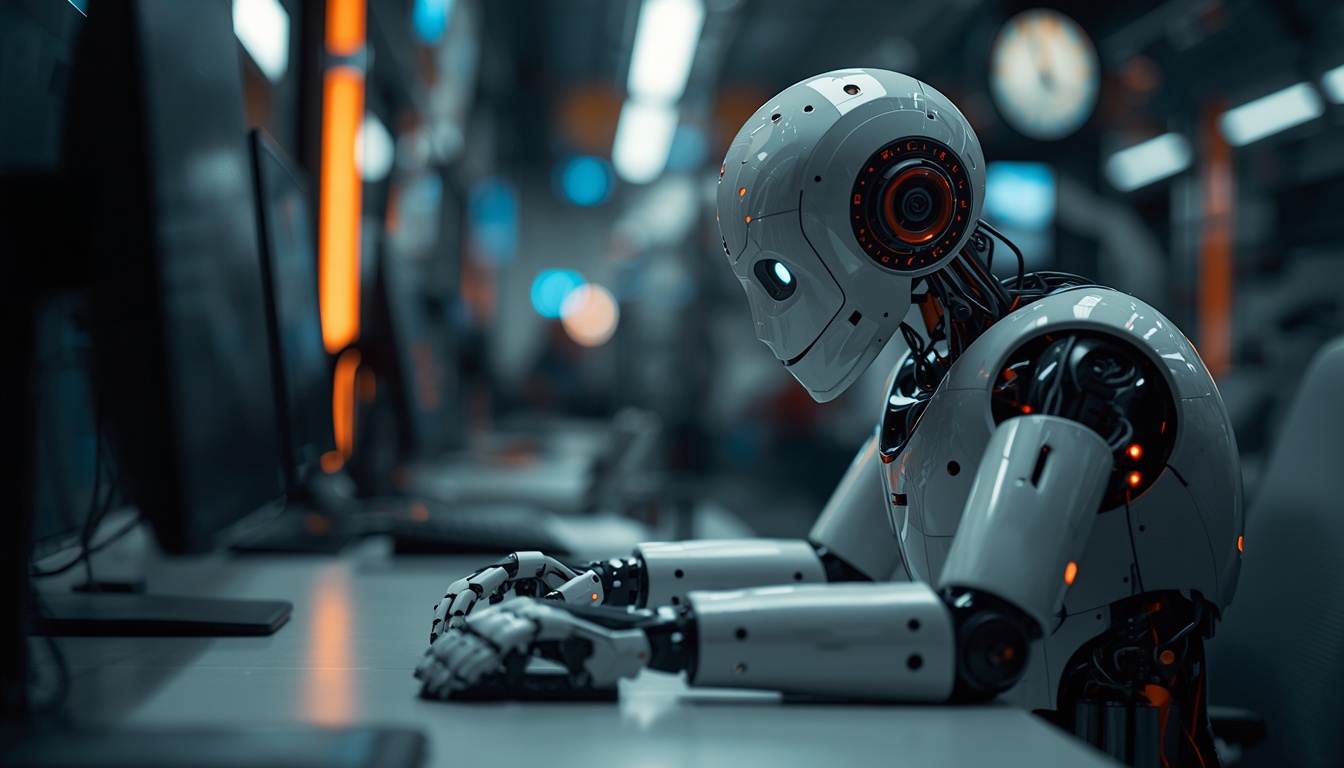
The smarter the robot gets, the more confusing the gap becomes. A robot can now solve a gold-medal International Mathematics Olympiad problem. It cannot reliably pick up a crumpled shirt from a bed. A robot can plan a logistics route across a continent. It cannot reliably retrieve a book from a packed shelf without knocking the adjacent ones over. These are not oversights waiting to be patched. They are the signature of a specific kind of problem — one that more processing power and larger training datasets are not, on their own, going to solve. A robot that can solve a gold-medal mathematics problem and cannot reliably pick up a crumpled shirt is not a broken robot — it is a robot built on a type of intelligence that evolution never connected to the physical world.
In 2026, with 4.66 million industrial robots in operational use worldwide and humanoid robot production scaling into the tens of thousands, the common-sense gap — the specific failure of AI robotic systems in unstructured, unpredictable, everyday environments — remains the defining unsolved problem separating robots that work reliably from robots that merely demonstrate impressively. The people whose decisions most depend on understanding this gap clearly — procurement officers, operations managers, investors, policymakers — are routinely the last to be told about it plainly.
What Is the Common Sense Gap in AI Robotics?
The common sense gap in AI robotics is the systematic failure of robotic systems to perform physical tasks that require contextual judgment about an unstructured environment — tasks that any healthy adult performs automatically and unconsciously but that require a robot to reason explicitly about conditions its training data did not anticipate. It exists because the physical world is not a dataset: it contains an essentially infinite variety of object states, lighting conditions, surface textures, spatial arrangements, and human behaviours that no training programme can fully enumerate, and that human common sense navigates not through reasoning but through embodied experience accumulated over a lifetime. For anyone evaluating a robot for real-world deployment — in a home, a hospital, a retail environment, or any setting where the physical conditions are not precisely controlled — the common sense gap is the specific technical reason why a robot that performs flawlessly in a demo may fail repeatedly in practice, and understanding it changes which questions you ask before signing a purchase order.
What Moravec Noticed in 1988 and What Has — and Hasn't — Changed
Hans Moravec wrote in Mind Children in 1988: "It is comparatively easy to make computers exhibit adult level performance on intelligence tests or playing checkers, and difficult or impossible to give them the skills of a one-year-old when it comes to perception and mobility." This observation has been reconfirmed by every generation of AI progress since. AlphaGo defeated the world champion at Go in 2016 and still could not move the pieces on its own. Large language models now solve gold-medal mathematics problems and cannot reliably write down the answer with a pencil, as Physical Intelligence's robotics blog noted in December 2025. The paradox holds because of an asymmetry that scaling alone cannot address: the tasks humans find cognitively hard — chess, mathematics, formal reasoning — are recent evolutionary acquisitions with high variance in human performance, which means they are amenable to pattern recognition on structured data. The tasks humans find trivially easy — walking, grasping unfamiliar objects, reading a physical situation — are the product of roughly a billion years of evolutionary refinement, encoded not in symbolic reasoning but in embodied sensorimotor systems whose complexity dwarfs anything in the training pipeline of a contemporary AI system.
What has changed since Moravec is the rate at which specific, narrow common-sense sub-problems are being solved through the combination of better sensors, larger training datasets from physical robot deployments, and the emergence of vision-language-action models that give robots richer environmental context before they act. Physical Intelligence's π0 series and similar architectures represent genuine progress on manipulation tasks that were intractable five years ago. But progress on specific bounded tasks — grasping known objects in known configurations — is not the same as progress on the general contextual judgment problem. The gap between "can grasp a box reliably in a warehouse" and "can handle whatever it finds in a household kitchen" is not a matter of degree. It is a qualitative difference in the kind of problem being solved.
What Robots Actually Fail At — and Why the Pattern Is Not Random
The failure modes are specific and instructive once you know what to look for.
When a human reaches for a book on a packed shelf, they typically nudge it sideways first to create space for their fingers, then slide it to the edge before lifting. Neither movement is consciously planned. It emerges from what this site calls contextual grip — the embodied, subconscious capacity to read a physical situation and adapt approach, force, and timing in real time from accumulated physical experience. A robot approaching the same book with a standard manipulation policy reaches directly for it, fails to account for the adjacent volumes, and either gets stuck or knocks them over. The failure is not a reasoning error. It is the absence of a type of physical knowledge that never existed in a training dataset because it was never explicit enough to be recorded.
Asia's industrial robot deployments — 74% of the world's 542,000 new installations in 2024, according to the International Federation of Robotics' World Robotics 2025 report — succeed at scale precisely because they operate in structured factory environments where the physical conditions are engineered to match what robots can handle: consistent object positions, predictable lighting, known part geometries, controlled surfaces. Chinese service robot industry analysts cited in the Global Times in September 2025 stated plainly that "high-precision sensors and force control remain the bottlenecks, and robots struggle to adapt from structured factory settings to unstructured homes." The world's most robotically intensive manufacturing economy has not solved this problem, because the factories were designed around the robots' limitations, not the other way around.
Europe's approach makes the constraint legible in a different way. Germany's industrial robot deployments — Europe's largest — are concentrated in automotive manufacturing, where parts arrive in known positions on known fixtures and the robot's job is to perform a fixed motion with high precision on a predictable input. Bain & Company's Technology Report 2025 found that most humanoid robot deployments globally "remain early-stage, with heavy reliance on human supervision." That supervision is not a temporary quality control measure. It is the human being present to handle the contextual judgment that the robot cannot yet exercise reliably.
The US is generating the clearest documentation of where the frontier actually sits. Physical Intelligence proposed what they called a "Robot Olympics" in December 2025 — a set of challenge tasks that expose the common-sense gap precisely: spreading peanut butter on bread, washing a greasy pan, putting a key in a lock, turning socks inside-out. These are not presented as achievements. They are presented as the frontier that current systems cannot reliably cross — a rare moment of honesty from a company that would benefit commercially from a more optimistic framing.
The robots that impress us most in demos are almost always performing in conditions engineered to hide the exact failure that would occur the moment you changed something small.
The Demo-to-Deployment Gap Is Not a Marketing Problem — It Is This Problem
The connection between the common sense gap and the persistent disappointment of real-world robot deployments is not incidental. It is the mechanism.
A demo is a controlled environment. The objects are known, their positions are fixed, the lighting is optimised, and the task sequence has been rehearsed to the point where the system's failure modes have been identified and engineered around. The robot performs impressively because the demo has been designed to stay within the region of the robot's competence. The deployment is not a controlled environment. The objects are different every day. The floor surface changes. A package arrives in an unexpected orientation. A sensor misreads a reflective surface. Someone has left something in the robot's path that was not in the training distribution.
Think about what happens when you give someone directions to a location they have never been to. If you tell them "turn left at the pharmacy, then right at the school," the instructions work — until the pharmacy is closed for renovation and the scaffolding has changed the visual reference. A person with contextual knowledge of the neighbourhood reads the situation and adapts. A navigation system without that contextual knowledge fails at the scaffolding and cannot recover without intervention. Robotic systems fail in deployment for the same reason: their task knowledge is precise but brittle, and the physical world has an essentially unlimited capacity to present conditions that fall outside the precision boundary. The demo minimises the number of ways this can happen. The deployment reveals all of them.
The practical implication is specific: any organisation deploying robots outside a controlled structured environment should treat the demo performance as the upper bound on what the system achieves when conditions are ideal — not as a representation of what it will do on a normal Tuesday morning.
Is the Common Sense Gap Closing — and If So, What Will Actually Close It?
Two positions in this debate are held by serious people with serious evidence, and neither deserves to be dismissed.
The optimist position, represented by researchers at Physical Intelligence, Boston Dynamics, and the teams building world models and vision-language-action systems, holds that the common-sense gap is closing faster than most observers acknowledge — not through symbolic AI or explicit programming, but through the accumulation of real-world deployment data. When robots operate at scale in real environments, they generate the kind of physical experience data that has historically been impossible to collect systematically. AGIBOT's 10,000 deployed humanoid robots are, among other things, a data collection infrastructure. Physical Intelligence's π0 architecture and similar systems are beginning to demonstrate generalisation across object types and task conditions that were intractable two years ago. The argument is that the gap is real but not fundamental — that sufficient physical training data, combined with better sensors and force-feedback systems, will progressively extend the region of reliable competence.
The structural sceptic position holds that the common sense problem is not a data problem — it is an architecture problem. The skills humans find trivially easy are not stored as explicit knowledge that can be captured in a training dataset; they are embodied in physical systems whose complexity is not yet approximated by current robotic hardware. A robot's hands, however sophisticated, lack the 17,000 mechanoreceptors in human fingertips that continuously provide tactile feedback about surface texture, slip risk, and force distribution. Without that physical sensing infrastructure, no amount of training data produces the contextual grip that makes manipulation of unfamiliar objects reliable. Bain & Company noted in their Technology Report 2025 that despite advances in AI reasoning, "dexterity and fine-motor control are still in relatively earlier stages, with real gaps in tactile sensitivity and precision."
The hard structural truth is that both positions are right about different timescales and different environments. For structured, bounded industrial tasks in controlled environments, the gap is closing, and it will continue to close as deployment data accumulates. For the general-purpose, unstructured everyday environment — the home, the street, the hospital ward with unexpected obstacles — the gap is not primarily a data problem and will not be closed primarily by more data. It will require hardware advances in tactile sensing, force control, and proprioception that are on a longer and less predictable timeline than the software advances that dominate the current robotics narrative. The honest answer — that different parts of the common sense problem are on very different timelines, and that knowing which part your deployment depends on is the most important question you can ask — is the one that most coverage declines to give.
South Korea is planning to invest $2.2 billion in service and manufacturing robotics through 2028 with the aim of deploying one million robots by 2030, according to the Information Technology & Innovation Foundation's July 2025 report. Whether those robots can be deployed in the environments that South Korea's aging population actually needs — homes, care facilities, unstructured community settings — depends on hardware advances that the investment alone cannot accelerate beyond the pace of materials science and manufacturing capability. Money closes software gaps faster than hardware gaps. The common sense gap is partly a hardware gap.
This connects to the deeper questions about how AI robotic systems actually function and where in the stack the real barriers to capability lie.
This development reinforces:
- What Is Physical AI?: The common sense gap is the central unsolved problem of physical AI — the reason that moving AI capability from the digital world to the physical one is categorically harder than scaling digital AI alone.
- When There Aren't Enough Hands: How AI Robots Are Changing Elder Care: The transfer burden in eldercare is precisely the kind of physical manipulation task — force-sensitive, contextually variable, performed on an unpredictable human body — that the common sense gap most directly constrains, which is why eldercare robotics is advancing at the hardware layer, not the software layer.
- Robots Aren't Taking Your Job — They're Taking the Parts of It That Were Hurting You: The specific tasks robots absorb first — repetitive, physically bounded, in controlled environments — are precisely the tasks that fall inside robots' competence boundary, and the tasks they have not absorbed yet are almost all outside it for reasons this article explains.
The packed-shelf problem is not a metaphor. It is a concrete, documented failure mode that researchers use to explain why a robot that can solve a university mathematics examination cannot perform a task that any ten-year-old completes without thinking. The ten-year-old has several hundred million years of evolutionary engineering in their hands and wrists, encoding physical knowledge that no training run can substitute for because it was never symbolic in the first place. Understanding this does not mean robots are not useful, or impressive, or genuinely transformative in the environments where they work reliably. It means the demo is almost always filmed in the packed shelf's absence — and the moment you put the shelf back in the room, you find out what the robot actually knows.
1. Why are robots so smart but struggle with simple tasks? Robots struggle with simple physical tasks because human "simple" tasks are not computationally simple — they draw on billions of years of evolutionary refinement encoded in embodied sensorimotor systems, not in explicit reasoning that can be captured in training data. This is known as Moravec's Paradox, described by robotics researcher Hans Moravec in his 1988 book Mind Children: tasks easy for humans are computationally hard for machines, and vice versa. Large language models can now solve gold-medal mathematics problems, according to Physical Intelligence's December 2025 analysis, but cannot reliably perform physical tasks like spreading peanut butter or turning a sock inside-out.
2. What is Moravec's Paradox in robotics? Moravec's Paradox is the observation that high-level reasoning — chess, mathematics, formal logic — is computationally easy for machines, while low-level sensorimotor skills — walking, grasping, reading a physical situation — are computationally hard. Hans Moravec proposed in 1988 that this asymmetry exists because sensorimotor skills are the product of roughly a billion years of evolutionary development, encoded in neural and physical systems whose complexity is not captured in any training dataset. The paradox remains relevant in 2026: robots installed at industrial scale globally handle structured manufacturing tasks reliably but consistently fail in unstructured home and service environments.
3. Why do robots work well in factories but fail in homes? Factory robots succeed because factories are designed around their limitations — objects arrive in known positions, lighting is consistent, surfaces are predictable, and the robot's task is precisely bounded. Homes are unstructured: objects are in variable states, surfaces are irregular, lighting changes, and the physical situations encountered are essentially unlimited in variety. Chinese service robot industry experts cited in the Global Times in September 2025 stated that robots "struggle to adapt from structured factory settings to unstructured homes" despite rapid advances in factory deployment. The gap is not a software limitation that will close quickly — it is partly a hardware limitation in tactile sensing and force control.
4. What is the common sense gap in robotics? The common sense gap is the specific failure of robotic systems to exercise the contextual physical judgment that humans apply automatically in everyday situations. It includes what this site calls contextual grip — the subconscious ability to read a physical situation and adapt grip, force, approach angle, and timing in real time without explicit planning. Robots lack this because it requires embodied physical experience of the kind that evolutionary biology produced over billions of years, not statistical learning over a training dataset. Most human "simple" physical tasks depend on it, which is why they sit on the far side of the common sense gap.
5. Is the robot common sense problem being solved? Partially, and in specific bounded environments. World models, vision-language-action systems, and large-scale deployment data collection are closing the gap for structured manipulation tasks — grasping known objects in known configurations, navigating predictable environments. The gap in unstructured everyday environments — homes, cluttered workspaces, care settings — is not closing at the same rate because it depends on hardware advances in tactile sensing and force control, not just software advances in AI reasoning. Bain & Company's Technology Report 2025 noted that "dexterity and fine-motor control are still in relatively earlier stages, with real gaps in tactile sensitivity and precision" even in leading humanoid robot platforms.
6. Why do robot demos look better than real deployments? Robot demos are conducted in controlled environments specifically designed to stay within the robot's competence boundary — known objects, fixed positions, optimised lighting, rehearsed task sequences. Real deployments encounter conditions that fall outside that boundary: unfamiliar object orientations, variable surfaces, unexpected obstacles, changed layouts. The gap is not deceptive in a conspiratorial sense — it is structurally inevitable given how these systems are validated. The practical implication is that demo performance represents the upper bound of what the system achieves under ideal conditions, and that any evaluation of a robot for real-world use should be conducted in the actual deployment environment, not a curated demonstration setting.