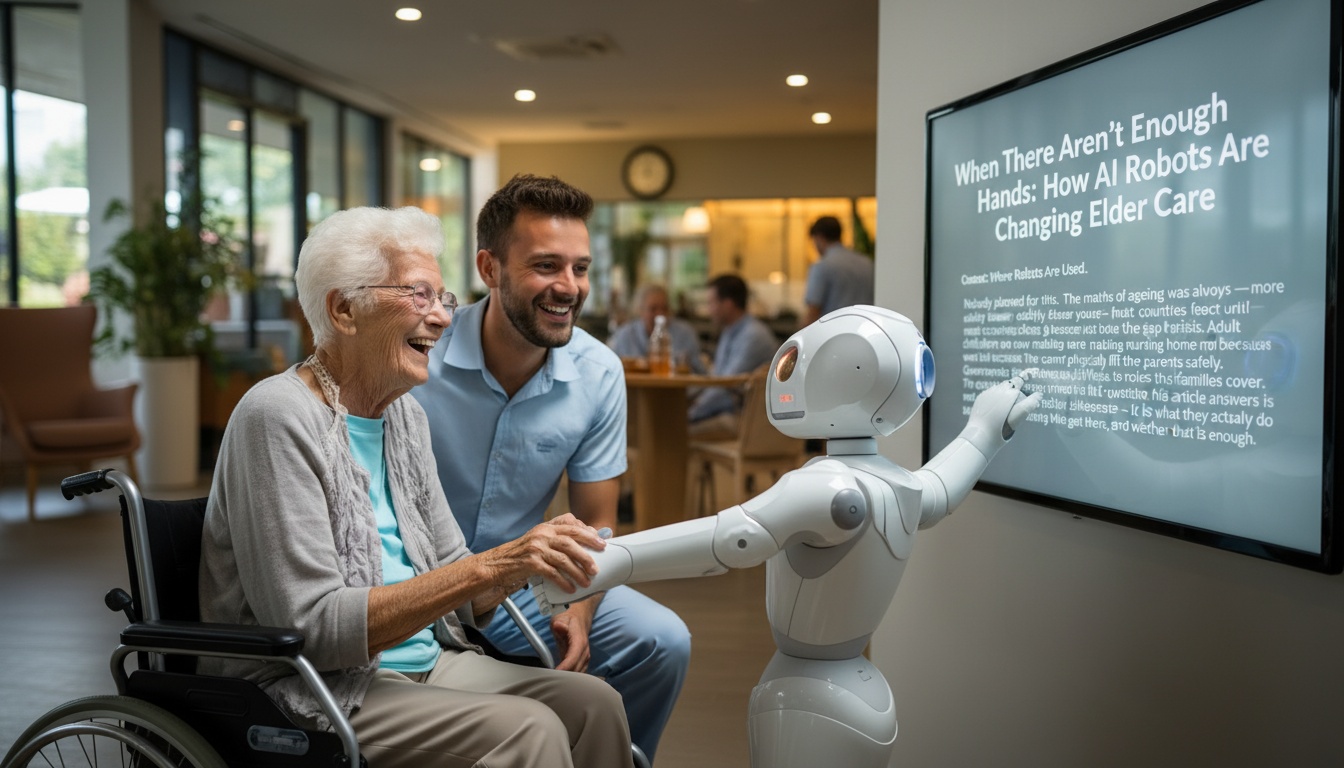
When There Aren't Enough Hands: How AI Robots Are Changing Elder Care
Nobody planned for this. The maths of ageing was always known — more elderly, fewer young, fewer carers — but most countries chose not to act until the gap became a crisis. Adult children are now making nursing home decisions not because they want to but because they cannot physically lift their parents safely. Governments are running out of workers to fill the roles that families cannot cover. The question this article answers is not whether robots belong in eldercare — it is what they actually

She had done the maths three times on the drive over. Her mother weighed 58 kilograms. Getting her from the bed to the bathroom required two people — one to support the shoulders, one to manage the legs — and took about four minutes when it went well. She was doing it alone, twice a night, and her back had started to go. Her brother lived in another city and called on Sundays. The nursing home her mother kept refusing was twenty minutes away and had a six-week waiting list. She was not there yet, but she was running the numbers, and the numbers were winning.
That calculation is being run by millions of people across every ageing society on earth right now, and most of them are losing. In 2026, the convergence of ageing demographics, care workforce collapse, and genuinely capable robotic systems has moved elder care robotics from a research curiosity to an operational necessity in every country that will face this problem first. The most important thing a robot can do for an elderly person is not entertain them — it is make it possible for them to get to the bathroom without asking for help. That is not a small thing. For the person who needs the help, it is the difference between a life with dignity and a life managed.
What Is AI Robots Elder Care?
AI robots elder care refers to the deployment of autonomous and semi-autonomous robotic systems in home and institutional settings to assist elderly individuals with physical tasks, safety monitoring, mobility support, and social interaction. These systems exist because the human caregiving workforce is shrinking faster than the elderly population is growing, and no combination of policy, immigration, or wage increases has closed or will close that gap at the speed the demographic data requires. For anyone with an ageing parent, a caregiving role, or a decision to make about a family member's independence, understanding what these robots can do — and, honestly, what they still cannot — changes which questions you ask and which decisions you defer.
How Many Countries Are Running Out of Carers at the Same Time?
The scale of the problem is not a projection. It is already here, and it is distributed across every economy that industrialised early enough to generate the longevity that now requires care.
Japan is the furthest along the curve, which is why it has also invested the most in the robotic response. The Japanese Ministry of Health, Labour and Welfare projects a shortage of 570,000 care workers by 2040, and the sector already has only one applicant for every 4.25 available jobs as of December 2024, according to data cited in US Trade.gov's Japan Healthcare Caregiving Technologies report (2025). The government's response is blunt: a ¥440 million Moonshot Research and Development programme funding humanoid caregiver prototypes, including AIREC, specifically designed to handle the tasks that are breaking the human workforce — patient lifting, bed-to-wheelchair transfers, bathing assistance, mobility support. The ambition is explicit. The timeline is long. Japan has been running this experiment longer than anyone, and it has not yet found the answer, but it has found the direction.
Europe is at a different stage of the same crisis. The OECD and European Commission's Health at a Glance: Europe 2024 report documents a shortage of approximately 1.2 million doctors, nurses, and midwives across EU countries as of 2022. One in five Europeans is already 65 or older. By 2050 that figure hits 30 percent, and the demand for long-term care workers is projected to rise by 23.5 percent in that period, according to RAND's 2025 analysis — while over a third of current EU doctors and a quarter of nurses are themselves aged over 55, meaning the workforce that would provide that care is itself approaching retirement. European governments are announcing strategies and launching consultations. The gap is widening while the frameworks are being drafted. Anyone who has read enough of these policy documents develops a particular kind of patience.
The United States presents the sharpest family-level data. In 2024, an American Health Care Association survey of 441 nursing homes found that two-thirds reported ongoing staffing shortages severe enough that they may require closure. The National Alliance for Caregiving and AARP's Caregiving in the US report (2025) estimates there are approximately 53 million unpaid family caregivers in the US, contributing over $870 billion annually in informal care — a number that represents the gap between what the formal system can provide and what people's parents actually need. MIT economist Jonathan Gruber called the situation "peak demand" creating a "critical labor shortage" in CNBC in November 2025. That is the polite version of what the families living it would say.
The pattern across all three regions is the same: more elderly, fewer carers, and family members absorbing the difference at cost to their own bodies, careers, and mental health.
What Do Robots Actually Do for Elderly People — and Why Does the Sequence Matter?
The way robots enter eldercare follows a logic that is economic and ergonomic at once — they go where the human cost of the task is highest, and where the task is defined enough for a machine to perform it reliably.
Think about how a well-run building maintenance crew handles a heavy load that needs moving between floors. There is a lift for the weight. There is a person to manage the lift, assess whether the load is stable, communicate with whoever is on the other end, and handle anything that goes wrong. The lift does not replace the person. It makes the physically impossible possible — and it means the person's judgment and attention can go to the parts of the job that require judgment and attention. Now imagine the lift is not there. The person either does not move the load, or they damage themselves trying, or they call in two colleagues they cannot afford and the whole process takes three times as long. That is what eldercare looks like without assistive technology in a facility where there are not enough carers. The robot — whether it is a transfer-assist system, a walking support device, or a fall-detection unit — is the lift. It does not replace the carer. It makes the situation viable.
The sequence in which robots are solving eldercare problems is instructive. Physical transfer and mobility assistance comes first, because the transfer burden — the specific physical and psychological weight of moving a dependent person from bed to wheelchair, from wheelchair to toilet, from floor to standing — is the task that injures the most carers and humiliates the most patients. In May 2025, MIT engineers announced the Elderly Bodily Assistance Robot (E-BAR), a mobile device that follows users, offers support during walking, sitting, and standing, and deploys inflatable airbags to catch individuals if they begin to fall — without requiring them to wear a harness. That is not a companion robot. That is a fall-prevention and dignity-preservation machine, and it addresses the specific problem that most eldercare discussion skips past because it is unglamorous.
"The eldercare assistive robot market is projected to grow from USD 16.42 billion in 2025 to USD 51.59 billion by 2034, driven not by the novelty of robot companions but by the structural impossibility of staffing the care that ageing populations require." (Source: Market Research Future, 2025)
The counterintuitive thing about robots in eldercare is that the most impactful applications are not the ones that generate headlines. Robotic seal companions and AI chatbots are visible and photographable. Transfer-assist systems and fall detection units are not. But it is the unsexy, physical, biomechanical layer of elder care robotics — the machines that handle weight, movement, and fall risk — that determines whether an elderly person retains any functional independence at all.
The robots that handle the weight do not solve the loneliness. That problem is harder, and it has a different answer.
Labour Shortages Opened a Door Policy Couldn't
The entry of robots into eldercare was not driven by technology enthusiasm. It was driven by the simple fact that in Japan, South Korea, and Germany, governments had run out of alternative answers. Immigration was politically constrained. Wages were rising but not fast enough to attract workers to physically demanding roles with high burnout rates. Family structures were changing — smaller households, women in the workforce, geographic mobility — eliminating the informal care networks that had previously absorbed the gap. The governments and facilities that moved first on robotic eldercare were not the most technically adventurous — they were the ones facing the most acute operational failure, and they adopted robots because the alternative was a care system that could not function. Japan introduced its Priority Areas for the Use of Robotic Technology in Caregiving as early as 2012, revised it in 2014, 2017, and again in June 2024 in response to accelerating need. South Korea set a goal of one eldercare assistive robot per five elderly people by 2025. These were not aspirational technology programmes. They were workforce emergency responses.
Acceptance Arrived Later Than the Need Did
The friction in eldercare robotics has never primarily been about the technology. It has been about the humans on both ends of it. Elderly people raised in a world where care meant human presence resist the substitution more than researchers expected. Care workers worry, not unreasonably, that robots will be used to justify further understaffing rather than to supplement adequate staffing. Families feel guilt about what they interpret as a mechanical replacement for their own presence. Being kept alive and being able to live are not the same thing, and for most elderly people the difference between the two is whether someone is available to help them move — but persuading people of this when the machine is also strange and unfamiliar takes time that the demographic data does not grant.
RobotAIGeek's honest position: the emotional resistance to elder care robots is real and deserves more attention than it gets in the technology press. The evidence base for some applications — particularly companionship robots — is thinner than advocates claim, and the deployment of robots as a substitute for adequate human staffing, rather than a supplement to it, is a genuine risk that facilities under financial pressure will face. The physical assistance layer is better evidenced. The social and emotional layer requires more rigour before the claims being made for it are warranted.
The survival strategy for families navigating this is not to wait for a definitive answer that the research will not deliver quickly enough — it is to understand which specific tasks in their parent's care are most dangerous and most burdensome, and to ask specifically whether robotic assistance exists for those tasks, rather than treating "elder care robot" as a single category.
Dignity Became the Actual Measure of Success
The result of two decades of elder care robotics deployment, primarily in Japan but increasingly across Europe and the US, is a clearer picture of what the technology is actually for. It is not for replacing human relationship. It is for preserving the minimum level of physical independence that makes a life worth describing as living. The transfer burden — the act of moving, the dependency it requires, the exposure it involves — is where dignity is most routinely lost in elder care, and it is where robotic assistance delivers the most measurable improvement for both the person being cared for and the person doing the caring.
Is Putting a Robot in Your Parent's Room a Surrender — or the Opposite?
This is where the Wise Peer stops being careful. There are two fears in every conversation about elder care robots, and both are real, and both need to be named before the question can be answered honestly.
The first fear is held by the families. It is the fear that accepting robotic assistance means admitting that they have failed — that their love was not enough, that their presence was not sufficient, that they chose a machine over their parent. This fear is specific to the only child who had no help, to the adult child who drove two hours every weekend and still couldn't be there every night, to the person who knows their sibling has not visited in four months and is somehow still the one who feels like they are failing. The fear is real. The framing is wrong.
The second fear is held by care workers and their advocates, particularly those aligned with labour rights organisations who argue — with evidence — that robots are being used by facility operators to justify lower staffing ratios rather than to improve care quality. This is a legitimate institutional concern. The American Health Care Association data showing that two-thirds of nursing homes already face closure-level staffing crises suggests the sector is not over-staffed and under-threatened by automation. It is under-staffed and under-resourced, and the risk of robots becoming a cost-cutting tool rather than a care-improving one is not paranoia.
The hard structural truth is this: the transfer burden will not be carried indefinitely by a workforce that cannot be grown fast enough, at wages that cannot be raised fast enough, with family carers who are already injuring themselves trying to fill the gap. The specific consequence of refusing robotic assistance in this context is not that human care continues — it is that the physically dangerous transfers happen less frequently, happen unsafely, or stop happening at all, and the elderly person loses the functional independence that makes daily life bearable. The question is not whether a robot in your parent's room is a surrender — it is whether the alternative to the robot is actually better care, or whether it is just a more familiar kind of inadequacy.
What the robot changes is not the love. It changes whether the love can be expressed in daily life or only in visiting hours.
This question about the transfer burden, the dignity floor, and who bears the cost when neither is met connects to the broader questions this site tracks across work, automation, and what it means when machines absorb the tasks that humans were not built to sustain.
This development reinforces:
- Where Robots Are Used: Elder care is among the most active and least publicly visible sectors of real-world robot deployment — this article grounds the pillar's argument in the most personal deployment context of all.
- What Jobs Do Robots Replace: Task Displacement 2026: The transfer burden in eldercare is the clearest case in the site's entire library of a task that robots absorb not to reduce headcount but to protect the people — carers and patients alike — from the physical cost of a task human bodies were not designed to perform indefinitely.
- Robotics ESG & Sustainability: The question of who bears the cost of care — the elderly person, the family, the state, or the robot — is fundamentally a governance and social contract question, and the entry of robotic systems into that question changes what accountability looks like.
She eventually found a transfer-assist system that let her mother move from the bed to a standing position with support, without requiring two people. Her back improved. Her mother, who had spent three months asking not to be moved because she was ashamed of needing help, started getting up in the morning again. The robot did not fix the relationship. It did not replace the visits or the phone calls or the specific grief of watching a parent become someone who needs to be carried. What it did was restore enough physical independence that her mother stopped spending every waking hour managing her own helplessness. The machine replaced the lift. The daughter replaced nothing. That is the distinction that the entire debate about robots in eldercare keeps failing to make — and it is the one that matters most to the people actually living it.
1. Can robots really take care of elderly people? Robots can assist with specific, bounded eldercare tasks — physical transfers, fall detection, mobility support, medication reminders, and companionship — but they cannot replace human judgment, emotional relationship, or complex care decisions. The most effective eldercare robots are those addressing what this site calls the transfer burden: the physically dangerous, dignity-compromising task of moving a dependent person between positions, which injures more carers and distresses more patients than any other single care activity. The eldercare assistive robot market is projected to grow from USD 16.42 billion in 2025 to USD 51.59 billion by 2034, according to Market Research Future (2025), reflecting how seriously the care sector is taking these tools.
2. Why are robots being used in elder care? Robots are entering elder care because the human caregiving workforce cannot grow fast enough to meet the demand generated by ageing populations. Japan already faces a shortage of 570,000 care workers by 2040 with only one applicant per 4.25 available jobs as of December 2024, according to US Trade.gov's Japan Healthcare Caregiving Technologies report (2025). In the US, two-thirds of nursing homes reported in 2024 that staffing shortages may force them to close, according to the American Health Care Association. The demographic arithmetic — more elderly, fewer young people, fewer carers — is the same across every industrialised economy, and robots are the only intervention that can scale at the speed the numbers require.
3. What do elder care robots actually do? Elder care robots perform physical transfer and mobility assistance, fall detection and prevention, medication management, vital sign monitoring, and social companionship. The physical assistance layer — helping elderly people move safely between positions, preventing falls, supporting walking and standing — is both the most technically advanced application and the most practically important. In May 2025, MIT announced the E-BAR robot, which follows elderly users and deploys inflatable airbags to prevent falls without requiring a wearable harness, targeting the specific transfer burden that causes the most injuries to carers and the most loss of dignity to patients.
4. Will robots replace human carers in nursing homes? No — robots are absorbing specific physically dangerous or repetitive tasks within care settings, not replacing the human judgment, relationship, and oversight that define quality care. The evidence from Japan, which has deployed elder care robots longer than any other country, shows that robots used well reduce carer injury rates and allow human carers to focus on the work that requires human presence. The risk is not replacement but misuse: facilities under financial pressure may use robots to justify lower staffing ratios, which is why how robots are deployed matters as much as whether they are deployed.
5. What is the transfer burden in elder care? The transfer burden is the specific physical and psychological weight of moving a dependent elderly person between positions — from bed to wheelchair, wheelchair to toilet, floor to standing — which is the most injury-prone task in care work and the most dignity-compromising experience for elderly people who need it. It is the primary reason family carers develop back injuries, the primary reason elderly people resist asking for help, and the primary application where robotic assistance delivers the most immediate, measurable improvement for both the person being cared for and the person doing the caring. Most eldercare robot development is focused precisely here, because it is the task where the human body is most poorly suited to what the situation demands.