Korea Wants One Robot-Elevator Standard. The Elevator Industry Already Wrote Three.
South Korea's new special act promises a standardized way for robots to enter apartment buildings and call elevators, but Otis, KONE and Schindler already built three incompatible proprietary APIs for that exact handshake years earlier, and only Singapore has tried to write a neutral cross-manufacturer standard for it.

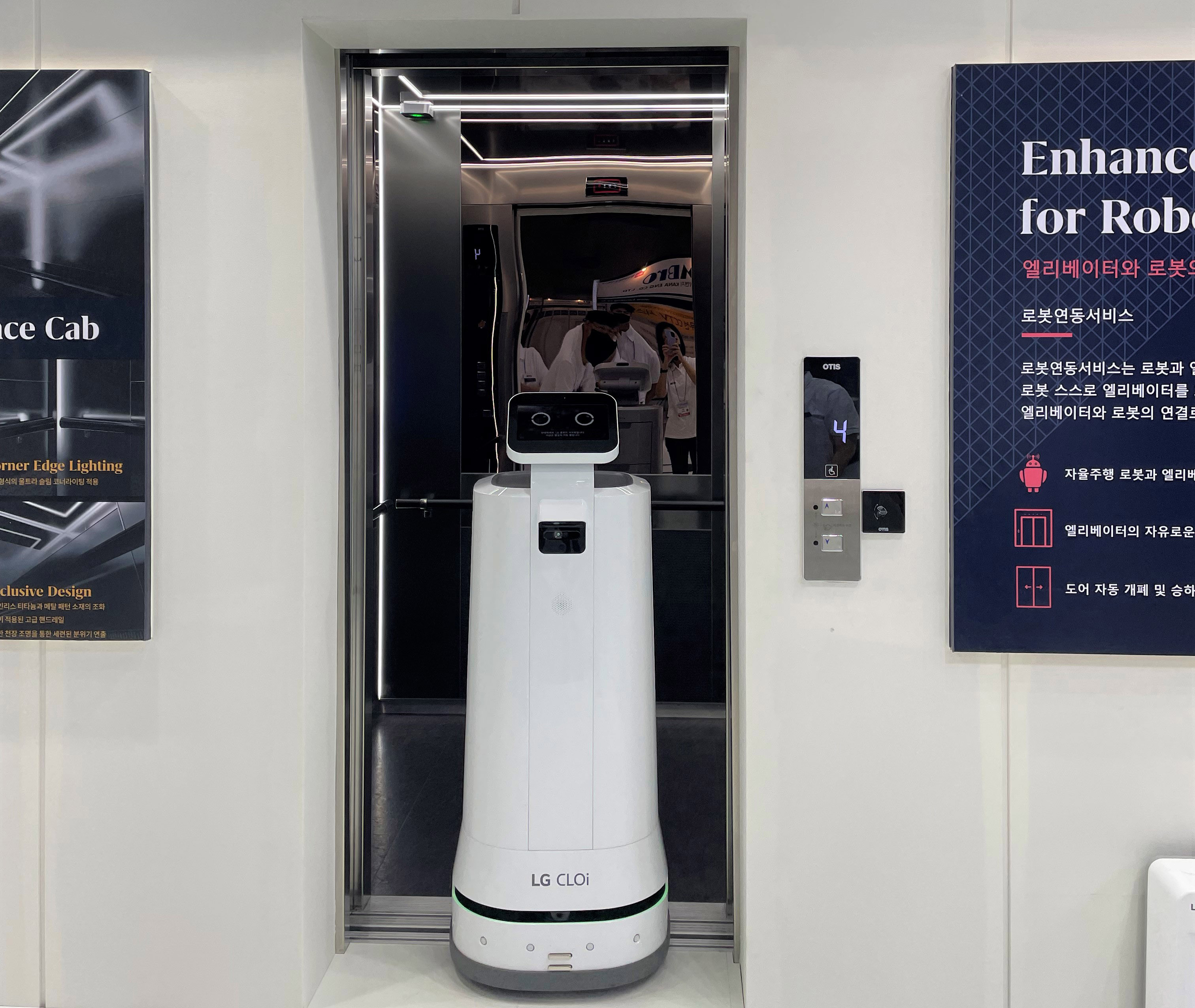
Picture a delivery robot parked at the lobby doors of a Seoul apartment tower, waiting on an elevator built by a manufacturer headquartered four time zones away, running a call protocol that manufacturer has never published. That single machine-to-machine handshake, robot to elevator, is the actual chokepoint South Korea's newest robotics bill promises to fix. It is also the one layer of the stack the bill does not reach.
The Special Act for the Safe Use and Commercialization Promotion of Mobile Robots, introduced by lawmaker Han Byung-do and drafted with the Ministry of Land, Infrastructure and Transport, is moving through South Korea's National Assembly with a year-end passage target. Its most-quoted provision standardizes how an approved robot authenticates itself at a building's front door and calls an elevator, replacing what is currently a building-by-building negotiation between whichever robot vendor shows up and whichever access-control installer that particular apartment building happened to hire. Fix that patchwork, the bill's backers argue, and a robot maker that clears one Korean apartment building has a template that transfers to the next one.
Here is the sentence that patchwork glosses over: the elevator itself is not part of what gets standardized.
Three Companies, Three Answers
Every major elevator manufacturer that would actually carry that robot between floors already built its own answer to the exact interoperability question Korea is legislating around, years before any government asked. Otis introduced its Integrated Dispatch application programming interface around 2018 and 2019, after watching robot adoption accelerate inside Chinese buildings, and the company now says it has engaged with more than sixty separate robot manufacturers on the platform, including a public integration with Cobalt Robotics and a deployment at Auckland's Sudima hotel that let a Pudu Robotics delivery unit call an Otis elevator on its own. KONE runs a parallel Service Robot API and a separate Elevator Call API for the same purpose, marketed through its own developer channel as connective tissue for autonomous cleaning, delivery and security robots. Schindler built a third version, a Robot API bundled into what it calls its BuilT-In platform, which links a robot to an elevator's control system over the building-automation protocol BACnet rather than a bespoke wire.
None of those three systems talks to either of the other two.
Otis's own senior director of design strategy, Nick Cope, has given the honest answer rather than the marketing one when asked why the industry has not converged on one shared interface: there will always be proprietary information between different elevator systems, and that is not going away. That is not a company hedging. That is the company that has done the most public integration work in the category saying, on the record, that the fragmentation is a deliberate feature of the business model, not an oversight waiting on a trade-group meeting to fix it.
One Government Tried to Force the Issue Anyway
Only one jurisdiction has actually attempted to write a neutral, cross-manufacturer answer to that problem, and it is not South Korea. Singapore's national standards body published SS 713 in 2025, a technical specification covering the minimum data exchange, hardware requirements and safety handling for connecting a robot to a lift or an automated doorway, developed through the country's Manufacturing Standards Committee with drafting work co-run by robotics group CHART and engineering firm HOPE Technik. A companion specification, TR 130, covers how a robot talks to a building's central command system. Singapore's Building and Construction Authority followed with a circular on the cybersecurity and interoperability of connected lift systems, and the standards body has said openly that it wants SS 713 elevated to a full ISO standard, aiming to turn a domestic rule into the reference point every elevator maker eventually has to support.
That is the harder version of the problem South Korea is not attempting yet. Singapore's standard sits at the layer where the robot and the elevator controller actually exchange data, the same layer Otis, KONE and Schindler each fenced off with a proprietary API. Korea's bill sits one layer up, at the building's obligations toward the robot: which committee approves it, how insurance and incident investigation get handled, how floor space gets counted for tax purposes. Those are real, useful fixes for a real, badly fragmented process. They are not the same fix.
Why the Distinction Matters to a Robot Vendor's Spreadsheet
A robot company planning to sell into a hundred Korean apartment towers cares which layer got standardized, because the layer that did not get touched is the one that decides how many separate integrations its engineering team still has to build. If a country's apartment towers run on four or five different elevator brands, as most national markets do, a vendor with regulatory approval in one building still needs a working relationship with whichever manufacturer's API sits behind that building's specific elevator bank before it can repeat the win next door. The special act removes the legal uncertainty and the building-committee negotiation. It does not remove the requirement to speak Otis in one tower and Schindler in the next.
A national law can order a building to open its lobby door to a robot. It cannot order three competing elevator manufacturers to publish the same interface.
That is not a knock on the bill. Standardizing building governance, insurance obligations and an accident investigation process for machines moving through residential space is a genuinely hard, genuinely necessary piece of policy work, and Korea's version, built with input from thirty-five companies across nine sessions including Samsung Electronics, Hyundai Motor Group, Naver Labs and delivery operator Woowa Brothers, reads like it was shaped by people who have already hit these problems in real pilot buildings rather than drafted from a whiteboard. The floor-area-ratio incentive for robot-friendly construction and the mandatory liability insurance for operators are the kind of unglamorous infrastructure that actually determines whether a pilot program survives contact with a homeowners' association.
The Layer Nobody Is Legislating Yet
What the bill does not do is force Otis, KONE, Schindler or any other manufacturer operating in Korea to expose a public, shared protocol the way Singapore's standard tries to. Nothing in the special act requires it, and nothing in an elevator manufacturer's commercial position points toward volunteering it. A proprietary API is a switching cost, and switching costs are the reason a robot fleet operator, once integrated with one elevator brand across a portfolio of buildings, tends to stay a customer of that brand's service contract far longer than the hardware itself would justify.
Running a platform that tracks robot deployments across a region most elevator case studies skip entirely, the pattern reads as familiar rather than surprising. A Manila condominium tower and a Seoul apartment block are frequently running the same handful of global elevator brands, and the integration friction a robot vendor hits in one is the friction it hits in the other, regardless of which country's legislature just passed a bill. Policy fixes the layer voters can see: who gets into the lobby, who pays when something goes wrong. It rarely reaches the layer a lawmaker cannot picture, the software handshake between a robot's dispatch system and a lift controller's firmware, because that layer was never public in the first place.
Singapore's bet is that a government-drafted technical standard can eventually out-compete three incompatible corporate ones, if enough of the market adopts it and enough pressure builds toward the ISO track. It is a slower, less headline-friendly wager than a national bill with a year-end passage target. It is also the only one of the two currently aimed at the part of the problem that does not disappear once the lobby door opens.
This analysis reflects publicly available information as of the publication date and should not be read as investment, financial, or professional advice; it is provided for general information purposes only.
Hero image: an LG CLOi service robot demonstrating Otis's "Enhance Cab for Robots" elevator integration at a trade exhibition. Official photography, Otis Worldwide.