The Humanoid Race Is Four Different Bets Wearing One Name
HD Hyundai, Doosan, Hanwha and DOBOT face identical humanoid-robot pressure and answer with four incompatible strategies, exposing how little the label "humanoid company" actually tells a buyer.
In the same week, one Korean industrial robot maker said its humanoid exists mainly to feed technology into machines it already sells, with no plan to sell the humanoid itself. A second Korean company signed a multi-year roadmap with Nvidia aimed at a shippable industrial humanoid two years out. A third Korean company, competing in the exact same domestic market as the first two, has no humanoid program at all and does not appear to want one. A Chinese desktop-arm exporter put a 1.3-meter humanoid on a runway in Berlin and called it a real product, price and shipping date still unconfirmed.
All four got filed under the same headline: another company entering humanoid robotics.
My thesis is that "humanoid strategy" has stopped meaning anything specific, and that is a worse problem for buyers than any single company's overclaiming, because it hides which of these four bets is the only one that actually puts a robot in your building. I maintain a taxonomy of thousands of robots and over a thousand companies for a living, and the label that breaks fastest under scrutiny right now is "humanoid company." It gets applied identically to a shipping product, a funded roadmap, an unfunded lab exercise, and a company doing none of it.
A prototype is not a product. A partnership is not a product. A press release is not a product.
The Prototype That Funds Something Else
HD Hyundai Robotics, the industrial-automation arm of South Korea's HD Hyundai group, said this week that its humanoid program exists to generate five specific capabilities, task recognition, environmental perception, precision manipulation, force and tactile control, and task planning, that get re-engineered into the collaborative robots it already ships. The humanoid itself is still a prototype with no announced shipping date. The company is not building the bipedal hardware alone: it partnered with humanoid developer Persona AI and integration firm Vazil Company to build a welding humanoid for shipyard work, targeting prototypes by the end of 2026 and commercial deployment in 2027, with Persona AI supplying the hardware and control software while HD Hyundai supplies the welding-specific training data.
Read that arrangement plainly and the humanoid is not the product. It is a financing structure. HD Hyundai gets the manipulation and safety research it needs for its HDC cobot line, which recently launched a 50-kilogram-payload, 1,700-millimeter-reach model running radar-based safety software, without carrying the cost of building bipedal hardware from scratch. The company raised US$144.3 million earlier this year specifically for AI-powered robot development, and the humanoid program is one line item inside that budget, not the budget's purpose. Calling this company a "humanoid entrant" tells a buyer nothing about whether they will ever be able to purchase a humanoid from it. On present evidence, they will not, at least not this decade.
The Bet on Someone Else's Timeline
Doosan Robotics, Korea's largest domestic cobot maker by market share, is running a different play entirely. Earlier this year it deepened a partnership with Nvidia to combine Doosan's own agentic robot operating system, which the company has separately said runs on Nvidia's Isaac Sim, with Nvidia's simulation and AI-training tools, on a roadmap that calls for intelligent robot solutions in 2027 and an industrial humanoid launch in 2028. Doosan is not building the humanoid hardware in isolation, and it is not building the AI training pipeline in isolation either. It is committing two years of its public roadmap to a partner's platform closing a gap that several well-capitalized humanoid startups have found harder to close than their own roadmaps promised.
A roadmap with someone else's name on half of it is not a product commitment. It is an option, and options expire on the counterparty's timeline as much as your own. If Nvidia's simulation-to-real pipeline hits friction industrial deployments have repeatedly exposed, elsewhere in robotics, Doosan's 2028 date moves with it, and there is no mechanism in this arrangement that lets Doosan control that outcome alone.
The One That Said No
Hanwha Robotics competes in the identical Korean cobot market as HD Hyundai and Doosan, facing the identical Chinese price pressure, and has no publicly disclosed humanoid program. It is competing on operational flexibility across a broad range of collaborative-robot models, the same strategy its corporate lineage has run since Hanwha Techwin launched the HCR-5, South Korea's first domestic cobot, in March 2017. Nothing about its public roadmap suggests that is about to change.
Widen the frame past Korea and the same posture shows up at Teradyne, the parent of Universal Robots and Mobile Industrial Robots. At an industry trade show this year, Teradyne positioned its AI-enabled cobots and autonomous mobile robots, sold today through system integrators rather than promised for a future model year, as what it called a practical, end-to-end alternative to humanoid robots. That is not a company behind on humanoids. It is a company that priced out the humanoid form factor for its current customer problems and said so in public, which is a less flattering sentence for a trade press built to cover announcements rather than omissions.
Saying no to a hype cycle is also a strategy. It is just the one that generates the fewest headlines.
The Company That Skipped the Roadmap Slide
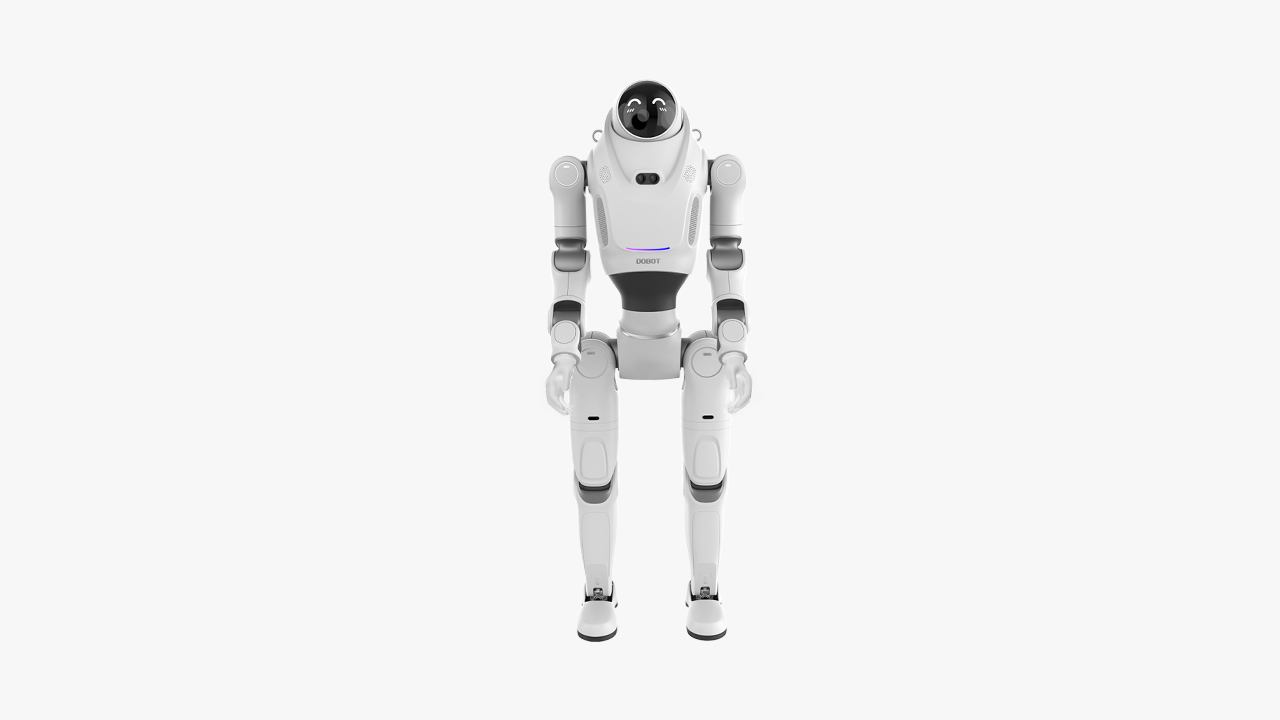
Shenzhen Yuejiang Technology, which trades on the Hong Kong exchange as DOBOT and has ranked as China's top cobot exporter for seven straight years by its own count, took a fourth path. Its core business is desktop and education robotic arms, the same category HD Hyundai, Doosan and Hanwha compete in at industrial scale. At IFA Berlin in September, DOBOT put a robot called LUMO on a runway alongside other exhibitors' humanoids: 1.3 meters tall, walking across grass, sand and cobblestone with an anthropomorphic gait, built for home, education, research and commercial use rather than a single industrial task.
DOBOT skipped the two-year roadmap slide entirely and shipped a positioning statement in the form of a runway demo instead. Whether LUMO is commercially significant is genuinely unproven: no price has been disclosed, and no production or shipping volume has been confirmed. But the strategic posture is categorically different from HD Hyundai's proving-ground humanoid or Doosan's 2028 partnership target. DOBOT built a distinct consumer product line and put it in front of buyers now, while its export cobot business keeps running underneath it unchanged.
The Question a Buyer Should Actually Ask
Four companies facing the same underlying pressure, Chinese cobot price competition and a generative-AI hype cycle that has made "humanoid" the word investors reward, produced four incompatible strategies within months of each other: outsource the hardware and keep the capability, outsource the platform and rent the timeline, decline the category outright, or ship a consumer product ahead of the roadmap. A fifth and sixth posture will likely appear over the next year as more companies get pulled into the same pressure. None of that will make the underlying label any more useful.
The practical fix is a different question than the one most coverage asks. Not "does this company have a humanoid program," which every company in this piece except one can answer yes to in some form. Ask instead what the announcement actually commits the company to, by what date, using whose hardware, and what happens to that commitment if the partner's timeline slips. HD Hyundai's answer is a research subsidy with no shipping date. Doosan's answer is a 2028 target contingent on Nvidia's tools performing as advertised. Hanwha's answer is that the question does not apply. DOBOT's answer is a product on a runway with the price still unannounced.
The next time a robotics company says it is entering humanoid robotics, the useful response is not excitement. It is a follow-up question, and most of the time the honest answer to that question is still being written.
This column reflects the author's own analysis of company statements and public market activity current as of September 28, 2026. It is for general information purposes only and does not constitute investment, financial, or professional advice.
Hero image: DOBOT's LUMO humanoid robot, official product render. Credit: DOBOT (Shenzhen Yuejiang Technology Co., Ltd.).