Cobot vs Robot: What a Cobot Actually Is and Where It Belongs
A cobot is not a safer robot. It is a slower one — and the slowness is the safety mechanism. Since April 2025, ISO 10218-2 has treated collaboration as a property of the application, not the machine. Which means the arm in the brochure is not collaborative until someone risk-assesses the tool on the end of it.

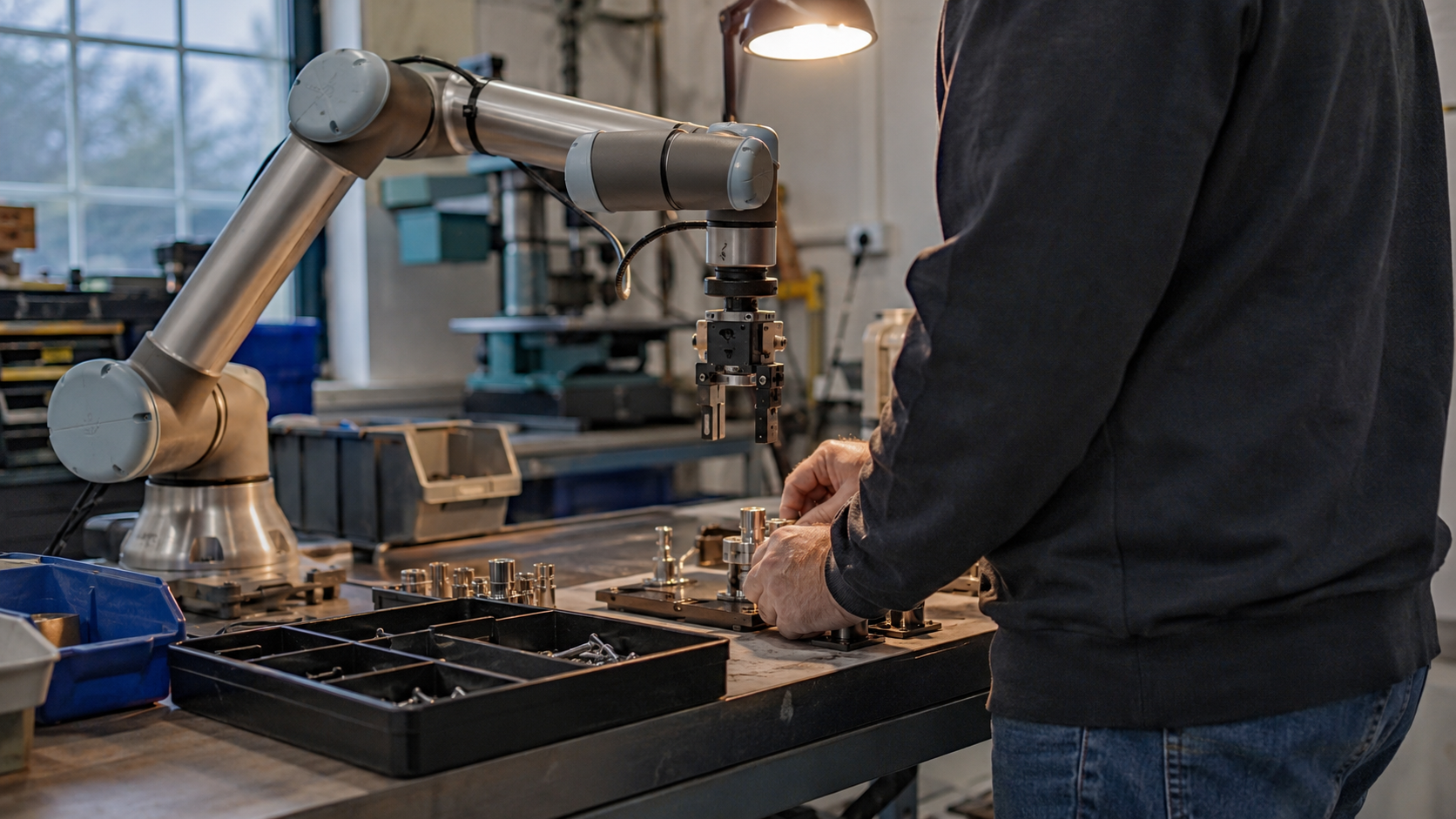
A cobot is not a safer robot. In the cobot vs robot comparison, the cobot is the slower and lighter one, and the slowness is the safety mechanism rather than a limitation the technology will grow out of.
That distinction became legally material on 1 April 2025, when ISO 10218-1:2025 and ISO 10218-2:2025 came into force — the first revision of the core industrial robot safety standard since 2011 — and dissolved ISO/TS 15066:2016 as a standalone document by absorbing its collaborative requirements directly into Part 2. Anyone specifying a fenceless cell in 2026 is working from a different rulebook than the one that governed most cobot installations between 2016 and 2025.
What Is a Cobot?
A cobot is an industrial robot built with force and torque limiting so it can operate near people without fencing. Under ISO 10218-2:2025, collaboration describes the application rather than the machine — a cobot only operates collaboratively when the whole system, including its tool, passes a risk assessment.
A cobot is an industrial robot with joint-level torque sensing and force limiting that allows a person to share its working space. It matters now because the standard governing that arrangement was rewritten in 2025 and most compliance documentation in circulation still cites the superseded framework. For a manufacturer buying a first robot, the practical consequence is that the fenceless promise carries a documented assessment obligation the brochure does not mention.
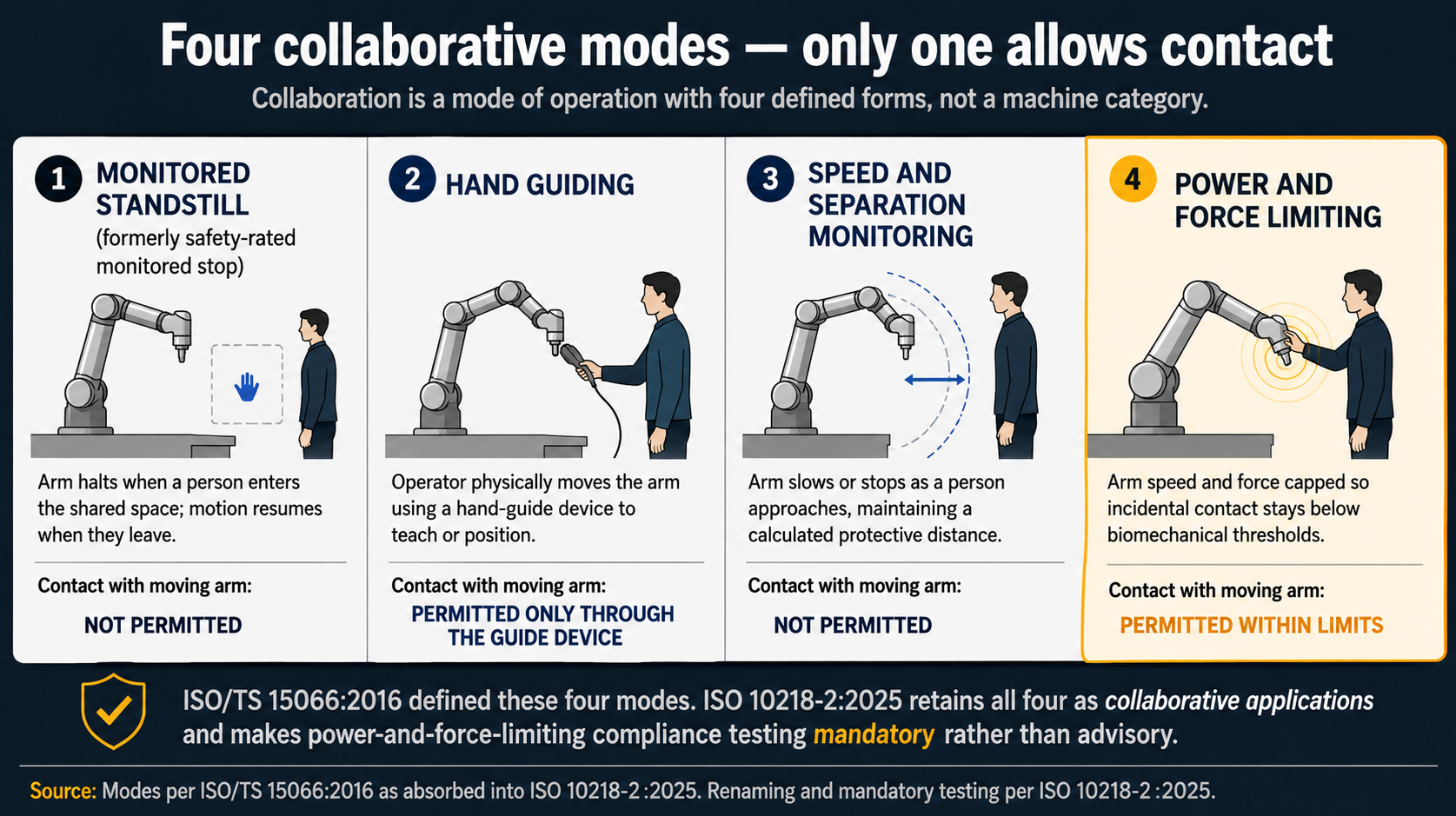
The hardware differences are real. A cobot's controller must know the mass and centre of gravity of both the end-of-arm tool and the expected payload, because it detects contact by comparing expected joint torque against measured joint torque. Rounded edges, pinch-point elimination, and back-drivable joints follow from the same requirement. ISO 10218-2:2025 recognises four collaborative application modes, set out in Figure 1, and only one of them — power and force limiting — permits the moving arm to touch a person at all.
 What Actually Separates a Cobot From an Industrial Robot
Force scales with mass and acceleration. To keep contact below the biomechanical limits — roughly 65 to 160 newtons depending on which part of a person the arm hits, per the thresholds compiled by PLC Programming in June 2026 — a collaborative application has to limit both. The speed cap is not a shortcoming of the technology. It is the technology.
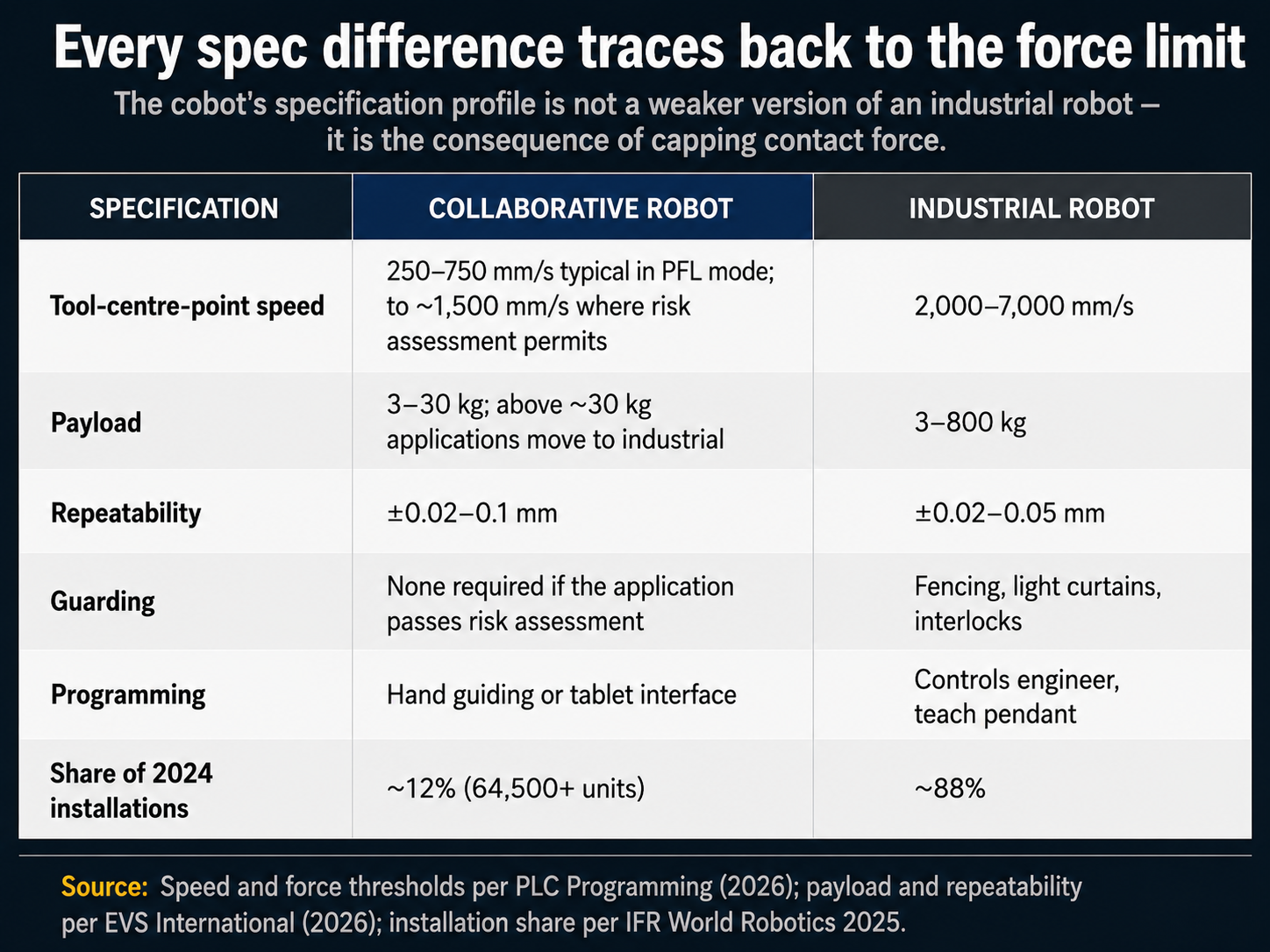
Every other specification difference follows from that constraint. Industrial arms span 3 to 800 kg payload against a cobot ceiling near 30 kg, and the full specification comparison in Figure 2 shows the same pattern repeating across speed, guarding, and deployment time.
 What is the difference between a cobot and a robot?
A cobot is an industrial robot with force and torque limiting that allows it to work near people without safety fencing, at the cost of speed and payload. Industrial robots run tool-centre-point speeds of 2,000–7,000 mm/s and payloads to 800 kg; cobots typically run 250–750 mm/s in collaborative mode with payloads under 30 kg, according to specification guidance compiled by PLC Programming (2026) and EVS International (2026). Since ISO 10218-2:2025 came into force in April 2025, the term "collaborative" formally describes the risk-assessed application rather than the machine itself.
One further consequence deserves stating: permissible speed falls as effective mass rises, and the end-of-arm tooling counts toward that mass. A cobot rated for a given speed with a bare flange runs slower with a gripper attached and slower again with a part in the gripper.
Why the 2025 Standard Moved Collaboration From the Machine to the Application
A car doing 20 mph past a school is not a safe car. It is an ordinary car under a constraint that makes contact survivable, and nobody sells it as a residential vehicle. Robot safety worked the same way all along, and in 2025 the standard caught up with the language.
ISO 10218-2:2025 states in its abstract that most requirements of ISO/TS 15066:2016 on collaborative robot applications were incorporated into Part 2. The framing shift matters more than the relocation. Under the old arrangement, a buyer purchased a "collaborative robot" and assumed safety arrived in the crate. The 2025 edition treats collaboration as a property of the application — the arm, the tool, the workpiece, the speed, and the cell layout assessed as one system. A power-and-force-limited arm holding a knife-edged gripper is not a collaborative application whatever the arm is called.
Two practical obligations follow. Compliance testing for power-and-force-limiting mode is now mandatory within Part 2 rather than advisory guidance from a separate technical specification, which makes it binding for any integrator claiming PFL operation. And Part 2 requires a documented schedule for periodic re-assessment, with programme changes, tool changes, payload changes, and cell layout modifications as the standard triggers, per the standards analysis published by Inmotion Global in April 2026. The United States followed within months: ANSI/A3 R15.06-2025 published across September and October 2025, replacing the 2012 edition that most US compliance documentation still cites.
Collaboration is an application, not a purchase.
What Cobots Are Genuinely Good At
Machine tending is the clearest fit — loading and unloading a CNC machine or injection moulder between cycles, where the robot's speed is irrelevant because the machine's own cycle dominates the station time. Screwdriving, dispensing, light assembly, and quality inspection follow the same logic: the process has its own dwell, and the arm is not the bottleneck.
Palletising at the lighter end works where case weight sits under the payload ceiling and the line rate is modest. Laboratory sample handling and electronics assembly suit cobots because payloads are small and layouts change with product mix.
The pattern across all of them is that the cobot wins where cycle time is not the binding constraint and something else is — floor space, capital, changeover frequency, or the absence of anyone on staff who can programme a teach pendant. The Association for Advancing Automation recorded North American companies purchasing 1,052 collaborative robots worth USD 39.2 million in the first quarter of 2025 alone, and the buyer profile behind that number is overwhelmingly the manufacturer for whom the alternative was not a fenced cell but continued manual work.
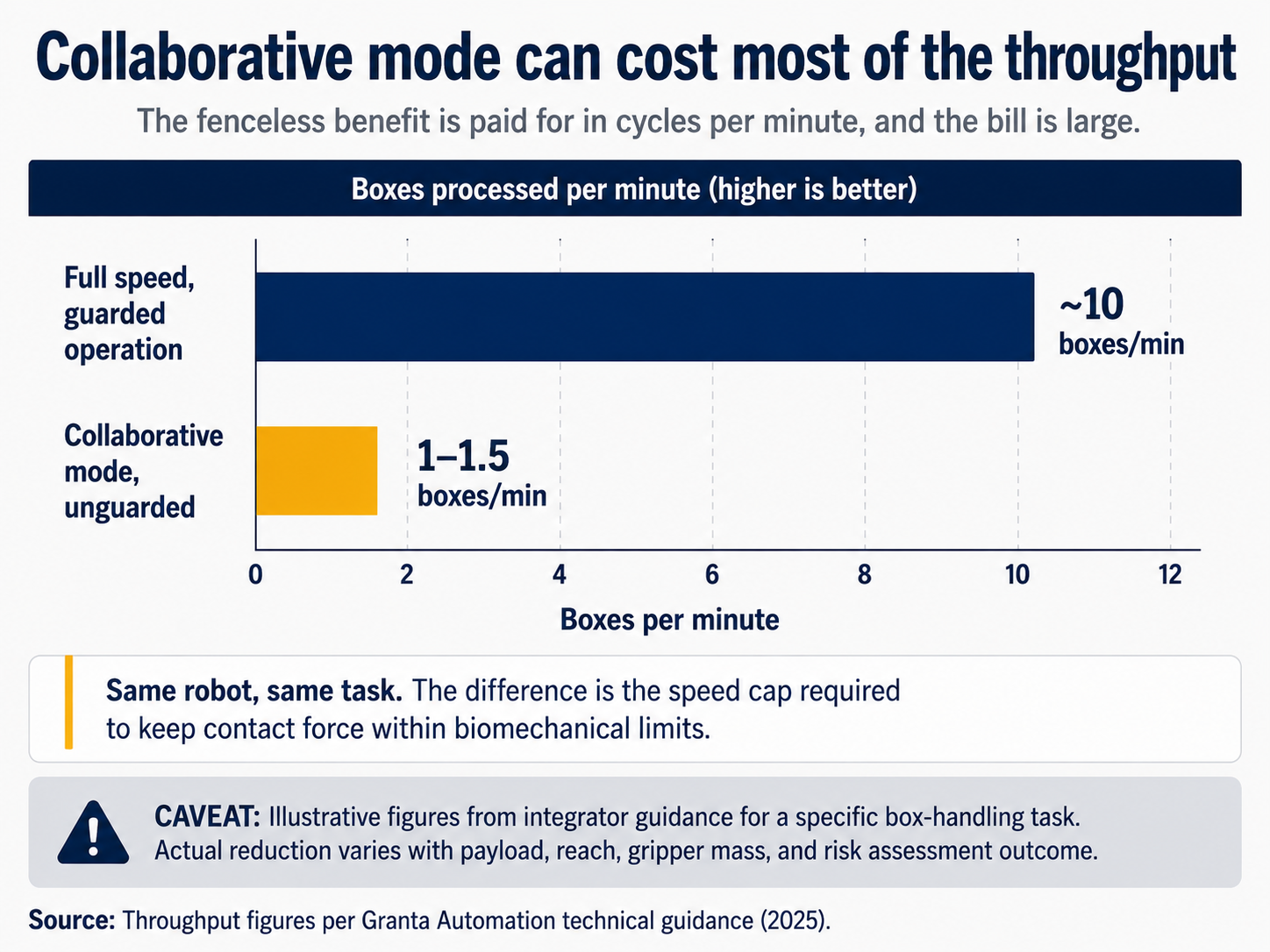
Where cycle time does bind, the arithmetic turns immediately. Granta Automation puts the practical cost at roughly 10 boxes per minute dropping to 1 to 1.5 in collaborative mode, the throughput gap shown in Figure 3.
Where the Speed Ceiling Ends the Argument
The IFR position: cobots complement rather than replace
The International Federation of Robotics stated its position directly in its December 2024 position paper: collaborative robots will complement, not replace, investments in traditional industrial robots, which operate at much faster speeds and remain important for productivity where product margins are tight. Cobots offer quick entry into automation, are programmable by hand guiding or tablet interface, and most often require no additional safety measures on the factory floor.
The unit data supports it. Cobots reached 10.5% of industrial robots installed worldwide in 2023 and exceeded 64,500 units in 2024 at approximately 12% of new installations, growing 13% year on year (IFR, World Robotics 2025). That growth comes disproportionately from buyers who had no automation path at all — no floor space for a guarded cell, no controls engineer, no volume to amortise fixed tooling. For them the comparison is not cobot against industrial robot. It is cobot against nothing.
The cycle-time position: where takt binds, integration simplicity is irrelevant
Integrator guidance puts the counter-case in numbers. A welding cell completing a fixture in 38 seconds will not be replaced by a cobot doing the same fixture in 90 seconds regardless of how much simpler the integration is, per the selection analysis published by PLC Programming in June 2026. Above roughly 30 kg payload, true power-and-force-limited arms do not exist — that range belongs to industrial robots, and the practical route for heavy handling near people is a higher-payload industrial arm running under monitored standstill or speed-and-separation zones.
That last point is the one most often missed. A conventional industrial robot operating under monitored standstill or speed-and-separation monitoring is running a collaborative application under ISO 10218-2:2025 — the machine does not have to be a cobot for the application to be collaborative.
The two positions describe different binding constraints rather than disagreeing about facts. Where the constraint is capital, floor space, or programming skill, the cobot removes it and the throughput penalty costs nothing because the alternative was a person doing it by hand. Where the constraint is takt time, the cobot cannot remove it, and the fenceless advantage buys nothing at all. The costly error is not picking the wrong philosophy — it is buying for the floor-space reason while carrying a takt-time constraint, and discovering the mismatch after the arm is on the bench.
This development reinforces:
- How AI Robots Work: The pillar covering robot mechanism, including why hardware constraints rather than product categories decide what a machine can do.
- Degrees of Freedom in Robotics: What Robot Axes Mean and Whether More Is Better: Most cobots are six-axis arms, and the same specification-versus-capability confusion appears when buyers read axis count as a quality rating.
- AMR vs AGV: The Difference Is Not Intelligence — It Is Who Pays for Change: The same error repeats in mobile robotics, where buyers compare navigation technology when the operative variable is how often the facility changes.
The slowness is not a stage the technology is passing through. Contact force scales with mass and acceleration, and no advance in torque sensing changes that — a faster collaborative arm is a heavier blow. What changed in April 2025 was not the physics but the paperwork: ISO 10218-2:2025 stopped treating collaboration as something a manufacturer can build into a product and started treating it as something an integrator has to demonstrate about a specific cell, with its specific gripper, at its specific speed, on a documented re-assessment schedule. The 64,500 cobots installed in 2024 were sold into a market that mostly still believes safety came in the crate. The ones that will pass an audit in 2027 are the ones whose owner has a risk assessment with the gripper's name on it.
Frequently asked questions
1. What is a cobot?
A cobot is an industrial robot with force and torque limiting that lets it work near people without safety fencing. Its controller compares expected joint torque against measured torque to detect contact, which requires knowing the mass and centre of gravity of both the tool and the payload. Cobots accounted for more than 64,500 units in 2024, roughly 12% of global industrial robot installations, according to IFR World Robotics 2025.
2. What is the difference between a cobot and a robot?
The difference is force limiting, and everything else follows from it. Cobots run 250–750 mm/s in collaborative mode with payloads under about 30 kg; conventional industrial robots run 2,000–7,000 mm/s with payloads to 800 kg but require fencing. Since ISO 10218-2:2025 came into force in April 2025, "collaborative" describes the risk-assessed application rather than the machine.
3. Are cobots safe to work next to without a fence?
Only if the specific application has passed a risk assessment. ISO 10218-2:2025 treats collaboration as a property of the application, so the arm, the tool, the workpiece, the speed, and the layout are assessed together. A force-limited arm fitted with a sharp gripper is not a collaborative application. Compliance testing for power-and-force-limiting mode is mandatory under Part 2 rather than advisory.
4. How fast can a cobot move?
Typically 250 to 750 mm/s in power-and-force-limiting mode, with excursions toward 1,500 mm/s where a risk assessment permits. The cap exists to keep contact force below biomechanical limits of roughly 65 to 160 newtons depending on body region. Permissible speed falls as effective mass rises, so the same arm runs slower once a gripper and payload are attached.
5. What are cobots used for?
Machine tending, screwdriving, dispensing, light assembly, quality inspection, light palletising, and laboratory sample handling. The common thread is that the process has its own dwell time, so the robot's speed is not the bottleneck. Cobots fit best where the binding constraint is floor space, capital, changeover frequency, or programming skill rather than cycle time.
6. Do cobots give a better return on investment than industrial robots?
For low-to-medium volume work with high product mix, often yes — no fencing, faster deployment, and no controls engineer required. For high-volume production where takt time binds, no. Integrator guidance illustrates the gap plainly: a task running at roughly 10 boxes per minute at full guarded speed can drop to 1–1.5 boxes per minute in collaborative mode, per Granta Automation (2025).
7. Does a cobot installation need a risk assessment?
Yes, and ISO 10218-2:2025 also requires a documented schedule for periodic re-assessment. Standard triggers for immediate re-assessment include programme changes, tool changes, payload changes, and cell layout modifications. In the United States, ANSI/A3 R15.06-2025 published in September and October 2025 and replaced the 2012 edition that much existing compliance documentation still references.