Agility Robotics Promised Not to Weaponize Robots. It Never Promised to Stay Out of the War Room.
Agility Robotics' CEO has joined Project Meridian, a MITRE-run Department of War strategy initiative, while the company works through a US$2.5 billion SPAC merger with Churchill Capital Corp XI. Both moves are fully compliant with the 2022 industry pledge against weaponizing robots, because that pledge was written to cover one mechanism only, and says nothing about advisory roles, defense-adjacent revenue, or what a newly public company discloses about either.

In October 2022, Agility Robotics put its name on a written promise. It would not weaponize its robots, would not weaponize the software underneath them, and would not help anyone else do it either. On October 5, 2026, the same company's chief executive signed up for something that 2022 promise never mentioned: a seat at the table where the Pentagon maps out what warfare looks like for the next twenty years.
Peggy Johnson, Agility's CEO since 2024, has joined Project Meridian, a strategic initiative run by the MITRE Corporation and commissioned by the Department of War, as the Pentagon now styles itself. The program gathers industry executives and former government officials to produce recommendations on a 10 to 20 year horizon for emerging military technology and operational concepts. "The future of robotics isn't just about developing new capabilities," Johnson said of the appointment. "It's about putting those capabilities to work where they can make a meaningful difference," a framing the company's own announcement ties directly to logistics and supply-chain work for military personnel. Nobody at Agility has strapped a weapon to Digit. Nobody needed to.
The 2022 pledge was written narrowly enough to survive almost anything the industry would actually go on to do.
A promise with one very specific door locked
Read the actual text, not the headline it generated. Agility, Boston Dynamics, ANYbotics, Clearpath Robotics, Open Robotics and Unitree Robotics wrote that they "will not weaponize" their general-purpose robots "or the software we develop that enables advanced robotics" and would not support others doing so. That is a real commitment, and as far as public record shows, every signatory has kept it. It is also a commitment about one mechanism: attaching lethal hardware to a chassis.
It said nothing about a chief executive personally advising a defense agency on force design. Nothing about selling logistics robots into defense-adjacent supply chains. Nothing about taking capital from investors who expect defense revenue as part of the growth story. The pledge drew a bright line through the single scenario that was always going to generate the worst headlines and the least actual business, and left every other form of defense engagement standing wide open on the other side of it.
A promise that only forbids the one thing nobody in the industry was seriously planning to do anyway is not restraint. It is a liability waiver with good PR.
The timing is the story, not the appointment itself
Advisory seats for robotics executives on defense-strategy panels are not new, and there is a reasonable case that putting people who actually build the hardware in the room produces better policy than leaving it to people who have only seen a robot in a procurement slide deck. Johnson's appointment, on its own, is defensible.
What changes the reading is what else is happening at Agility this quarter. The company is mid-process on a business combination with Churchill Capital Corp XI, a transaction that values Agility at roughly US$2.5 billion pre-money and is expected to deliver more than US$620 million in gross proceeds once it closes, a combination of the SPAC's trust account and a US$200 million common-stock PIPE priced at US$10 a share and led by Foxconn. The deal is still working through SEC review and a shareholder vote, expected to close later this year, which would list Agility on Nasdaq under the ticker AGLT as a pure-play humanoid robotics company.
A company about to take public money, anchored by a PIPE from one of the world's largest electronics manufacturers, now has its sitting CEO personally advising a defense agency on the next two decades of warfare, in her own name, as "an individual consultant" rather than under a corporate contract. That structure may be exactly how MITRE wants to keep its advisors insulated from vendor conflicts. It is also a detail that standard SPAC disclosure language was never built to flag, because the risk it describes, a founder-level conflict of interest tied to future defense policy rather than a disclosed government contract, does not fit cleanly into the boxes that proxy statements usually check.
Humanoid robotics is about to get a pure-play public stock. Its disclosure paperwork was not written for a CEO who also sits on a body shaping future war doctrine.
The whole industry is leaning the same direction
Agility is not an outlier here, it is early. Congress is already writing defense-market protection into law: the House passed Section 163 of the FY2027 National Defense Authorization Act, barring the Pentagon from procuring or operating humanoid robots linked to China, Russia or Iran, a provision that functions as a subsidized lane for American manufacturers even though it leaves the commercial market untouched. Foundation Future Industries, a two-year-old humanoid maker backed in part by Eric Trump, has built its business explicitly around military and industrial buyers, reporting roughly US$100 million in contracted annual recurring revenue and pricing defense units at roughly US$300,000 each. Europe is moving in parallel on the defensive side of the same ledger: the European Commission added EUR130 million, about US$141 million, to its counter-drone border funding on October 5, pushing the total committed through that single instrument past EUR500 million, over US$540 million, in under a year.
None of this requires anyone to break a weapons pledge. That is precisely the point. Defense-adjacent revenue, defense-protected market access and now defense-policy access have all become normal, fundable parts of the humanoid business case, while the only formal restraint the industry has ever written down covers a single mechanism almost nobody was going to use regardless.
It is also worth noticing who never signed anything. Figure AI, Apptronik and most of the venture-backed humanoid makers that have launched since 2022 were not party to the original pledge and have published no comparable commitment of their own. The industry's one written promise on this question predates the current funding and defense-contracting wave by several years, and nobody has been asked to update it since.
What I would actually want disclosed
Running a platform that tracks company and robot data for a living means spending a lot of time in filings, press releases and investor decks looking for the sentence that was left out rather than the one that was included. The sentence missing from Agility's SPAC materials, and from the broader humanoid sector's standard disclosures, is a plain statement of what it means when a founder or CEO holds a personal advisory role inside a national-security planning body while the company they run is raising public capital.
That disclosure gap will not stay empty for long. As more humanoid makers go public over the next two or three years, and as defense budgets keep underwriting a market segment that cannot yet support itself on commercial deployment volume alone, more of these executives will end up in rooms like MITRE's. The pledge the industry wrote in 2022 will keep being technically honored the entire time, precisely because it was never built to reach any of this.
This analysis reflects the author's own reading of public company disclosures, SEC filings and official announcements. It is for general information purposes only and does not constitute investment, legal, or financial advice.
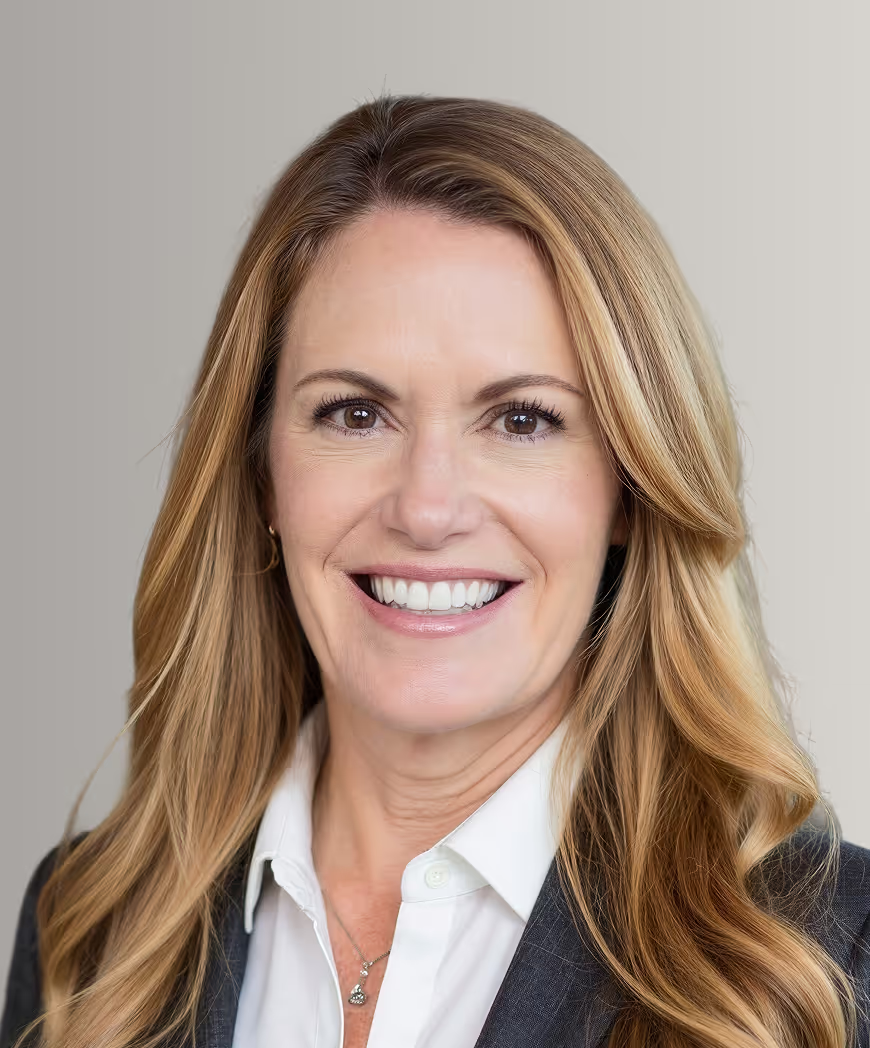
Hero image credit: Agility Robotics, official executive photography of CEO Peggy Johnson.