Robots in the Ukraine War: The Ledger Every Military Fears
Drones are everywhere in Ukraine but they didn’t replace soldiers—they changed how soldiers survive. Drones now cause 80% of all battlefield casualties. Ukraine is killing Russian troops faster than Russia can recruit new ones. Four years in, the data is no longer a prediction — it's a permanent record.

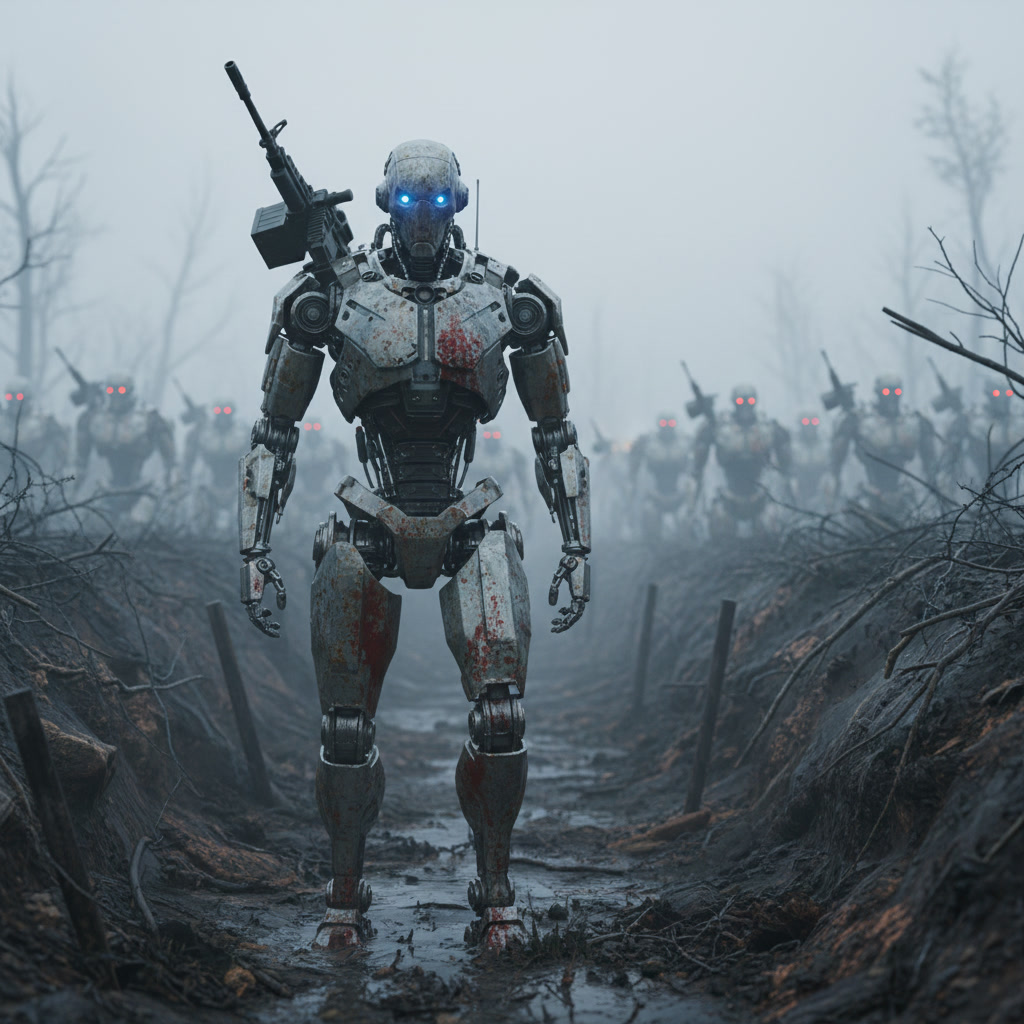
In mid-December 2025, Russia sent a 24-vehicle assault column toward Ukrainian positions near Dobropillia. Tanks. Infantry fighting vehicles. All-terrain carriers. It was the kind of force that, in 2022, would have required a significant defensive response. Not one vehicle made it through. The column drove into drone-seeded minefields, then came under simultaneous fire from FPV drones, bomber drones, mortars, artillery, and rocket systems. No Ukrainian soldier had to stand in an open field to stop it. "We do drones," said Sgt. Maj. Vasyl, a drone operator near Pokrovsk. "We kill with drones. We save with drones. We liberate with drones." Source: Military Times / Defense News, February 2026.
That moment isn't a highlight reel. It is the new operational baseline of robots in the Ukraine war. By the end of 2025, drones were responsible for more than 80% of all enemy targets destroyed — 819,737 video-confirmed hits. Ground robots were running 90% of logistics in the most contested sectors. Ukraine had built the world's first Unmanned Systems Forces as a standalone military branch. The country is now killing Russian troops faster than Russia can recruit replacements. Source: Defense News / Modern War Institute, West Point, February–March 2026 This affects every military budget on earth. It reshapes how governments calculate the cost of starting, sustaining, or losing a conflict. Understanding what actually happened — not the marketing version, not the sci-fi version — is one of the most important strategic briefings of the decade.
In the Ukraine and broader Western context, the war has effectively become the world’s first large-scale “robot war.” Ukraine now has around 500 domestic companies producing drones, with approximately 95% of its combat drones manufactured locally. The scale is striking: Ukraine is producing close to 4 million drones annually, compared to roughly 100,000 in the United States. This gap has drawn close attention from the US, which is actively studying the conflict to update its military doctrine.
The deployment of ground robotics has also accelerated rapidly. Around 15,000 unmanned ground vehicles (UGVs) were delivered to the frontline in 2025, up sharply from 2,000 in 2024. Drone strikes have become so frequent that, since late 2025, they are reportedly outpacing Russia’s ability to recruit new troops. Ukraine’s targeting rate is estimated at 50,000 to 60,000 Russian troops struck per month heading into 2026. (Source: Modern War Institute, West Point; Hudson Institute, Feb–Mar 2026).
In China, the approach is different. The country is not engaged in an active conflict of this scale, but it is preparing at industrial levels. China supplies around 90% of the global commercial drone market, and both Russia and Ukraine rely heavily on Chinese components. At the same time, the People’s Liberation Army (PLA) is integrating AI systems, including DeepSeek, into drone swarms, robotic dogs, and autonomous ground vehicles.
China is also experimenting with swarm behavior inspired by nature, training systems based on predator dynamics such as hawks and wolves. The scale of its industrial base is significant: China installs approximately 300,000 factory robots annually, compared to about 34,000 in the United States. Globally, the military robotics market is projected to reach around $49 billion by 2032–2033. The PLA’s Swarm I and Swarm II systems are designed to launch hundreds of drones under a single autonomous mission objective. (Source: BGR; Wall Street Journal; CSET Georgetown; CNA, Jan–Feb 2026).
In Europe and NATO countries, progress has been slower but is now accelerating. In February 2026, five nations—France, Poland, Germany, the United Kingdom, and Italy—launched the LEAP joint autonomous drone program, incorporating lessons learned from Ukraine’s battlefield experience. Germany alone allocated €200 million in March 2026 for medium-range drones to support Ukraine.
Investment in European defense technology has surged, growing from €200 million in 2021 to €2.6 billion in 2025. The military robotics market in Europe is projected to expand from €6.6 billion in 2024 to €17.6 billion by 2033, representing an annual growth rate of 11.5%. Companies like ARX Robotics in Munich are updating their battlefield software for Ukraine every two to three weeks, reflecting how fast deployment realities are shaping development cycles. (Source: McKinsey; MarketDataForecast; PBS NewsHour, 2025–2026).
Ukraine has battle data that no lab can simulate. China has the manufacturing infrastructure to produce at a scale no other country can yet match. Europe has the money — and is now spending it, fast, after four years of watching how badly being behind this curve costs you. The ARX Robotics CEO said it without qualification after visiting Ukraine: "The armies of Western democracies are not prepared for robotic warfare." Source: Fortune / ARX Robotics, 2025 That's not pessimism. It is a consensus view among NATO defense planners who have studied the results.
What Does "Military Robotics" Actually Mean on a Real Battlefield?
One sentence: robots in the Ukraine war don't replace soldiers — they replace the assignments that were killing soldiers without changing the outcome of a fight.
Think about how a chess grandmaster plays end game. They don't protect every piece at equal cost. They sacrifice bishops and rooks to hold key squares if that's what the position demands. A queen that walks into a forced exchange to preserve a pawn structure is not a mistake — it is a decision about what matters. Ukraine's commanders made the same calculation: a $400 FPV drone that dies destroying a $3 million tank is not a loss. It is one of the best trades in the history of warfare. Ukrainian drone operators are not flying valuable assets into danger. They are flying expendable ones into the most dangerous jobs — supply runs under surveillance, minefield reconnaissance, casualty evacuation through kill zones — and keeping the irreplaceable parts of their force (judgment, command, terrain control) away from the situations most likely to end them.
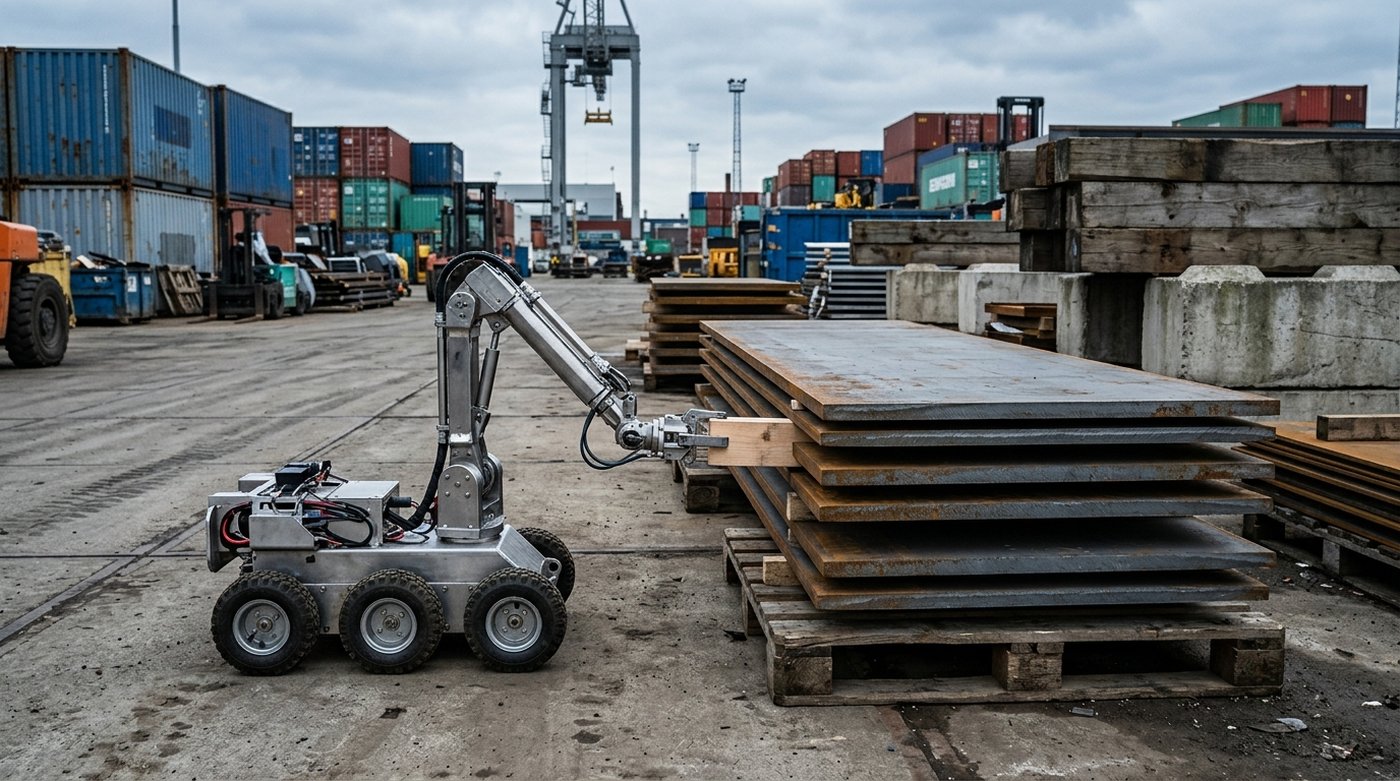
In the 3rd Assault Brigade, UGVs now conduct 80% of all logistics operations along the line of contact — carrying loads up to 450 pounds per mission across routes no vehicle or soldier can safely cover under drone surveillance. Source: Modern War Institute, West Point, March 2026
How Warfare Changed in Four Years: A Timeline That Can't Be Undone
Era One: The War That Was Supposed to Happen (2022)
Russia's February 2022 invasion was designed for a different century. Massed armored columns. Air supremacy to neutralize ground defenses. A rapid decapitation strike on Kyiv to produce political collapse inside 96 hours. It was a war plan built on the assumption that industrial-era military hardware — tanks, artillery, fixed-wing aircraft — would still dominate a 21st century battlefield if deployed in sufficient numbers. Russia had the most tanks in Europe. It had cruise missiles, glide bombs, and a 3-to-1 manpower advantage. On paper, it should have worked.
- Russia's initial assault on Kyiv failed within days, repelled by Ukrainian territorial defenses using man-portable anti-tank weapons — many bought on the commercial market and delivered by civilian logistics networks. Source: Institute for the Study of War, 2022
- The war settled into a grinding attritional contest along a 1,000+ km front line — the kind of war where manpower depth, supply chain endurance, and the ability to absorb casualties become the decisive factors.
- Ukraine, with a population of 44 million against Russia's 144 million, could not win that version of the war. It needed to change the version.
Era Two: The Machine That Broke the Math (2023–2024)
The shift didn't come from a single breakthrough. It came from thousands of small ones, running simultaneously, at a speed that no traditional procurement process could have produced. Ukrainian brigades began embedding engineering workshops directly inside their drone units. A jamming frequency that worked on Monday was countered by Thursday. Commercial FPV racing drones were fitted with explosive payloads. Off-the-shelf thermal cameras replaced expensive military-grade sensors. Drone operators evolved from support personnel into a primary combat arm — and then into a standalone military branch. By 2024, according to Ukrainian and Western officials, drones were already responsible for 69% of strikes on Russian troops and 75% of strikes on Russian vehicles. Source: Defense News / Reuters, 2024
- Russia adapted — scaling its own FPV production, deploying fiber-optic guided drones that can't be jammed, and flooding the front with loitering munitions at a rate of at least 100 per day into Ukraine. Source: National Security News, April 2025
- Ukraine answered by pushing drone ranges from 20 km to hundreds of kilometers — striking Russian oil refineries, ammunition depots, and military infrastructure deep inside Russian territory. By October 2025, drone strikes had forced nearly 40% of Russia's oil refining capacity offline. Source: Russia Matters / CSIS, January 2026
- China's role became a structural fact of the conflict: 88.9% of Ukraine's drone component parts came from China despite Beijing's ban on Western drone sales, and Russia purchased the majority of its attack drones wholesale from Chinese manufacturers. Source: BGR / DefenseScoop, February 2026
Era Three: The Doctrine That Replaced Infantry (2025–Present)
By 2025, "robots and drones go into battle first" had shifted from a slogan to the operating doctrine of the Ukrainian Armed Forces. Ukraine stood up its Unmanned Systems Forces as a dedicated military branch — the first of its kind in the world. Frontline brigades restructured around unmanned systems battalions. The 3rd Assault Brigade deployed UGVs to hold a fighting position for over a month under repeated Russian attacks — sustained by 48-hour maintenance cycles, no rotation, no sleep, no fear. Ground robots carried out 15,000 missions in the Donetsk region in 2025, up sevenfold from 2024. Source: Kyiv Post / Modern War Institute, January–March 2026
- Ukrainian drone commander Maj. Robert Brovdi confirmed 33,019 Russian personnel struck by drone in December 2025 alone — a 26% increase from November. The Unmanned Systems Forces set a target of 50,000–60,000 Russian troops struck per month in 2026. Source: Kyiv Post, January 2026
- Ukraine's Maul UGV retrieved a wounded soldier from 64 km inside Russian-held territory, driving back under repeated drone strikes and surviving at least one mine blast. Source: Modern War Institute, West Point, March 2026
- Ukraine started mass production of Rubaka kamikaze drones with a 500 km range, using an inertial guidance system designed to defeat GPS jamming. Source: Euromaidan Press, February 2026
Ukraine is no longer supplementing its infantry with technology. In many cases, it has replaced the infantry itself — with drones, ground robots, sensor networks, minefields, and artillery cued by unmanned systems. — Defense News / Military Times, February 2026
Two Real Fears — And Why the Hard Numbers Override Both
Fear One: No Rules, No Accountability
Autonomous drones in Ukraine are already making targeting decisions without a human in the loop — when Russian jamming cuts the control link, AI-enabled systems identify and engage independently. The UN's 2026 deadline for a binding treaty on autonomous weapons passed with no agreement. Nobody has defined what accountability looks like when a machine kills a civilian. Source: OHCHR / UN, 2025–2026
Fear Two: Robots Make War Easier to Start
When soldiers don't die, democratic governments face less public pressure to end a war. The political cost of initiating conflict drops when the casualties are made of steel. Autonomous systems researchers and military ethicists have raised this directly as a structural danger — not a hypothetical one. It changes the calculus of escalation in every future crisis. Source: Hudson Institute / Time, 2025–2026
Both fears are real and deserve serious governance responses. Neither changes the structural momentum — because the casualty math forces every military's hand whether or not the ethics are resolved.
The casualty math is the SME counter that changes the conversation. Russia has suffered approximately 1.28 million total casualties since February 2022 — including an estimated 240,000–325,000 killed in action, the largest battlefield death toll since the Second World War. Source: CSIS / Ukrinform, January–March 2026 Russian government compensation for a killed soldier is 15 million rubles. In December 2025 alone — when Ukrainian drones struck 35,000 Russian troops — Moscow's compensation liability exceeded 500 billion rubles for that single month. Source: United24 Media, January 2026 Russia will need at least five years to reconstitute the personnel and equipment losses it has already sustained. And Ukraine's drone forces are killing Russian troops faster than Russia can recruit new ones — Mediazona's verifiable data shows confirmed Russian KIAs in 2025 increased 40% over 2024. Source: Mediazona / Kyiv Post, January 2026.
For any government making a defense investment decision, this math is decisive. A military that ignores robot warfare doesn't save the cost of building robots. It pays that cost in soldiers. The choice isn't between spending money and spending nothing. It's between spending it on machines before the war starts, or spending it on funerals and five-year reconstitution programs after.
On the civilian harm question — the UN's own data shows that short-range FPV drones were the deadliest weapon for civilians in Ukraine in January 2025, killing 38 and injuring 223 in a single month. Source: OHCHR HRMMU, February 2025 That is not a reason to abandon autonomous systems — it is the strongest possible argument for governance frameworks that don't yet exist. The technology is four years ahead of the legal structures built to manage it, and that gap is widening every month.
This development reinforces:
What Is Physical AI? When Intelligence Gains a Body : Robots act in the real world where mistakes have real consequences.
AI Robotics in the Real World — Where Robots Are Actually Used : Robots succeed first in high-risk, high-pressure environments.
War, Geopolitics & Power — When Speed Becomes a Weapon : Faster sensing and response changes how conflicts unfold.
The robot didn't change who wins a war. It changed what a country has to be willing to spend — in steel, not blood — before the first shot is fired.
1. How effective are robots in the Ukraine war?
Highly effective in their defined roles. By the end of 2025, drones had destroyed more than 80% of all Russian targets, with 819,737 video-confirmed hits. Ground robots reduced personnel casualties by up to 30% in frontline units, now handle 80–90% of logistics in contested areas, and have carried out over 15,000 missions in Donetsk alone. Robots don't replace soldiers — they replace the assignments that were killing soldiers fastest. Source: Modern War Institute, West Point / Defense News, February–March 2026.
2. How does Ukraine's robot war differ from Russia's approach?
Ukraine adapts fast and precisely. Russia relies on volume and attrition — launching at least 100 one-way drones into Ukraine daily and deploying loitering munitions against infrastructure to exhaust civilian resilience. Ukraine launched 819,737 verified precision strikes in 2025. Russia has sustained 1.28 million total casualties, including 240,000–325,000 killed — the largest combat death toll since World War II. Source: CSIS / Ukrinform, January–March 2026.
3. How is China preparing for the next robot war?
At industrial scale and speed. China installs 300,000 factory robots a year (the US installs 34,000), supplies roughly 90% of the global commercial drone market, and is integrating DeepSeek AI into autonomous military vehicles, drone swarms, and robot dogs. Its Swarm I and Swarm II systems can launch hundreds of drones under a single autonomous objective and are specifically designed to keep operating when communications are jammed. Source: BGR / Wall Street Journal / CSET Georgetown, January–February 2026.
4. Are autonomous robots making kill decisions without human approval in Ukraine?
In some cases, yes — by operational necessity. When Russian electronic jamming cuts the control link, certain Ukrainian AI-enabled drones identify and engage targets autonomously. The "human in the loop" principle — the legal foundation of current international autonomous weapons policy — has been bypassed in live combat. The UN's 2026 deadline for a binding treaty on autonomous weapons passed without agreement. Source: OHCHR / Hudson Institute, 2025–2026.
5. What does the Ukraine war prove about the future of military robotics globally?
Three things that can't be walked back. First: drones have replaced artillery as the primary killer on a modern battlefield — drone-inflicted casualties surged from under 10% to 80% over four years, rewriting ground warfare. Second: the cost of ignoring robots is paid in soldiers, not savings. Third: the country that can produce the most expendable, adaptable, networked autonomous systems faster than its adversary is the country that controls the tempo of any future conflict. The future isn't robots vs. humans. It's humans who use robots vs. humans who don't. Source: Defense News / Euromaidan Press / Modern War Institute, 2026.