Inside Gongsheng Zhixing's Bet on a Unified Robot Brain
Beijing startup Gongsheng Zhixing argues that unified, end-to-end AI models outperform the industry's layered reasoning-and-control architecture, a claim it demonstrated by having a humanoid robot drive a go-kart around a closed track.

Betting Against the Layered Brain
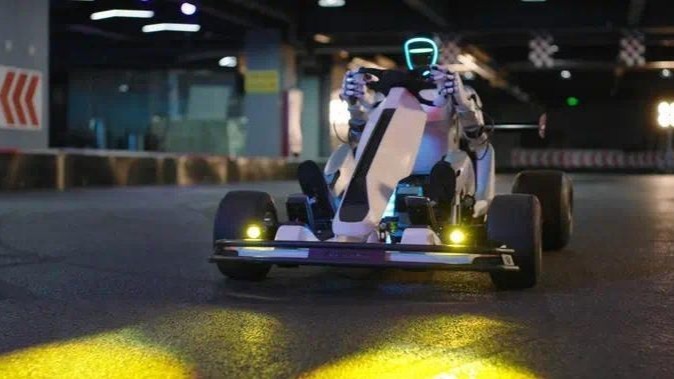
The dominant approach to humanoid robot intelligence right now stacks a large language model for reasoning on top of a separate, faster control system for movement, two models talking to each other across a latency gap that shows up as a half-second hesitation before a robot reacts to anything unexpected. A small Beijing startup called Gongsheng Zhixing is betting that architecture is a detour, not a destination, and it picked an unusually public way to make the case: releasing its official website and its first technology demonstration on the same day in August, with a biped humanoid gripping a steering wheel and driving a go-kart around a closed indoor track.
Gongsheng Zhixing, whose name translates roughly as symbiotic cognition and action, is an embodied-intelligence startup founded by Ding Pengxiang, a researcher born in 1996 whose team spans former staff and graduates from the Beijing Academy of Artificial Intelligence, the Hong Kong University of Science and Technology, Xiaomi, Alibaba's DAMO Academy, Ant Group, and Tsinghua University. The company's core claim is architectural rather than commercial: that a single end-to-end model, one that reasons about a task and outputs joint-level motor commands directly, without handing off between a slow planning layer and a fast control layer, produces faster and more coherent whole-body movement than the layered systems most of the industry, including several well-funded Western labs, has converged on.
What the Go-Kart Demo Was Actually Testing
The demonstration itself, published August 17 and covered widely across Chinese tech media over the following days, ran on a Unitree-built humanoid platform, since Gongsheng Zhixing builds the model rather than the robot body it runs on. The robot entered a go-kart's driver's seat, gripped the steering wheel with both hands, positioned its feet in the pedal well, and completed laps on a closed track, controlling throttle with its right foot and executing quick steering corrections ahead of turns. The company was explicit in its own framing that the go-kart itself is not a product ambition: as Gongsheng Zhixing put it, the exercise is a whole-body intelligence stress test, not a preview of a driving robot business.
That framing matters because a go-kart forces several capabilities to work in tight coordination that most robot demonstrations test separately. Steering requires continuous visual tracking of the track ahead; throttle control requires proprioceptive feedback from a foot that cannot see the pedal it is pressing; and the two have to stay synchronized at a speed where a half-second processing delay would mean missing a turn entirely. Gongsheng Zhixing's pitch is that its model handled hand-eye-foot coordination, visual timing, and precise throttle modulation as a single continuous inference process, combining what the company calls driving semantics with the raw motor output, rather than as three separate subsystems voting on an action.
The Technical Bet, Explained Plainly
Most humanoid control stacks today use some version of a hierarchical design: a vision-language model interprets a scene and issues a high-level instruction, such as pick up the cup, and a separate, much faster low-level policy translates that instruction into the joint torques needed to actually move an arm. The split exists for a practical reason. Large reasoning models are too slow to run at the update rates a moving robot needs, often more than one hundred times per second, so the industry has generally accepted the latency cost of a two-tier system in exchange for using more capable reasoning models at the top.
Gongsheng Zhixing's team argues that split introduces a translation loss: the low-level policy has to guess at intent the high-level model never fully specified, and the two systems are typically trained on different datasets with different objectives, which shows up as stiff, less naturalistic movement, particularly in tasks requiring continuous, fast full-body coordination rather than a single discrete manipulation. A hierarchical system asked to catch a falling object, for instance, has to wait for the reasoning layer to classify the object and issue an instruction before the control layer can even begin computing a reach trajectory, a sequential delay that a unified model is designed to collapse into a single inference pass.
Its alternative, described as combining task behavior modeling with motion prior distillation, trains a unified model to output joint-level commands directly from the same representation used for scene understanding, at the cost of a much larger and more expensive training problem. The company says its current Motion Expert models run to roughly one billion parameters, trained on more than ten thousand hours of motion data, figures that place it well below the scale of foundation-model efforts from better-capitalized rivals but large enough to support a real-time demonstration rather than an offline research result. Motion prior distillation, in the company's own description, means the model is trained to compress a large library of previously captured human and robot movement into a set of reusable motion primitives, which the unified model then draws on and recombines on the fly rather than generating every joint trajectory from first principles at inference time, a design choice that trades some training-time complexity for lower latency once the robot is actually operating.
Credibility Without Commercial Track Record
Gongsheng Zhixing has no announced funding round, no disclosed revenue, and, as of this week, a website that is only days old, which makes its actual claims difficult to verify independently and means procurement teams have nothing yet to evaluate beyond a single video and the company's own technical framing. What it does have is a specific, checkable research credential: Ding Pengxiang was a contributor to ReconVLA, a vision-language-action research project that won an outstanding paper award at AAAI 2026, one of the most competitive artificial intelligence conferences globally, and the broader team says it has published more than forty papers at top-tier venues with multiple best-paper recognitions between them.
That is a meaningfully different credibility signal than most early-stage humanoid startups offer at launch. A trade-show demo backed by a large funding round proves access to capital and hardware; a team with a recent best-paper award at a leading AI conference proves the underlying research claims are at least being taken seriously by peer reviewers who have every incentive to reject weak methodology. It does not prove the approach scales past a go-kart track, and the company itself has been careful not to claim that it does, positioning the driving demo explicitly as the first of a planned sequence of public tests rather than a finished product.
Where This Fits in China's Crowded Embodied-AI Field
Gongsheng Zhixing's public positioning includes a pointed rejection of what its founders describe as a Silicon Valley follower posture, the pattern among some Chinese labs of adapting a Western foundation-model architecture rather than building a distinct technical approach. Whether that framing is accurate about the rest of the field or simply useful marketing for a team without capital to compete on scale is not something outside observers can settle from a single demo, but it does signal how the company intends to differentiate itself in a market where dozens of well-funded competitors are chasing similar embodied-AI milestones with far larger training budgets and hardware fleets.
The company is also making a specific bet about what buyers will eventually pay for. If the industry's current two-tier architecture proves to be a genuine ceiling on how naturally a humanoid can move, the value accrues to whoever solves the unified-model problem first, regardless of how many robots they have shipped in the meantime. If the ceiling turns out to be hardware, battery density, actuator precision, sensor latency, rather than model architecture, a small research-driven team betting entirely on the software layer could find itself out-resourced by competitors who spent the same period improving the machine rather than the brain driving it.
What to Watch Next
For a market that has grown accustomed to funding announcements as the primary signal of a startup's seriousness, Gongsheng Zhixing is testing a different sequence: publish a credible technical claim first, demonstrate it in public, and let capital follow evidence rather than the reverse. The near-term signals worth tracking are whether the company announces a funding round in the months after this debut, whether it publishes benchmark comparisons against established VLA baselines rather than relying on demo footage alone, and whether its next public test moves beyond a closed go-kart track into a task with commercial application, a warehouse pick sequence or a mobility task with actual customer demand behind it.
Until then, the go-kart video remains what the company itself called it: a stress test of an idea, not proof that the idea has won. Whether a team of PhD researchers betting on unified architecture over layered convenience can out-execute rivals with a hundred times their funding is the question the field will be watching this founder answer next.
There is a broader lesson here for anyone tracking China's embodied-AI sector from the outside, where funding announcements and unit-shipment figures tend to dominate coverage because they are the easiest numbers to report. Research credibility is a slower, less headline-friendly signal, but it has historically been a reasonable predictor of which small teams eventually attract the capital and hiring pipeline to compete with better-funded incumbents, precisely because investors evaluating a pre-revenue robotics startup have almost nothing else concrete to underwrite a bet on beyond the technical judgment of the people building it. A best-paper award at a top-tier AI conference will not move a single unit off a factory floor, but it does tell a sophisticated investor that the underlying methodology survived scrutiny from reviewers with no commercial stake in the outcome, which is a different and arguably harder test than convincing a trade-show audience.
Disclaimer: This article is for general information purposes only and does not constitute investment, legal, or procurement advice. Readers should verify details with primary sources before making business decisions.