Types of Exoskeletons, What They Do, and Why Adoption Keeps Stalling
The industry says the blockers are battery life and weight. A peer-reviewed study of occupational exoskeletons found setup takes 39 to 110 steps and up to 25 minutes, failing nearly half the time. Passive exoskeletons have no battery at all. They have not reached mass adoption either. The power source is not the constraint.

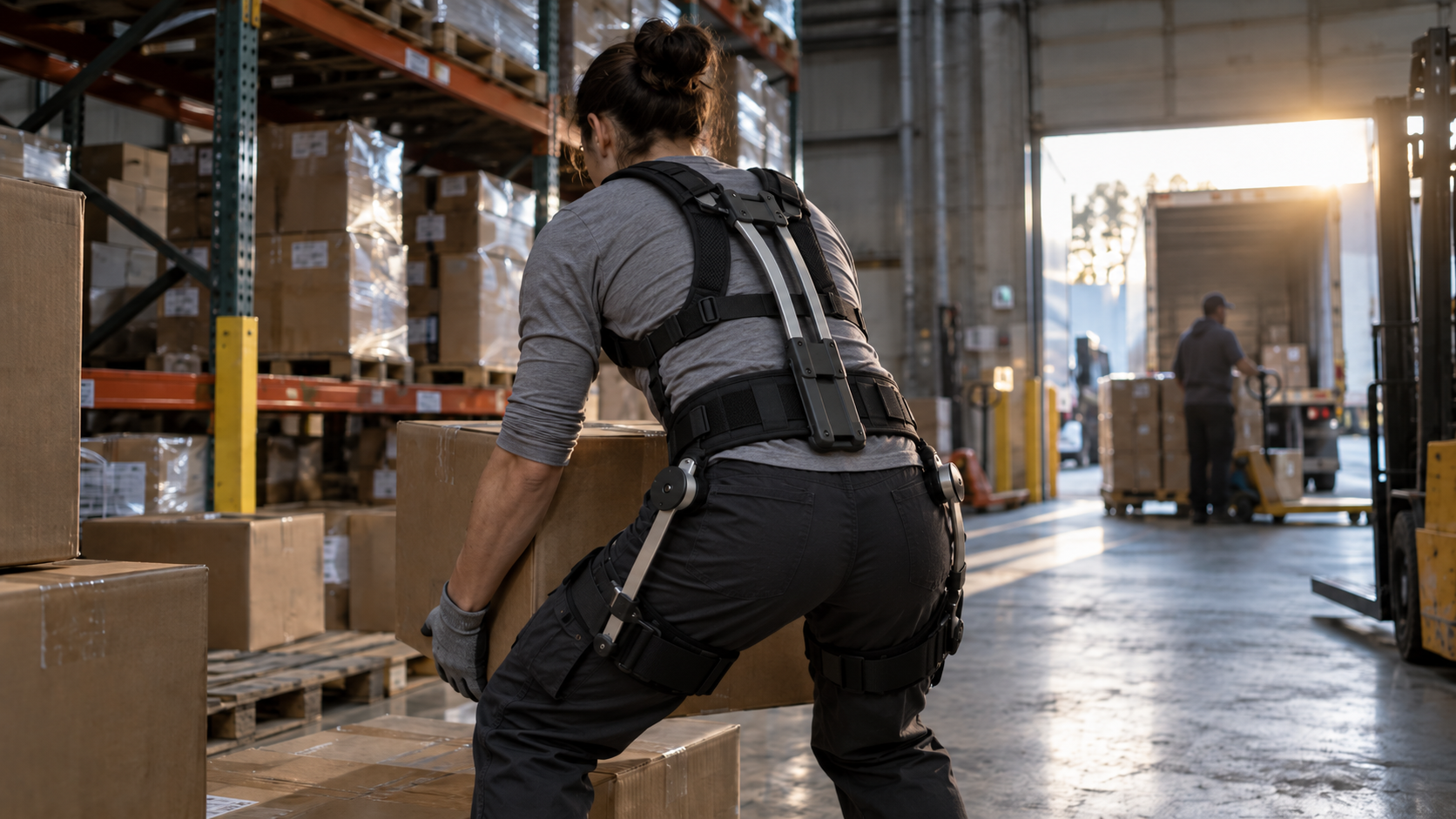
Putting one on can take 110 steps. In April 2026, engineers at the University of Texas at El Paso published a study in PLOS One measuring what it actually takes to deploy an occupational exoskeleton — 39 to 110 procedural steps, 6.5 to 25 minutes to complete, and failure rates reaching 49%.
The industry conversation is about batteries and weight. Those are real constraints and they are getting better. They are also not the ones deciding whether a device is still being worn in month six — and the market has already run the experiment that proves it.
What Is an Exoskeleton?
An exoskeleton is a wearable frame that transfers load off the body during physical work. Passive designs use springs and elastic elements with no power source; powered designs use motors and batteries. Powered systems hold most of the market by value, while passive systems dominate industrial ergonomic deployments.
An exoskeleton is a structure worn on the body that redirects mechanical load away from muscles and joints and into the frame. It matters now because more than 80 companies worldwide are working in the category, per ASTM International, and buyers have no certification mark to compare them against. For an operations lead, the practical consequence is that every claim on a datasheet is the manufacturer's own.
The category divides on one question before any other: whether the device adds energy to the wearer's movement or only redistributes what is already there.
The Four Classes Actually on the Market
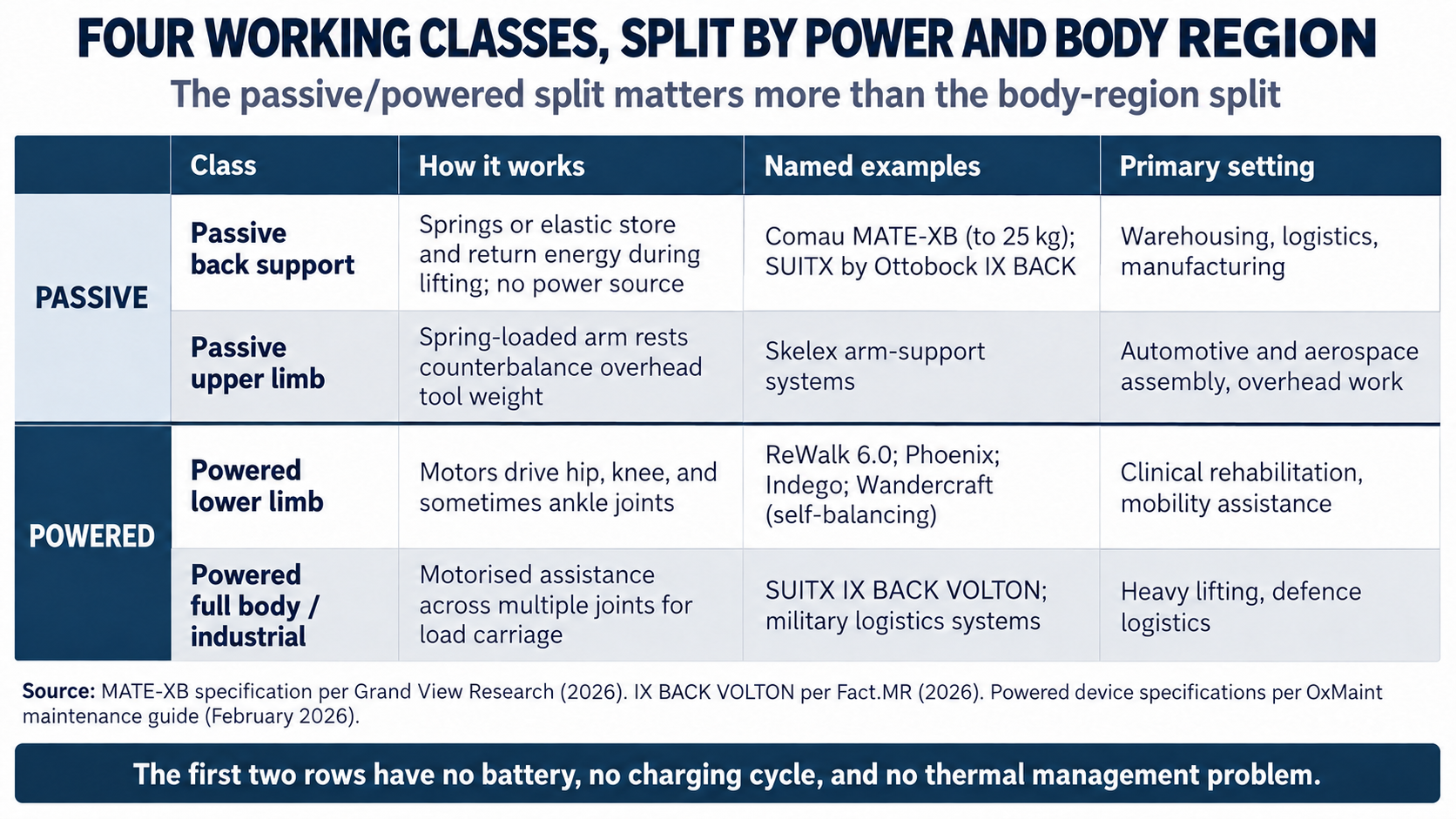
Passive devices store energy from the wearer's own motion in springs or elastic elements and release it where it helps. They add no force the body did not generate. Comau's MATE-XB carries up to 25 kg with no power source at all, and the four working classes in Figure 1 set out where that design sits against the powered alternatives.
 What is the difference between a passive and a powered exoskeleton?
A passive exoskeleton uses springs, elastic bands, or counterweights to redistribute load and has no battery, motor, or electronics. A powered exoskeleton uses motors and sensors to actively add torque, requiring a battery — the Phoenix runs about four hours at 1.1 mph and the ReWalk 6.0 up to eight hours per charge, per manufacturer specifications compiled by OxMaint (February 2026). Passive units cost less and dominate industrial ergonomic deployments; powered units can exceed human capacity and dominate medical rehabilitation.
Market share figures for the split disagree substantially — Fortune Business Insights puts powered at 86.36% in 2026, Fact.MR at around 60% — because each measures a different base. Both point the same direction: powered leads by value, passive leads industrial unit deployment.
What Each Sector Actually Deploys
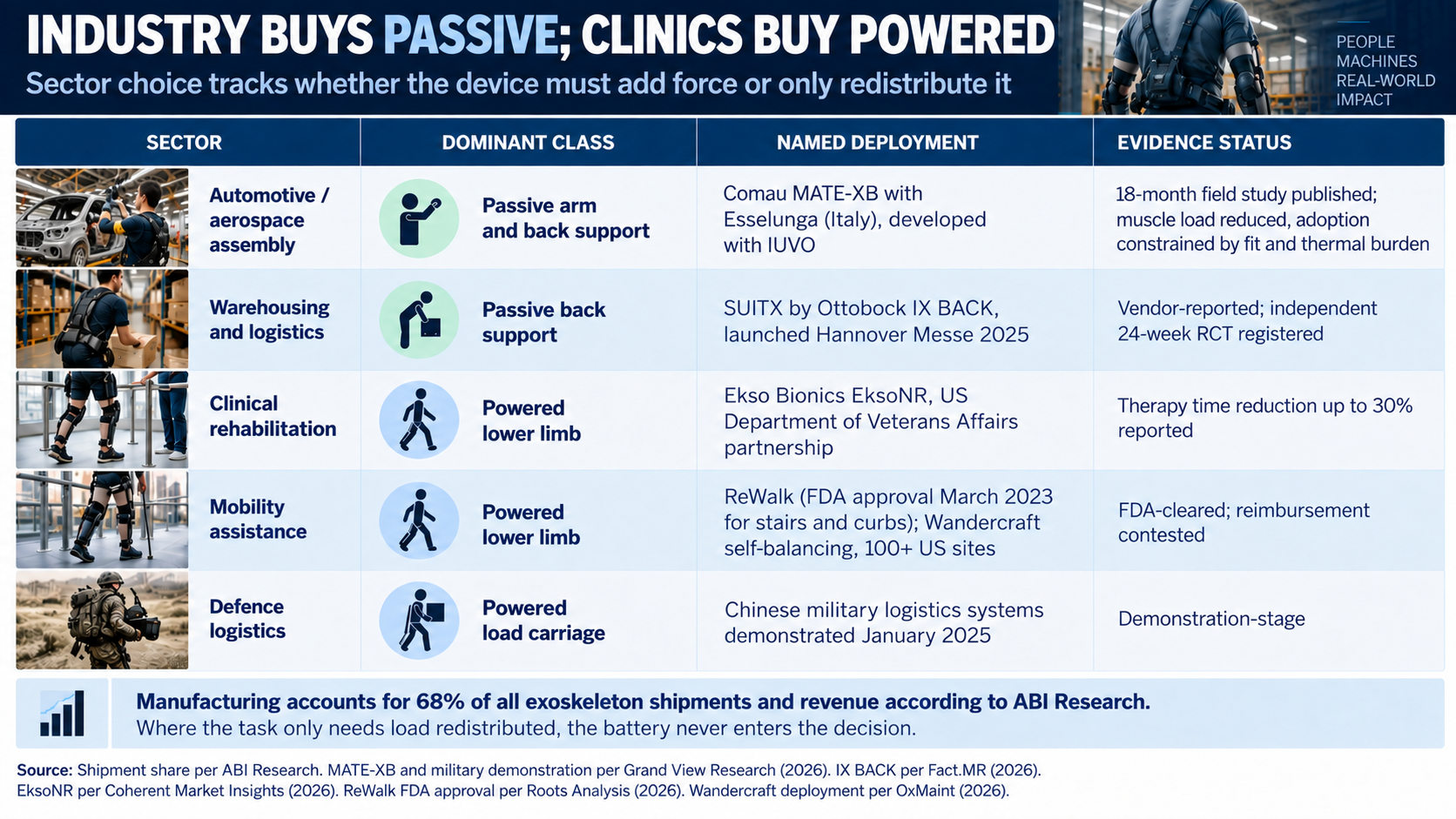
Manufacturing accounts for 68% of all exoskeleton shipments and revenue according to ABI Research, and the sector-by-sector split in Figure 2 shows which class each one actually buys.
The Barriers Everyone Names
Battery life is the barrier most often cited, and the four-hour figure that circulates has a source. The Phoenix delivers approximately four hours at an average walking speed of 1.1 mph, per manufacturer specifications compiled by OxMaint (February 2026). The ReWalk 6.0 reaches up to eight hours on the same basis. Four hours is the lower bound of the powered range, not the category norm.
The less-discussed battery problem is degradation rather than runtime. Lithium-ion capacity typically falls around 20% within 12 to 18 months of daily use, per the same source — meaning a device specified at four hours delivers closer to three by its second year, and the maintenance schedule rather than the datasheet governs what a clinic actually gets.
Weight, comfort and cost are equally real. The October 2025 systematic scoping review covering 49 papers found adoption constrained by discomfort and fit challenges, thermal burden, and limited usability in dynamic settings. On cost, most insurers classify medical exoskeletons as experimental or luxury devices rather than essential medical equipment, per Fortune Business Insights (2026) — which is a reimbursement classification problem rather than a price problem, and no engineering advance fixes it.
Each of these is being worked on, and each is improving. None of them explains the passive segment.
The Barriers Almost Nobody Measures
Hard hats did not spread because hard hats got better. They spread when certification and employer liability made not wearing one expensive. Exoskeletons are being sold as robots and adopted as PPE, and the PPE playbook has not been run.
Passive exoskeletons have no battery, no charging cycle, and no thermal management problem. Comau's MATE-XB supports up to 25 kg with no power source at all. If battery capacity were the binding constraint on adoption, the passive segment would already be everywhere. It is not.
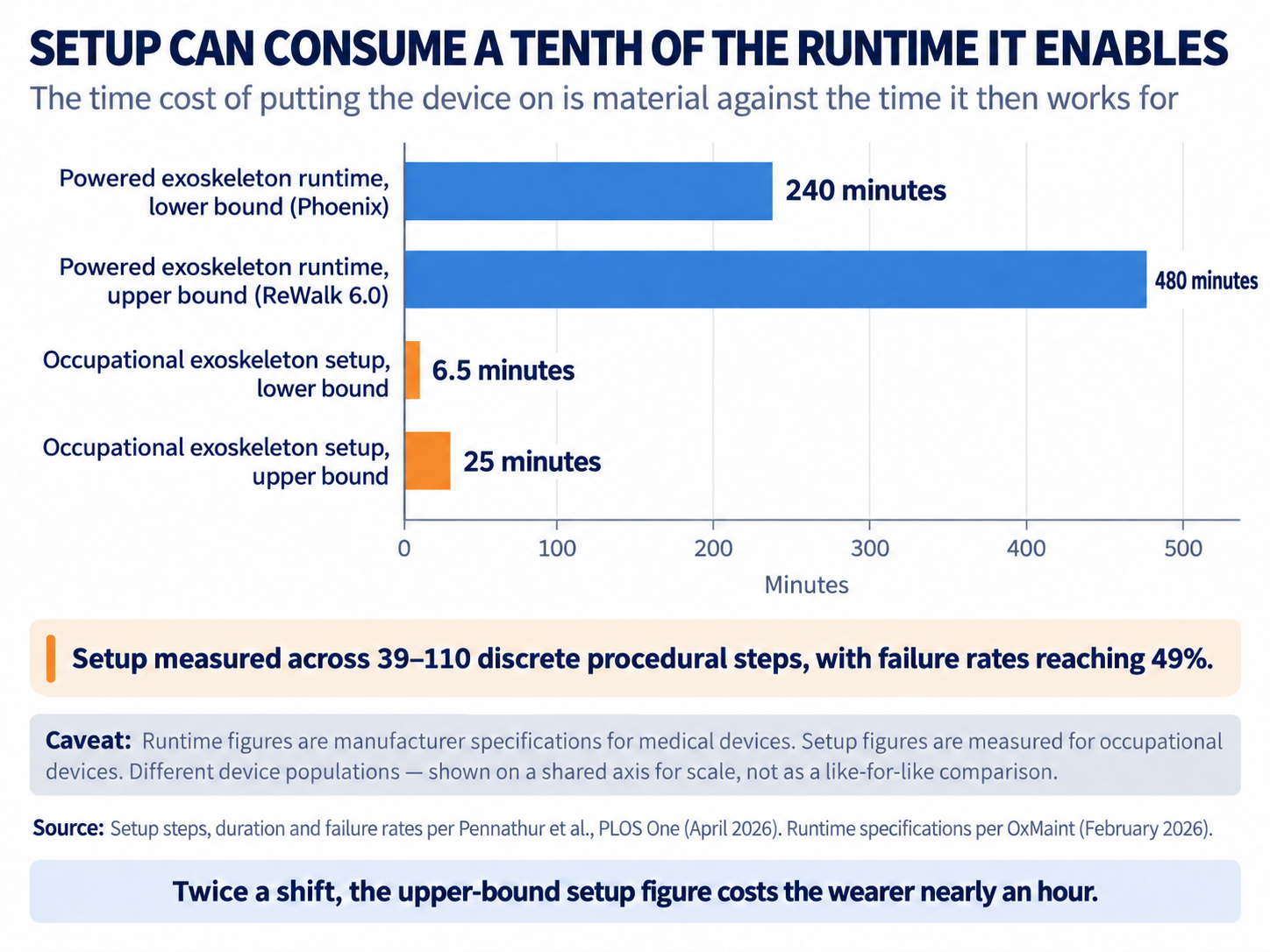
What the evidence points at instead is procedural. Setup can consume 25 minutes against a four-hour runtime, and Figure 3 puts both on the same axis.
Fit is the second unmeasured constraint, and it is more dangerous than uncomfortable. Anthropometric mismatch between wearer and device converts part of the assistive force into parasitic force, per research published on arXiv (2025) — meaning a poorly fitted exoskeleton does not simply help less, it actively loads the body in directions it was not meant to. The same work notes that users often cannot tell when a device is improperly worn, because the failure is silent.
The third is that the benefit fades. A Frontiers in Public Health study published in May 2026 found the same upper-body device that reduced shoulder muscle activity by 29% to 41% in controlled laboratory conditions drew only moderate ratings for usefulness and intention to use from soldiers in the field. Laboratory efficacy and field effectiveness are different measurements, and the industry markets the first.
No battery. Same adoption ceiling.
Standards or Design: Two Routes to the Same Fix
The ASTM F48 position: the category has no certification mark
Billotte, Lowe and Peterson set out the standards argument through NIOSH and NIST in 2019: lack of product standards and certifications has been described as a barrier to adoption in industry practice, and while exoskeletons are not considered traditional PPE, they are similarly wearable and the industrial interest in them is motivated by injury prevention.
The position has precedent behind it. ASTM Committee F48 was formed in 2017 with six subcommittees covering design and manufacturing, human factors, task performance, maintenance, security, and terminology. It has since approved F3771, a digital human modeling standard letting engineers simulate an exoskeleton's effect on the body before building it, and has a maintenance standard in development as work item WK89778. Around 80 companies are in the market and none of them can point at a mark a safety officer recognises.
The UT El Paso position: the barrier is in the design brief
The PLOS One study takes the other route. Devices requiring extensive measurements, specialised tools, more procedural steps and sequential dependencies take longer to set up and fail more often, and the fix belongs to designers: reduce the steps, eliminate the tools and body measurements, build in self-aligning connections, provide clear feedback.
The position has the numbers the standards argument lacks. It also has a shorter path to effect — a manufacturer can act on it in the next product revision without waiting for a committee.
The two are the same fix approached from opposite ends. No current standard requires setup time to be measured or disclosed, so a buyer comparing two devices cannot see the variable that most predicts whether either will be worn. PPE standards force fit-testing precisely because fit determines whether protection is real. Exoskeletons sit outside that classification, which is why neither the disclosure nor the design pressure has arrived — and why a category with 80 companies and a decade of products still has no way for a safety officer to tell, before purchase, how long the thing takes to put on.
This development reinforces:
- How AI Robots Work: The pillar covering the mechanisms behind robot capability, including why the constraint that decides deployment is rarely the one on the datasheet.
- Cobot vs Robot: What a Cobot Actually Is and Where It Belongs: Collaborative robots faced the same classification question, and ISO 10218-2:2025 resolved it by making the application rather than the machine the unit of assessment.
- Robots Aren't Taking Your Job — They're Taking the Parts of It That Were Hurting You: Injury prevention is the stated purpose behind most industrial exoskeleton purchases, and the task-level view explains which parts of a role the device is actually meant to absorb.
The 110 steps are the number to carry out of this. A device that reduces shoulder muscle activity by 29% to 41% in a laboratory, per the Frontiers in Public Health study, is doing exactly what it was engineered to do — and a worker who has to complete up to 110 procedural steps to access that benefit, with a failure rate near half, will find a reason not to on the third day. The battery will keep improving, because battery engineering has a global industry behind it. The frames will keep getting lighter, because materials science does too. Neither of those forces is working on the harness, the fit range, or the number of buckles, because nothing in the market currently rewards it — no standard requires the measurement, no buyer asks for it, and no datasheet carries it. Comau's MATE-XB has been supporting 25 kg without a battery since 2023. The passive segment removed the constraint everyone talks about and hit the same wall, which is the clearest evidence available about where the wall actually is.
Frequently asked questions
1. What is an exoskeleton?
An exoskeleton is a wearable frame that redirects mechanical load away from the body's muscles and joints. It can be passive, using springs and elastic elements to redistribute the wearer's own energy, or powered, using motors and batteries to add force the body cannot generate. More than 80 companies worldwide work in the category, according to ASTM International.
2. What are the main types of exoskeletons?
Exoskeletons divide first by power source and then by body region. Passive back-support and arm-support devices dominate industrial ergonomics; powered lower-limb devices dominate clinical rehabilitation and mobility assistance; powered full-body systems serve heavy lifting and defence logistics. Comau's MATE-XB is a passive back-support device supporting up to 25 kg with no power source, per Grand View Research (2026).
3. How long does an exoskeleton battery last?
Powered exoskeleton runtimes typically range from about four to eight hours per charge. The Phoenix delivers approximately four hours at an average walking speed of 1.1 mph, and the ReWalk 6.0 up to eight hours, per specifications compiled by OxMaint (February 2026). Lithium-ion capacity typically degrades around 20% within 12 to 18 months of daily use. Passive exoskeletons have no battery.
4. What are exoskeletons used for?
Industrial exoskeletons support overhead assembly work, repetitive lifting, and material handling — manufacturing accounts for 68% of all exoskeleton shipments and revenue according to ABI Research. Medical exoskeletons support gait rehabilitation after stroke or spinal cord injury; Ekso Bionics reports its EksoNR reducing therapy time by up to 30%. Defence applications focus on load carriage for logistics.
5. Why are exoskeletons not more widely adopted?
The most measured barrier is setup burden. A PLOS One study from UT El Paso (April 2026) found occupational exoskeletons required 39 to 110 procedural steps and 6.5 to 25 minutes to set up, don, doff and store, with failure rates reaching 49%. A systematic scoping review of 49 papers published October 2025 also cited discomfort, fit challenges, thermal burden, and limited usability in dynamic tasks.
6. How much does an exoskeleton cost, and is it covered by insurance?
Cost varies widely by class, with passive industrial devices priced far below powered medical systems. Insurance is the larger obstacle for medical use — most insurers classify medical exoskeletons as experimental or luxury devices rather than essential medical equipment, per Fortune Business Insights (2026). Some manufacturers have responded with leasing and subscription models rather than outright purchase.
7. Do exoskeletons actually prevent injury?
Laboratory evidence for load reduction is strong; field evidence for injury prevention is thinner. A Frontiers in Public Health study (May 2026) recorded a 29% to 41% reduction in shoulder muscle activity under controlled conditions, while the same device drew only moderate field ratings for usefulness. Poor fit can make matters worse — anthropometric mismatch converts assistive force into parasitic force loading the body in unintended directions, per arXiv research (2025).