Inside Kairos-HomeWorld: Why Training a Robot in a Chinese Home Is Harder Than It Looks
When ACE Robotics the embodied AI arm of SenseTime-affiliated Daxiao Robotics announced Kairos-HomeWorld in early June 2026, most coverage focused on the headline: a new dataset, a new framework, hundreds of millions in funding. What those headlines missed is the harder and more interesting story underneath. Kairos-HomeWorld is not simply a dataset. It is a generative pipeline designed to solve a problem that has quietly undermined every attempt to build a domestic service robot for the Chinese market: the training data does not look like a Chinese home. This article goes deeper on three angles that the initial news coverage.
1. What Kairos-HomeWorld Actually Does Under the Hood
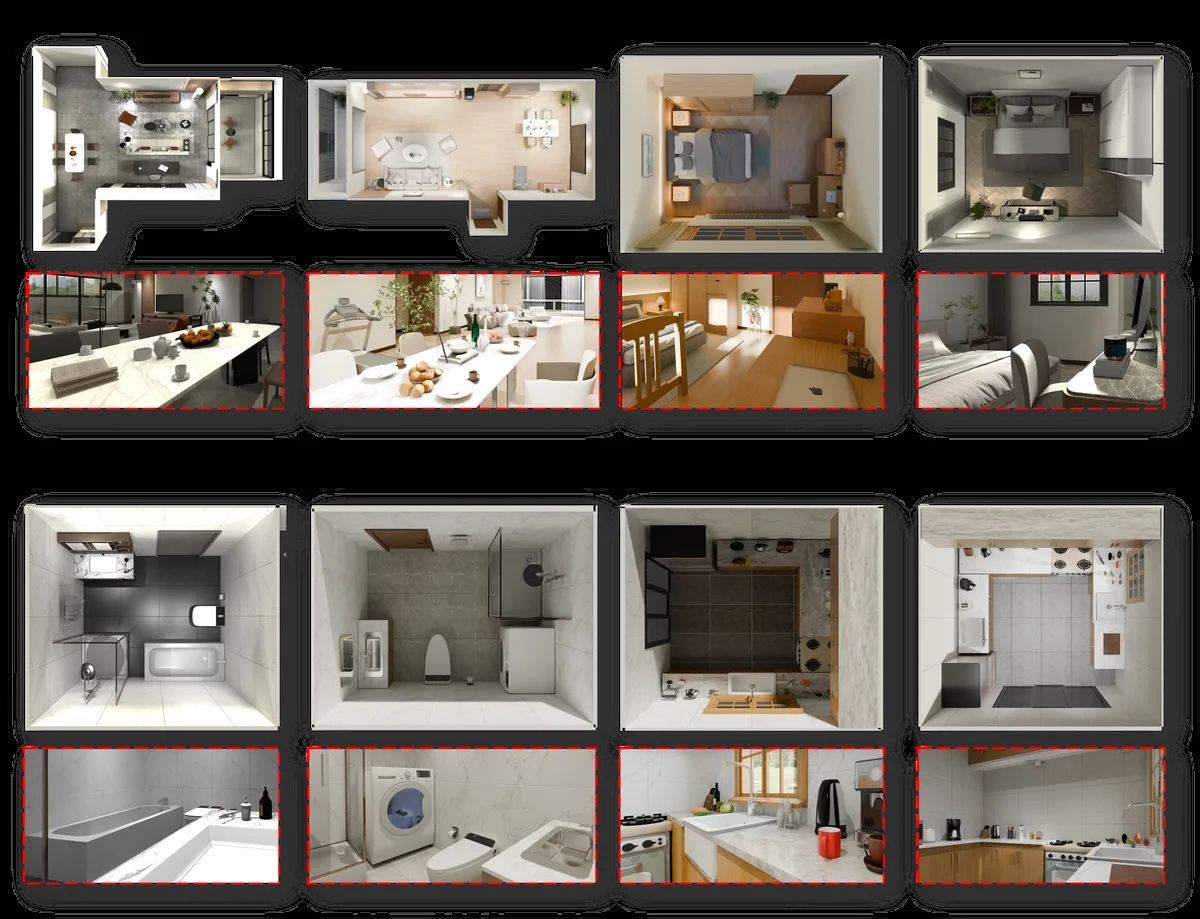
Most simulation datasets for domestic robots are static: a fixed library of pre-built 3D rooms that researchers sample from during training. Kairos-HomeWorld works differently. It is a four-stage generative pipeline that produces new, unique, simulation-ready home environments on demand from a single text prompt.
The pipeline works as follows:
Stage 1: Floorplan Generation. The system was trained on 300,000 real Chinese residential floorplans, sourced from property listings and processed through an automated vectorisation pipeline. Each floorplan is encoded using a K-D tree representation, a hierarchical spatial data structure which allows a large language model to understand and generate room layouts with coherent spatial relationships. This step alone is a significant contribution: the two most widely used open floorplan benchmarks, RPLAN and ResPlan, contain roughly 80,000 and 17,000 plans respectively. Kairos-HomeWorld's 300,000-plan corpus is nearly four times larger than the next best alternative.
Stage 2: 2D-to-3D Lifting and Furniture Layout. Once a floorplan is generated, the system instantiates an empty 3D building shell and furnishes it using a hierarchical view-roaming approach as a top-down global pass to place large furniture, then a first-person walkthrough to add detail. This dual-pass method addresses a common failure mode in 2D-to-3D lifting called "geometric drift," where objects placed in a 2D plan end up misaligned or floating when rendered in three dimensions.
Stage 3: Recursive Refinement. A fine-tuned vision-language model (VLM) acts as a quality controller, scanning each generated scene for physical violations: blocked doorways, furniture collisions, objects clipping through walls. It then proposes and applies corrections in an iterative loop. The result is among the lowest furniture-collision rates reported for any comparable method.
Stage 4: Manipulable Object Placement. The final stage populates surfaces such as desks, counters, dining tables, shelves with small objects, each assigned physical properties including material composition, density, friction coefficients, and structural support relationships. Each generated scene contains an average of more than 15 manipulable objects and achieves a Footprint Object Density (FOD) of 4.16, the highest reported among comparable methods. All objects are natively compatible with simulation engines, meaning a robot can immediately begin training tasks such as grasping, stacking, pouring, and opening articulated objects like refrigerator doors.
The practical implication is significant. Where a conventional dataset gives a robotics team a fixed library of, say, 5,000 rooms to train on, Kairos-HomeWorld can generate millions of unique, physically valid environments at near-zero marginal cost. New scene generation requires no physical property access, no furniture damage liability, and no human annotation beyond the initial prompt.
2. The China Home Layout Problem Is a Data Sovereignty Moat
Here is the detail that most Western robotics observers have not fully absorbed: a robot trained on American or European simulation data will likely fail in a Chinese home not because of hardware limitations, but because the environments are structurally different in ways that matter for robot navigation and manipulation.
Chinese urban apartments, which house the majority of the country's 500 million urban residents, have a distinct spatial grammar. They tend to be compact typically 60 to 90 square metres for a two-bedroom unit with enclosed kitchens rather than open-plan layouts, dedicated service balconies for laundry, wet-and-dry-separated bathrooms, north-south cross-ventilation corridors, and entryway storage alcoves. Older housing stock, which represents a substantial portion of the addressable market for domestic service robots, often features irregular room geometries that deviate significantly from the rectangular layouts that dominate Western simulation datasets.
These differences are not cosmetic. A robot trained to navigate an open-plan American kitchen will not have learned the spatial reasoning required to work in a narrow, enclosed Chinese kitchen where the refrigerator, stove, and sink may be arranged in a single galley row with less than 80 centimetres of clearance. A robot trained to place objects on a Western dining table will not have encountered the rotating lazy-susan configurations common in Chinese dining rooms. A robot trained on Western bathroom layouts will not have learned to navigate the step-down wet zone that separates the shower area in a Chinese bathroom.
Kairos-HomeWorld's dataset was purpose-built to address this gap. It spans unit sizes from approximately 30 square metres (studio apartments) to over 200 square metres, and explicitly covers the architectural features listed above. The team at ACE Robotics and CUHK describe this as deliberate coverage of "historically under-represented housing typologies" a polite way of saying that the global robotics research community has, until now, been building training data for a world that looks like Palo Alto, not Shanghai.
The competitive implication is substantial. Any international robotics company that wants to sell domestic service robots in China will need training data that reflects Chinese homes. Kairos-HomeWorld, as an open-source release, lowers that barrier for the research community but ACE Robotics and Daxiao Robotics, having built and deployed the pipeline first, retain a structural head start. They are already using Kairos-HomeWorld in their own daily robot training workflows. By the time a competitor builds a comparable dataset from scratch, Daxiao's robots will have accumulated months of additional training cycles on environments that competitor cannot yet generate.
This is what a data sovereignty moat looks like in practice.
3. Does It Actually Solve the Sim-to-Real Transfer Problem?
The most important question about any simulation framework is the one that press releases rarely answer directly: does training in simulation actually produce robots that work in the real world?
Simulation-to-real (sim2real) transfer is one of the most persistent unsolved problems in robotics. The core challenge is the "reality gap" the difference between the physics, lighting, material textures, sensor noise, and object behaviour in a simulation and the same properties in the physical world. A robot that achieves 95% task success in simulation may achieve 40% in a real environment, because the simulation did not accurately model the way light reflects off a glossy ceramic tile, or the way a soft object deforms when grasped, or the way a door hinge resists at the beginning of its arc.
Kairos-HomeWorld addresses the reality gap through several design choices. Physical attributes such as material density, friction coefficients, structural support relationships are assigned to every object in Stage 4, using the PhysX-Omni physics engine, which is the same engine used in NVIDIA Isaac Sim. This means the simulation's physical behaviour is grounded in the same physics model that the broader robotics industry has converged on as a standard. The recursive refinement in Stage 3 eliminates the most common sources of physical implausibility of floating objects, clipping geometry, blocked pathways that cause sim2real failures by training robots on impossible scenarios.
ACE Robotics reports that Kairos-HomeWorld has "significantly accelerated the simulation-to-reality transfer cycle" in their own training workflows. However, it is worth noting that this is a self-reported claim from the company's own press release, not an independently benchmarked result. The technical report (arXiv:2606.06390) provides quantitative comparisons on layout diversity and 3D design appeal metrics, but does not yet publish end-to-end sim2real transfer rates for specific household tasks.
For context, the broader field has made meaningful progress on sim2real transfer in 2025 and 2026. MIT CSAIL's real-to-sim-to-real approach (2024) demonstrated that scanning a real environment and training in a simulation of that specific environment dramatically improves transfer rates. ETH Zurich's PACE system (2025) showed systematic sim2real transfer for legged robots using domain randomisation that deliberately vary lighting, friction and object properties during training so the robot learns to handle variation rather than memorise a single environment. Kairos-HomeWorld's VLM-based refinement and physics-grounded object placement are consistent with these best practices, but the field is still waiting for published head-to-head benchmarks.
The honest assessment is this: Kairos-HomeWorld is the most credible attempt yet to build a simulation environment specifically calibrated to Chinese domestic settings, and its technical architecture is sound. Whether it fully closes the sim2real gap for complex household tasks with the kind of multi-step, multi-room sequences that a genuinely useful domestic robot would need to perform remains an open question that only real-world deployment data will answer.
What This Means for the Broader Race
Kairos-HomeWorld is not a product announcement. It is infrastructure. The companies that build on top of it including Daxiao Robotics, but also any researcher or startup that uses the open-source dataset will be training their robots on a foundation that did not exist six months ago.
The parallel with the early days of large language model training is instructive. When Common Crawl and The Pile became available as open training corpora, they did not guarantee that any particular model would succeed but they raised the floor for everyone. Kairos-HomeWorld does something similar for domestic robot training in Chinese environments. It raises the floor. The question of who builds the best robot on top of that floor is still very much open.
For the domestic service robot market which Goldman Sachs estimates could reach $38 billion by 2035, with China representing the largest single addressable segment, the company that solves sim2real transfer at scale, in Chinese homes, will have a durable advantage that is difficult to replicate from outside the country.
Daxiao Robotics is not yet that company. But it is building the infrastructure that company will need.
Sources:
- ACE Robotics / Kairos-HomeWorld Official Project Page (June 2026)
- ACE Robotics Press Release via Asia News Network “ACE ROBOTICS Open-Sources Kairos-HomeWorld" (June 6, 2026)
- arXiv Technical Report 2606.06390 HomeWorld: A Unified Floorplan-to-Furnished Framework (Li et al., 2026)
- MIT CSAIL "Precision home robots learn with real-to-sim-to-real" (July 2024)
- ETH Zurich Robotic Systems Lab PACE: Systematic Sim-to-Real Transfer (September 2025)
- Goldman Sachs Global Investment Research Humanoid Robots Market Sizing (2024)
RobotAIGeek reported on June 16, 2026 Daxiao Robotics Raises Hundreds of Millions, Launches Kairos-HomeWorld AI Framework
Disclaimer: All editorial content is independently written by RobotAIGeek based on publicly available sources. Quoted material is attributed to its original publisher and not independently verified by RobotAIGeek.