What to Expect from the Next Generation of Humanoid Robots
A plain-language roadmap for the next generation of humanoid robots, covering the technology ceiling, whole-body control, dexterous interaction, AI software, realistic cost drivers, and evidence-based 2026–2028 milestones.
The next generation of humanoid robots will not arrive as one dramatic product launch. It will arrive through a series of less visible improvements: robots that recover more safely from a mistake, learn a new task with fewer demonstrations, use less power, tolerate more variation, and come with clearer evidence that they can work beside people. That is why the right way to read the roadmap is not to ask when a perfect human substitute will appear. It is to ask which capability is moving from a laboratory demonstration into a repeatable operating threshold.
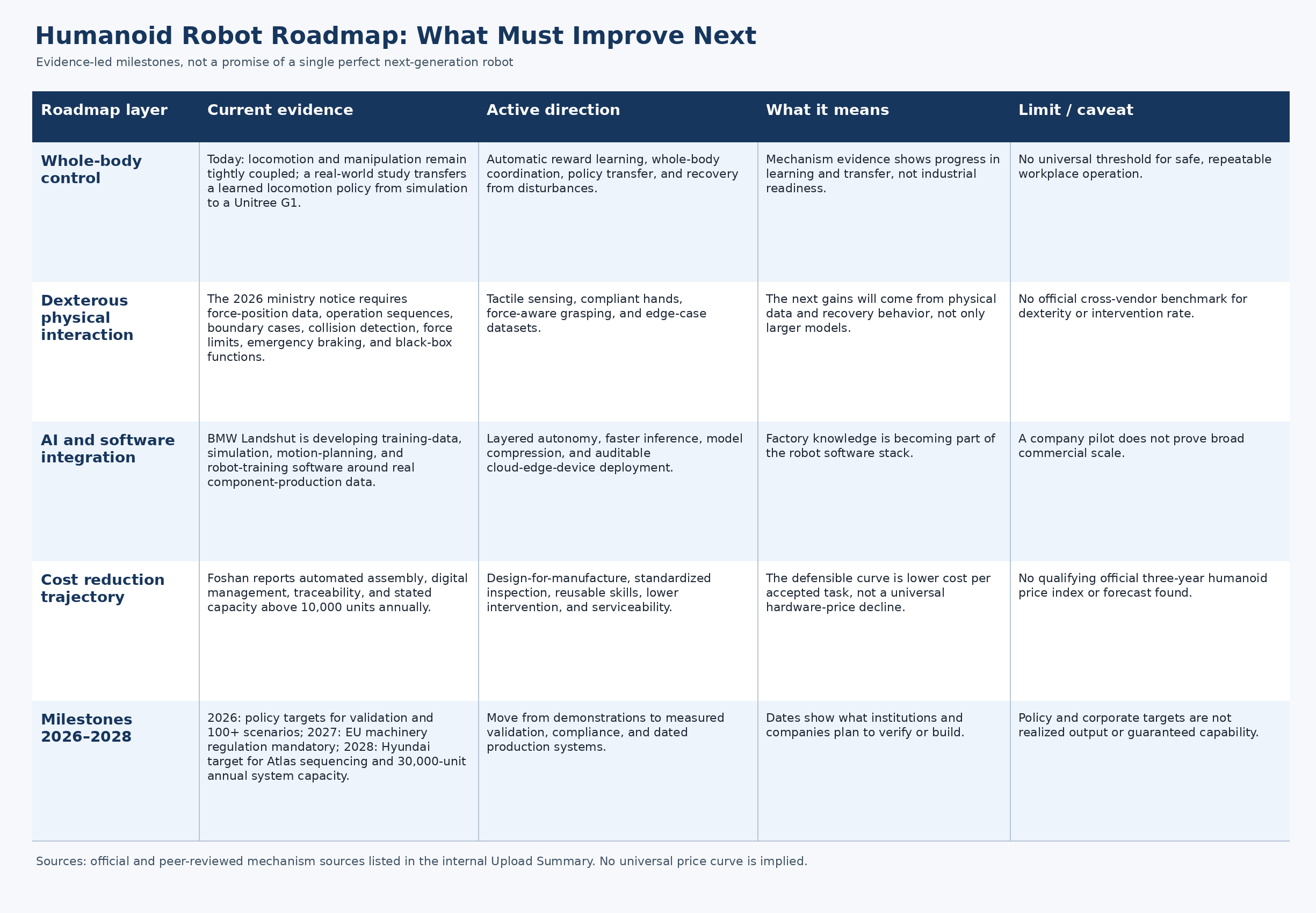
The public evidence points to a sector moving from prototype breadth toward controlled validation. China’s State Council Information Office reported that its Ministry of Industry and Information Technology counted more than 140 domestic manufacturers and more than 330 models in the preceding 12 months, while also identifying high costs, fragmented scenarios, limited generalization, and reliance on imported core components as bottlenecks. A larger model count therefore signals experimentation, not a finished technology ceiling.
Current Technology Ceiling
Today’s humanoid robots can often demonstrate an impressive isolated skill. The harder test is maintaining that skill when the object, lighting, floor, work sequence, or recovery condition changes. A robot may walk across a prepared surface yet struggle with a small disturbance. It may pick a known item yet fail when the item is rotated, partly hidden, or placed in a crowded bin. Human workers solve these variations continuously. The robot must convert them into sensing, planning, control, and recovery problems.
A June 2026 notice from the Ministry of Industry and Information Technology and the State-owned Assets Supervision and Administration Commission describes the current ceiling in operational terms. It calls for real-world validation of task success rate, efficiency improvement, safety, reliability, and economic feasibility. It also highlights force control, collision detection, force limits, emergency braking, black-box functions, data governance, and long-duration operation. These requirements show that the next bottleneck is not only whether a robot can complete a task once. It is whether the robot can complete it safely, repeatedly, and economically.
Research points to the same constraint at the control level. A February 2026 open-access study in a Science Partner Journal used automatic reward learning for deep reinforcement learning and transferred a learned locomotion policy from simulation to a real Unitree G1 humanoid. The result is a mechanism advance, not proof of commercial readiness. It demonstrates why simulation, policy learning, and real-world transfer are becoming central to the roadmap, while also showing how much engineering is required before a skill becomes dependable outside the laboratory.
Key R&D Directions
The first major direction is whole-body control. A humanoid cannot treat walking, balancing, reaching, gripping, and looking as separate modules forever. A change in hand position can alter balance; a carried object can change the motion plan; a collision can require an immediate whole-body response. The practical objective is a controller that coordinates the body while respecting joint limits, contact forces, energy use, and safety boundaries.
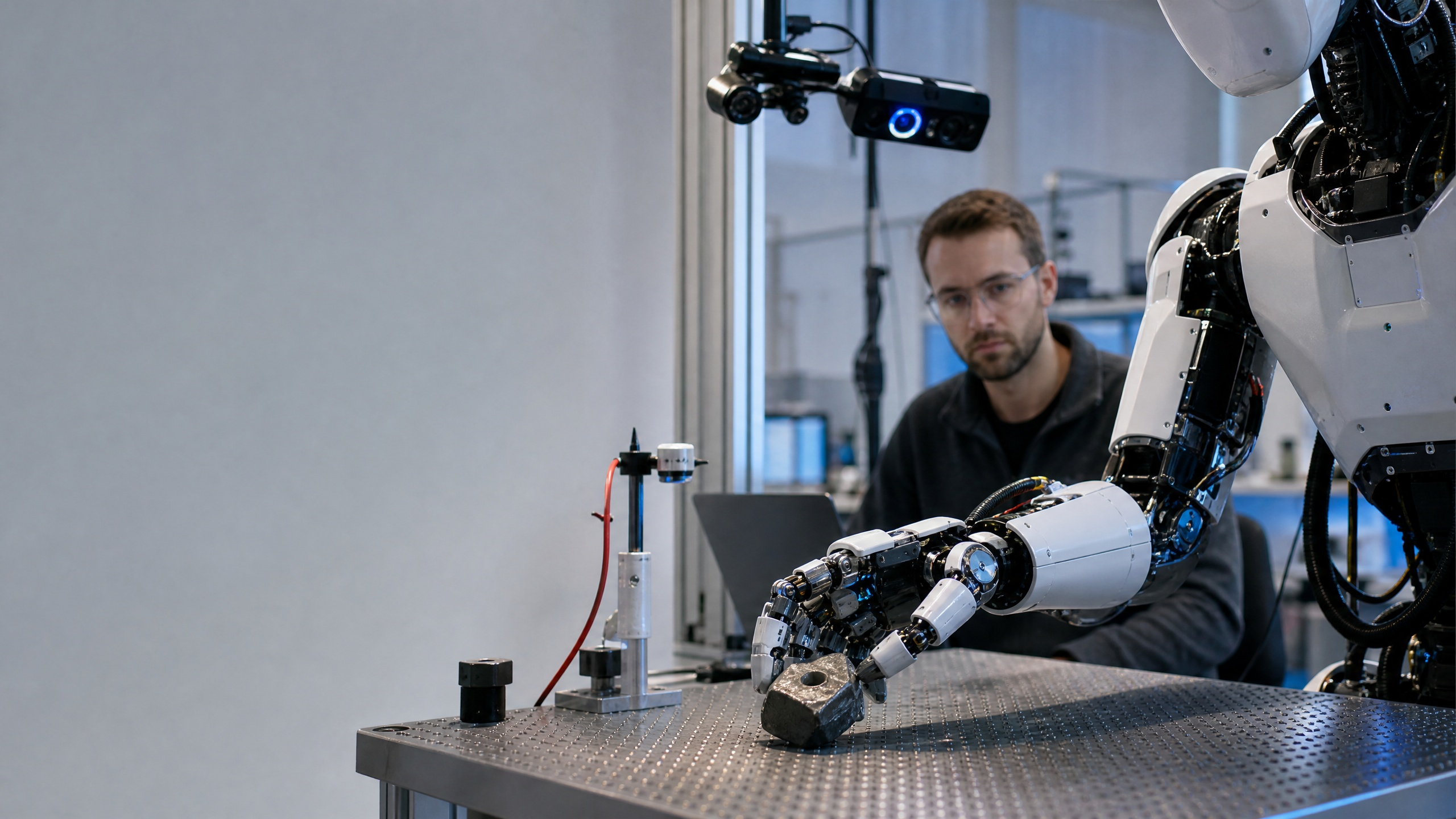
The second direction is dexterous and force-aware manipulation. Hands, wrists, tactile signals, and compliant control determine whether a robot can handle objects that are not perfectly presented. The ministry notice calls for high-fidelity records of force-position curves, operation sequences, timing logic, abnormal conditions, and boundary cases. That is a signal that future progress will depend on collecting better physical data, not only scaling language or vision models.
The third direction is validation infrastructure. The same notice calls for real-world training spaces, user-led application groups, scenario-specific tests, and reports that determine whether a solution is ready for regular deployment. The important shift is from a robot being shown to a robot being measured. A factory, hospital, or logistics site becomes part of the development loop because it supplies the edge cases that simulation alone cannot capture.
AI and Software Integration
Artificial intelligence is increasingly being integrated as a layered control system rather than a single chatbot-like brain. A high-level model may interpret an instruction or plan a sequence, while lower layers estimate motion, regulate joints, manage contacts, and trigger a safe stop. The system must also detect when its confidence is insufficient and request help rather than improvise.
BMW’s July 2026 disclosure provides a clear industrial example. Its Landshut plant is developing software for artificial-intelligence-supported robotics in component production, including training-data processing, simulation, motion planning, and robot training. BMW says teams capture data from real production environments, test movement patterns in simulation, and move from pilots toward staged scale-up. The lesson is that software integration is inseparable from production knowledge. A general model becomes more useful in industrial settings when it can be connected to a plant’s objects, tolerances, work instructions, and safety rules.
The next generation will therefore be judged by the quality of its data loop. A strong system should record what the robot saw, what it tried, where it failed, how a human intervened, and whether the corrected skill transfers to a related task. The Ministry of Industry and Information Technology and State-owned Assets Supervision and Administration Commission notice also emphasizes privacy, commercial-secret protection, high-quality real-machine data, model compression, inference acceleration, and cloud-edge-device deployment. Those requirements point toward smaller, faster, more auditable software stacks rather than a model that depends on a remote connection for every movement.
Cost Reduction Trajectory
There is no qualifying official three-year price curve for humanoid robots. Public procurement records can show the price of a named configuration in a specific institution and period, but they cannot establish a universal entry, mid-range, or premium band. The earlier price references in this series should therefore be read as configuration-specific evidence, not as a forecast of how quickly the average humanoid will become cheaper.
The more defensible cost trajectory is operational. Costs can fall when component designs become easier to manufacture, when assembly and inspection are standardized, when training data is reused across tasks, and when a robot needs fewer human interventions. The Foshan production-line disclosure from April 2026 illustrates the manufacturing side of this equation through automated assembly, digital management, and quality traceability. It does not show utilization or unit economics, but it identifies the mechanisms a future cost curve would need.
Buyers should expect uneven progress rather than a smooth annual decline. A new hand, battery, actuator, or safety system may initially increase the purchase price while lowering maintenance or intervention costs. A software update may improve utilization without changing the hardware price. For buyers, a more meaningful metric may be total cost per accepted task, including installation, integration, supervision, training, downtime, service, and compliance.
Timeline Milestones
2026: validation becomes the milestone. The national real-world training notice sets targets for application verification, regular deployment in representative scenarios, more than 100 high-value application scenarios, and deployment capability at the 10,000-unit scale by the end of the year. These are policy targets, not a guarantee that the sector will achieve them. For readers, the key test is whether vendors publish repeatable task results, intervention rates, safety records, and economic evidence.
2027: compliance becomes the milestone. The European Commission states that Regulation (EU) 2023/1230 will apply on a mandatory basis from 20 January 2027. That date is not a humanoid product-generation promise. It is a reminder that safety requirements, conformity assessment, technical files, and harmonised standards can determine whether a robot is deployable in a destination market. The next generation will need a compliance pathway as well as a better demonstration.
2028: scalable production and controlled deployment become the milestone. Hyundai Motor Group says Atlas is intended to enter sequencing tasks at its Metaplant America from 2028, with component assembly targeted for 2030, and that the Group aims to establish a scalable production system capable of manufacturing 30,000 robot units annually by 2028. These are corporate targets, not realized industry output. They illustrate the kind of dated, task-specific roadmap buyers should request from every supplier.
The next generation of humanoid robots will be defined less by a single leap in appearance than by the connection of five systems: robust whole-body control, dexterous physical interaction, efficient AI software, manufacturable hardware, and evidence that the robot can operate safely in a real workplace. The companies and countries that connect those systems will move forward. For everyone else, the most valuable progress may be learning to measure the gap honestly.