US Robotics Industry Sees Double Digit Growth in 2025
The International Federation of Robotics reports an 11% increase in US industrial robot installations for 2025, driven by strong adoption in the food sector, though the US still trails significantly behind China's deployment scale.
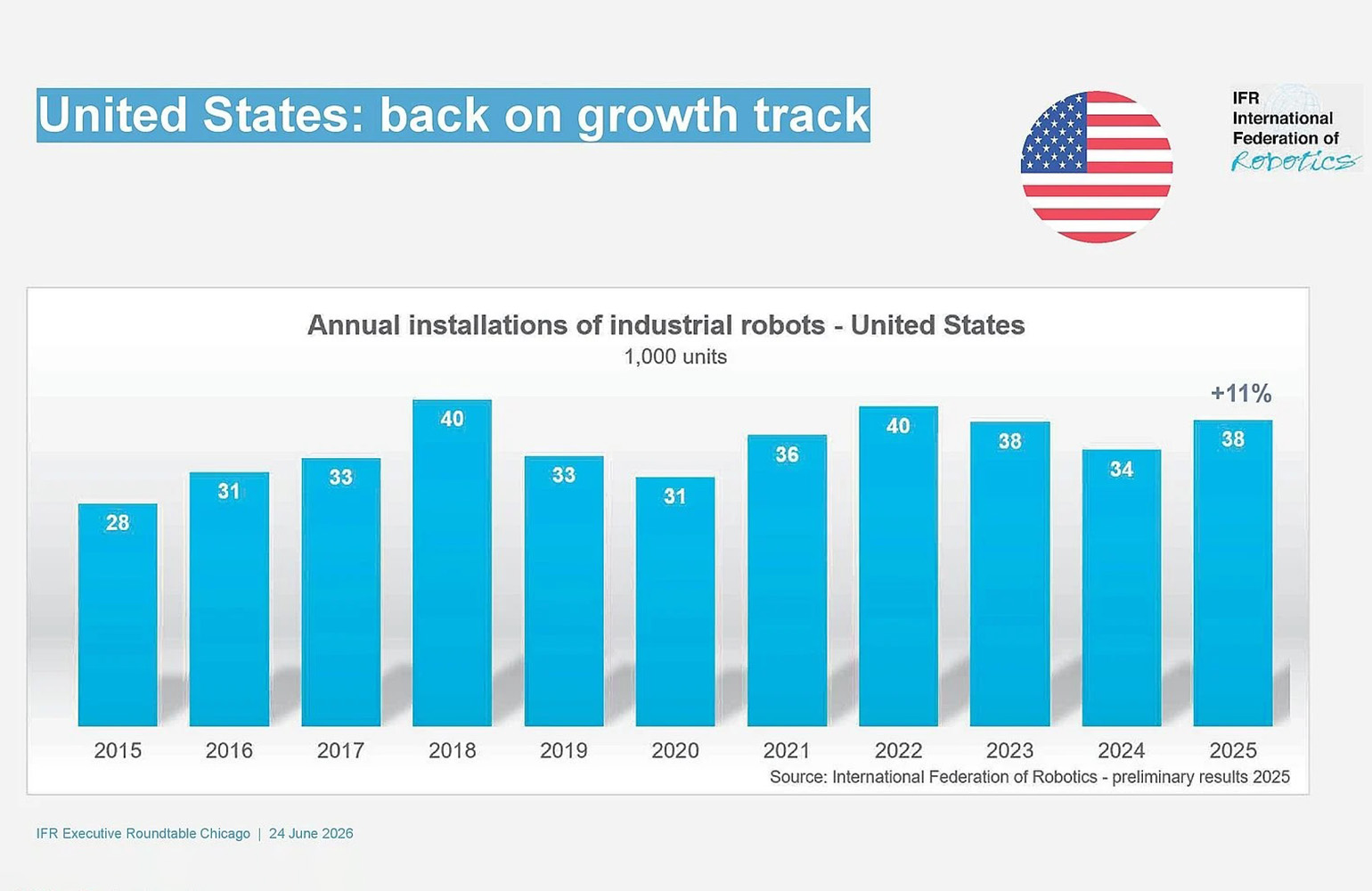
The United States robotics market has returned to a trajectory of significant expansion. According to preliminary data released by the International Federation of Robotics (IFR), the number of industrial robot installations in the US rose by 11% year over year, reaching 38,000 units in 2025 [1] [2].
This recovery highlights a broadening base of automation adoption across the American economy. While the automotive industry remains the largest single adopter, accounting for 13,500 units, the growth was primarily driven by non manufacturing sectors [1].
The Diversification of Automation
The most notable shift in the 2025 data is the rapid acceleration of robotics adoption in the food industry. Installations in this sector surged by 30%, bringing it to parity with traditional automation strongholds such as the metal, machinery, and electrical electronics industries, each of which recorded approximately 3,000 installations [1] [2].
This diversification indicates that robotics technology is becoming more accessible and adaptable. As collaborative robots and AI driven vision systems improve, industries that previously found automation too rigid or complex are now deploying robotic solutions to address persistent labor shortages and improve operational efficiency.
The Global Context
Despite the strong domestic growth, the US remains significantly behind the global leader in automation scale. The US currently ranks eighth worldwide in robot density, with 307 industrial robots in use for every 10,000 employees in the manufacturing industry [1].
In terms of total market size, the disparity is stark. China installed 295,000 units in 2024, representing a 54% global market share. While the IFR has not yet published final 2025 figures for China, estimates suggest that Chinese installations are approximately ten times higher than those in the United States [1] [2].
The Bigger Signal
The double digit growth in the US indicates a resilient demand for automation, driven by reshoring initiatives and structural workforce gaps. However, the massive volume disparity between the US and China underscores the impact of coordinated national strategy.
China's aggressive, state backed push to integrate robotics into its modern industrial system has created an adoption scale that no other nation currently matches. In response, organizations such as the Association for Advancing Automation (A3) are actively lobbying the US government to establish a comprehensive National Robotics Strategy, complete with tax incentives and workforce retraining programs, to ensure long term industrial competitiveness [1].
RobotAIGeek Perspective The 11% growth in US installations is a positive indicator for domestic integrators and manufacturers. The surge in food industry adoption proves that physical AI is successfully expanding beyond the automotive assembly line. However, the data confirms that the US is still playing catch up. Without a cohesive national policy that aggressively incentivizes automation investment, the US will struggle to close the volume gap with China, potentially impacting the long term competitiveness of the American manufacturing base.
References:
1. The Robot Report. (2026, June 19). U.S. robotics industry saw double-digit growth in 2025, says IFR.
2. Business Wire. (2026, June 18). US Robot Industry Returns to Double Digit Growth – IFR Reports.
3. Chart: International Federation of Robotics (IFR), Executive Roundtable Chicago, June 24, 2026.