Rokae Robot Lists in Hong Kong: China's Cobot Champion Takes On Global Capital
Chinese collaborative robot maker Rokae Robot with 34% of China's market share on cobot has launched its Hong Kong IPO subscription at HKD 38 per share, with listing expected on July 9 under the 18C specialist technology chapter.
Rokae Robot Lists in Hong Kong: China's Cobot Champion Takes On Global Capital
When Rokae (Shandong) Robotics Group opens for trading on the Hong Kong Stock Exchange on July 9, 2026, it will mark the public market debut of the only company in China that mass-produces both industrial robots and collaborative robots on a single technology platform. The company priced its initial public offering at HKD 38 per share on June 30, targeting a raise of approximately HKD 800 million (roughly USD 103 million) under HKEX's Chapter 18C framework for specialist technology companies. Public subscription opened the same day and closes July 6, with shares expected to begin trading under stock code 3752 three days later.
From University Lab to Factory Floor
Rokae was founded in 2015 by a team of robotics researchers with backgrounds from Tsinghua University, Peking University, and Beihang University. The company is headquartered in Jinan, Shandong Province, with additional R&D centres in Beijing, Tokyo, Shanghai, and Shenzhen. More than 80% of its R&D staff hold master's degrees or above.
The company's growth trajectory has been rapid. From its first Series A of $6 million in 2017, Rokae has raised approximately $210 million across nine funding rounds before this IPO. Key investors include Shunwei Capital (the venture fund of Xiaomi founder Lei Jun), Shenzhen Capital Group, New Hope Group, and the National Manufacturing Transformation and Upgrade Fund, a Chinese government-backed strategic investor that led the most recent pre-IPO round of over RMB 500 million in April 2024.
Today, Rokae operates a factory with annual production capacity of 50,000 robots, serves over 1,000 customers across approximately 40 countries, and holds more than 600 patents. Its customer roster includes Xiaomi Group (as a domestic industrial robot supplier across several factories), Valeo (deployed across more than ten global production sites since 2017), and Fotong Cummins.
What Rokae Builds
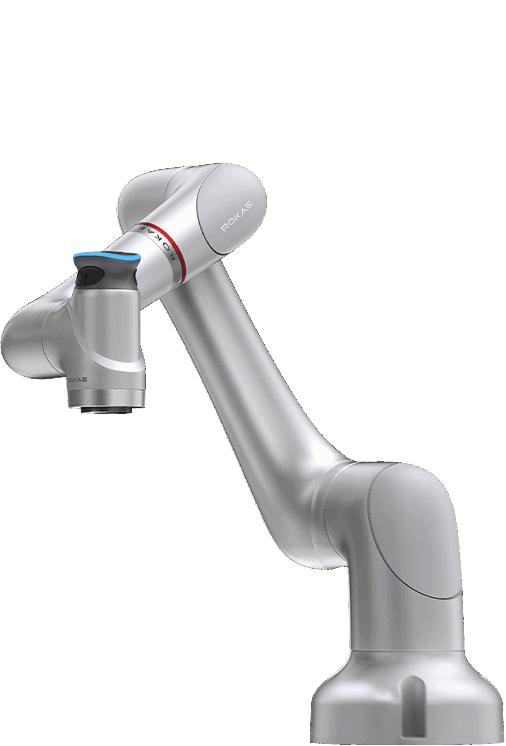
Rokae's product portfolio spans three categories. The first is industrial robots with payloads ranging from 4 to 220 kilograms, targeting traditional manufacturing automation. The second is its flagship flexible collaborative robot line, the xMate series, which uses integrated joint force control with high-precision torque sensors embedded within each joint. This architecture enables native, multi-point force sensing rather than relying on a single end-effector sensor, making the robots suitable for precision assembly, medical rehabilitation, and close human-robot collaboration.
The third and newest category is embodied AI robots, including humanoid arms, dual-arm wheeled platforms, compound robots, and an intelligent welding robot. In September 2025, Rokae signed a supply agreement with Zhiyuan Robotics to provide humanoid arms for integration into Zhiyuan's humanoid robot products, an early commercial signal for this division.
Underpinning all three product lines is Rokae's xCore control platform, a unified proprietary system that achieves 0.15 millimetre absolute positioning accuracy and incorporates vibration suppression algorithms that reduce joint oscillation amplitude by more than 80%. The company holds 21 TUV functional safety certifications, more than any other Chinese robot manufacturer, and was the first in China (second globally) to obtain IEC medical certification for collaborative robots.
Market Position: Dominant in Flexible Cobots
According to the Frost & Sullivan report commissioned for the listing, Rokae holds a commanding 34% share of China's flexible collaborative robot sub-segment, roughly double the combined share of its next two competitors. In the broader multi-joint robot market, Rokae ranks third among Chinese domestic manufacturers and seventh globally by volume, with a 2.7% share of the Chinese market in 2024. In light-payload industrial robots (25 kilograms and below), it leads the Chinese market with a 3.8% share.
The company has ranked first in volume growth rate among major Chinese multi-joint robot manufacturers for two consecutive years. Customer concentration has been declining steadily, with the top five customers falling from 39.5% of revenue in 2022 to 18.0% by 2024, indicating a broadening commercial base.
Financial Profile: Fast Growth, Narrowing Losses
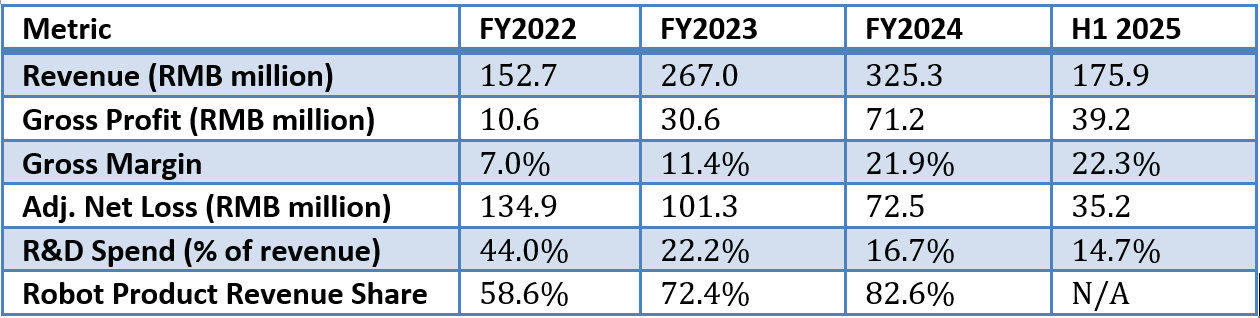
Revenue has grown at a 2022 to 2024 compound annual growth rate of 46%, with gross margins tripling from 7% to 22% as the company shifts from lower-margin custom solutions toward standardised robot products. The company remains loss-making, though adjusted net losses have narrowed from RMB 135 million in 2022 to RMB 35 million in the first half of 2025. R&D expenditure as a percentage of revenue has fallen sharply as revenue scales, though absolute R&D spend has plateaued around RMB 50 million annually.
Competitive Landscape
China's collaborative robot market has become intensely competitive, with domestic manufacturers collectively exceeding 52.3% of the Chinese multi-joint robot market by volume in 2024 for the first time, displacing foreign brands from majority share. The key players occupy distinct positions:
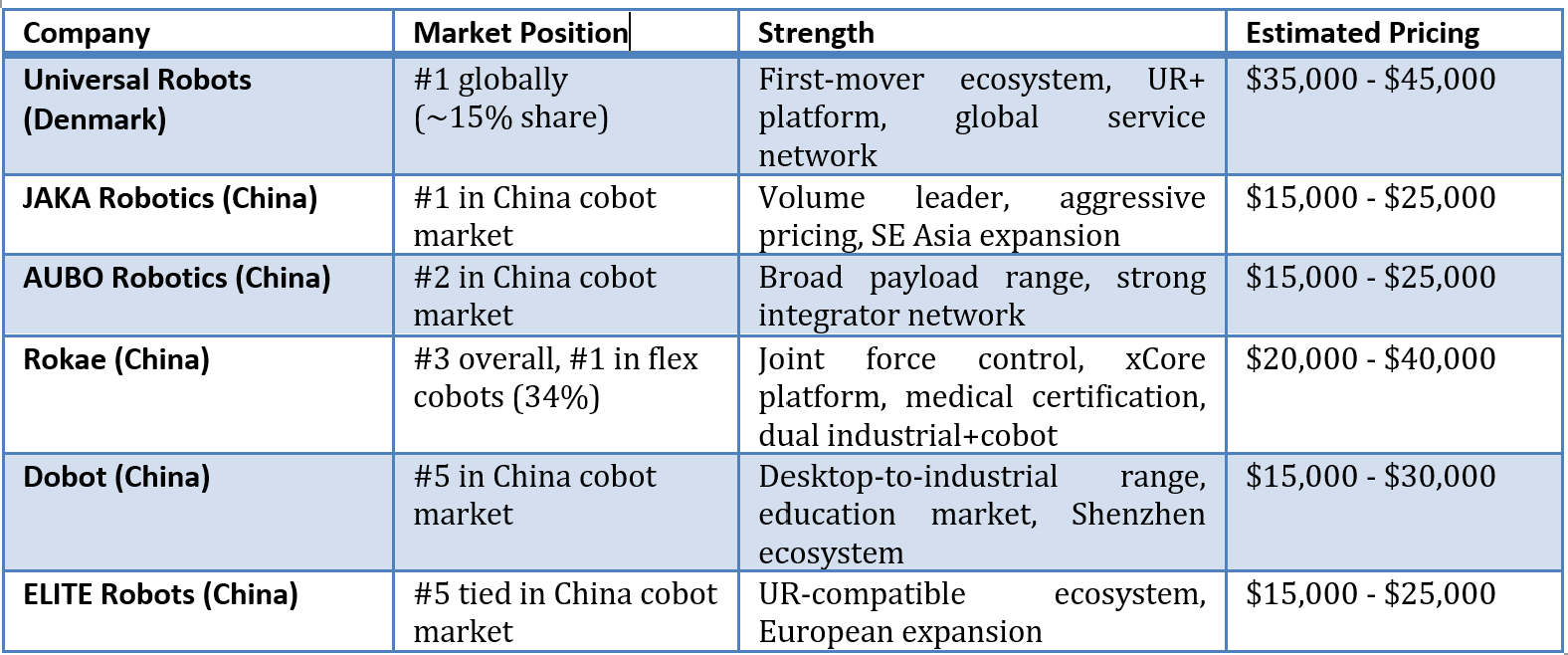
Rokae's competitive advantage lies in its technology differentiation rather than price competition. While most Chinese cobot makers compete on cost against Universal Robots, Rokae competes on capability: its integrated joint force control architecture, medical-grade safety certifications, and unified xCore platform that spans industrial, collaborative, and embodied AI robots. This positions it as a premium domestic option rather than a low-cost alternative.
Why Chapter 18C, and Why Now?
Chapter 18C is HKEX's framework for specialist technology companies, launched in 2023 to attract pre-profit tech firms that would not qualify under traditional listing rules. The regime has accelerated sharply in 2026: six firms listed under 18C in Q1 alone (compared with five for all of 2025), raising US$2.5 billion, more than double the combined total for 2024 and 2025. Hong Kong's IPO proceeds surged 454% year-on-year in Q1 2026 to US$13.3 billion, with nearly a fifth coming from 18C companies.
For Rokae, the timing aligns with three factors. First, the company's gross margins have crossed 20% and losses are narrowing, signalling commercial maturation. Second, the embodied AI opportunity requires significant capital investment that private rounds alone cannot efficiently provide. Third, a public listing in Hong Kong gives Rokae international visibility and currency for potential acquisitions as it expands into Europe and Southeast Asia, where overseas revenue (currently 9% of total) is targeted for growth.
The ARPI Perspective: Industrial Cobots as the Penetration Backbone
From an Autonomous Robot Penetration Index standpoint, Rokae's IPO represents a milestone in the maturation of China's industrial robotics supply chain. While humanoid robots and consumer companions attract headlines, collaborative robots are the workhorses driving actual robot penetration into factories, hospitals, and logistics centres today. China's multi-joint robot market is forecast to grow from RMB 21.9 billion in 2024 to RMB 45.3 billion by 2029, a 15.7% compound annual growth rate. The collaborative segment within that grows at 28.8% annually.
The structural shift is significant. In 2024, Chinese domestic manufacturers collectively surpassed 52.3% of the domestic multi-joint robot market by volume for the first time, displacing decades of foreign brand dominance by FANUC, ABB, KUKA, and Yaskawa. Rokae's IPO, alongside the concurrent listings of other Chinese robotics firms, represents the capital market validation of this domestic supply chain maturation.
The embodied AI angle adds optionality. Rokae's xCore platform is designed to run humanoid arms and compound robots on the same architecture as its industrial and collaborative lines. If the embodied AI market reaches the RMB 1 trillion scale projected by Frost & Sullivan by 2035, companies with production-proven control systems and safety certifications will have a significant head start over pure research labs attempting to commercialise. Rokae is positioning itself as a bridge between today's industrial automation revenue and tomorrow's embodied AI opportunity.
Going Forward
Three risks warrant monitoring. First, the company remains loss-making and has cautioned that net losses may continue for the foreseeable future. Gross margin expansion must continue to demonstrate a path to profitability. Second, overseas revenue declined from 14.3% to 9.0% between 2023 and 2024, and the planned European and Southeast Asian service centres have yet to demonstrate traction. Third, the flexible collaborative robot sub-segment where Rokae dominates is still relatively small, and maintaining 34% share as the segment scales and attracts more entrants will require sustained R&D investment.
Sources:
2. Rokae Robotics Official. "About ROKAE." rokae.com.
4. Securities Times (证券时报). "珞石机器人招股拟全球发售2303.19万股H股." June 30, 2026.
5. HKTDC Research. "AI boom fuels Hong Kong's 18C listing surge." June 5, 2026.
6. HKEX Group. "18C, Explained." hkexgroup.com.
7. MarketsandMarkets. "Collaborative Robot Market Size, Share & Trends, 2025 to 2030."
Disclaimer: RobotAIGeek provides news and analysis for informational purposes only. This article does not constitute investment advice. Readers should conduct their own due diligence before making any investment decisions. RobotAIGeek has no commercial relationship with Rokae or any company mentioned in this article.