Kunlunxing Robotics Reaches Unicorn Status Within 90 Days
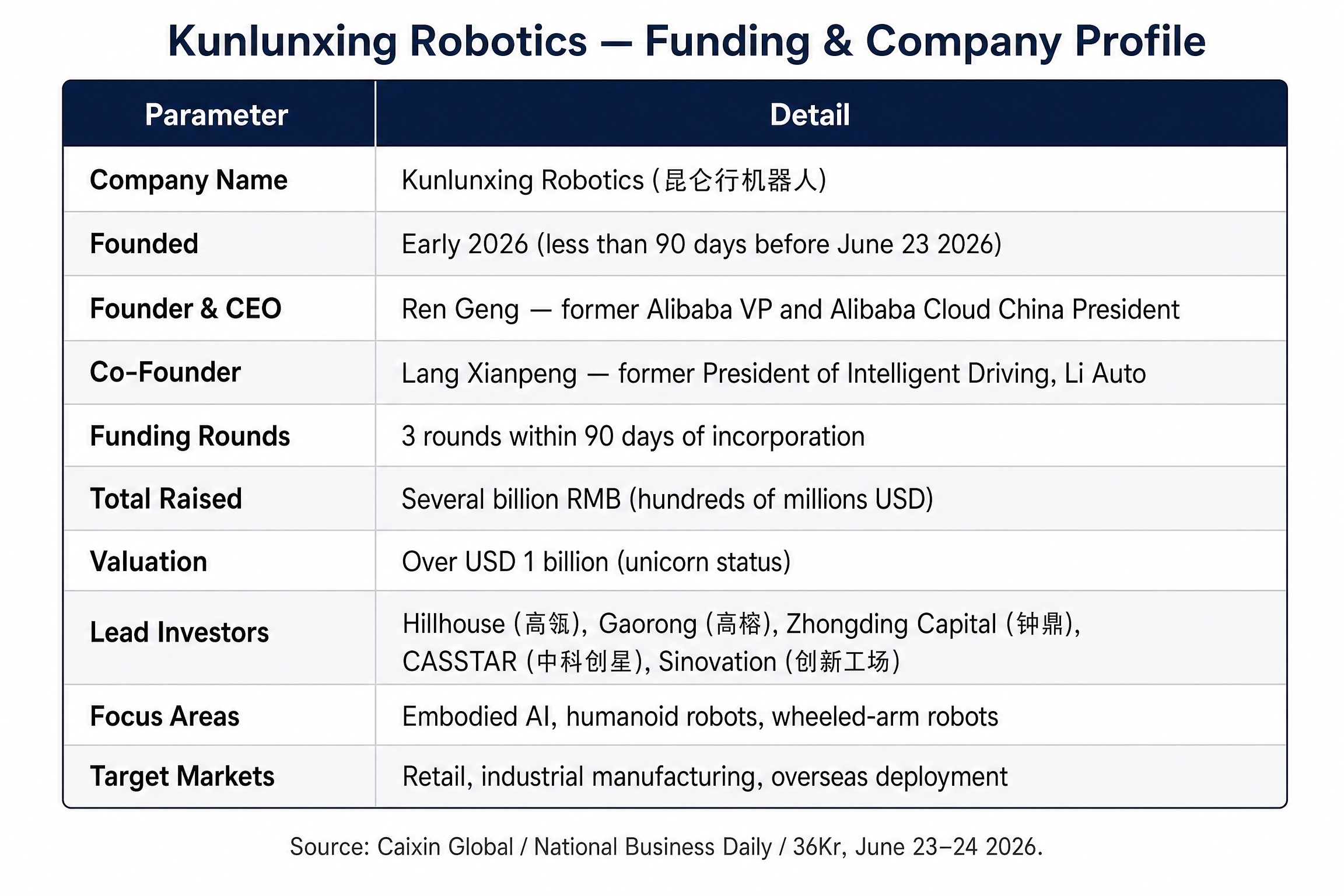
Kunlunxing Robotics (昆仑行机器人), founded by former Alibaba VP Ren Geng and ex-Li Auto intelligent driving president Lang Xianpeng, has raised several billion RMB across three rounds within 90 days of incorporation, reaching unicorn status. Investors include Hillhouse, Gaorong, Zhongding Capital, CASSTAR, and Sinovation.

Kunlunxing Robotics (昆仑行机器人) has raised several billion RMB across three funding rounds within 90 days of incorporation, reaching a valuation above USD 1 billion and joining China's growing list of embodied AI unicorns before most startups have shipped a single product. The round was confirmed by Caixin Global, National Business Daily, and 36Kr on June 23–24, 2026.
What Is Kunlunxing Robotics and Who Is Behind It?
Kunlunxing Robotics (昆仑行机器人) is a Beijing-based embodied AI startup founded in early 2026 by Ren Geng, former Vice President of Alibaba and President of Alibaba Cloud China, and Lang Xianpeng, former President of Intelligent Driving at Li Auto. The company focuses on humanoid robots and wheeled-arm robots targeting retail, industrial manufacturing, and overseas markets. Within 90 days of incorporation it completed three funding rounds totalling several billion RMB, backed by Hillhouse (高瓴), Gaorong (高榕), Zhongding Capital (钟鼎), CASSTAR (中科创星), and Sinovation Ventures (创新工场).
Why Capital Is Moving This Fast
The speed of Kunlunxing's fundraising is not an accident. It reflects a structural dynamic that has taken hold in China's embodied AI sector over the past 18 months: tier-one venture funds are competing to back founding teams with proven operational pedigree before those teams have a product, a factory, or a customer. The logic is straightforward — in a market where hardware development cycles run 18 to 36 months, the window to back a credible founding team at a reasonable valuation closes quickly.
Ren Geng's background at Alibaba Cloud is directly relevant. Cloud infrastructure at scale requires the same organizational disciplines that embodied AI deployment will eventually demand: distributed system reliability, edge-to-cloud data pipelines, and the ability to manage hardware-software integration across thousands of nodes simultaneously. Lang Xianpeng's experience leading intelligent driving at Li Auto adds a second layer of credibility — autonomous vehicle development is the closest existing analogue to the sensor fusion, real-time inference, and safety-critical control that humanoid robots require.
The investor list reinforces the signal. Hillhouse and Gaorong are not seed-stage generalists; they are late-stage and growth-stage funds that have moved unusually early here. CASSTAR (中科创星), the venture arm of the Chinese Academy of Sciences, adds a state-adjacent dimension that matters for government procurement access. Sinovation, founded by Kai-Fu Lee, brings AI-specific technical diligence. The combination suggests that this is not a speculative bet on a trend — it is a coordinated institutional position on a specific founding team.
What Kunlunxing Is Building
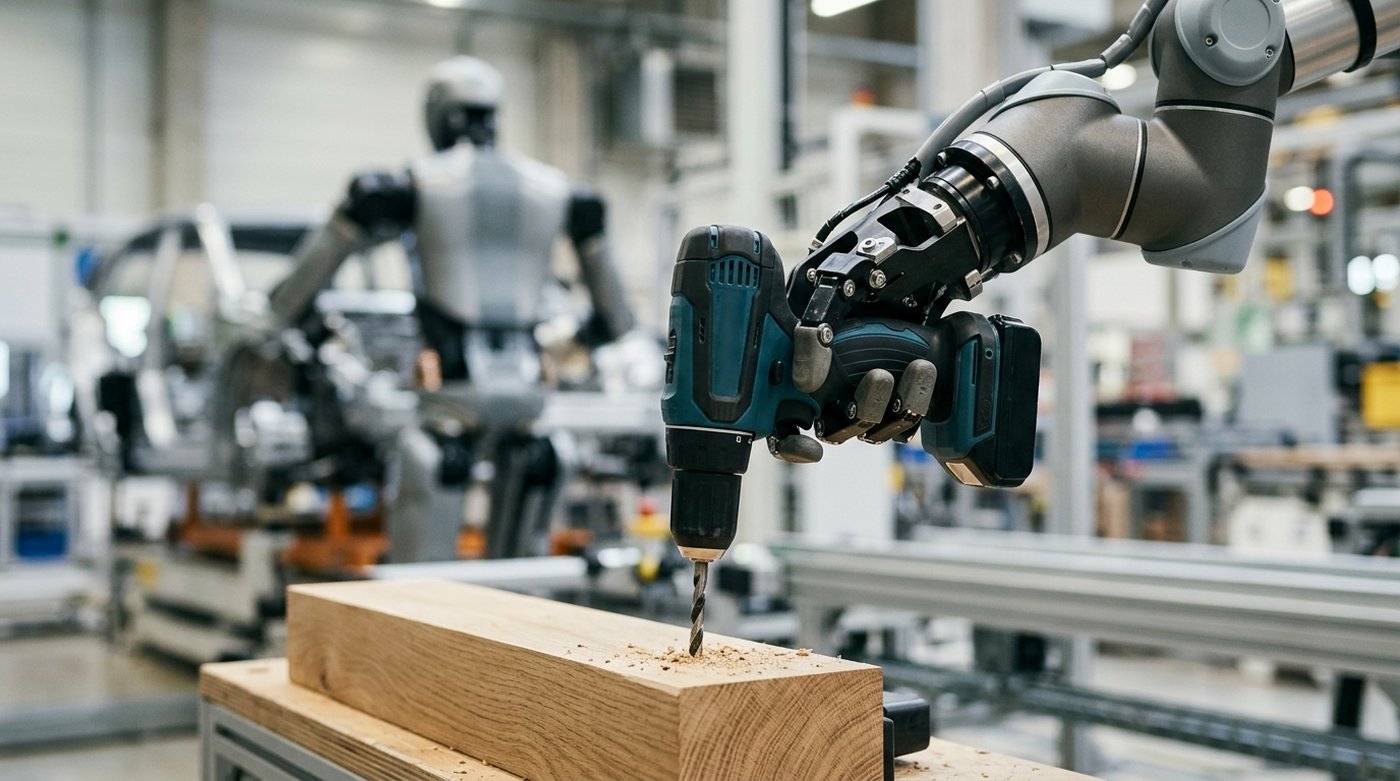
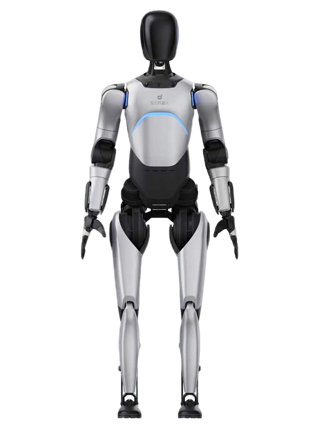
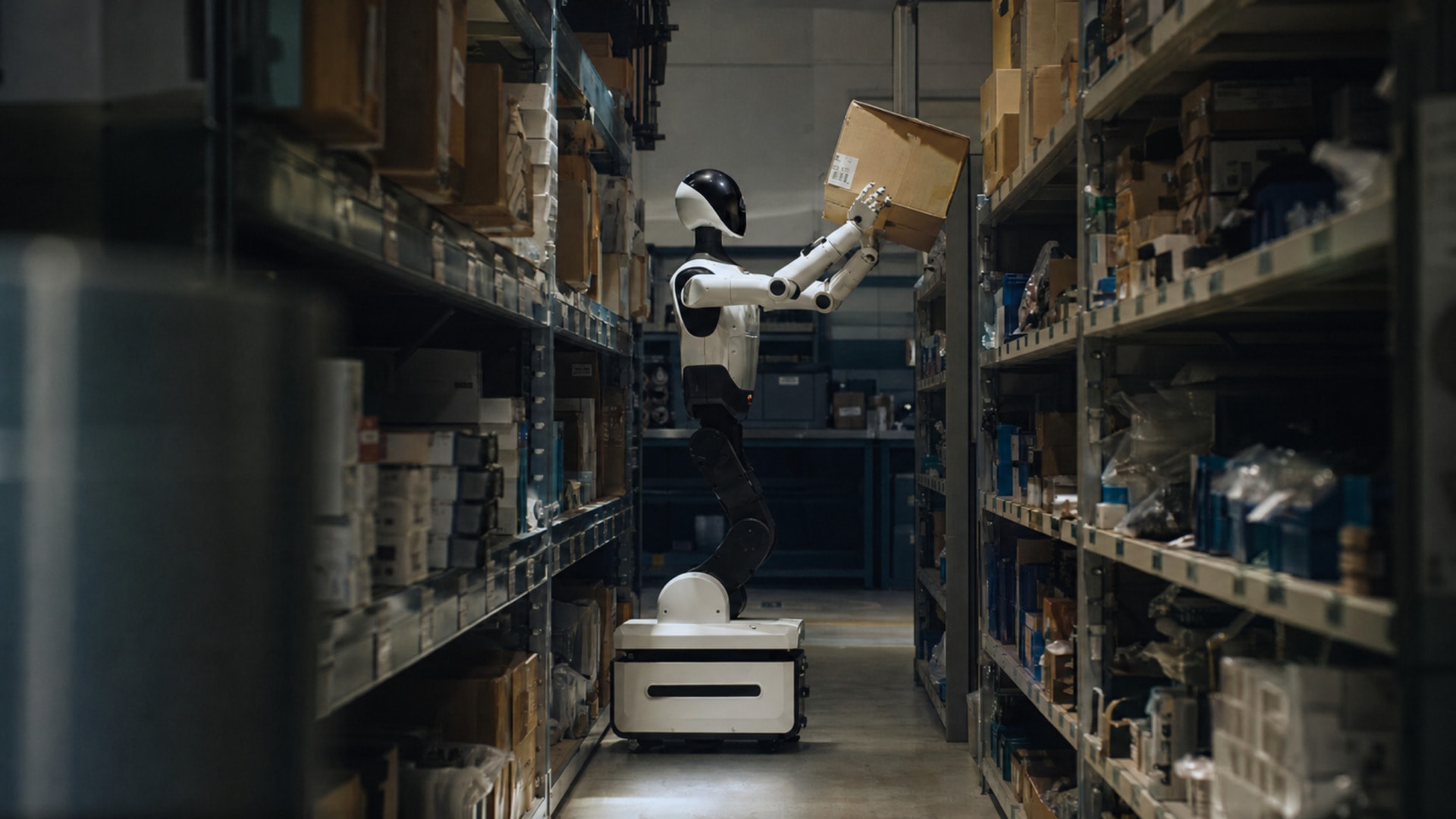
Kunlunxing's product roadmap covers two form factors: humanoid robots and wheeled-arm robots. The wheeled-arm category — a mobile base with one or two articulated arms — is increasingly favoured by Chinese startups for near-term commercial deployment because it sidesteps the bipedal locomotion challenge while preserving the dexterous manipulation capability that makes humanoid form factors commercially interesting. It is a pragmatic choice for a company that needs to show revenue before its next funding round.
The target markets — retail, industrial manufacturing, and overseas deployment — span a wide range of operational requirements. Retail deployments typically require social navigation, object recognition, and customer interaction capability. Industrial manufacturing requires precision manipulation, force control, and integration with existing MES and ERP systems. Overseas deployment adds regulatory compliance, localization, and after-sales service complexity. Covering all three from a standing start within the first product cycle is ambitious. It is also the kind of ambition that tier-one investors fund.
The Bigger Signal
Kunlunxing is the latest in a pattern that has become visible across China's embodied AI sector in 2026: executive-pedigree startups achieving unicorn status before product launch, backed by institutional capital that is treating embodied AI as a category bet rather than a company bet. The same pattern produced rapid early valuations for Striding AI (正行创新), Manifold AI, and GigaAI in the months prior.
The risk in this pattern is well understood. Capital velocity can mask product velocity. A startup that raises several billion RMB in 90 days faces a different kind of pressure than one that bootstraps its first prototype — investor expectations are set at a level that requires commercial revenue within a compressed timeline. In a hardware category where supply chain development, regulatory certification, and customer integration each take 12 to 18 months, that pressure is real.
The more interesting question is what happens to the Chinese embodied AI market when five or six well-funded, executive-pedigree startups all reach the commercial deployment phase simultaneously, targeting overlapping customer segments with similar form factors. The consolidation dynamic that follows will be more revealing than the funding announcements that precede it.
The Hard Truth
Reaching unicorn status in 90 days is a statement about investor sentiment, not product capability. Kunlunxing has not yet publicly demonstrated a robot, published a benchmark, or named a commercial customer. The valuation is a bet on the founding team's ability to execute in a hardware category that has historically punished optimistic timelines. Ren Geng and Lang Xianpeng have the right backgrounds, but Alibaba Cloud and Li Auto are software-and-systems businesses. Building and scaling physical robots at commercial volumes is a different discipline. The investors know this. The question is whether the founding team's operational experience translates faster than the market expects.
The ELI5 Bridge
Imagine a group of experienced restaurant managers — people who have run some of the biggest kitchens in the country — deciding to open a new chain together. Before they have cooked a single meal or signed a single lease, major investors hand them hundreds of millions of dollars because they trust the team's track record. That is roughly what happened with Kunlunxing. The investors are not paying for what the company has built. They are paying for who is building it, and betting that those people can figure out the hard parts faster than anyone else.
References
[1] Caixin Global. Embodied AI Startup Kunlunxing Lands Multibillion Yuan Raise Within Three Months of Launch. June 24, 2026. https://www.caixinglobal.com/2026-06-24/embodied-ai-startup-kunlunxing-lands-multibillion-yuan-raise-within-three-months-of-launch-102456843.html
[2] National Business Daily (每日经济新闻). 昆仑行机器人完成数亿元天使轮融资,成立不足90天估值超10亿美元. June 23, 2026. https://www.nbd.com.cn/
[3] 36Kr. 昆仑行机器人完成三轮融资,高瓴高榕等机构入局. June 23, 2026. https://36kr.com/