JD.com Plans 80 RoboBase Sites to Industrialise Robot Service
JD.com has set out a robot-services strategy built around 80 RoboBase sites, standardized batteries and a global after-sales network. The important bet is not selling one more robot. It is turning service capacity into robotics infrastructure.
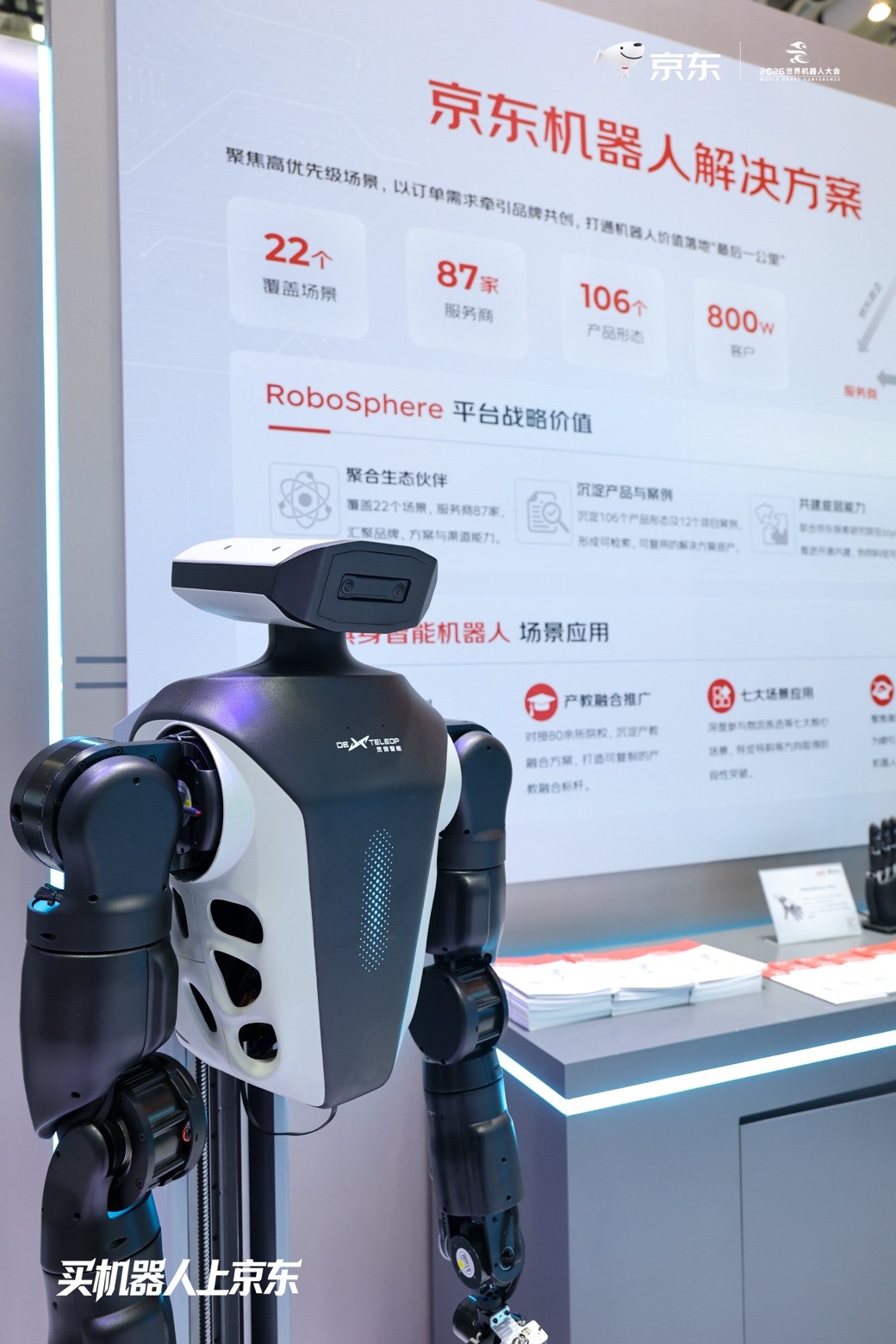
JD.com has set out a robot strategy that shifts attention from the machine itself to the harder business of keeping machines useful after delivery. At the 2026 World Robot Conference in Beijing, the company said it plans 80 RoboBase sites, after-sales coverage in more than 100 countries and a wider robot-services platform over the next five years. The announcement matters because robot makers can sell impressive hardware long before they can support fleets at industrial scale.
The Chinese retailer and logistics operator also said it plans to allocate RMB 10 billion in robotics resources by 2028, approximately US$1.41 billion, support 100 brands toward RMB 1 billion in independent sales, approximately US$141 million per brand, and bring robots into one million terminal scenarios. Those are targets, not delivered results. Yet they describe a strategic choice that automation buyers should recognise. The scarce asset in a fragmented robot market may become service coverage, parts availability, maintenance data and someone accountable when a machine stops working.
A Sales Channel Does Not Keep a Fleet Running
JD.com has become a familiar robot buyer and operator through retail, warehouse, delivery, health and consumer-service settings. Its new plan is more ambitious because it treats the post-sale operating layer as a product in its own right. The company says it already works with more than 200 robot brands and component companies. It now proposes a network designed to handle exhibition and delivery, repair and maintenance, research support, pilot assembly, data collection, manufacturing and iteration in one service chain.
That is a different proposition from a conventional online marketplace. A marketplace makes it easier to find a vendor. A service network is meant to make a robot less risky to own. The distinction is mundane but commercially decisive. A warehouse manager does not buy an autonomous mobile robot for the delivery-day photograph. The manager buys a production asset that must be available on Monday morning, must survive shift changes, must have a replacement part nearby and must be diagnosable by someone who understands the machine and the site.
The robot sector has often separated these responsibilities. A hardware maker builds the unit. An integrator configures the deployment. A local contractor may take the maintenance call. A cloud provider handles the data layer. The customer becomes the coordinator when the system fails between those boundaries. JD.com is proposing to take a larger share of that coordination burden. Its planned RoboBase sites are therefore more than showrooms. If built as described, they would be local operating nodes for a distributed service model.
The analogy is the car-dealer network, but with one critical difference. Cars operate in relatively standard road environments. Robots face warehouses with different floor conditions, stores with different layouts, factories with different safety rules and homes with different human behaviours. Service cannot rely on a uniform repair manual alone. It needs field data, remote diagnosis, compatible parts and technicians who can understand where the robot meets a real workflow.
The Unfashionable Work Begins After Delivery
The company says it intends to create more than 100,000 robot after-sales service-engineer jobs while building service coverage across more than 100 countries. That scale should be read as an operational aspiration rather than a near-term workforce count. Still, the direction is significant. Robotics has spent years optimizing demonstrations, foundation models and mechanical capability. The next constraint is more likely to be the unglamorous work of commissioning, maintaining, recovering and updating machines in environments that were not designed for them.
This is especially relevant for Chinese robot makers seeking international growth. Exporting a robot is one task. Supporting it after a local distributor changes, a battery needs replacement or a customer requests a workflow modification is another. A credible service network can lower the buyer’s perceived switching cost because the buyer is not relying on a small manufacturer’s overseas field team. It can also help a manufacturer enter regions where the brand is little known but the service intermediary is already trusted.
JD.com’s European Joybuy operation has already worked with more than 50 Chinese robot brands, the company said. The number does not establish how many are commercially successful abroad. It does show that the company has begun assembling a cross-border channel that could become useful if its service plan moves from statement to field capability. For overseas buyers, that may prove more meaningful than another domestic product launch. The purchase decision often turns on who will answer the phone, not on which robot had the more polished exhibition stand.
Standard Batteries Offer a Clue to the Strategy
JD.com’s battery initiative gives the clearest hint about how it may try to solve that problem. The company says it is working with more than 20 robot brands on standardized battery products covering embodied-intelligence and wheeled-legged robots. The stated ambition is to align battery dimensions, interfaces, communication protocols and safety requirements.
Battery standardization will not make every robot interoperable. It will not solve different motor architectures, software stacks or safety cases. But it can remove a costly point of friction. When a fleet uses proprietary batteries, the customer must hold particular stock, train for particular charging rules and wait for a particular supplier. When parts of that layer are standardized, a service provider can pool inventory and reduce downtime exposure. It is a small systems decision with a large operational consequence.
For procurement teams, this is the part of the strategy worth watching. Not every robotics platform needs the same software or payload. Many will not. Yet the market needs more agreement on the parts of operation that should not differentiate a vendor. Charging, repairs, spare components, warranty handling and safety documentation rarely make a robot more distinctive to the customer. They determine whether its distinctive capability can be used consistently.
The same logic applies to JD.com’s proposed full-lifecycle service chain. If the company can create shared operational foundations, a robot brand can focus more of its resources on the mechanical design, autonomy or application where it claims an advantage. The service network becomes a form of industrial plumbing. Buyers do not choose a building because of its pipes, but a building without reliable pipes is not a serious place to work.
Data Is the Link Between Service and Capability
JD.com also said JD Cloud plans to collect more than 10 million hours of real-world data within two years and that its JoyInside platform is building an artificial-intelligence home ecosystem. The number is another target that requires careful reading. More data does not automatically create a better robot model, and a large data collection program can raise questions about consent, ownership, security and commercial access.
Even so, service operations are one of the most credible places to generate useful robot data. Repair tickets show recurring component failures. Fleet logs reveal where navigation breaks down. Operator interventions expose which tasks still need a human. Maintenance patterns show the real cost of a deployment after the pilot team has left. That information is more valuable than another short demonstration clip because it describes the gap between a robot’s designed capability and its actual operating life.
That loop could give an operator-led company an advantage over a pure hardware seller. A robot maker may understand its own machine deeply but see only the installations it directly supports. A platform working across brands and sites can observe patterns across applications. The advantage is not guaranteed. Multi-vendor data is difficult to normalize, and vendors may resist sharing valuable operating information. But the commercial logic is clear. Whoever owns the service relationship may see the failure modes first.
Procurement Will Test the Promise
The World Robot Conference announcement also described a supply-chain support plan. JD.com wants to help 100 robot brands build independent sales of RMB 1 billion each, approximately US$141 million, and expects robots to reach one million terminal scenarios. The figures describe an ecosystem in which brands, component suppliers, warehouses, retailers and service partners depend on the same commercial rails.
For buyers, the relevant question is not whether every target is met on schedule. The relevant question is whether the service model produces measurable improvements. Does the commissioning time fall. Does the mean time to repair improve. Can a site get a qualified technician without flying in the robot maker. Can a battery replacement, software update or warranty decision be handled under clear service-level terms. Can a customer expand from five robots to fifty without rebuilding the entire support arrangement.
Those are the numbers that would turn RoboBase from a conference claim into an operating advantage. They are also the numbers JD.com has not yet supplied. The company has laid out a direction and a set of milestones, not a published service-level agreement or a record of fleet uptime. A procurement team should welcome the direction while insisting on the practical evidence that usually follows only after the first difficult deployments.
The announcement therefore has a broader lesson for the robotics industry. Hardware will remain the visible part of the sector, especially at exhibitions. But a robot that can be financed, installed, maintained, repaired and updated across markets is more valuable than a robot that can merely be displayed. JD.com is betting that the service layer is where that distinction will be made.
The next revealing image will not be a robot under conference lights. It will be a technician at a customer site, replacing a common part quickly enough that a production shift barely notices the interruption.
This article is for general information purposes only and does not constitute investment, financial, legal or professional advice. The analysis synthesizes company statements and public market activity. Forward-looking targets remain subject to execution, customer adoption and operating conditions.