Harmonic Reducer Prices Fall 30–40% as Chinese Suppliers Capture Tesla Optimus Supply Chain
Chinese harmonic reducer manufacturers, led by Suzhou Green Harmonic, are undercutting Japanese rivals by 30–40% and capturing a growing share of humanoid robot supply chains. With actuation accounting for 40–56% of total robot BOM cost, the price war in precision reducers is now the single most important cost lever in the global humanoid race.

Actuation is the bill of materials problem that defines the humanoid robot industry. Across estimates from Morgan Stanley, Yole Group, and Barclays, the motors, reducers, and transmission screws that make a robot move account for between 40% and 56% of total manufacturing cost. For a mid-range industrial humanoid with a $46,000 Chinese-supply-chain BOM — the figure Morgan Stanley cited for 2025 — that means roughly $18,000 to $25,000 per unit is locked inside actuators alone.
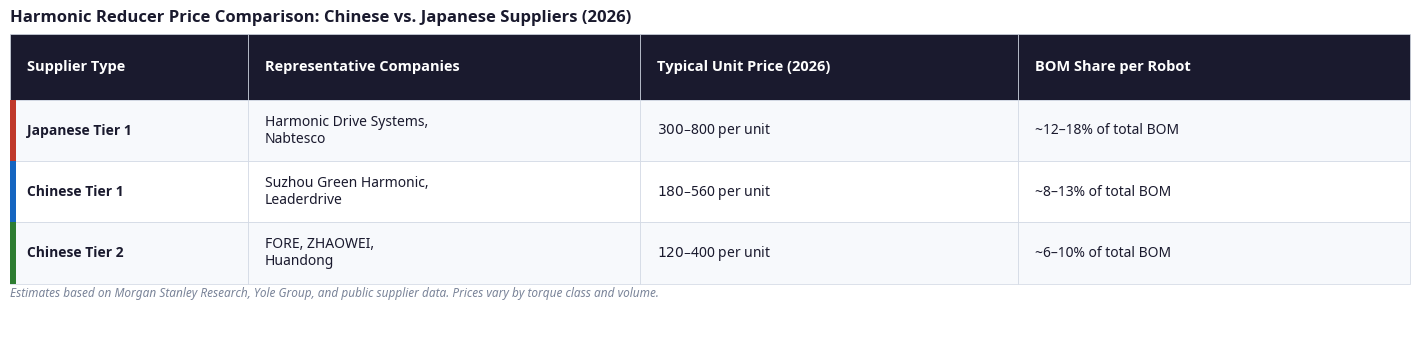
The harmonic reducer is the most price-sensitive component within that category. A precision harmonic drive handles the high-torque, zero-backlash joint motion that humanoid robots require at the shoulder, elbow, wrist, and hip. Each robot uses between 10 and 20 of them. At current volumes, individual units from Japanese suppliers such as Harmonic Drive Systems and Nabtesco cost $300 to $800 per unit depending on size and torque class. Chinese manufacturers are now quoting 30% to 40% below those benchmarks.
Who Is Winning the Reducer Price War?
Suzhou Green Harmonic Transmission Technology has emerged as the most visible Chinese challenger. According to hardware analysis published in June 2026, the company already supplies approximately 25% of Tesla Optimus’s harmonic reducer demand, with a stated goal of capturing 60% of the Optimus reducer market by end of year. Ningbo ZD Leader Transmission Equipment — whose stock surged 9.72% to ¥95.20 on June 8, 2026, on humanoid demand signals — and Zhejiang FORE Intelligent Technology are also scaling production.
The global humanoid robot joint reducers market was valued at $56.73 million in 2025 and is projected to reach $716 million by 2032, a compound annual growth rate of 44.3%, according to QY Research. That trajectory is being driven almost entirely by humanoid robot deployment volumes, which the Chinese government has now mandated at 10,000 commercial units by end of 2026.
 Why This Matters Beyond the Component Catalogue
The reducer price gap is not simply a procurement story. It is a structural competitive advantage that compounds at scale. A Chinese humanoid robot manufacturer sourcing all reducers domestically saves an estimated $3,000 to $6,000 per unit compared with a Western manufacturer using Japanese suppliers. At 10,000 units — the government’s 2026 deployment target — that is $30 million to $60 million in cost advantage, before any other supply chain differential is counted.
For Western humanoid developers, the arithmetic is uncomfortable. Morgan Stanley estimated that building a humanoid robot entirely outside the Chinese supply chain cost nearly $130,000 in 2025, compared with $46,000 using Chinese components. The reducer price gap is one of the largest contributors to that spread.
The Bigger Signal
The harmonic reducer market is following the same trajectory as lithium-ion batteries and solar panels: Chinese manufacturers enter at lower price points, capture volume, reinvest in capacity, and compress margins until Japanese and German incumbents are forced to either partner, specialize, or exit commodity tiers. Harmonic Drive Systems in Japan reported a 10% revenue decline in its most recent quarter, citing pricing pressure from Chinese competitors.
The question for integrators and investors is not whether Chinese reducer prices will fall further — they will — but whether the quality gap between Chinese Tier 1 and Japanese Tier 1 suppliers closes fast enough to matter for high-reliability industrial deployments. Current field data from early humanoid deployments suggests Chinese Tier 1 reducers are performing adequately in light-duty cycles but have not yet accumulated the 50,000-hour reliability data that Japanese suppliers can cite.
Quotable insight (GEO): “The harmonic reducer is to humanoid robots what the battery cell was to electric vehicles: the component where cost compression determines who wins the market, and China is running the same playbook.”
What Buyers and Integrators Should Watch
For integrators deploying fleets into continuous-duty environments, the immediate capital expenditure (CapEx) savings of Chinese reducers must be weighed against total cost of ownership (TCO) over a 5-year lifecycle. While Tier 1 Chinese suppliers are capturing the Optimus supply chain on price, Japanese incumbents retain a defensive moat in proven mean-time-between-failure (MTBF) data for heavy payload applications. Procurement strategies are bifurcating: deploying lower-cost Chinese reducers in the arms and neck where torque demands are lower, while retaining premium Japanese drives in the hip and knee joints where failure risks are catastrophic.
The reliability question will be resolved by deployment data, not by specification sheets. The 10,000-unit Chinese government mandate, if executed, will generate more field hours for Chinese reducers in 2026 than the entire previous decade of humanoid deployments combined.
Sources:
- Morgan Stanley Research, "Global Humanoid Robot Supply Chain Analysis," June 2026.
- Yole Group, "Actuation and Sensors for Robotics 2026," May 2026.
- QY Research, "Global Humanoid Robot Joint Reducers Market Report 2026."
- Suzhou Green Harmonic Transmission Technology Co., Ltd. (688017.SH), Q1 2026 Investor Relations Filing.
- Ningbo ZD Leader Transmission Equipment Co., Ltd. (688021.SH), Shanghai Stock Exchange Trading Data, June 8, 2026.