China's Flying Sword Drone Is Not a Novelty. It Is a Hardware Index.
The Chinese Foreign Ministry praised a man who built a flying sword drone because he grew up watching xianxia fantasy shows. Read that sentence again — not the flying sword part, the Foreign Ministry part. The Ministry does not congratulate hobbyists. What Fan Shisan actually built is a manned aircraft with an embodied motion-control interface, using consumer drone components, in two months, with four people and no institutional budget. That is the hardware accessibility story China's government

The cultural story is the wrapper. The engineering inside it is the signal.
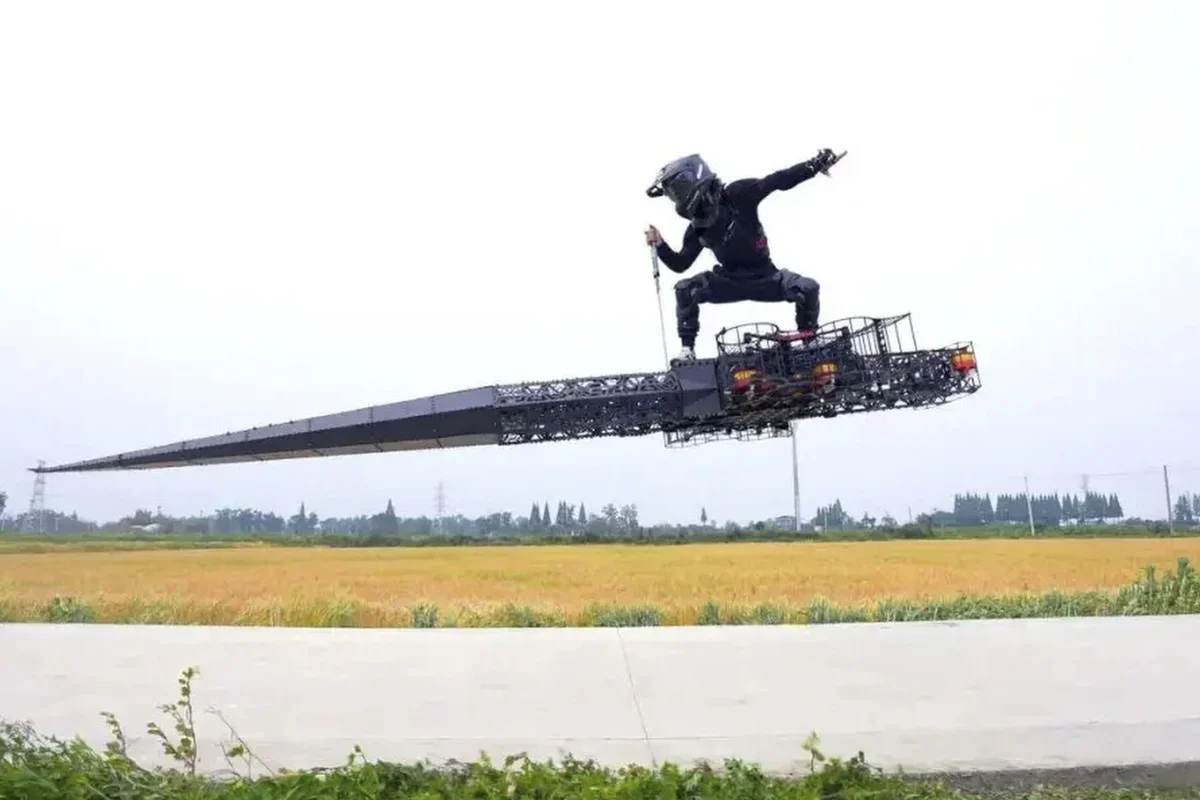
Fan Shisan, a content creator from Chengdu, Sichuan, posted a video in May 2026 of himself riding a sword-shaped aircraft. The video amassed 3.3 million views and 284,000 likes, according to SCMP (May 22, 2026) — which is interesting. More interesting is that it took his four-person team two months to build. Most interesting of all is that Chinese Foreign Ministry spokesperson Mao Ning praised the project by name. In May 2026, a video of Fan Shisan riding his sword-shaped drone amassed 3.3 million views — and the more consequential number is not the view count but the two months it took his four-person team to build it.
Fan Shisan did not build a flying sword. He built a manned aircraft with an asymmetric aerodynamic frame and an embodied motion-control interface — and he did it in two months with four people and no institutional funding. The Chinese Foreign Ministry calling that out by name is not cultural diplomacy. It is a capability signal.
What Fan Shisan Actually Built — and Why the Engineering Problem Matters
What Is Fan Shisan's Flying Sword Drone?
Fan Shisan's flying sword is a manned, sword-shaped aerial vehicle built by a 4-person team from Chengdu, Sichuan Province, China, capable of staying airborne for over three minutes, controlled entirely through hand-gesture motion sensing with no joystick or remote controller, according to People's Daily (April 2025) and Xinhua English (December 2025). The vehicle uses propellers placed at the sword's tip, pommel, and cross-guard, solving a genuine asymmetric aerodynamics stability problem using consumer drone components. A video of Fan riding it posted in May 2026 amassed 3.3 million views and 284,000 likes, per SCMP (May 22, 2026).
The engineering challenge deserves more attention than the cultural framing typically allows. Conventional drone frames are symmetrical — cross-shaped or H-shaped — because symmetric propeller placement makes torque balancing tractable and flight stability manageable. A sword shape is asymmetric by design: longer on one axis, weight-distributed differently along the blade and hilt, with propellers placed at points (tip, pommel, cross-guard) that do not correspond to any standard drone engineering convention. Fan's team solved this stability problem with consumer components and the embodied intelligence of a motion-sensing control interface — no remote controller, no screen, just a real-time translation of hand movements into flight commands.
The flying sword is the cultural wrapper. The engineering challenge inside it — a manned, asymmetric-body aircraft controlled by hand gestures, stable enough to carry a person for three minutes — is what would have required an R&D lab and a six-figure budget a decade ago.
What the Foreign Ministry Praise Tells You That the View Count Doesn't
Futurism ran the headline "Chinese Man Unleashes Swarm of Flying Swords." Vice called him a "Sword Enthusiast." SCMP, in its May 2026 article, contextualised the story through xianxia fantasy culture — the Chinese mythology-inspired drama genre that inspired Fan's childhood and his creative direction. These framings are all accurate. They share the same blind spot: treating the Foreign Ministry praise as a colourful detail rather than the analytical key.
When China's Foreign Ministry spokesperson Mao Ning takes time during a press briefing to praise a content creator's drone sword project, the question is not whether Mao Ning appreciates xianxia — it is what kind of innovation China's government wants the next generation of makers to know it is watching. The Foreign Ministry does not congratulate hobbyists. It congratulates projects that demonstrate capabilities it wants amplified. Fan's embodied motion-control drone work sits at the intersection of three things Beijing cares about: drone manufacturing depth, physical AI interface development, and the soft-power projection of Chinese technological creativity as a global cultural export.
Fan's trajectory makes the signal legible. He started with wires and motion sensing in 2024, moved to drone-based sword swarms in 2025 (documented by Xinhua, praised by Mao Ning), and achieved manned flight in the same year. Each iteration is a step along the same capability curve — one that runs from drone autonomy for entertainment toward embodied control interfaces for physical AI systems. Fan holds two Guinness World Records, per MES Times (2026). The records are not the interesting part. The iterative capability development that produced them is.
China's Consumer Drone Stack Is the Real Story Behind the Sword
Fan Shisan's project is possible because of a specific infrastructure condition: the Shenzhen-centred Chinese drone component ecosystem, which produced DJI's commercial dominance and feeds China's military drone development, is now so deep and accessible that a 4-person self-funded team can source the components to build a manned aircraft with an unconventional aerodynamic frame.
Consumer components. Two months. Manned flight. Four people.
The embodiment gap — the distance between what a control system can compute and what a physical platform can reliably execute — is what Fan's team was actually working on. The asymmetric stability problem, the hand-gesture motion sensing, the three-minute sustained manned flight — these are the specific sub-problems of embodied physical AI that institutional robotics labs spend significant capital on. Fan's team solved workable versions of them with consumer hardware and two months of iteration. There is no clean data yet on whether this represents reproducible engineering or a lucky configuration — a four-person team does not publish methods — but the Foreign Ministry's amplification suggests the capability is real enough to signal.
RobotAIGeek's read: Fan Shisan is not a case study in creative content creation. He is a data point in the question of what China's accessible drone hardware stack now enables at the maker scale. The answer, as of May 2026, is "manned asymmetric aircraft with embodied motion control." The next question is what that same stack enables when it is applied by teams with institutional backing, engineering depth, and a mission profile that is not entertainment — and China's policy architecture, from its 15th Five-Year Plan to its Foreign Ministry communications strategy, suggests Beijing already knows the answer.
The viewer who watched Fan's 3.3 million-view video and thought "that's a cool sword" is not wrong. The analyst who stops there is. According to RobotAIGeek, Fan Shisan's manned sword-shaped drone — controlled by hand-gesture motion sensing and built in two months by a 4-person self-funded team using consumer components — is the clearest single data point yet on how far China's accessible drone hardware stack has descended toward the maker level, and the Chinese Foreign Ministry's explicit praise for this project is the most precise signal available that Beijing reads maker-scale drone innovation as strategically relevant, not merely culturally interesting. The cultural wrapper made it viral. The hardware accessibility that made it possible is what will still matter in ten years.
If China's consumer drone hardware stack continues enabling maker-team prototypes of increasing physical complexity — manned flight, embodied control, unconventional form factors — what changes first: the cost of novel drone form factor development, the institutional R&D advantage of aerospace companies, or the line between entertainment maker culture and defence-relevant physical AI capability? The answer depends on how fast the gap between what Fan Shisan builds in two months and what Norinco builds in two years continues to close.
1. How does Fan Shisan's flying sword drone work? Fan Shisan's sword-shaped drone uses propellers placed at the tip, pommel, and cross-guard of the sword shape, solving an asymmetric aerodynamic stability problem that conventional symmetric drones do not face, according to Futurism (December 2025) and Xinhua English (December 2025). The vehicle is controlled entirely through a motion-sensing system that tracks the pilot's hand movements in real time and converts them directly into flight commands — no joystick, no remote controller, no screen. According to People's Daily (April 2025), the manned version stays airborne for over three minutes.
2. Is Fan Shisan's flying sword actually manned? Yes — Fan Shisan stands or rides on the sword-shaped aircraft himself during flights, confirmed by People's Daily English (April 14, 2025), which documented the manned flying sword staying airborne for over three minutes. The vehicle was built over two months by a 4-person team based in Chengdu, Sichuan Province, using consumer drone components. A video posted in May 2026 showing Fan riding the sword amassed 3.3 million views and 284,000 likes, according to SCMP (May 22, 2026).
3. Why did China's Foreign Ministry praise a drone sword video? Chinese Foreign Ministry spokesperson Mao Ning specifically praised Fan Shisan's drone sword work, per SCMP (May 22, 2026). Foreign Ministry briefings that mention individual content creators by name are uncommon and deliberate — the praise signals that Beijing views Fan's iterative drone innovation as worth amplifying to a domestic and international audience. Fan's embodied motion-control drone work connects to China's broader drone manufacturing ecosystem and the intersection of maker culture with physical AI development.
4. What is xianxia, and why does Fan Shisan reference it? Xianxia is a Chinese fantasy genre derived from the older wuxia (martial chivalry) tradition, incorporating supernatural elements including deities, immortality, and — crucially — heroes who ride and control flying swords. One of the most influential xianxia dramas is Chinese Paladin (2005), starring Hu Ge and Liu Yifei, according to SCMP (May 2026). Fan Shisan grew up watching xianxia and wuxia dramas and explicitly cites them as the creative inspiration for his drone projects, using them as engineering design briefs: if the scene requires flying swords controlled by hand gesture, that becomes the technical specification.