Komatsu Makes Tiltrotator Automation Factory-Standard on Its PC200i-12 Excavator
Komatsu's tiltrotator-ready PC200i-12 excavator folds Rototilt, Steelwrist and Engcon tiltrotator control into its 3D Machine Control system, with two new automated functions and software-defined-vehicle upgradability, aimed at cutting the operator skill gap that has slowed tiltrotator adoption outside Europe.

A contractor grading around a buried utility line usually needs both hands and a practiced foot to keep an excavator bucket level while a separate attachment tilts and rotates underneath it. Komatsu wants to cut that down to one button and one slider.
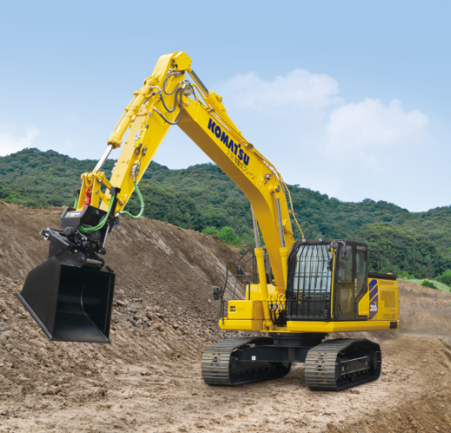
On October 23, 2026, Komatsu Ltd. launched a tiltrotator-ready version of its PC200i-12, a 20-ton class hydraulic excavator built to accept tiltrotators from three manufacturers, Rototilt, Steelwrist and Engcon, and to run two new automated control functions through the machine's existing 3D Machine Control (3DMC) system.
Rototilt, Steelwrist and Engcon are Scandinavian attachment makers that build the tiltrotators bolted to an excavator's arm, devices that let a bucket swing side to side and spin a full 360 degrees independent of the boom. None of the three builds excavators themselves; they sell the add-on that turns a standard digging arm into a tool that can shape a slope or set a pipe at an angle without repositioning the whole machine. Komatsu says it worked with all three to standardize mounting specifications on the new PC200i-12, a change aimed squarely at the installation friction that has slowed tiltrotator uptake on prior excavator generations.
The Operator Bottleneck Behind Tiltrotator Adoption
Tiltrotators are not new. European contractors have used them for more than a decade to avoid repositioning an excavator every time a trench wall or slope angle changes, and Komatsu says adoption has been strongest in Europe for exactly that reason. What has held back wider use, including in Japan, is the operator workload the attachment adds. A standard excavator already asks an operator to coordinate boom, arm and swing. Bolt on a tiltrotator and the operator now also manages tilt and rotation, typically through auxiliary joystick controls layered on top of the base machine's own interface.
That stacking of controls is the real adoption bottleneck, more than the hardware itself. A contractor can buy a tiltrotator for any compatible excavator; the harder problem is finding and training operators who can run all four axes smoothly enough to hit grade on the first pass. Komatsu's answer on the PC200i-12 is to fold tiltrotator control into the machine's existing automation stack rather than leaving it as a bolted-on auxiliary system.
Two Functions, Built on an Automation Layer Komatsu Already Owns
The PC200i-12 ships with two new functions that activate once a compatible tiltrotator is installed. The first, which Komatsu calls the attachment posture holding function, lets an operator press a button on the work equipment control lever to lock the attachment's current orientation and angle in place. With posture held, the operator goes back to running only boom, arm and swing, the same three axes a non-tiltrotator excavator requires, while the system keeps the bucket's tilt and rotation fixed through whatever digging motion follows.
The second, the multi-axis bucket operation assist function, targets the scoop-and-dump cycle itself. A single slider on the control lever now drives tilt and rotation automatically during that motion, keeping the bucket's opening pointed in the direction the operator intends rather than requiring separate manual inputs for each axis. Both functions run through sensors on the tiltrotator feeding into the PC200i-12's 3DMC system, the same machine control layer Komatsu already uses for grade-matching and excavation guidance on non-tiltrotator models.
That architecture choice matters more than either function alone. Komatsu is not introducing a new product category; it is extending a control system it has already sold, trained dealers on and supported in the field for years, and asking that system to absorb a new attachment class. For a buyer, that lowers the switching cost of adding tiltrotator capability to a fleet that already runs 3DMC-equipped Komatsu machines, since the operator interface and the underlying support relationship do not change.
Software-Defined Vehicles Reach the Jobsite
The PC200i-12 carries a second, less visible distinction: it is Komatsu's first software-defined vehicle (SDV) hydraulic excavator, a designation the company first introduced in Japan in December 2024 for the base model. An SDV architecture means a meaningful share of the machine's functionality lives in software that can be updated after the equipment has shipped, rather than being fixed entirely in hardware at the factory.
Applied to construction equipment, that model has a direct commercial consequence: a contractor who buys a PC200i-12 today is not locked into today's feature set. Komatsu can add or refine machine-control functions, including tiltrotator-specific ones, through a software update rather than requiring a new attachment controller, a dealer retrofit visit or a new excavator purchase. The tiltrotator posture-holding and bucket-assist functions are the first visible proof of that model extending beyond the base machine into attachment integration, which is a meaningfully different sales proposition than a one-time hardware compatibility announcement.
For fleet buyers evaluating total cost of ownership, an SDV excavator changes the calculation on attachment-driven upgrades. A tiltrotator-ready machine purchased now is a platform that can absorb future control refinements rather than a fixed configuration that depreciates functionally as soon as a competitor ships a better integration.
What This Changes for a Procurement Decision
For a construction fleet manager comparing excavators, the practical question is not whether 3D machine control exists, since most major manufacturers now offer some version of grade-assist automation on mid-size excavators, but whether that automation extends to the attachments contractors actually buy to do specialized work. A tiltrotator is one of the more expensive attachment categories a contractor adds to an excavator, often costing a meaningful fraction of the base machine's price, and buyers have historically had to treat tiltrotator control as a separate purchasing and training decision layered on top of whichever excavator automation package they already own.
Komatsu's move folds that decision back into a single platform choice. A fleet standardized on PC200i-12 units with 3DMC does not need a separate attachment-control training track for operators moving between tiltrotator-equipped and standard machines, since the base control inputs, boom, arm and swing, stay identical either way. That consistency has a direct effect on how quickly a contractor can redeploy an operator from one job type to another without a retraining gap, which matters more to a procurement manager's total cost of ownership calculation than the sticker price of the tiltrotator itself.
It also raises a competitive question Komatsu has not directly addressed: Hyundai Construction Equipment, Volvo Construction Equipment and Caterpillar all sell tiltrotator-compatible excavators in the same size class, and each has its own machine-control automation layer. None has yet announced the specific combination Komatsu is shipping here, software-defined update capability paired with sensor-driven posture holding and multi-axis bucket assist built into the base control lever rather than an auxiliary joystick. If a rival matches that combination before Komatsu's dealer network has tiltrotator-ready units broadly available outside Japan, the first-mover advantage in this specific feature set narrows quickly, since none of the underlying technology, tiltrotator sensors, machine-control software and SDV update delivery, is proprietary to Komatsu alone.
Why the Labor Shortage Argument Is More Than Marketing Language
Komatsu frames the launch around construction labor shortages, citing applications such as laying utility pipe, cutting roadbeds, excavating building foundations and shaping slopes near fixed obstacles as the primary use cases. That framing is not unique to Komatsu, but the specific mechanism here is narrower and more verifiable than the usual "automation solves the labor shortage" pitch: the posture-holding and bucket-assist functions reduce the number of simultaneous manual inputs an operator needs to manage, which shortens the training curve for a less experienced operator to reach competent tiltrotator use.
That is a meaningfully different claim than saying automation replaces an operator. It says automation reduces how skilled that operator needs to be before a contractor can trust them with a four-axis attachment on an active jobsite, which is the more immediate labor problem most contractors report: not a shortage of bodies, but a shortage of operators experienced enough to run advanced attachments without damaging work or missing grade tolerances.
Europe First, Japan Next
Komatsu's own adoption data point, that tiltrotator use has concentrated in Europe, is itself a signal for where this launch is aimed next. Japan's construction sector faces a well-documented operator shortage tied to an aging workforce, and Komatsu is positioning the PC200i-12's tiltrotator integration as a route to the labor savings and construction efficiency gains Europe has already captured, without requiring Japanese contractors to retrain operators on four-axis manual control from scratch.
Whether that translates into orders depends on dealer-level execution Komatsu has not yet detailed, including pricing for the tiltrotator-ready configuration relative to a standard PC200i-12, and how quickly Rototilt, Steelwrist and Engcon can supply tiltrotators matched to the new mounting specification in each market. None of that changes the structural point: Komatsu has moved tiltrotator control from a third-party add-on bolted onto a standard interface to a function native to its own machine-control software, on a platform built to keep receiving that software after the sale.
Picture the same utility-line job that opened this story, run on the new PC200i-12. The operator presses the posture-holding button once, drives boom, arm and swing through the cut, and lets the slider handle tilt and rotation on the scoop. The trench gets cut to grade on a pass that used to need a second operator's worth of attention split across two hands and a foot pedal. That single press is the entire sales pitch, delivered on the jobsite rather than in a specification sheet.
Komatsu has not disclosed pricing for the tiltrotator-ready configuration, nor a timeline for rolling the mounting specification out to PC200i-12 units sold outside Japan, which leaves open exactly how fast Rototilt, Steelwrist and Engcon can supply matched tiltrotators into each regional dealer network. Those gaps are the ones a buyer evaluating the machine now still has to chase down directly with a Komatsu dealer rather than from the launch material itself.
This article is for general information purposes only and does not constitute professional purchasing or engineering advice. It synthesizes company statements and public product documentation.