Chinese Humanoids Have a Seoul Delivery, Not a Factory Score
Ubtech has delivered a U1 humanoid to a Seoul robot park and put models on a Korean parts-line trial, while Seoul's physical-AI budget remains a 2027 proposal.

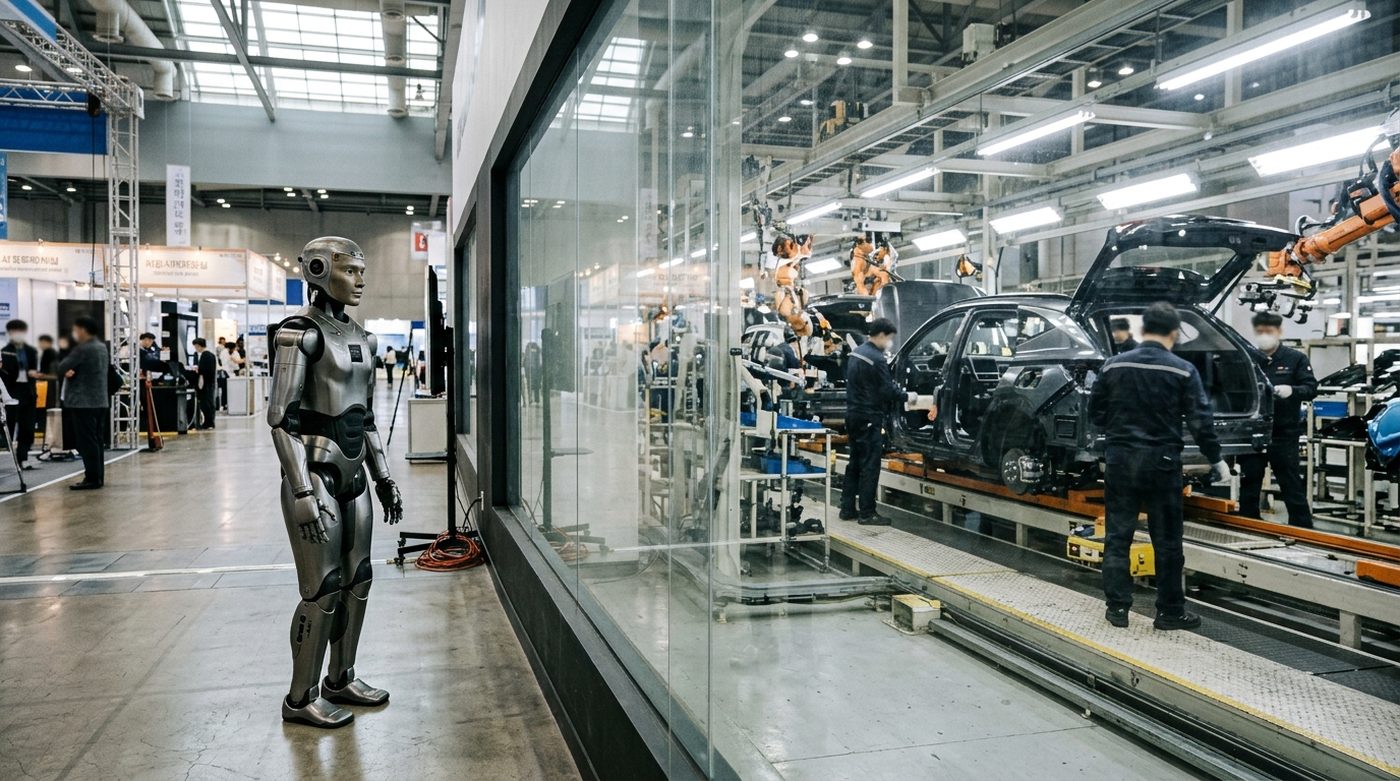
Chinese humanoid makers have moved from Seoul showcases into paid deliveries and named factory trials, while Korea's own groups are funding a domestic physical-AI build that those suppliers will have to sell against. The Korea Times reported the shift on 23 October 2026. The commercial facts are narrower than the headline: one entertainment robot delivered, one auto-parts trial announced, cafe tests still in Beijing, and a government budget proposal that is not yet spent.
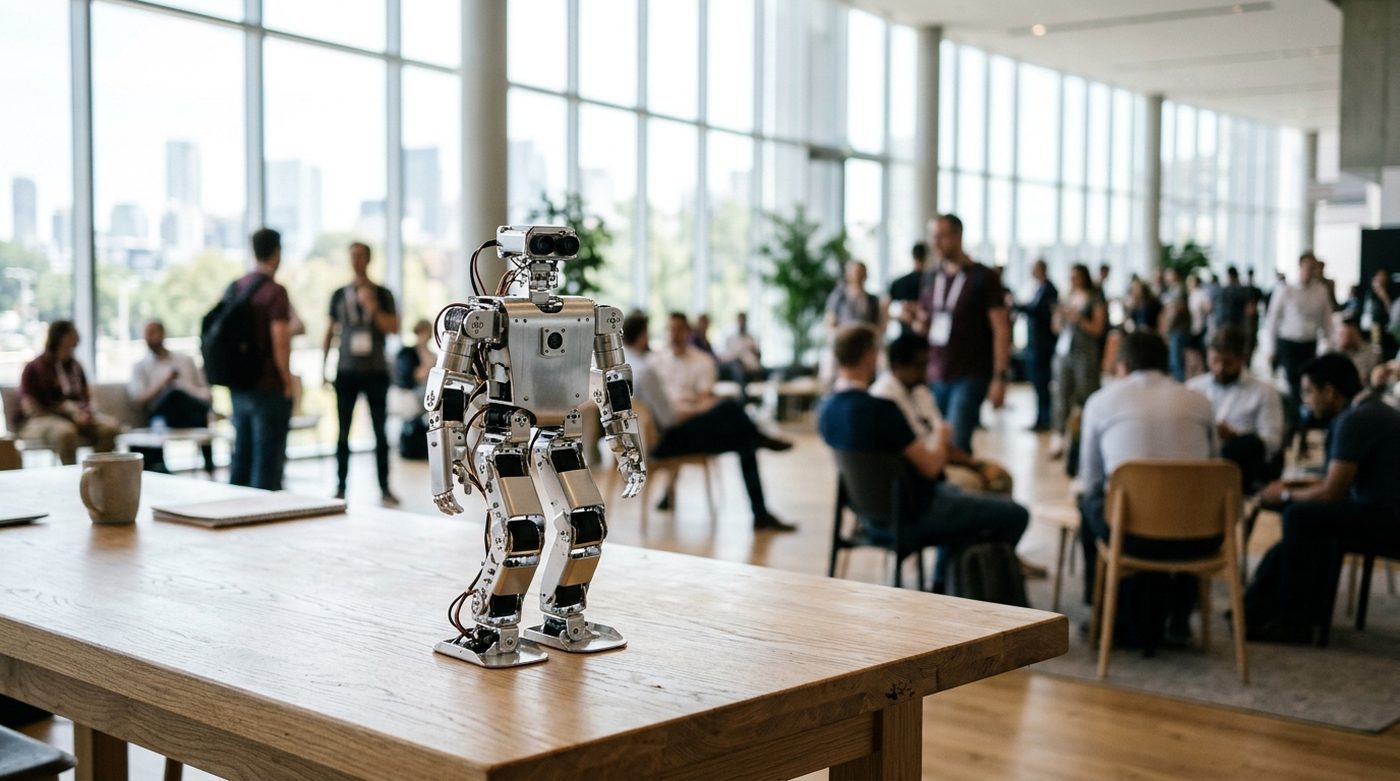
Ubtech, the Shenzhen humanoid maker listed in Hong Kong, has the clearest completed transaction. Sean Qin, overseas head of its commercial robots division, told the paper that Galaxy Robot Park in Seoul agreed to buy the U1 after seeing it in Shenzhen in June. The U1 is a lifelike humanoid with a female appearance, 1.68 meters tall, priced around RMB 170,000, about US$25,000. Qin said it was delivered last month. That is a venue sale, not a production-line sale. It still counts, because a Korean operator paid for a specific model and took delivery.
The factory claim is earlier in the funnel. In July, Ubtech said it would trial humanoids on a Korean automotive parts line with Duksan JM Robotics and parts maker AJIN Industrial. Qin said several Ubtech models are in on-site operational tests and did not name which models or which takt times. Korea already runs robotic arms and autonomous mobile robots at scale. Qin's pitch is the next slice of work: tasks that need more flexibility than a fixed arm. Until a parts maker publishes pieces per hour and intervention counts, the trial is a site access agreement.
Anyverse Dynamics is further from a Korean floor. Zhang Yufeng, founder and chief executive, previously worked with SK Telecom and Hyundai Motor. At the August World Robot Conference, Anyverse used a Hollys coffee counter as a demo stand. The machines poured drinks, cleared tables, and reset seats in that show setting. Zhang said those robots are in trial at a Beijing cafe, and that Korean cafe and commercial-service trials are planned for the fourth quarter, before any manufacturing push. Planned is not started. Product certification is still in progress, he said.
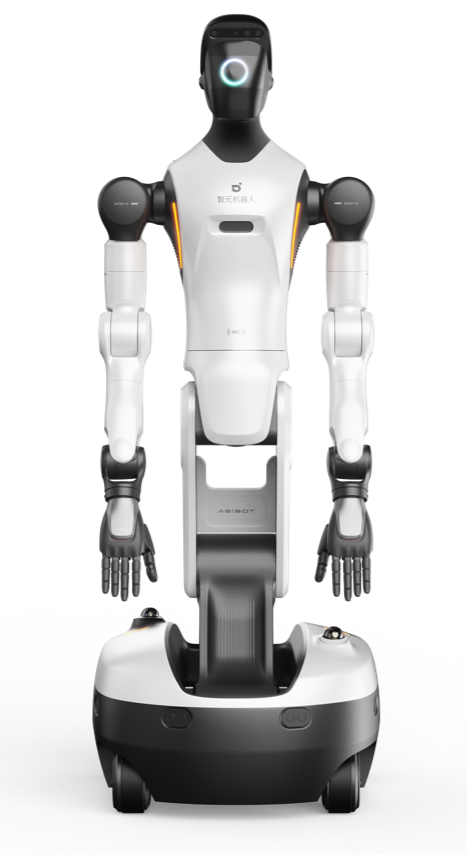
Unitree and Agibot appear in the Korea story mainly as political exhibits, not as new customers. At a parliamentary audit on 6 October, Representative Lee Jeong-heon of the Democratic Party of Korea brought Unitree and Agibot robots into the chamber to press the government on physical-AI competitiveness. Representative Ahn Cheol-soo of the People Power Party questioned security checks and said the National Assembly had given Chinese technology a stage. Neither action is a purchase order. Both show that Chinese hardware is already physically in Seoul's political debate.
Customs data gives the only cross-border number in the report. In the first seven months of this year, Korea ranked third by value among China's export markets for the new intelligent bionic robots category, behind the United States and Japan. Exports to Korea were RMB 96.45 million out of RMB 949 million shipped worldwide, about US$13.5 million out of about US$133 million. China shipped 12,368 robots in that category to 95 countries and regions. The category covers humanoids and robot dogs. It does not say how many of the Korean-bound units were humanoids, who imported them, or whether they are running.
A Labsdeep report, cited by Electronic Times this month, said eight of China's ten top-selling humanoid makers have started Korea work through certification, trademark filings, or sales channels. That is a presence metric. Certification and a trademark are how a vendor prepares to sell. They are not evidence that a chaebol plant has accepted a cell. Counterpoint Research associate director Ethan Qi said the lack of locally built humanoids at scale has left an opening, and that Korea is one of the more important Asia-Pacific markets for this generation of Chinese robot firms. He also said access to car, shipyard, and semiconductor sites is hard without a local customer willing to run a proof of concept.
Korea is not an empty field waiting for imports. For 2027, Seoul has put a physical-AI request of KRW 3.1 trillion on the table, roughly US$2.34 billion, and more than three times the current-year ask. Trade, Industry and Resources is already running M.AX, its Manufacturing AI Transformation program, with a 2030 aim of 500 AI factories and a KRW 1.1 trillion AI-transformation budget in the current year. Kim Jung-kwan, the industry minister, said in August that public support should go to plants run by AI and robots, and that Korea ought to lead that shift by 2030. A proposal and a 2030 target are policy, not installed humanoids.
Domestic programs already occupy the sites Chinese vendors want. LG Electronics is building a Data Factory in Seoul to train robots for industrial and household work and is testing robots on its own lines. Samsung Electronics set up a Robotics eXperience division in July, aimed first at manufacturing and later at homes and retail. JoongAng Ilbo reported on 21 October that a bipedal robot for round-the-clock manufacturing and logistics could debut at CES 2027. Hyundai Motor Group is already schooling Atlas, the Boston Dynamics humanoid, on its Georgia plant campus. The stated factory role is scheduled for 2028, not this quarter. Doosan Robotics has shown AI sanding and palletizing systems and is building control software with Nvidia support. A Chinese trial on a parts line sits next to those programs. It does not replace them.
Capital inside Korea is already tilted to the theme. AI and robotics took 45 percent by value of third-quarter investments tracked by The VC, a Korean startup and venture database. Within physical AI, money is reaching robot makers and also teams building foundation models and training data. That split matters for a sourcing lead. A Chinese hardware quote competes with Korean capital that can fund a local integrator, a local model, or both. Price on a single humanoid is not the whole bid.
Regulation is already changing the product. Qin said Korea's KC certification led Ubtech to adapt communications modules and radio settings. That is a small fact with a large implication. A robot cleared in Shenzhen is not cleared in Seoul. Radio, safety, and data-handling changes add weeks and a local test house. Zhang's fourth-quarter cafe plan depends on the same gate. Buyers should ask which certificate is in hand before they book a line trial.
The political layer will affect vendor access even when engineers like the hardware. Deputy Prime Minister and Science and ICT Minister Bae Kyung-hoon, at a Physical AI Tech Week roundtable at COEX on 13 October, said China is fielding more humanoids and collecting data, and he asked whether Korea's targets were bold enough. He also said companies must carry more of the spend because the state cannot fund everything. Park Young-hoon, who leads the Korea Trade-Investment Promotion Agency office in Shenzhen, told Newspim in October that Korean firms should use Shenzhen supply chains while competing with Chinese technology. Zhang called the industrial fit highly complementary: Korea's manufacturing and AI base, China's supply chain and iteration speed. Qin said the Korean customers he has dealt with remain open to Chinese makers despite policies that favor domestic firms. Open is not selected.
For a procurement team the map is four buckets. Completed: Ubtech U1 delivered to Galaxy Robot Park at about RMB 170,000. Announced and partially active: Ubtech models on test with Duksan JM Robotics and AJIN Industrial, scope unpublished. Intended: Anyverse cafe and service trials in the fourth quarter, still pre-certification. Ambient: Unitree and Agibot present in a parliamentary audit, plus eight of ten Chinese humanoid sellers touching certification or channels. Only the first bucket is a closed commercial event. The second is the one that could change a factory plan this year, if the parts maker releases operating data.
Security and data questions are not side issues in this market. Ahn's objection at the audit was about checks on Chinese robots brought into the National Assembly. A car-parts line and a semiconductor clean area will ask harder versions of the same question: where telemetry goes, who can update the model, and whether a trial robot stores process video. Bae's point that China is collecting field data is the mirror image. A Korean plant that hosts a Chinese humanoid is also a data source. Contracts should say who owns logs before the robot is powered on.
The export statistic should not be used as a market-share slide. RMB 96.45 million over seven months is a small flow next to Korea's installed base of industrial arms. The new customs code mixes humanoids and robot dogs, so a high unit count can be low-priced quadrupeds. Ranked third behind the United States and Japan tells a vendor where Korea sits in China's outbound table. It does not tell a plant manager that humanoids have entered serial production in Ulsan or Pyeongtaek.
What to do this week is administrative, not visionary. If a Chinese humanoid is offered for a Korean site, require the KC status, the named Korean integrator, the task the arm cannot do, and a 30-day intervention log from a comparable trial. If the offer is a cafe or showroom unit, price it as a venue product, on the evidence of the U1, and do not infer a welding or assembly rate from a 1.68 meter entertainment robot. If the offer is a policy meeting about the KRW 3.1 trillion 2027 proposal, file it under budget process. The money is not on a purchase order.
The durable fact from 23 October is a split market. Chinese humanoid firms have a Seoul entertainment delivery, a parts-line trial without public metrics, and a certification queue. Korean industrials and the state are building training factories, a robotics division, an Atlas manufacturing plan, and a tripled funding proposal. Buyers who treat those as one story will either overpay for a pilot or miss a real site test. They are parallel tracks, and only the track with a named operator and a delivered robot is ready to score.
This analysis is based on company statements, official remarks, and public market records available on 23 October 2026. Figures attributed to executives or customs categories are reported as stated and have not been independently audited. Deployment language describes pilots, trials, or deliveries as disclosed, not proven large-scale production use.