Tesla Starts Optimus Production as Profit Falls 43 Percent
Tesla started building Optimus humanoid robots on a converted Fremont, California production line on October 21, 2026, the same day it reported Q3 net income down 43 percent to US$787 million on nearly flat revenue of US$28.04 billion. Executives called the ramp early and bumpy, with a target of 20,000 units per week by the end of 2027, a pace that would require compressing years of typical manufacturing learning curve into about fourteen months.

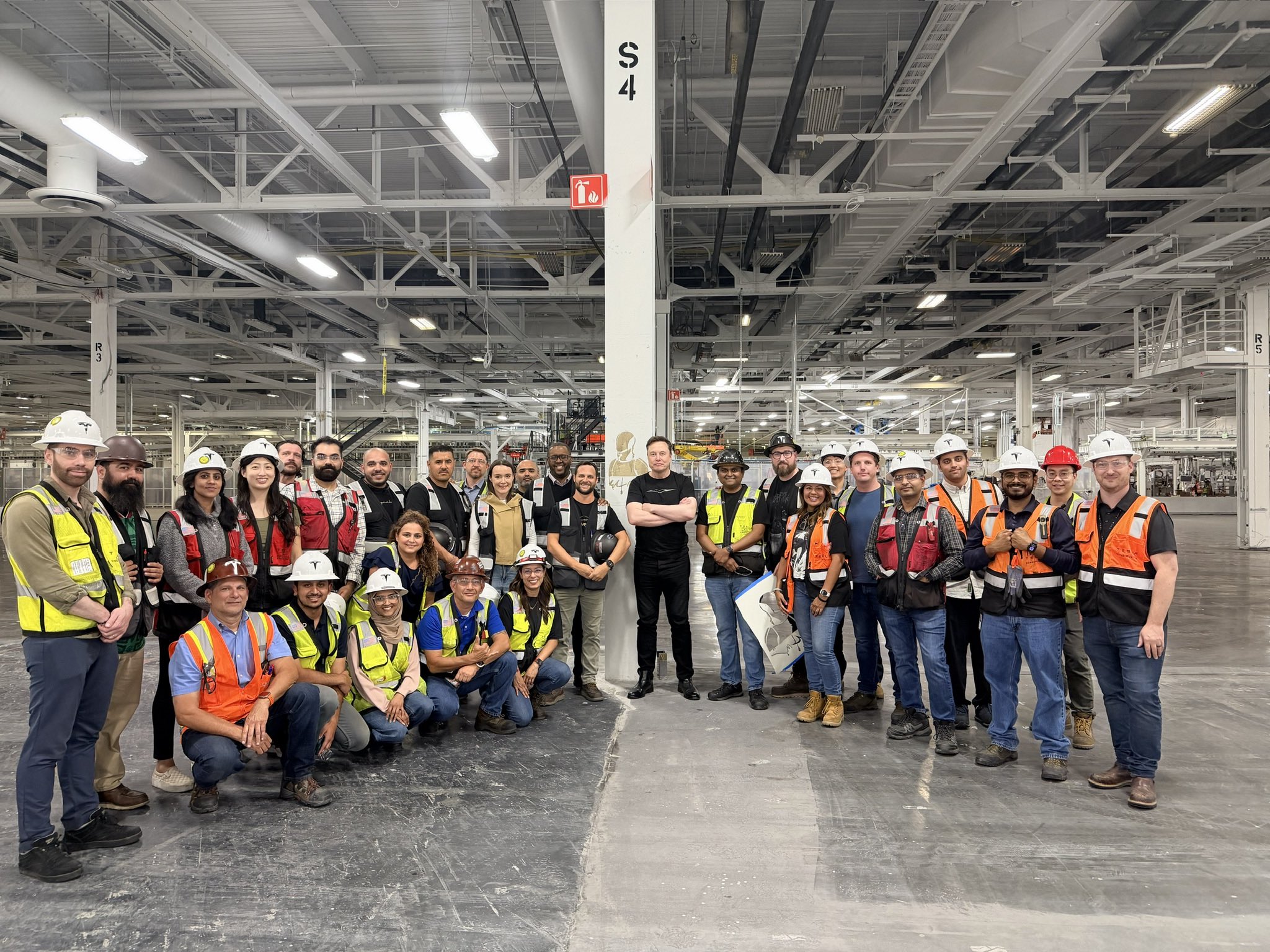
Tesla's net income fell 43 percent to US$787 million in the third quarter of 2026, down from US$1.37 billion a year earlier, even as the company announced on October 21 that it has started building Optimus humanoid robots on a production line inside its Fremont, California, factory, in floor space that used to build Model S and Model X sedans. Quarterly revenue held nearly flat at US$28.04 billion, and the company used the same shareholder letter that disclosed the profit decline to frame Optimus, not the car business, as its next growth engine.
The juxtaposition is the story. A company reporting its steepest profit drop in years chose that exact moment to say, in its own words, that "the bots coming off this line are the first production-quality bots that we have manufactured." For investors and industrial buyers alike, the quarter forces a question that speculative Optimus coverage has mostly avoided: is Tesla funding a genuine new product line out of a core auto business that is still generating tens of billions in revenue, or is it leaning on a humanoid story to offset a vehicle and energy segment that is no longer growing the way it once did.
What Actually Moved in the Numbers
Vehicle deliveries held at 486,532 units for the quarter, and electric vehicle revenue was roughly flat year over year at about US$20 billion, so the profit decline was not primarily a volume story. Solar and energy storage revenue fell 16 percent to US$2.8 billion, the one segment that contracted outright. Services revenue was the bright spot, growing 33 percent to US$4.6 billion with a record US$734 million in gross profit, a reminder that Tesla's highest-margin growth right now comes from software, charging and service contracts rather than from selling additional cars or robots. None of those line items individually explains a 43 percent profit drop; taken together with rising spending tied to Optimus tooling, AI compute and the Fremont line conversion, they point to a company absorbing a new product line's startup costs inside an auto business that is no longer expanding fast enough to cover them comfortably.
Elon Musk was unusually candid about the production ramp's immaturity on the earnings call, calling the early output "early production" and warning that the ramp will be "somewhat bumpy because it is such a radically new product." That is a different register from the confident mass-manufacturing claims Tesla made about Model 3 and Model Y in their own early ramps, and it is worth taking at face value: Optimus has roughly 10,000 unique parts across an entirely new production line that shares little tooling with vehicle assembly, so the usual EV-manufacturing playbook does not transfer directly.
A Target That Requires Near-Flawless Execution
Musk told investors Tesla expects to build 20,000 Optimus units per week by the end of 2027, a figure that implies annual output above one million robots within roughly fourteen months of the first production unit leaving the Fremont line. For comparison, Tesla took years to scale Model 3 production to a sustained 5,000 vehicles per week after its own notoriously bumpy 2018 ramp, on a product line with a much longer manufacturing track record behind it. Hitting 20,000 humanoid units a week by late 2027 would require Tesla to compress a multi-year yield-and-tooling learning curve into roughly five quarters, on a robot with triple the unique part count of a Model 3 and none of the decade of supplier qualification that underpins current EV output.
Ashok Elluswamy, who leads Tesla's AI software effort, added a second, less-discussed data point: some early customer vehicles could join the robotaxi fleet around the second quarter of 2027, pending an unsupervised Full Self-Driving software update. That detail matters because it signals Tesla is treating Optimus and its autonomous-driving stack as converging programs competing for the same engineering and compute resources, not as separate bets, which raises the stakes if either program slips.
The part-count gap is worth sitting with. A Model 3 reached its 5,000-unit weekly rate on a drivetrain and chassis platform that had already gone through several design iterations and years of supplier qualification before Tesla pushed for volume. Optimus has none of that inheritance: every actuator, gearbox, tactile sensor and structural component is new to Tesla's supply chain this year, which means the company is simultaneously qualifying thousands of new parts, training a largely new assembly workforce, and debugging a new robotics-specific quality process, all inside a 14-month window it set for itself rather than one dictated by supplier readiness. Automotive manufacturing veterans inside and outside Tesla have pointed to exactly this kind of compressed parts-qualification timeline as the most common cause of yield problems in a new production line, regardless of how experienced the manufacturer is with adjacent products.
What This Means for Buyers Watching the Humanoid Market
Procurement teams evaluating humanoid suppliers over the next two budget cycles should treat Tesla's Fremont announcement as a signal about manufacturing intent, not evidence of a qualified product. Tesla has not published per-unit cost targets, payload specifications, safety certification status or a commercial order process for Optimus, in contrast to competitors such as Figure, Apptronik and Agility Robotics, which have each disclosed specific enterprise deployments, named customers or certification milestones in 2026. What Tesla has instead is something rarer in this market: an existing high-volume automotive manufacturing organization, with its own battery, motor and compute supply chains, converting idle capacity to a new product category rather than starting tooling from zero the way a venture-funded humanoid startup must.
That manufacturing base is precisely why the 43 percent profit decline matters commercially rather than just financially. Tesla is self-funding Optimus tooling, AI compute and the Fremont conversion from operating cash flow rather than a dedicated funding round, which means the pace of the humanoid ramp is now directly exposed to vehicle and energy segment performance. A buyer weighing a future Optimus order against established humanoid suppliers with purpose-raised capital should price in that dependency: if EV demand or energy storage margins weaken further, Optimus tooling spend competes for the same balance sheet, a constraint that pure-play humanoid companies such as Figure or Agility, funded on dedicated venture and strategic rounds, do not carry in the same way.
China's humanoid makers present the opposite risk profile and are worth naming as the comparison set that matters most for a 2027 procurement decision. Unitree and UBTECH have both shipped humanoid units at prices well below anything Tesla has suggested for Optimus, backed by a domestic supply chain for actuators, reduction gears and batteries that is years ahead of Tesla's on cost, even if it still lags on the kind of integrated software stack Tesla and Figure are building. A procurement team running parallel evaluations should treat Tesla's Fremont ramp, a Chinese supplier's lower unit cost, and Figure or Apptronik's named enterprise deployments as three different bets on three different parts of the supply chain problem, not as interchangeable entries on the same shortlist. None of the three has yet demonstrated the combination buyers actually need: automotive-scale manufacturing discipline, software general enough to handle varied tasks, and a landed cost that clears a factory or warehouse's existing automation budget.
The quotable fact for this quarter is simple and ought to anchor any Optimus timeline a buyer builds into a 2027 or 2028 deployment plan: Tesla needs to go from first production units to 20,000 robots a week in about fourteen months, a compression of the manufacturing learning curve that no company, including Tesla itself with its own vehicle lines, has previously achieved on a new hardware product with this many moving mechanical parts.
Tesla's own production chief called the ramp bumpy before a single external customer had received a unit, and that admission, arriving in the same letter as the steepest profit drop in years, is the number industrial buyers should hold onto longer than the one million-unit ambition. The next checkpoint worth watching is not a stage demo or a new rendering, but Tesla's fourth-quarter 2026 production count, the first hard figure that will show whether Fremont's early output is tracking toward 20,000 units a week or settling into a slower curve that pushes the 2027 target out further.
There is a parallel worth drawing to how markets judged Tesla's own vehicle ramps in their early quarters. Investors who treated the 2018 Model 3 production crisis as a reason to doubt Tesla's long-term manufacturing capability were wrong about the eventual outcome, even though the near-term pain was real and the stock reflected genuine uncertainty for several quarters running. Investors who extrapolate confidently from a handful of Optimus units leaving Fremont to a one million-unit annual run rate risk repeating the opposite mistake: assuming execution difficulty resolves itself on the timeline a chief executive announces rather than the timeline a new, unproven manufacturing process actually allows. Both the bulls and the skeptics are, for now, working from the same thin evidence base, a single shareholder letter and a production line that has barely started moving.
This article synthesizes Tesla's Q3 2026 shareholder update and public earnings call statements as of October 21 and 22, 2026. It is for general information purposes only and does not constitute investment, financial or professional advice.