What Is a Quadruped Robot? Definition, Capabilities, and Where They Actually Work
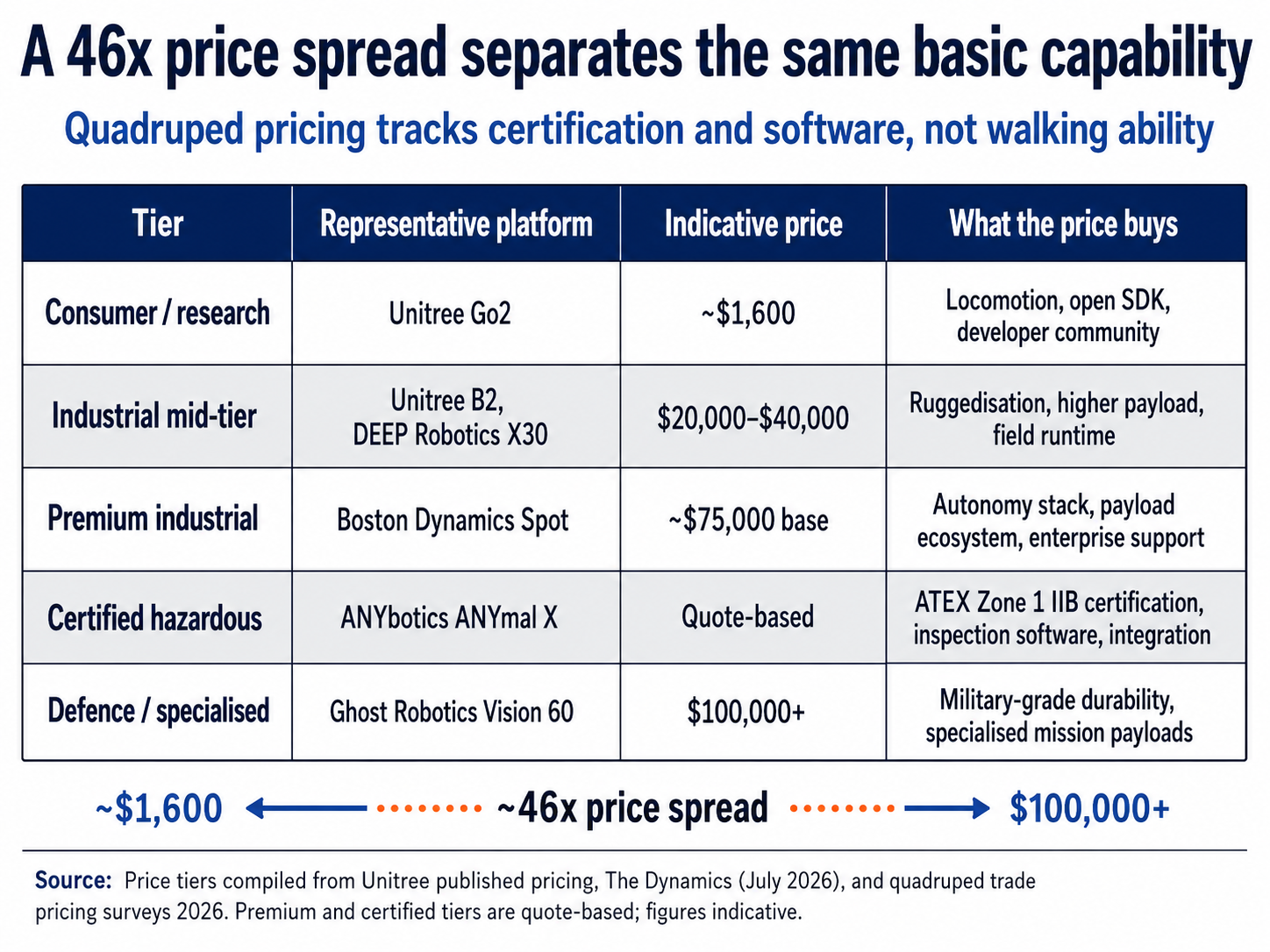
A Unitree Go2 costs $1,600. A Boston Dynamics Spot costs $75,000. Both walk, climb stairs, and carry sensors. The 46-fold gap has almost nothing to do with locomotion. It has everything to do with what happens after the robot arrives.

A Unitree Go2 costs about $1,600. A Boston Dynamics Spot costs roughly $75,000. Both walk, both climb stairs, both carry sensors — and the 46-fold gap between them has almost nothing to do with how well they walk.
That gap is the fastest way to understand what this category actually sells. Precedence Research valued the global quadruped robot market at $3.12 billion in 2025, projecting $17.53 billion by 2035 at an 18.8% compound annual growth rate. The money is not flowing toward better legs. Locomotion has largely commoditised — a Chinese-built quadruped for the price of a used motorcycle will cross terrain that stopped wheeled robots a decade ago. What buyers at the top of the market pay for is certification, integration, and someone contractually willing to stand behind the data the robot brings back.
What Is a Quadruped Robot?
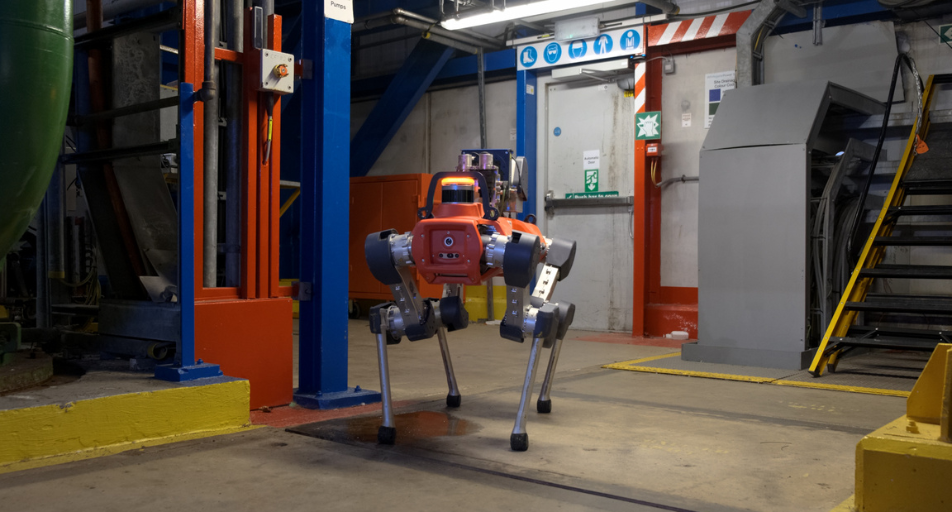
A quadruped robot is a four-legged mobile robot that carries sensors across terrain wheeled machines cannot cross, including stairs, ladder landings, and debris. Most commercial units perform autonomous industrial inspection, patrolling fixed routes to capture thermal, visual, and acoustic data. Boston Dynamics' Spot and ANYbotics' ANYmal lead industrial deployment.
A quadruped robot is a four-legged machine that walks, balances dynamically, and carries a sensor or tool payload across uneven ground. It matters now because industrial sites built for human inspectors contain stairs, catwalks, and confined spaces that wheeled robots cannot reach. For an operations lead, that means routine inspection rounds run continuously without putting a person into a hazardous zone.
The architecture is consistent across manufacturers: a central body housing processors, batteries, and control electronics; four legs with two or three powered joints each; and mounting points on the back for payloads. Each joint lifts, swings, places, and adjusts its foot in response to what the terrain does underneath it. That adjustment loop, running continuously, is what separates a quadruped from a wheeled platform — and it is also the single largest drain on the battery.
Why Four Legs Beat Wheels in Human-Built Spaces
The case for legs is narrower than the marketing suggests, and it is worth stating precisely. On flat concrete, a wheeled robot beats a quadruped on every metric that matters: energy per metre travelled, payload capacity, cost, mechanical reliability, and runtime. A warehouse AMR will outwork a robot dog and cost less doing it.
Legs win in one specific condition — environments built around the assumption that a human would be walking through them. Refineries have staircases between deck levels. Substations have kerbs and cable trays. Construction sites have rubble, and mines have gradients that were surveyed for boots rather than tyres. None of those were designed to exclude wheeled robots; they simply were not designed with any robot in mind, and a staircase is where wheeled autonomy stops.
Boston Dynamics' Spot has been deployed across more than 50 countries and over 20 industries. The pattern in those deployments is consistent: the robot goes where the site was laid out for a person carrying a clipboard.
 Where Quadruped Robots Actually Earn Their Keep
The gap between what quadrupeds are famous for and what they are paid for is wide. Spot became a viral phenomenon for dancing. It earns its keep photographing pressure gauges.
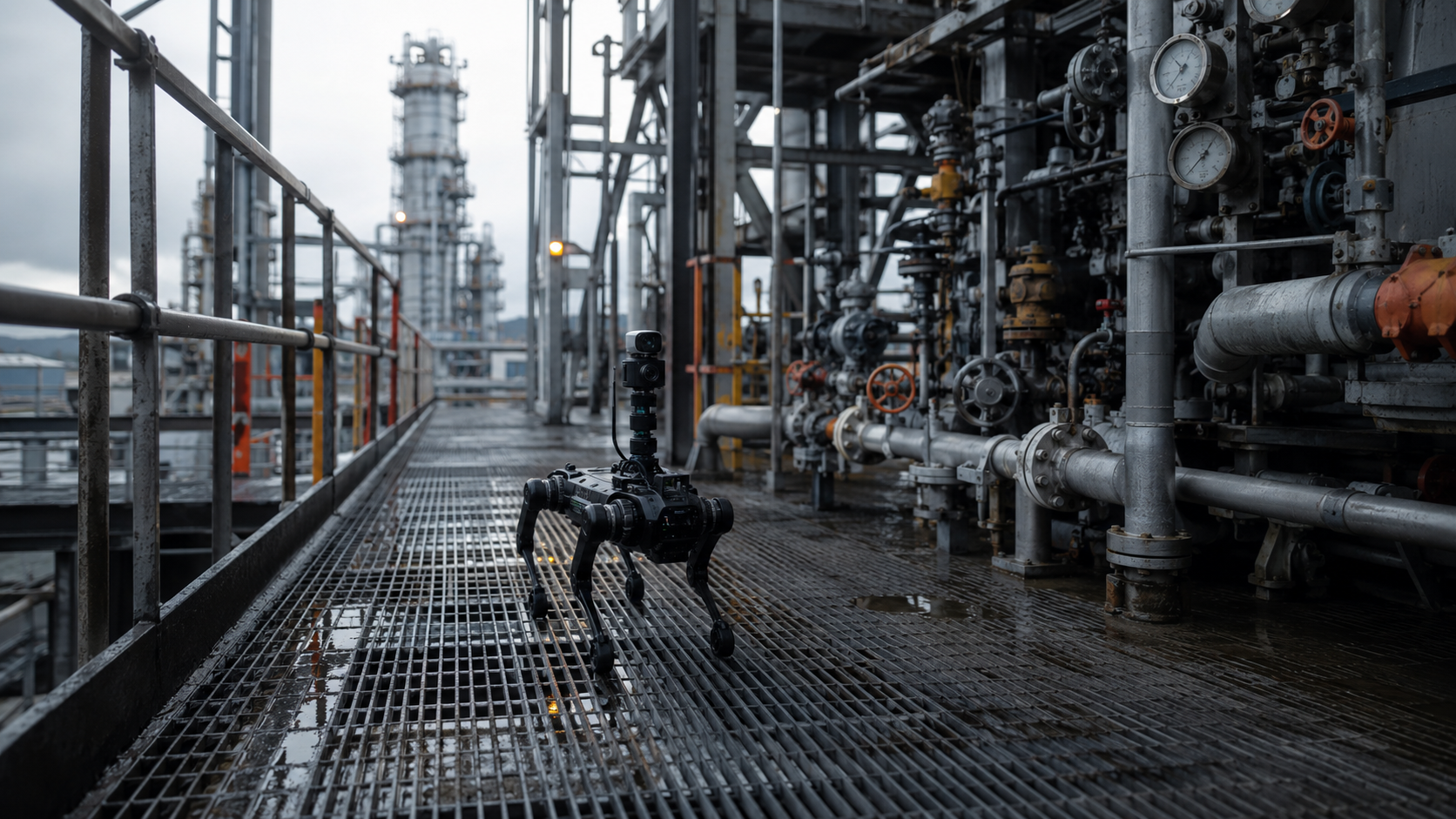
Industrial inspection in energy and heavy process industries is the anchor application. ANYbotics has shipped more than 200 ANYmal units, and that fleet performs thousands of inspections weekly across oil and gas, mining, power, utilities, and metals, according to the company and Climate Investment (September 2025). The named operators are specific: Equinor, ENI, and Petrobras among them, alongside SLB, Siemens Energy, GE Vernova, Novelis, and Outokumpu. One documented deployment runs at the Northern Lights carbon capture and storage facility in Norway, a joint venture between Equinor, TotalEnergies, and Shell.
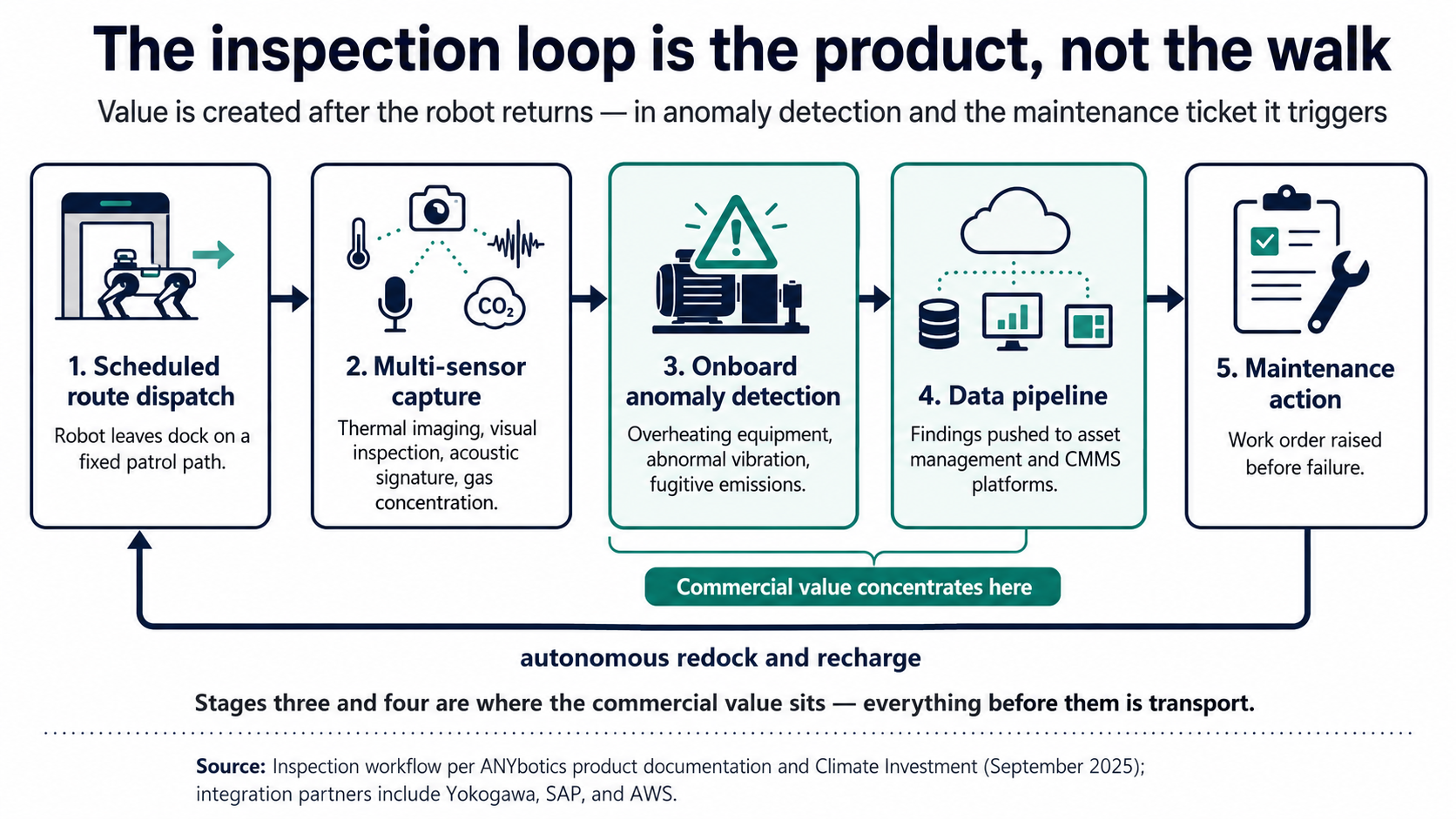
What the robot does on those patrols is unglamorous and valuable. It walks a fixed route, captures thermal imagery of equipment that should not be running hot, records acoustic signatures of bearings that should not be vibrating, and reads instruments that have no digital output. ANYbotics launched integrated gas-leak and presence detection in June 2025, pairing gas detectors with acoustic imaging to locate leaks and measure ambient concentration in the same pass.
Data centres have become the fastest-growing segment. Merry Frayne, senior director of product management at Boston Dynamics, told Business Insider in March 2026 that the company had seen a sharp rise in data centre interest over the preceding year. The fit is clean — large flat facilities, consistent patrol routes, thermal anomalies that matter, perimeter fences requiring continuous monitoring, and a 24/7 cadence where human fatigue is an operational risk rather than an HR concern.
Research and education absorb a large share of unit volume without generating comparable revenue, which is where Unitree's pricing has reshaped the field. A $1,600 platform with a published SDK puts a working legged robot in every robotics lab with a modest equipment budget.
Two Bets on Where Quadruped Value Settles
The industry contains a genuine strategic disagreement about where this market goes, and both positions are held by companies with real deployments behind them.
ANYbotics: the value is in certification and the inspection stack
ANYbotics built ANYmal for industrial inspection from the outset rather than adapting a research platform. Its ANYmal X is Ex-certified for explosive atmospheres including Zone 1 IIB, with customer deliveries planned for 2026. The company's total funding passed $150 million in September 2025, and its integration partners — Yokogawa, SAP, AWS, NVIDIA — are software and data companies rather than hardware suppliers.
The position is defensible on evidence. In a refinery, an uncertified robot is not a cheaper option; it is not an option. ATEX certification is a regulatory gate, and passing it costs years and capital that a $1,600 platform cannot recover. Equinor and Petrobras are not buying legs. They are buying inspection data that will survive a regulator's scrutiny, delivered into asset management systems they already run. That combination of certification and integration is exactly the kind of accumulating switching cost that makes vendor replacement progressively harder — platform gravity operating in the industrial inspection layer.
Unitree: locomotion commoditises, and the market expands underneath the incumbents
Unitree, headquartered in Hangzhou, prices its B2 industrial and Go2 research platforms 40 to 70% below comparable Western alternatives, and shipped an estimated 4,500 units globally in 2025 according to trade press estimates cited by The Dynamics (July 2026). Its position is that walking is a solved problem, that the certified-inspection segment is a small fraction of the eventual market, and that an open developer ecosystem produces applications the incumbents will not anticipate.
This position also has evidence behind it. Ukrainian forces have used Unitree quadrupeds in the field, with the Go2's roughly four-kilogram payload capacity carrying sensors and supplies into positions inaccessible to wheeled machines. That was not a Boston Dynamics use case, and it was not certified by anyone.
The distinction that resolves the two is not capability. It is who bears the liability when the data is wrong. Certified inspection markets pay for the certificate and the audit trail; open developer markets pay for the platform and accept the risk themselves. Those are separate businesses that happen to share a body plan, and the gap between them narrows only if certification costs fall — which, historically, they do not. The security research also cuts against fast convergence: an analysis published by Hackaday in May 2026 documented an arbitrary command execution flaw in a Unitree quadruped via the Wi-Fi password field, alongside CVE-2025-2894 and unexplained traffic to Chinese servers. A refinery operator evaluating a low-cost platform is not weighing $1,600 against $75,000; they are weighing $1,600 against the cost of an uncertified robot's data being inadmissible in a safety audit.
This development reinforces:
- How AI Robots Work: The pillar covering the mechanisms behind robot capability, including why form factor follows deployment environment rather than the reverse.
- AMR vs AGV: The Difference Is Not Intelligence — It Is Who Pays for Change: The same selection logic applies in warehouse automation, where infrastructure cost rather than robot intelligence determines the correct platform.
- Why Robots Struggle With Common Sense — and Why That Matters: The embodiment gap explains why quadrupeds succeeded at fixed-route inspection years before they managed anything requiring situational judgment.
The $1,600 robot and the $75,000 robot climb the same staircase. What separates them is a certificate, a set of integrations into systems a plant already runs, and a company willing to put its name on the inspection record. ANYbotics raised more than $150 million and spent it building inspection software, gas detection payloads, and ATEX certification rather than faster legs — and its customer list runs to Equinor, ENI, Petrobras, and the Northern Lights CCS project in Norway. That is the clearest available signal of where the industry believes the value sits. The legs get the robot to the gauge. Everything that happens after it arrives is the actual product.
Frequently asked questions
1. What is a quadruped robot?
A quadruped robot is a four-legged machine that walks and carries a sensor payload across terrain wheeled robots cannot cross. Each leg has two or three powered joints that lift, swing, and place the foot in response to the ground underneath. Most commercial units are used for autonomous industrial inspection in energy, mining, and utilities.
2. How much does a robot dog cost?
Prices range from about $1,600 to over $100,000 depending on tier. A Unitree Go2 research platform starts around $1,600, industrial units such as the Unitree B2 and DEEP Robotics X30 run $20,000 to $40,000, a Boston Dynamics Spot starts around $75,000, and defence platforms such as the Ghost Robotics Vision 60 exceed $100,000. Certified hazardous-area units are quote-based.
3. What are quadruped robots used for?
The dominant commercial application is autonomous industrial inspection — walking fixed routes to capture thermal, visual, and acoustic data in refineries, power stations, mines, and substations. ANYbotics reports over 200 ANYmal units performing thousands of inspections weekly across oil and gas, mining, power, and metals customers. Secondary applications include public safety, data centre patrol, defence, and research.
4. Why do robots have four legs instead of wheels?
Legs earn their cost only in environments built for human movement. Wheeled robots beat quadrupeds on energy efficiency, payload, runtime, and price on flat ground. Legs win where there are staircases, catwalks, kerbs, cable trays, or rubble — conditions common in industrial plants and construction sites that were laid out for people rather than machines.
5. Do police and military use quadruped robots?
Yes. More than 60 bomb squads and SWAT teams across the US and Canada use Boston Dynamics' Spot, according to company data shared with Bloomberg in late 2025. Ukrainian forces have deployed Unitree quadrupeds in the field. Boston Dynamics and other manufacturers published an open letter in 2021 opposing the weaponisation of commercial robot platforms; armed quadrupeds have since been fielded by several militaries regardless.
6. How long does a quadruped robot's battery last?
Runtime varies by platform and workload, typically ranging from under an hour to several hours. Boston Dynamics' Spot runs roughly 90 minutes in law-enforcement use, compared with 20 to 30 minutes for a comparable drone, according to Ryan Calo of the University of Washington quoted by Governing in October 2025. Continuous balance correction is the largest single power draw on any legged platform.