Teradyne Robotics and Sereact Partner to Scale Physical AI for Retail and Logistics
Teradyne Robotics and Sereact announced a partnership on Oct. 21, 2026, running Sereact's Cortex physical-AI model on Universal Robots cobot arms to automate returns handling, piece-picking, kitting and replenishment for retail and logistics customers. Hundreds of dual-arm UR systems are already live across Europe, including a Zalando/CEVA Logistics returns operation in Germany and Poland, with Sereact's new Boston HQ aimed at bringing the combination to North America.

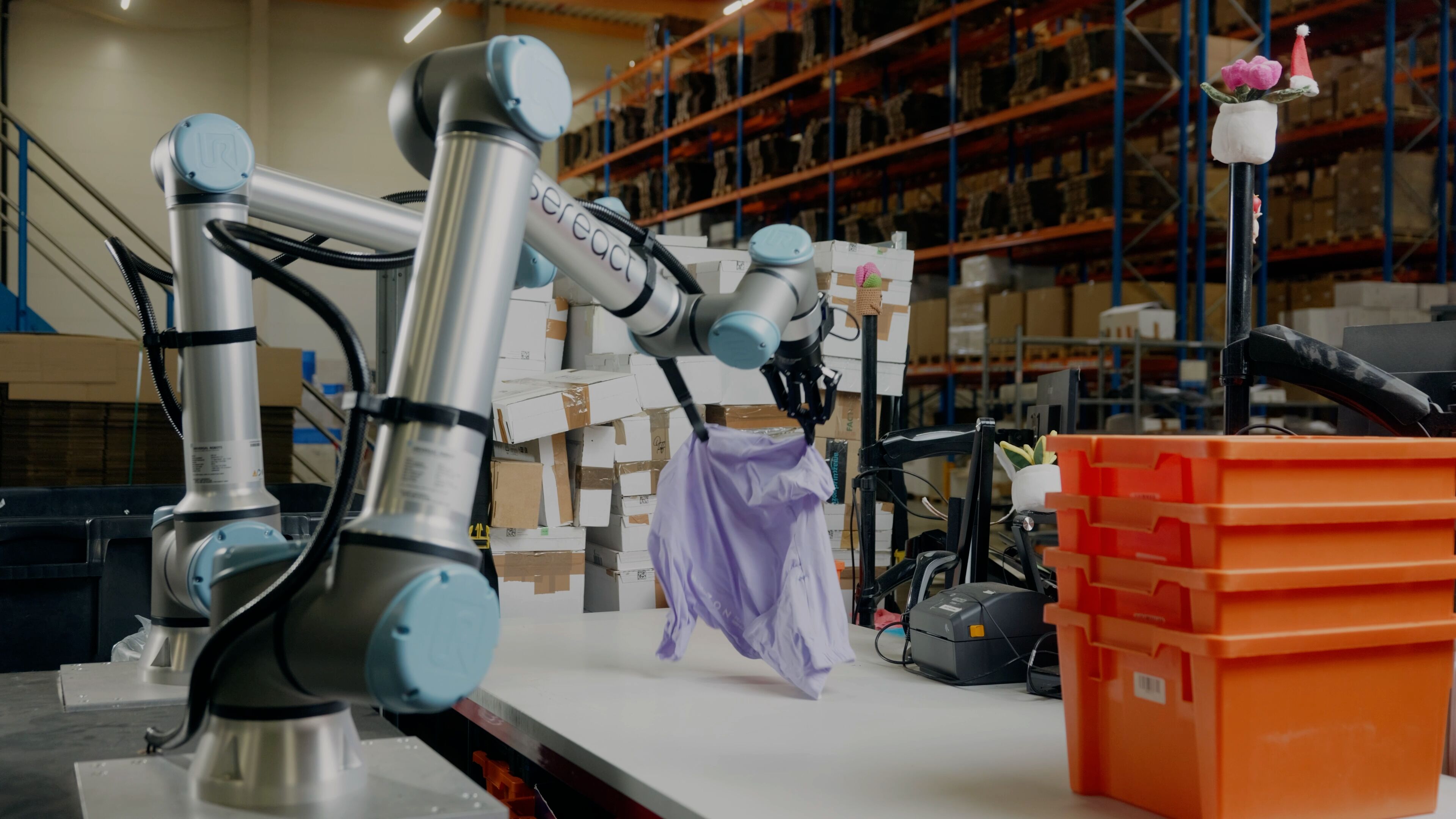
Teradyne Robotics and Sereact announced an official partnership on Oct. 21, 2026, pairing Sereact's Cortex physical-AI software with Universal Robots cobot arms so retailers and logistics operators can automate unstructured tasks, led by returns handling and piece-picking, that fixed-program robots have never reliably managed. The deal is already commercial rather than experimental: the companies say they have shipped hundreds of dual-arm UR systems to live customer sites across Europe, with returns handling, piece-picking, kitting and replenishment named as the first wave of applications.
The announcement reflects a structural change underway in warehouse and store automation. For a decade, retailers and third-party logistics providers automated the easy parts of their operations first: palletizing uniform cartons, moving totes between fixed points, scanning barcodes on standardized packaging. The work that remained manual was the work that resisted fixed programming: a returned sweater balled up inside a poly bag, a mixed tote of apparel in random orientations, a SKU the robot had never been shown before. Hard-coded vision and gripper setups could not scale across that variety without a re-engineering cycle for every new item category. Sereact's pitch, and the reason Teradyne Robotics is putting its cobot distribution network behind it, is that a single trained model can now generalize across those categories without per-SKU retraining, turning what used to be an integration project into a software deployment.
Sereact is the less familiar name in this pairing and worth placing. The company is headquartered in Stuttgart, Germany, founded by Dr. Ralf Gulde and Marc Tuscher, and builds Cortex, a vision-language-action model that lets robot arms grasp, identify and handle objects they have not previously encountered. It raised a US$116 million Series B round earlier in 2026 and counts Zalando, IKEA, DHL, Rohlik, Arvato, alza.cz, BMW, Mercedes-Benz and Daimler Truck among its customers, a list that already spans fashion e-commerce, retail, parcel logistics and automotive manufacturing. Teradyne Robotics needs less introduction to industrial buyers: it is the Teradyne, Inc. (NASDAQ: TER) division that owns Universal Robots, the collaborative-arm maker, and Mobile Industrial Robots, the autonomous mobile robot maker, and it is headquartered in Odense, Denmark.
The commercial mechanics of the deal are straightforward. Cortex is the software layer; Universal Robots arms are the hardware it runs on. Teradyne Robotics gets a production-proven AI application to put in front of its global distributor and systems-integrator network, broadening what its arms can be sold to do without changing the hardware. Sereact gets access to that distribution network plus an installed base Jacob Pascual Pape, Chief Commercial Officer of Teradyne Robotics, put at more than 100,000 industrial UR deployments worldwide, a number he cited directly in the companies' joint statement as evidence that "physical AI only matters when it performs in real-world operations." Dr. Gulde, Sereact's chief executive, framed the value proposition for buyers in equally operational terms: "One brain serves every robot, with no retraining for each new item or task. And what one robot learns, every robot benefits from." For a procurement team evaluating automation vendors, that is a claim about total cost of ownership as much as capability: a single model amortized across returns handling, replenishment, kitting, sortation, order induction, machine tending, bin consolidation, packing and goods handling is a different purchasing decision than buying a separate point solution for each task.
The partnership is not a pilot announcement dressed up as news. The companies are demonstrating it this week at NVIDIA's GTC Berlin 2026 event, where Cortex runs live on two Universal Robots UR12e-1300 arms performing returns handling, and that demo mirrors a deployment already running in production. Sereact's returns-handling application operates at Zalando fulfillment centers in Greven, Germany, and Świebodzin, Poland, run in partnership with third-party logistics operator CEVA Logistics. Zalando is Europe's fashion and lifestyle e-commerce platform, serving more than 62 million active customers across more than 7,000 brands in 29 markets, which makes this one of the highest-volume return streams in European retail to put a learned grasping model in front of. Dr. Gulde described why returns specifically are a hard automation target: "Returned products almost never arrive in a robot-friendly sequence. Items differ in shape, orientation and packaging, and the mix changes continuously." He also tied the deployment to regulation, noting that rapidly reconditioning returned goods for resale "helps retailers comply with European Union regulations prohibiting the destruction or landfill disposal of returned merchandise," a compliance deadline that is pushing EU retailers toward automated reverse logistics regardless of what it costs to build. Fashion e-commerce in particular runs high return rates against thin per-order margins, so a returns line that still relies on manual sorting is simultaneously a cost center and, once destruction bans take effect, a regulatory exposure, which is why a 3PL as large as CEVA Logistics is willing to run a learned grasping model on a live production line rather than wait for a more mature version of the technology.
The two companies are also building out the surrounding technology stack rather than shipping a single model in isolation. Cortex is trained in NVIDIA Isaac Sim using NVIDIA Cosmos world models, post-trained with reinforcement learning in NVIDIA Isaac Lab, and benchmarked on Teradyne Robotics hardware before any version reaches a customer site. In production, inference runs locally on NVIDIA Jetson Thor modules at the robot cell, where latency has to stay low enough to keep pace with a moving conveyor, while NVIDIA DGX Spark handles site-level validation and model updates. Teradyne Robotics is separately contributing SimReady OpenUSD assets for both Universal Robots and MiR hardware to the SimReady Central Library on Hugging Face, lowering the cost for any developer, including competitors, to simulate against UR and MiR robots. That last move matters commercially: it positions UR and MiR hardware as a default simulation target for the broader physical-AI developer community, not just for Sereact.
Geography is the other half of the scaling story. Sereact opened a United States headquarters in Boston, Massachusetts, this past summer specifically to bring the joint UR-Cortex solution to North American customers, which signals the European returns-handling proof points at Zalando are meant to be a template rather than a one-off reference account. For buyers in North American retail and logistics, that is the signal to watch: a European deployment history plus a fresh US office plus an established cobot distributor is the standard playbook a vendor follows when it intends to sell into a new region within the following one to two budget cycles, not a multi-year horizon.
What this deal says about the competitive structure of retail and logistics automation is more interesting than the deal itself. Robot arm manufacturers that spent the last decade competing mainly on payload, reach and price are now competing on which AI software partner they can attach to their hardware, because the software is what determines whether a cobot can be sold into unstructured, high-variety tasks instead of only repetitive, pre-programmed ones. Teradyne Robotics choosing Sereact, after NVIDIA technology partnerships and its own PolyScope X platform work shown earlier in 2026, suggests the company is assembling a stack rather than betting on one vendor, which rival cobot makers without an equivalent AI partner bench will have to answer with partnerships of their own or with in-house models that lack Sereact's multi-customer production track record. The buyers best positioned to benefit are the ones who already operate UR or MiR fleets: this partnership is explicitly a retrofit play on top of an installed base, not a new robot category requiring fresh capital approval. Arm makers such as Fanuc, ABB and Kuka face the same question Teradyne Robotics has just answered, and picking-software specialists such as Covariant and Dexterity face the mirror version of it: whether to keep selling a model that works on a narrower set of arms or to pursue the kind of hardware-agnostic reach Sereact is now building through a named distribution partner. Neither path is obviously superior, but a buyer evaluating vendors in this category should expect the field to sort into hardware-plus-software pairings like this one rather than remaining a market of standalone point products.
For a procurement or operations team actually weighing this combination, the commercial announcement answers the existence question but not the operational one, and the questions worth putting to either company before signing are the same ones that apply to any AI-software-on-existing-hardware deal: what the model's error rate looks like on an unfamiliar SKU mix on day one rather than after a tuning period, what service-level commitment backs the uptime of a production line that now depends on a cloud-trained model rather than fixed logic, how frequently the model is updated and who validates a new version before it reaches a live cell, and what the integrator relationship looks like when something needs debugging at 2 a.m. on a shift. A production reference at Zalando answers the feasibility question. It does not substitute for a site-specific pilot before committing fleet-wide budget.
Retail and logistics automation is shifting from buying robots that execute fixed instructions to buying robots that can be re-tasked by updating a model, and this partnership is the clearest commercial proof of that shift to date: a vendor with more than 100,000 industrial cobot deployments already in the field has chosen to extend that installed base with a single AI model built to handle the unstructured work, led by returns, that fixed automation could never reach.
This article synthesizes company statements and public partnership disclosures as of 2026-10-21. It is for general information purposes only and does not constitute investment, financial, or professional advice.