Origami Robotics Starts Mass Production of S1 Dexterity-Capture Glove
San Francisco-based Origami Robotics has started mass production of the S1, a skill-capture glove that records 20 finger joint angles, fingertip and palm pressure, and synchronized wrist-camera video to train robot hands. The glove shares a joint layout with Origami's companion robotic hand, mapping each finger joint directly, though a contact-alignment model to bridge human and robot fingertip differences is still in development. S1 is available by access request only, with no published price or ship date.

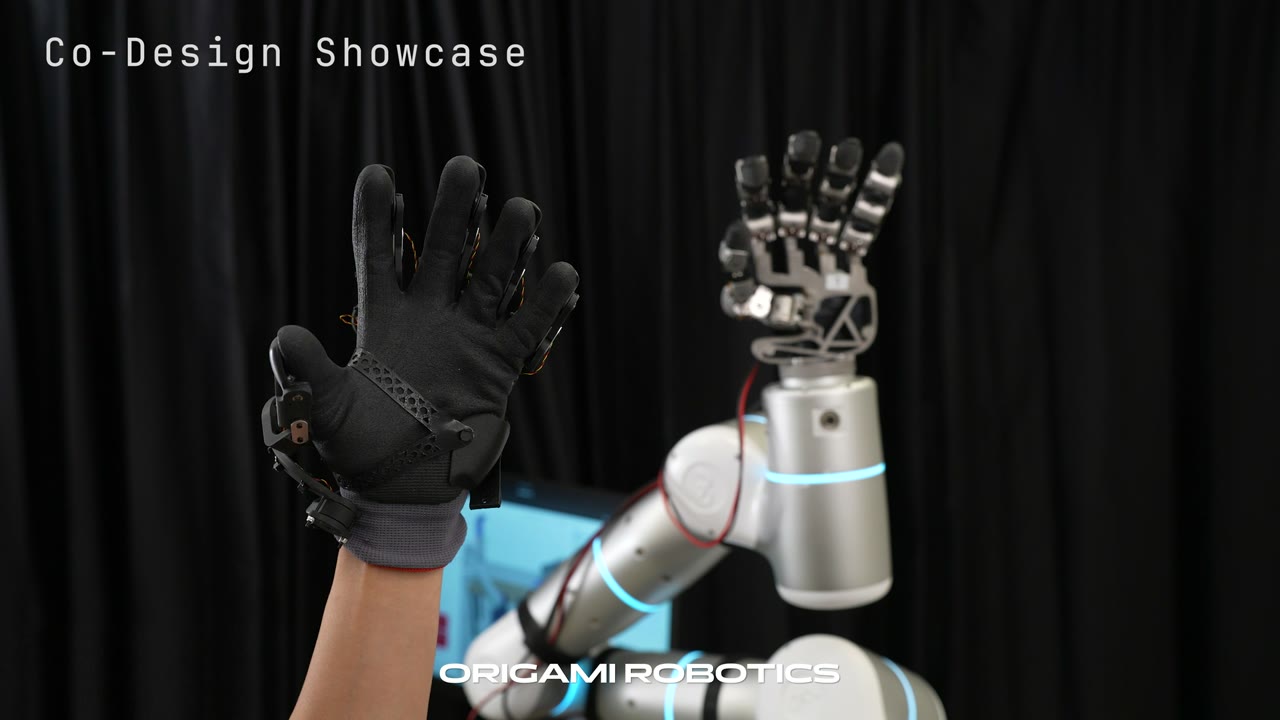
SAN FRANCISCO, Oct. 21, 2026. Origami Robotics has begun mass production of the S1, a wearable glove that records 20 finger joint angles through onboard encoders, fingertip and palm pressure through tactile sensors, and synchronized wrist-camera video, built to capture human dexterity data for training robot hands rather than for animation or sports science. In tests the company published alongside the launch, those encoder-based measurements kept recording hand motion when a camera's view of the fingers was fully blocked, something the vision-only tracking methods it compared against could not do.
Origami Robotics is a five-person, San Francisco-based startup backed by Y Combinator's W26 batch, founded this year by co-founder Quanting ("Daniel") Xie, who studied robot manipulation at the CMU Robotics Institute, and Ryan Xie, a repeat hardware-company founder now serving as chief operating officer. The company's premise is that robots will learn to manipulate objects by imitating recorded human hand movement, and that the quality of that recorded data, not just its volume, decides how well a trained model transfers to a real robot hand. S1 is described by the company as the first in a new family of products, sold alongside a companion robotic hand built on the same joint layout.
The glove's case for existing rests on a problem familiar to anyone who has tried to extract hand-pose data from video: cameras lose track of fingers whenever an object, a sleeve, or the other hand gets in the way. Origami's blog post detailing the launch, published Oct. 21, 2026, walks through a direct comparison. The company recorded hand movements inside a closed container, where no camera could see the fingers at all, and separately recorded movements where an object or the other hand obscured only some fingers. Two vision-only baselines were run against the same footage: Google's MediaPipe Hand Landmarker, and an offline pipeline combining a WiLoR hand detector with HaMeR 3D reconstruction. Under full occlusion, the company says, both vision pipelines sometimes lost the hand estimate entirely; under partial occlusion, estimates kept being produced but jumped between finger poses. The glove's joint encoders, reading flex at the hand itself rather than inferring it from pixels, kept measuring through both conditions with smoother joint trajectories, according to the company.
A second validation compared the glove's calculated fingertip positions against OptiTrack, an external optical motion-capture system treated as a reference point in robotics and biomechanics research. Origami combined its measured joint angles with the hand's link geometry through forward kinematics and compared the resulting fingertip trajectory with OptiTrack's, in the glove's own wrist-relative frame. The company reports millimeter-level accuracy for the index, middle, and ring fingers in that comparison. That is a single company-run test rather than an independently audited benchmark, and buyers evaluating the glove for their own pipelines should expect to run their own accuracy checks before committing a training program to it. Still, the result tracks with the basic physics of the approach: a joint encoder measuring flex does not need a clear sightline, while a camera-based estimator does.
Encoders do not blink, and that single property, not any accuracy figure, is the argument a procurement team should weigh first: a joint sensor keeps reporting motion long after a camera loses the hand behind a part or a tool, and that continuity is what a teleoperation data contract is actually paying for.
Origami also published footage meant to show the glove does not get in the way of the skill it is trying to capture. A musician performed a composed piece on violin, piano, and percussion while wearing S1, chosen, the company says, because the instruments demand small, practiced finger adjustments that a clumsy glove would visibly disrupt. Separately, the team ran 30 other tasks meant to stress dexterity and speed, including fast Rubik's Cube solves, card shuffling, and knife-flipping tricks. None of this is a formal usability study, but it answers the most basic commercial question about any wearable capture device: whether wearing it changes the behavior being recorded, which would defeat the purpose of capturing it in the first place.
The manufacturing story behind S1 matters as much as the sensor count for anyone assessing whether this is a lab prototype or a deployable tool. Origami built an earlier, rigid-shell version of the glove roughly seven months before this launch and placed it in a couple of factories. Once more workers tried it on, the company ran into a familiar hardware problem: hand sizes vary enough that a rigid shell fits only a subset of a workforce, and that subset is not representative of the range any buyer actually needs to capture from. The company redesigned the glove around a soft shell to fit a wider range of hands, while keeping a per-wearer fitting and calibration step before each recording session. That redesign, not the sensor specification sheet, is the more telling signal of where Origami sits on the path from prototype to supplier: it already hit, and had to work through, the kind of fleet-deployment problem that stalls hardware pilots long before accuracy becomes the limiting factor. The company says it has now started mass production and intends to put the same hardware into more hands, recording a wider range of tasks, objects, and working conditions.
What separates S1 from a generic motion-capture glove is how tightly it is coupled to Origami's own robotic hand. The two devices share the same joint arrangement, so a measured glove angle becomes a position target for the corresponding robot joint directly, without a geometric retargeting solver translating between a human hand's proportions and a robot hand's. That mapping preserves independent control of each finger's three joints, the MCP at the knuckle, the PIP at the middle, and the DIP at the tip, rather than collapsing them into a single fingertip target the way inverse-kinematics retargeting typically does. Origami argues this distinction matters for tasks such as writing, where a finger needs to hyperextend in a way a fingertip-only target would not capture. The same tactile sensors are mounted on both the glove and the robot hand, so recorded contact data from a human attempt can in principle inform the robot's own grip. Differences in fingertip shape and hand size between wearers still leave a gap between where a person's fingertip contacts an object and where the robot hand's fingertip would land, a gap Origami says it is addressing with a learned contact-alignment model planned for a later release. For buyers, the honest reading is that matched kinematics solves the easier half of the sim-to-real problem and leaves the harder half, contact transfer, as a named, unsolved, in-progress item rather than a settled feature.
Origami positions this work against UMI and DexUMI, two published approaches to transferring human demonstrations onto robot hands, crediting UMI with the idea of designing the capture interface and the execution hardware together rather than treating data collection as a separate problem from deployment. That lineage places S1 in a specific, fast-moving niche: hardware built to produce training data for dexterous manipulation models, distinct from general motion-capture suits built for animation or sports analytics, and distinct from teleoperation rigs built mainly to drive a robot in real time rather than to log a dataset. Humanoid and manipulation-robot developers currently assemble this kind of data pipeline from a patchwork of vision models, custom rigs, and in-house gloves. A vendor selling a glove co-designed with a matching robot hand, paired with an occlusion-robust sensing approach and a stated accuracy benchmark, is a narrower and more commercially legible product than most of what this category has offered to date.
None of this is available for purchase in the ordinary sense yet. Origami is taking access requests rather than orders, asking prospective users to specify their intended use, among robotics research, robot training or data collection, teleoperation, and product development or education, along with an estimated quantity and timeline. No price has been published, and no shipping date is public beyond the claim that mass production has started. That gap between "in mass production" and "orders open" is worth watching rather than assuming away: a buyer with an active data-collection program should treat S1 as a vendor to qualify now and contract with once pricing and lead times are confirmed, not as a device available off a shelf today.
Origami has also signaled that a second-generation robotic hand is coming, framed in its own materials as a response to how demanding the human movements captured by S1 turned out to be: natural finger speed and dexterity, the company says, remain difficult for current robotic hands to reproduce, which is the gap the next hand generation is meant to close. The product story to track from here is less the glove's sensor count than whether Origami converts its current factory deployments and mass-production claim into a shipping product with public pricing, and whether its promised contact-alignment model actually closes the gap between a human fingertip and a robotic one. Buyers building out dexterous-manipulation data pipelines over the next two quarters should treat S1 as a vendor worth qualifying now, with the expectation that the harder claims, contact transfer and hand-to-hand generalization, get tested against real production data rather than a single company demonstration.
This article synthesizes company statements and public product disclosures as of 2026-10-21. It is for general information purposes only and does not constitute investment, financial, or professional advice.