AGCO Puts Agility's Digit Humanoid to Work Sorting Parts in Kansas
AGCO and Agility Robotics have signed a commercial agreement to pilot the Digit humanoid robot at AGCO's Hesston, Kansas, factory starting in 2027, testing humanoid automation on a discrete manufacturing line rather than a warehouse floor.

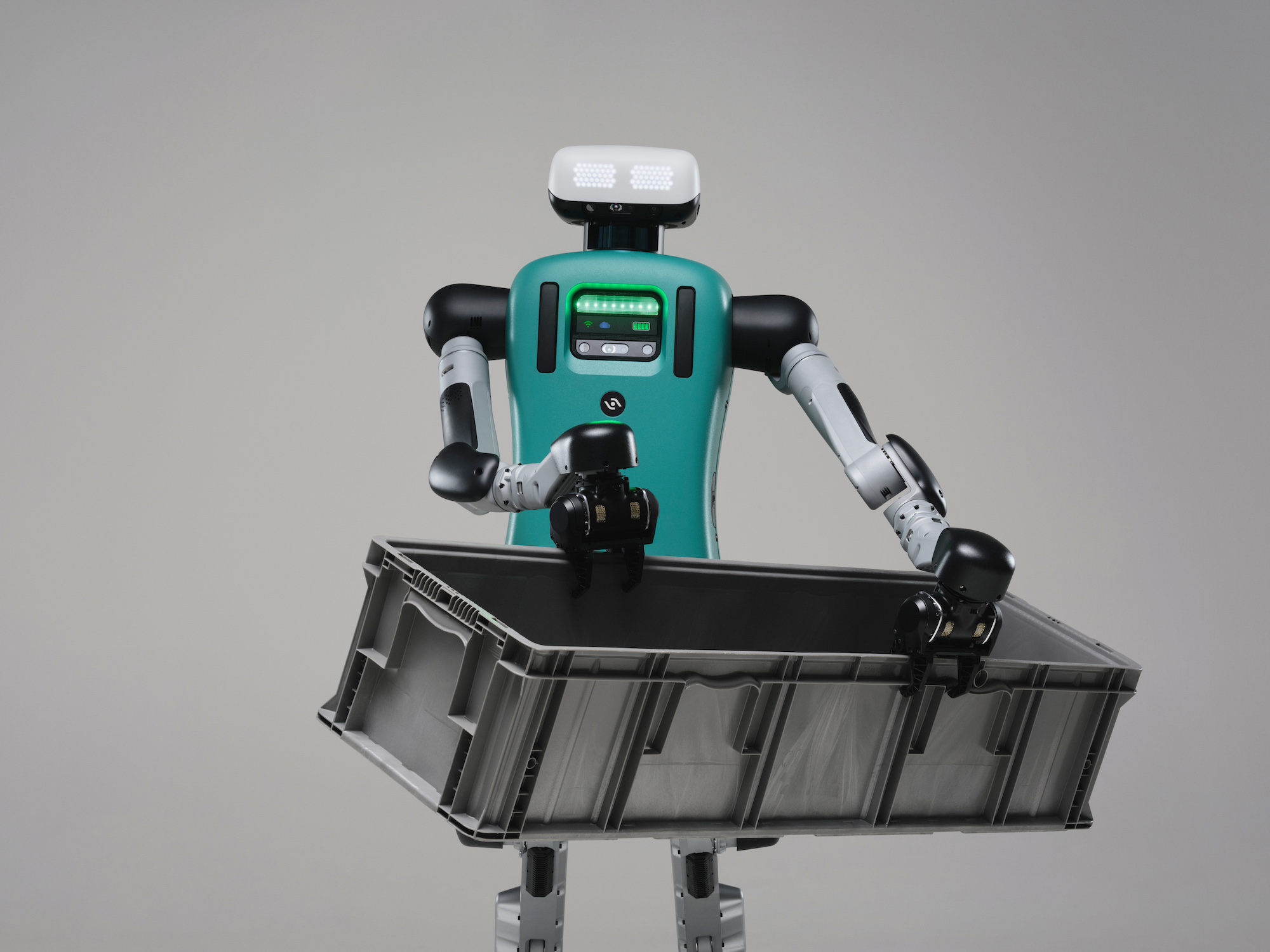
AGCO Corporation and Agility Robotics signed a commercial agreement on October 20, 2026, to bring a humanoid robot onto a discrete manufacturing line, with a United States pilot set to begin in 2027 at AGCO's production facility in Hesston, Kansas. The deal pairs AGCO, a Duluth, Georgia-based maker of agricultural machinery listed on the New York Stock Exchange (NYSE: AGCO) under brands including Fendt, Massey Ferguson, PTx, and Valtra, with Agility's Digit robot for parts sorting, stacking, and tote placement inside an active factory.
The agreement answers a question that has dogged humanoid robotics for two years: whether the technology that impresses on a trade-show floor can hold a job on a real assembly line. AGCO and Agility have set a 2027 start date, a named Kansas facility, and a defined first task list, which is a different commitment than the pilots, demos, and letters of intent that have characterized most of the industry's "deployment" announcements to date.
A Factory, Not a Warehouse Floor
Most of the humanoid robot deployments procurement teams have tracked this year sit inside warehouses and distribution centers, where floors are flat, tasks are repetitive, and the cost of an error is a dropped box rather than a missed assembly step. AGCO's commitment moves the test onto a factory floor that builds tractors and harvesting equipment, a setting with tighter tolerances, more variable part geometry, and less forgiving safety margins.
That distinction is not cosmetic for a buyer comparing vendors. A warehouse pilot can be staged in a corner of a distribution center with minimal disruption to existing operations, and a robot that underperforms can be quietly withdrawn without touching the output schedule. A production line inside an agricultural-equipment plant has no such slack: Hesston's output feeds AGCO's broader order book, and any station Digit occupies has to keep pace with the rest of the line or become the bottleneck that delays shipments. Agreeing to run the pilot inside an active facility, rather than a demonstration cell built for the occasion, raises the stakes for both companies in a way that a trade-show showcase does not.
Thomas Enghof, AGCO's Director of Manufacturing Technology, frames the robot as a colleague rather than a tool, describing humanoid robotics and artificial intelligence as "teammates" in building flexible, intelligent factories, an approach he says pairs human ingenuity with robotic engineering and strict safety governance. That language matters for a procurement audience: it signals that AGCO expects Digit to work alongside line staff rather than behind a fenced cell, which is a harder automation problem than caged palletizing or inspection work.
What Digit Will Actually Do First
The initial task list is deliberately narrow. Digit will sort and stack parts and place totes for storage, work the companies describe as repetitive and physically demanding, the kind of job that drives ergonomic injury claims and turnover on a factory floor. AGCO's stated rationale is to remove that strain from employees and redirect them toward higher-skill, higher-value production work rather than to cut headcount outright, a framing increasingly common among industrial buyers wary of a pure labor-substitution narrative.
Agility's pitch rests on Digit's track record rather than its novelty. The company says the robot has logged more than 65,000 hours of real-world operation and already works for logistics customers including Toyota, GXO, and Schaeffler. Daniel Diez, Agility's Chief Business Officer, said the Hesston deployment is a chance to "demonstrate how advanced robotics can create measurable impact across modern production environments," a statement that puts the burden of proof squarely on execution rather than on the robot's specifications.
The Software Layer Buyers Should Watch
The more consequential part of the deal for other industrial buyers may be Agility Arc, the company's cloud-based fleet management platform, which Agility says lets a customer integrate automation without extensive infrastructure changes or costly facility upgrades. That claim, if it holds at Hesston, addresses the single biggest objection procurement teams raise about humanoid robots: that the robot's sticker price is the smaller line item next to the cost of reconfiguring a facility to accommodate it. Digit is also described as AI-powered and able to continuously learn and adapt to evolving workflows, which positions the Hesston pilot as a test of adaptability under real production variance rather than a fixed, pre-programmed routine.
For buyers evaluating humanoid robots against fixed automation such as conveyors, autonomous mobile robots (AMRs), or robotic arms, the relevant comparison is not raw throughput but flexibility: a Digit unit redeployed from tote placement to a different task as AGCO's production mix shifts is the argument Agility is making for humanoid form factors in general, and it is exactly the gap between demo performance and deployment reality that has made 2026 a skeptical year for the category.
That skepticism has a specific shape in most procurement conversations. Buyers who sat through 2025 and 2026 humanoid demonstrations have grown wary of robots that perform well under lighting, floor, and task conditions chosen by the vendor, then struggle once moved into a customer's own variable environment. Agility's answer is to point to deployed hours rather than demo footage, and to let Agility Arc's claimed low-friction integration do the persuading on cost. Whether that holds at Hesston will depend less on Digit's hardware than on how much the surrounding workflow, part bins, tote racks, staging areas, has to be redesigned around the robot rather than the other way around, a detail the companies have not yet disclosed.
A Public Listing Arrives Before the Pilot Does
Agility Robotics is not waiting for Hesston to prove itself financially. The company is pursuing a business combination with Churchill Capital Corp XI, a special-purpose acquisition company trading on Nasdaq as CCXI, in a deal expected to close in the fourth quarter of 2026. The combined entity would operate as Agility Robotics and trade on Nasdaq under the ticker AGLT. A registration statement tied to the transaction was declared effective on October 13, 2026, with a shareholder record date of September 14, 2026.
That timing means Agility will likely be a newly public company, subject to public-market scrutiny of its unit economics and customer pipeline, at almost exactly the moment its Hesston pilot is meant to get underway. Investors and procurement teams alike will be reading the same signal from the same deployment: whether a named industrial OEM committing to Digit in a factory setting, rather than a warehouse, changes the market's read on how fast humanoid robots can move from pilot to production. AGCO, for its part, is treating the robot's entry into its supply chain with the same caution it brings to any new piece of capital equipment, which is itself a data point for buyers trying to gauge how conservative, mainstream manufacturers are starting to approach this category.
Why Agricultural Equipment Is a Harder Test Than It Looks
Agricultural-equipment assembly involves heavier, less standardized parts than the parcels and totes that dominate warehouse robotics, and AGCO's four brands run distinct product lines with their own component mixes. A robot that can sort and stack reliably across that variability, rather than on a single, tuned product line, is a more demanding proof point than most of the humanoid deployments announced so far this year. It is also a test the companies have chosen to run quietly, without a public demo, before committing to a production timeline, which is itself worth noting: the agreement names a facility and a start year rather than a launch event.
If the ergonomic and efficiency gains Enghof describes hold up once lines are running in 2027, AGCO becomes one of the first named discrete-manufacturing OEMs, rather than a logistics operator, to put a commercial humanoid deployment into production, a distinction the rest of the industrial-automation buying community is likely to watch closely as its own capital budgets for 2027 take shape.
Picture the Hesston floor in 2027: a line built to assemble Fendt or Massey Ferguson components, with a Digit unit moving between stacking stations and tote racks under Agility Arc's scheduling, not as a showcase for visitors but as a working part of the shift. That is the image AGCO and Agility are betting procurement teams will eventually take for granted, and it is the image this pilot now has one calendar year to earn.
This article synthesizes company statements and public corporate disclosures current as of publication.
Disclaimer: This article is for informational purposes only and does not constitute investment, legal, or procurement advice. RobotAIGeek makes reasonable efforts to verify facts at the time of publication but cannot guarantee complete accuracy of third-party claims, forward-looking statements, or figures that may change after publication. Readers should conduct independent due diligence before making business or investment decisions related to the companies, products, or markets discussed.