Kodama Systems Raises US$7 Million to Scale Teleoperated Forestry Robotics
Sonora, California-based Kodama Systems raised US$7 million to expand its teleoperation and supervised-autonomy retrofit system for logging equipment, betting that terabyte-scale daily operating data will become its durable moat.

Kodama Systems, a Sonora, California, startup that retrofits forestry equipment with teleoperation and supervised-autonomy hardware, said Monday it has raised US$7 million, bringing its total funding to US$14 million. Konvoy Ventures and Breakwater Ventures co-led the round, with participation from Blue Forest Asset Management, NYA Ventures, Breakthrough Energy Ventures, Congruent Ventures, Dangerous Ventures and M1C. The company will use the capital to expand commercial deployments, deepen integrations with heavy-equipment manufacturers and extend supervised autonomy into more of the machine types used on an active logging site.
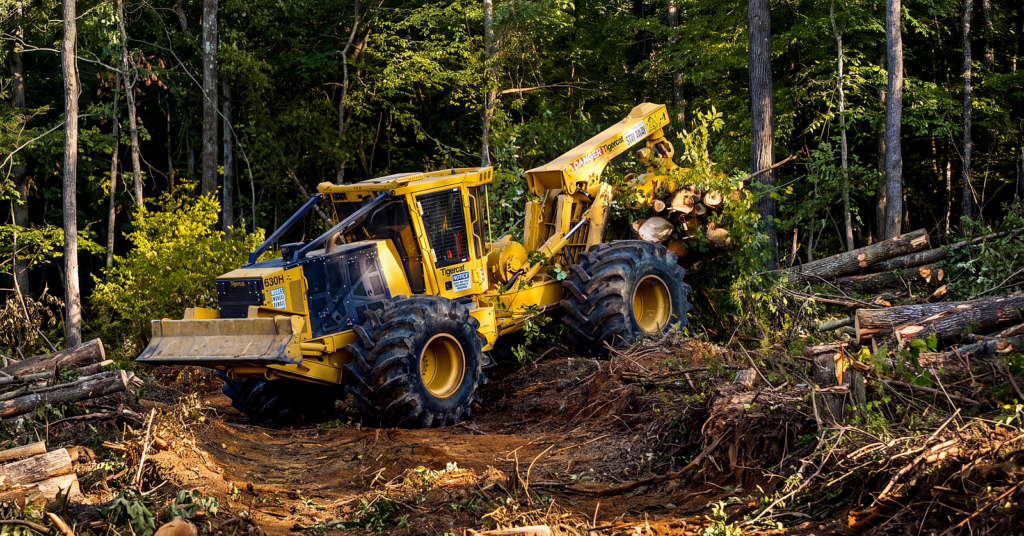
Kodama does not build its own machines. It installs sensors, controls and a remote-operation layer onto skidders that forestry contractors already own, letting a remote operator run a machine from a command center while the equipment handles repeatable motions on its own. Over the past six months, equipment running Kodama's system has moved more than 100,000 tons of timber across multiple states in the southeastern United States, operating 10 to 14 hours a day on active sites, according to the company.
Retrofitting the Machines Contractors Already Own
The forestry-equipment market has a structural reason automation has lagged behind warehouses and factories: the machines are expensive, the terrain is irregular, and the operators who buy skidders and cutters are not going to replace a six-figure asset to get a software upgrade. Kodama's answer is to work inside that constraint. The company says it has integrated its hardware and software with two of the three largest forestry-equipment manufacturers in the world, rather than building proprietary machines from scratch, which keeps a customer's existing warranty and service relationships intact.
Kodama's commercial focus is plantation timber operations specifically. "We're focused on specifically plantation timber operations," said Merritt Jenkins, the company's co-founder and chief executive, a commercial niche distinct from the wildfire-mitigation contracts Kodama started with in the western United States. The company has been running commercial deployments for close to two years, including a customer in Georgia that has worked with Kodama for more than a year.
Data as the Product Being Built Alongside the Hardware
Every hour a Kodama machine spends under remote operation also trains the system toward more autonomous behavior. "Every day that we remotely operate the machine, we're generating about a terabyte of training data," Jenkins said. That is the figure worth holding onto: Kodama is not simply selling remote-control hardware today, it is accumulating the off-road manipulation and navigation data that will determine how quickly supervised autonomy in forestry moves closer to full autonomy.
Off-road physical AI has a narrower data supply than warehouse or urban-driving robotics, because there are fewer machines, fewer operators, and no public dataset equivalent to dashcam footage. A company already generating terabyte-scale data daily from paid commercial operations, rather than from demonstration pilots, has a head start that is difficult for a later entrant to replicate quickly, regardless of how much capital that entrant raises. Ben Pinfield, who leads go-to-market for Kodama, described the company's current stage directly: "We're at a point where we're scaling, integrating into new machine types, and developing more autonomy capabilities."
A Market Automation Has Mostly Skipped
Logging automation has historically meant better hydraulics, better cab ergonomics and, more recently, telematics that track machine utilization, not autonomy. The handful of forestry-robotics efforts that predate Kodama, mostly university research projects and a few harvester-head attachments from Scandinavian equipment makers, focused on narrow tasks like automated delimbing rather than full machine operation. That gap exists partly because forestry terrain defeats the sensor assumptions that make warehouse and highway autonomy tractable: ground that shifts under load, foliage that occludes lidar and camera sightlines, and weather that varies by the hour rather than the season. Kodama's bet is that teleoperation sidesteps the hardest part of that problem in the near term, since a human operator can still make the judgment calls a perception stack cannot yet make reliably, while the system banks the sensor and control data needed to eventually remove that human from the loop entirely.
That sequencing, selling a human-supervised product today while quietly building toward an autonomous one, is a strategy increasingly common across physical AI, from agricultural robotics to long-haul trucking. It lets a company generate revenue and real-world data in the same motion, rather than spending years in stealth mode perfecting autonomy before any commercial deployment. The risk is that a teleoperation-first business can get commoditized on cost before its autonomy stack matures enough to be the actual differentiator, since any competitor with similar hardware can offer remote operation at a comparable price. Kodama's two OEM integrations are the company's hedge against that risk: a rival selling only aftermarket retrofit kits has a harder sales cycle than one whose system already ships pre-integrated through machines contractors are already buying.
Why Climate-Linked Capital Is Backing a Logging Company
The investor list is itself a signal. Blue Forest Asset Management specializes in financing forest-restoration and wildfire-resilience projects, and Breakthrough Energy Ventures, which backed Kodama's original 2022 seed round, invests specifically in technologies that cut greenhouse-gas emissions at scale. Neither fund is a generalist robotics investor chasing a humanoid trend. Their continued presence signals that Kodama's pitch still carries its original environmental thesis, mechanized thinning and harvest operations that reduce wildfire fuel loads and support sustainable timber yields, even as the company's near-term revenue has shifted toward commercial plantation contracts in the Southeast.
That dual identity, climate infrastructure financed like an industrial-automation vendor, is becoming a recognizable pattern in physical AI. Capital that would once have gone exclusively to carbon-offset projects or forest-health nonprofits is now flowing into companies that monetize the same underlying work through equipment-as-a-service contracts with ordinary logging contractors. For a buyer evaluating forestry automation, this financing structure gives Kodama a longer runway and a more patient investor base than a pure productivity-software startup typically has, which matters in a category where sales cycles run through relationship-driven rural contractors rather than enterprise procurement departments.
The Labor Argument Behind the Safety Pitch
Running a skidder is physically taxing work, done for long shifts on terrain that rolls equipment and injures drivers, and Kodama's pitch to contractors leans on that reality as much as on productivity. Moving an operator into a remote seat changes who can do the job: a remote-operation model lets one experienced operator oversee or intervene across more machines than a single cab allows, and it widens the hiring pool to people unwilling to relocate to a remote logging camp. Forestry contractors have struggled for years to find and retain skilled equipment operators willing to work long shifts in isolated locations, and for a procurement team evaluating forestry automation, that labor-elasticity argument is often more durable than any single productivity claim, because it addresses a hiring constraint that capital alone has not solved.
The Competitive Window Before Autonomy Becomes the Product
Right now, Kodama is selling teleoperation with a path toward autonomy, not autonomy itself, and that distinction matters for how quickly competitors could catch up. A teleoperation system is a lower bar to build than a fully autonomous one, which means Kodama's durable advantage is not the hardware retrofit but the data pipeline it is accumulating from paid, continuous commercial use. Every forestry-automation entrant that arrives later will have to either buy data access it does not have or spend years generating its own under worse commercial terms, since contractors who already have a working vendor relationship have little incentive to host a second company's sensors for free.
The new funding is earmarked for deepening those original equipment manufacturer partnerships and extending supervised autonomy into more difficult off-road scenarios, plus adding cutters and loaders to the skidder work Kodama already automates. That product road map matters commercially because a logging operation runs several machine types in sequence, felling, skidding and loading, and a contractor is more likely to adopt a vendor that can eventually cover the full chain than one locked to a single machine class.
For now, Kodama has a working commercial deployment across two OEM relationships and a data set built from paid operations rather than pilots, a different starting position than most climate-tech-adjacent robotics plays bring to a seed-stage round. The forestry-equipment market will not be automated in one funding cycle, and the company that ends up owning it will be decided less by who raises the next round than by who has accumulated the most hours of real working data when autonomy finally becomes commercially viable.
This account synthesizes Kodama Systems' funding announcement and public statements from its executives.
Disclaimer: This article is for informational purposes only and does not constitute investment, financial, or procurement advice. RobotAIGeek is not affiliated with Kodama Systems. Readers should conduct independent due diligence before making business or investment decisions related to the companies, products, or markets discussed.