NEURA Robotics Builds Humanoid Memory With Austria's NXAI
NEURA Robotics and Austrian deep-tech firm NXAI are building a working- and episodic-memory layer for NEURA's Neuron AI foundation model, using NXAI's xLSTM architecture, aimed at the reliability gap between humanoid demos and real deployment.


Most robots that can see, touch, and talk still cannot remember. A humanoid that inserts a connector correctly on Monday has no way to recall, by Tuesday, that it already learned the trick. That gap between perception and memory is what NEURA Robotics and NXAI set out to close when the two companies announced, on October 20, 2026, in Metzingen, Germany, a partnership to build a shared memory architecture for physical AI, pairing NEURA's robotics stack with NXAI's recurrent neural network design, xLSTM.
The deal gives NEURA's Neuron AI foundation model two new kinds of memory: a working memory that tracks the immediate state of a task, such as whether a part has been inserted, a door is open, or a button has already been pressed, and an episodic memory that lets a robot draw on how it handled a similar situation before. Both run inside Neuron AI, the multimodal model NEURA already uses to fuse 3D vision, tactile and force-torque sensing, audio, robot state, and language into a single stream of action, processed locally on the robot rather than in the cloud.
NXAI is the newer name in this pairing. The company is a deep-tech research firm based in Linz, Austria, built around xLSTM, an extended version of the long short-term memory network that its founder, Sepp Hochreiter, co-invented in the 1990s and revived in 2024 to compete with the transformer architectures that now dominate large language models. Hochreiter, who also directs the Institute for Machine Learning and the ELLIS Unit at Johannes Kepler University Linz, built NXAI's commercial case on a specific claim: that xLSTM holds and updates state across long sequences more cheaply than a transformer does, which matters for anything that has to track context for minutes or hours rather than a single forward pass. The company's other product, a time-series forecasting model called TiRex, is built on the same architecture.
The Amnesia Problem in Physical AI
Vision-language-action models, the dominant approach to teaching robots new tasks, are generally built to map a snapshot of the world to an action, not to carry state forward across an entire shift. That design choice is defensible for single-step picking or spot demonstrations, but it breaks down the moment a task has sequence and history: a multi-stage assembly job, a facility tour that repeats itself with small variations, or a maintenance round where the robot needs to know what it checked an hour ago. Without memory, every one of those situations is treated as new, and the model either fails quietly or needs a human to re-establish context.
That is the commercial argument David Reger, NEURA's founder and chief executive, made in announcing the partnership. "A robot that genuinely helps in everyday life and industry must be able to remember," he said, framing memory not as a research curiosity but as the missing piece between a robot that performs a trick and one that holds a job. Hochreiter's framing lands on the same point from the architecture side: he has argued that memory and accumulated experience are what let a system solve multi-step tasks reliably, and that xLSTM's efficiency at holding state across long sequences is what makes that practical to run on a robot rather than a data-center cluster.
What Changes When a Robot Keeps Score
The distinction between working memory and episodic memory is not cosmetic; it separates two different commercial problems. Working memory is about getting through a single task correctly: a robot that knows a fastener is already torqued does not re-torque it, and one that knows a door is already open does not push against it. Episodic memory is about getting faster and more reliable over repeated instances of a similar task, drawing on a stored record of how the robot handled comparable situations before rather than reasoning from scratch each time. Put together, the two give a deployed robot something closer to a shift memory: a sense of where it is in a process and what has already worked.
Neither company has published benchmark numbers for the combined system, and none should be assumed until NEURA or NXAI release them; what has been confirmed is the architecture and the intent, not a measured improvement in task success rates. That caveat matters, because the industry has a well-documented habit of treating a capable demo as a deployable capability. The distinction between a demo and a deployable system is exactly the gap that memory is supposed to narrow, and buyers evaluating this class of claim should ask for task-level reliability data before they ask about the underlying model.
An Open Platform, With the Data Staying Put
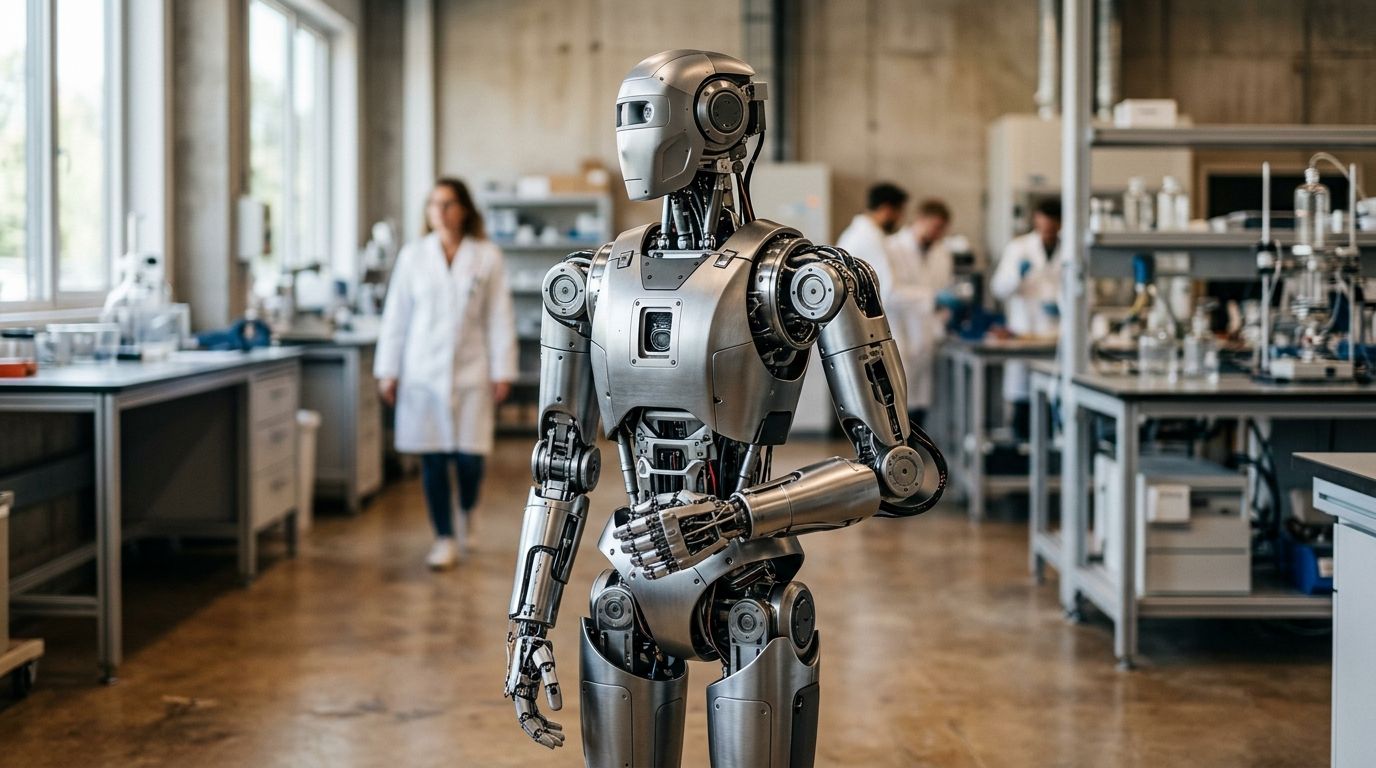
The integration point is Neuraverse, NEURA's ecosystem for distributing AI capabilities across its robot line. Under the partnership, NXAI's xLSTM-based model becomes a second option on that platform alongside Neuron AI itself, and companies that want to use it can fine-tune it through the Neuraverse toolchain, test it in NEURA's physical training environments, known internally as NEURA Gyms, and deploy it on whichever of NEURA's five robot embodiments fits the job, including the third- and fourth-generation 4NE-1 humanoid, a wheeled variant, and two bimanual platforms. NEURA has structured the arrangement so that a company adopting the memory system keeps control of its own process knowledge, choosing whether to share the data and skills it generates rather than surrendering them to the platform by default.
That data-control clause is a commercial signal as much as a technical one. NEURA has spent the past year assembling a full-stack strategy rather than a single-product one, pairing its own hardware and foundation model with outside specialists: a chip collaboration with Qualcomm for on-device compute, a virtual-twin pipeline with Dassault Systèmes, and now a memory layer from NXAI. Keeping customer data inside the customer's control is the condition under which an industrial buyer, particularly one in automotive or precision manufacturing, is willing to let a third-party model anywhere near its production data in the first place.
Why Germany and Austria, and Why Now
The quotable claim in this announcement is also its most testable one: that a robot's usefulness in a real factory or home scales with what it remembers, not just what it perceives. NEURA has already built its Neuron AI training pipeline on data partnerships with Schaeffler and Bosch, giving it a route to real industrial deployment data rather than simulation alone, and layering a memory architecture on top of that pipeline is a bet that reliability, not another sensor or another degree of freedom, is the current bottleneck on humanoid deployment.
For NXAI, the deal is a chance to prove xLSTM's efficiency claims outside a research paper, on hardware with real power and latency budgets. For NEURA, it is a hedge against building every layer of its stack alone, at a moment when European policymakers and corporate buyers are increasingly asking whether the continent's physical-AI champions can assemble a competitive full stack from European components rather than importing a foundation model from the United States or China. Whether that framing survives contact with deployment data will depend on what NEURA's industrial customers report once robots running the new memory system are actually working a floor, not a demo stage, through a full shift without needing to be told, again, what they already know.
What Procurement Teams Should Actually Ask
For an automation buyer evaluating this class of announcement, the useful questions are narrower than the press release. The first is timeline: NEURA and NXAI have described an architecture and a platform slot, not a shipping date for the combined system on a specific robot generation, so a procurement team should ask when the memory-enabled version of Neuron AI reaches a pilot-ready state rather than assuming it is already deployable. The second is scope: working memory and episodic memory address context loss within and across tasks, not the separate problems of manipulation dexterity, battery life, or safety certification that still gate most humanoid deployments. A buyer comparing this announcement against a rival's humanoid roadmap, whether from a Chinese platform maker scaling unit shipments or a US competitor focused on dexterous manipulation, should weigh it as a reliability feature layered onto an existing stack, not a standalone reason to switch vendors.
The third question is about data governance, and it is the one NEURA's statement tries hardest to answer in advance. Letting an outside model from an Austrian AI lab run inside a factory's physical AI stack raises the same objections that cloud-based machine vision raised a decade earlier: who sees the data, and what happens to it after the model is retrained. NEURA's answer, that customers keep control of their own process knowledge and choose whether to share data and skills, is a sales pitch as much as a technical fact, and it is the clause a cautious buyer should push hardest to verify in contract language before any pilot begins, since a platform's default settings and its marketing language do not always match.
This analysis synthesizes company statements and public technical documentation surrounding the announcement. This article is for general information purposes only and does not constitute investment, legal, or professional advice.