Gecko Robotics Quadruples Its Navy Inspection Contract to US$300 Million
The U.S. Navy and GSA raised the ceiling on Gecko Robotics' hull-and-deck inspection contract from US$71 million to US$300 million just six months in, a rare sign that a physical-AI defense vendor has moved from pilot to repeatable, scaling business.

Defense robotics has a pilot problem: a contractor wins a small evaluation order, performs well, and then waits years for a program of record that may never arrive. Gecko Robotics just skipped that wait. In Pittsburgh on October 20, 2026, the company announced that the U.S. Navy and the General Services Administration (GSA) had quadrupled the ceiling of its indefinite-delivery, indefinite-quantity (IDIQ) contract to US$300 million, just six months after the initial US$71 million award.
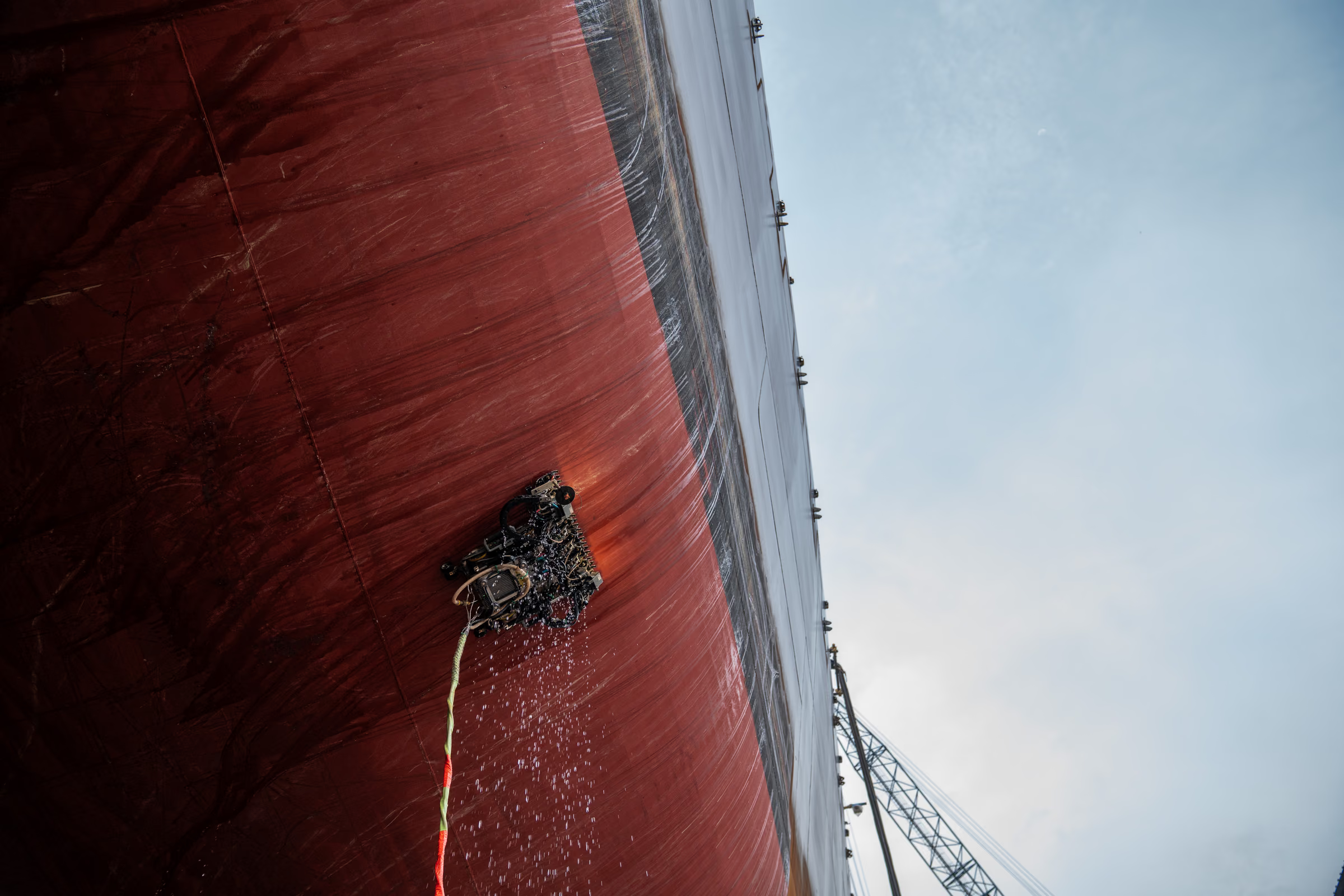
The expansion funds wider use of Gecko's wall-climbing inspection robots, drones, and fixed sensors across Navy ships and submarines, paired with artificial intelligence (AI) models trained to catch structural problems that inspectors miss, including some invisible to the human eye. Gecko says the work can cut inspection timelines from months to days and save up to US$8 million in repair costs per ship, figures tied directly to the Chief of Naval Operations' target of restoring 80 percent fleet readiness.
A Four-Fold Jump That Signals Something Other Than a Trial
Government procurement rarely moves this fast. An IDIQ contract sets a ceiling value and a roster of approved work types, then agencies issue task orders against it as needs arise; the ceiling itself is usually a conservative placeholder, not a number a vendor expects to approach. Gecko's Navy IDIQ started at US$71 million in April 2026. Six months later, the Navy and GSA raised that ceiling to US$300 million, a four-fold increase that implies the service is already drawing down task orders fast enough to need the headroom, not merely keeping options open.
Pittsburgh-based Gecko Robotics builds hardware and software for infrastructure inspection in sectors where a missed defect is catastrophic: ships, power plants, and industrial facilities. Its core product is a family of magnetic-wheeled or tethered robots that climb hulls, tanks, and boilers while carrying ultrasonic and other sensors, feeding data into an AI analysis layer the company calls Cantilever. The flagship capability for this contract is Komodo, a system that scans through thick non-skid deck coatings without stripping them first, producing a full-deck heatmap of corrosion and material thickness that repair planners can use before a vessel ever enters drydock.
That sequencing detail matters more than it sounds. Drydock time is one of the most constrained resources in naval maintenance: every day a ship sits in a dock without a clear repair plan is a day the fleet readiness clock keeps running. By generating the heatmap before the ship arrives, Komodo converts an open-ended diagnostic process into a scoped work order, which is the difference between a maintenance visit measured in weeks and one measured in months.
What the Contract Actually Buys
The structure of the award matters as much as its size. An IDIQ ceiling is not a guaranteed revenue number; it is a cap on how much business a single contract vehicle can carry before a new procurement action is required. Raising it from US$71 million to US$300 million does two things for Gecko: it removes a near-term ceiling that would otherwise force a renegotiation mid-deployment, and it signals to other Navy commands, shipyards, and prime contractors that this vendor has already cleared the security, performance, and integration bar once and can be tasked again without restarting that process.
For a sector still dominated by single-site pilots, that repeatability is the commercially relevant fact. Jake Loosararian, Gecko's co-founder and chief executive officer, framed the shift bluntly: "The conversation around AI and robotics in defense is no longer about experimental technology." Loosararian's statement is less a marketing line than a claim about procurement maturity, and the contract math behind it is the evidence: a vendor does not get a four-fold ceiling increase in six months by staying in evaluation mode.
Most robotics vendors that pitch into defense maintenance budgets never see this kind of math. The typical path looks like a one-time evaluation contract, a favorable after-action report, and then a multi-year gap while the customer decides whether to fund a program of record or let the relationship lapse. Procurement teams across the Navy, the Army, and allied defense ministries have spent recent budget cycles funding exactly this kind of exploratory work with physical AI vendors, generating plenty of press releases about demonstrations and comparatively few follow-on task orders large enough to matter to a vendor's revenue line. A ceiling increase six months into a contract, before the vendor has even argued for a formal follow-on competition, is hard to manufacture for a press release; it requires an active customer already spending against the original number.
That distinction matters for anyone evaluating inspection-robotics vendors as a category. A marketing page listing the Navy as a customer says little on its own; a four-fold ceiling increase inside two quarters says more, because contracting officers do not raise ceilings as a courtesy. They raise them once task orders are being issued fast enough that the original number becomes a planning constraint.
Reading the Readiness Math
The Navy's 80 percent fleet-readiness target is the backdrop against which this expansion has to be read. Fleet readiness is constrained less by the number of ships in commission than by how quickly maintenance can be diagnosed, scheduled, and executed without schedule slip. Gecko's pitch is that robotic inspection attacks the diagnostic bottleneck directly: if a hull or deck survey that used to take a human inspection team months can be compressed into days, and if the output is a prioritized, ship-specific repair list rather than a general advisory, the Navy can plan drydock periods around known work instead of discovering scope once the ship is already in the yard.
That is also why the inspection-robotics category sits closer to deployable physical AI than most of the humanoid demonstrations competing for attention this year. The distinction between a demo and a deployable system is rarely about the robot's mobility; it is about whether the data the robot collects changes a procurement officer's or a maintenance planner's decision. Komodo's full-deck corrosion maps do exactly that, which is why the Navy relationship has scaled from a first task order to a nine-figure ceiling inside two quarters rather than stalling in an evaluation loop, the pattern that still defines most robotics-and-defense procurement.
Where the Growth Still Has to Be Proven
None of this guarantees the full US$300 million gets spent, and Gecko has not disclosed how much of the original US$71 million ceiling had already been drawn down before the increase. A higher ceiling is permission to scale, not a guarantee that every additional task order will materialize on the timeline the company implies. Buyers evaluating Gecko, or any inspection-robotics vendor citing defense traction as a credibility signal, should still ask for drawn-versus-ceiling figures and the specific ship classes or hull types the Komodo system has already surveyed, since a corrosion-mapping capability proven on a single hull form does not automatically transfer to a different class without recalibration.
There is also a question of attribution the company's release does not fully answer: how much of the readiness improvement is credited to Gecko's robots specifically, versus to the broader maintenance-process changes the Navy has pursued alongside the 80 percent readiness push. Robotic inspection is one input into a repair-planning pipeline that also depends on shipyard capacity, parts availability, and workforce staffing, none of which a sensor fleet can fix on its own. A buyer comparing inspection-robotics vendors should treat Gecko's cited savings and speed figures as useful benchmarks, not yet independently audited numbers every competing vendor can be measured against on equal footing.
The more durable test is whether this contract becomes the template other Navy commands, or other services, reach for when they want physical AI inspection capability without running a new procurement from scratch. An IDIQ vehicle another command can simply task against, rather than re-bid, is what turns one successful pilot into a multi-year revenue base, and that step matters more than the headline dollar figure.
The gap between a research-grade demo and a system a maintenance crew will actually schedule around is where most physical AI pitches still fail; Gecko's contract trajectory is one of the few publicly visible cases where a procurement office has put its own budget behind closing that gap rather than funding another pilot.
Picture the alternative this contract is designed to erase: a destroyer easing into a drydock with no deck survey in hand, a repair crew improvising a work plan over the following weeks as corrosion is found hull section by hull section, and a readiness clock that keeps running the entire time. Under the scaled-up version of this program, that same ship arrives with Komodo's heatmap already printed, repair crews walking straight to the sections that need steel instead of searching for them, and the drydock gate closing behind a vessel that knows, before the first grinder starts, exactly how long it will be there.
This analysis synthesizes company statements and public contracting activity as of October 20, 2026.
Disclaimer: This article is for informational purposes only and does not constitute investment, procurement, or legal advice. Readers should conduct independent due diligence before making business or purchasing decisions based on this content.