Generative Bionics and AMD to Build Europe's Largest Physical AI Training Hub
Italian humanoid-robotics startup Generative Bionics, an IIT spin-off building the GENE.01 platform, announced a three-site Physical AI Data Factory network starting with a 5,000-square-metre hub in Italy, operational by Q4 2027, running on AMD Helios rack-scale compute to generate and validate the real-world and digital-twin training data its industrial humanoids need before deployment.

MILAN, Oct. 21, 2026. Generative Bionics said it will build a three-site "Physical AI Data Factory" network, starting with a 5,000-square-metre hub in Italy running on AMD compute, to generate and validate the training data that humanoid robots need before they work unsupervised on factory and shipyard floors.
The announcement lands inside a real tension. Europe's humanoid-robotics ambitions sit on chip architectures designed in the United States and cloud infrastructure run mostly by American and Chinese hyperscalers. Generative Bionics, a company spun out of Genoa's Istituto Italiano di Tecnologia in July 2024, builds the GENE.01 humanoid platform, a full-size robot wrapped in a proprietary full-body tactile skin that reads contact, force, proximity and temperature as it moves. Still unfamiliar to most buyers outside robotics circles, the company is answering a narrower, more solvable version of the sovereignty question than Europe's chip debate: not where the silicon is made, but where the data, models and operating know-how behind a working humanoid robot are generated and controlled.
Generative Bionics raised a €70 million seed round (roughly US$78 million at prevailing exchange rates) in December 2025, led by CDP Venture Capital's AI Fund, with AMD Ventures, Duferco, Eni Next, RoboIT and Tether also investing. Its first disclosed industrial customer is shipbuilder Fincantieri, under a four-year development partnership aimed at putting GENE.01 onto welding tasks in Italian shipyards, one of the harder manual jobs to automate because the work surface, the joint geometry and the welder's own posture change from hull to hull. AMD's relationship with the company began with that seed round and now extends to the chips running onboard GENE.01 itself, which process the contact, force, proximity and temperature signals the tactile skin generates in real time as the robot works.
The Fincantieri partnership is the clearest near-term test of whether the Data Factory plan is more than infrastructure spending announced ahead of any product. Shipyard welding is seasonal, physically punishing work with a chronic labor shortage across European yards, and Fincantieri's four-year development timeline, which predates Tuesday's facility announcement, gives Generative Bionics a paying customer to validate against well before the first hub opens. A buyer tracking this deal should watch whether the GENE.01 welding pilot at Fincantieri produces disclosed performance data, defect rates, cycle times, uptime across a full shipyard shift, before the Italian hub comes online in the fourth quarter of 2027. That would be the first evidence the company's current hardware works outside a demonstration, independent of whatever the new facility eventually trains into later hardware generations.
Tuesday's announcement, made at an event tied to CES Unveiled Milan, is about what happens before a robot like GENE.01 reaches a customer site. Generative Bionics plans three Physical AI Data Factory facilities. The first, 5,000 square metres and located in Italy, is scheduled to be operational by the fourth quarter of 2027 and is billed as Europe's largest Physical AI training facility for humanoid robots. A second site is planned elsewhere in Europe, and a third is meant to serve global markets. Each will reproduce real industrial environments so fleets of GENE.01 units can perform tasks under realistic conditions while the facility captures vision, motion and full-body skin data from every run.
AMD is supplying the compute behind the network. It will run on AMD Helios, AMD's rack-scale AI infrastructure, which the companies say will provide the high-performance computing and storage needed to process that physical and synthetic data, train what Generative Bionics calls "World Action Models," and run thousands of digital-twin simulation variants in parallel. Those digital twins let the company repeat a single recorded task across different layouts, objects, materials, operating conditions and failure modes that would be impractical or unsafe to stage physically, then send the resulting models back to the robots for real-world validation before deployment. Generative Bionics describes this as a continuous real-to-sim-to-real loop, with data from fielded robots feeding the next training cycle.
The data problem behind this plan is real and specific to the industry. Language models learn from text that already exists online in enormous quantities. Humanoid robots have no equivalent library: no large, pre-existing dataset of how a machine should grip an object, keep its balance, recover from a slip or hand a part to a human coworker on a shop floor. Every one of those situations has to be captured, repeated and verified before a robot is trusted to do it unsupervised, which is why Generative Bionics frames the facility as training infrastructure for its whole product line rather than a one-off investment tied to a single customer contract. Companies building humanoid robots either generate that data themselves, through recorded operation and simulation, or depend on someone else's. Generative Bionics' facility plan is an attempt to own that pipeline rather than rent it.
On the sovereignty language, it pays to be precise about what is and is not being claimed. Generative Bionics and AMD frame the project as keeping the information layer underneath Europe's industrial humanoids, the recorded data, the trained models and the operating expertise, inside the region rather than dependent on a facility elsewhere. That is a real and achievable claim about where robot training happens and who holds the resulting datasets and models. It is not a claim about chip fabrication: AMD's processors, however the deal is structured, remain designed by an American company and manufactured outside Europe. Policymakers reading "humanoid sovereignty" into this deal should understand it as data and model sovereignty layered on top of imported compute architecture, not independence from it.
The financial scale of the commitment itself is not disclosed, and buyers should not assume otherwise. Generative Bionics' only public funding figure remains the €70 million seed round closed in December 2025 (about US$78 million), raised before Tuesday's announcement and earmarked broadly for its Physical AI development rather than for this specific facility network. Building, staffing and operating a 5,000-square-metre robotics training site, plus the rack-scale AMD compute it will run, is capital-intensive work that companies at this stage typically finance through dedicated project funding or a later equity round. None of that has been announced here. The first hub will not be operational until the fourth quarter of 2027, more than a year after Tuesday's announcement, and the second and third sites in the network carry no location or date at all yet.
AMD's involvement did not start with this announcement, and it is not limited to Generative Bionics either. Nvidia already operates its own Physical AI Data Factory blueprint with a roster of robotics and industrial customers elsewhere, so AMD's deal gives it a flagship humanoid-robotics reference customer in Europe to set against that roster, and a concrete example of AMD Helios running outside the hyperscale data centers the platform is more commonly associated with. Neither company has described the arrangement as exclusive, and nothing disclosed so far commits future GENE.01 hardware generations to AMD silicon alone. For AMD, the value of the deal extends beyond one robotics customer: a visible, named deployment of Helios for industrial Physical AI gives the company a reference case to point to as it competes for the same workload with other robotics and automation vendors across Europe.
For procurement and operations teams evaluating humanoid suppliers, the useful distinction is between a roadmap commitment and a current capability. Nothing about Tuesday's news changes what a GENE.01 unit can do on a shop floor today, or what validation evidence is available for a pilot signed this year or next. Any fleet deployed before the Italian hub opens will not benefit from data or validation produced inside it. Buyers assessing Generative Bionics, or any humanoid supplier citing a similar data-factory pipeline, should ask for the specific safety validation protocol behind each robot configuration, which failure modes have actually been tested in simulation, and a firm date for when facility-trained models will reach a production fleet, rather than treating the sovereignty language as a proxy for readiness. Policy-facing buyers and public-sector procurement teams weighing EU-aligned sourcing requirements should also separate the two layers explicitly in any tender or funding application: data and model provenance is the part this announcement actually addresses, while compute hardware origin is not, and conflating the two in a compliance filing would overstate what the arrangement delivers.
The quotable fact in this announcement is also the most testable one: a humanoid robot company is now proposing to build physical real estate, not just software, specifically to manufacture the training data its product cannot get anywhere else.
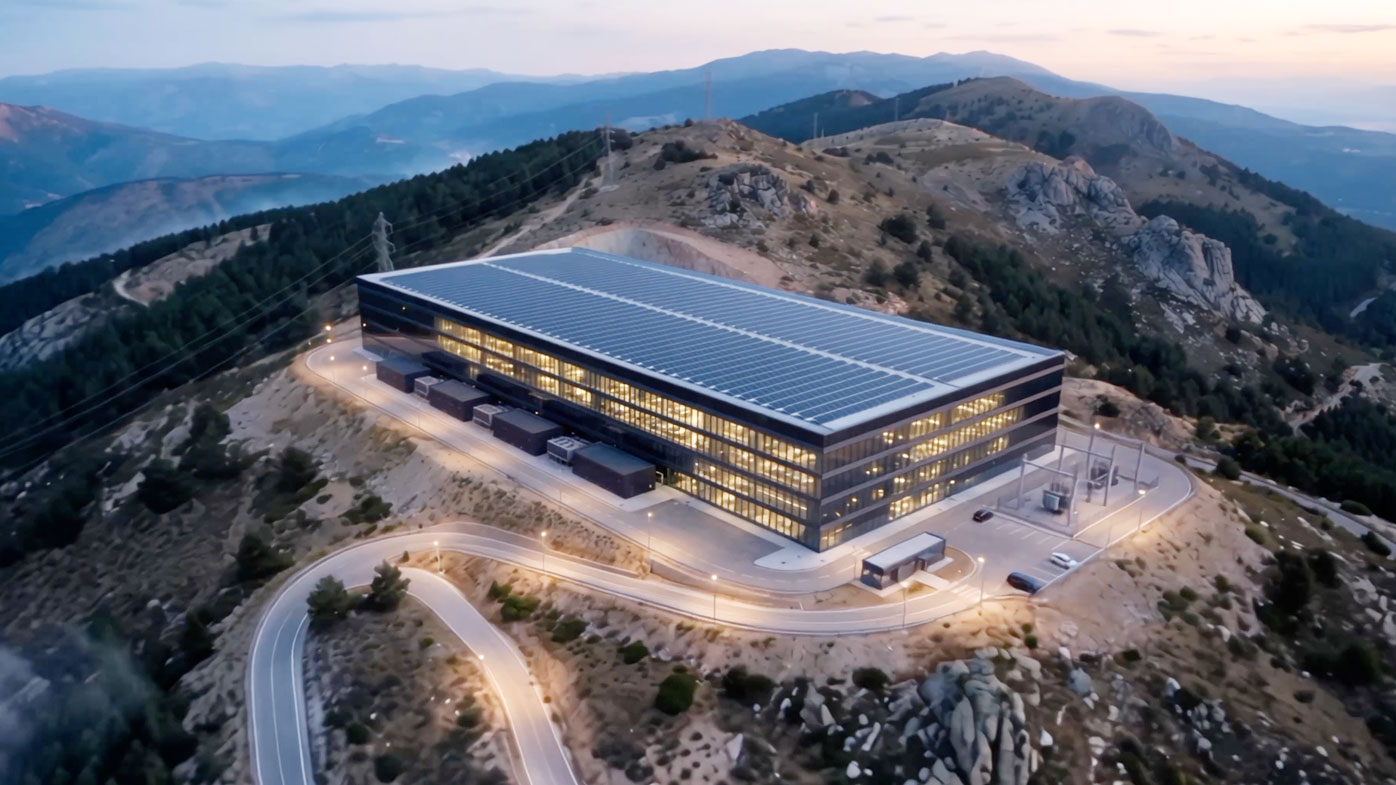
The image Generative Bionics circulated alongside Tuesday's announcement shows a glass-walled, solar-roofed building perched on a ridge line, lit from inside at dusk, with an access road curling up to it and no robots yet visible on the grounds. That is the state of the project this week: a rendering and a 2027 completion date, with the fleets, the data and the sovereignty claim still to be proven once the building is finished and GENE.01 units are actually working inside it.
This article synthesizes company statements and public infrastructure disclosures as of 2026-10-21. It is for general information purposes only and does not constitute investment, financial, or professional advice.