Pony.ai Starts Fully Driverless Robotaxi Tests in Zagreb
Pony.ai and Verne began invited-passenger tests without an onboard operator on a 22-kilometer Zagreb airport route, advancing an existing supervised service toward fully driverless operation.
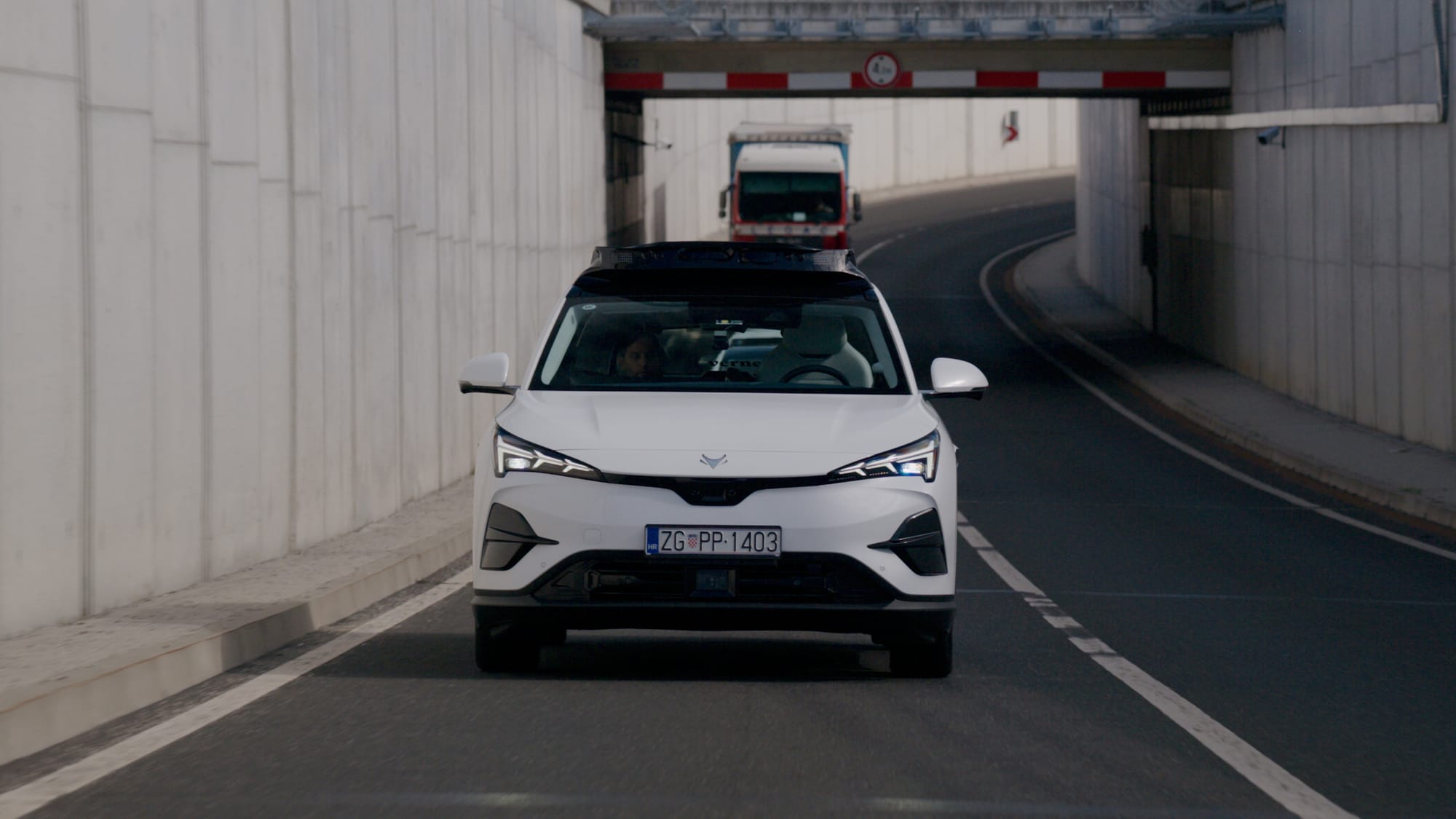
ZAGREB, Croatia, September 10, 2026. Pony.ai and Verne began fully driverless test rides with invited passengers on a 22-kilometer public-road route linking Verne’s headquarters, a Zagreb business district, and Franjo Tuđman Airport. The test removes the onboard autonomous-vehicle operator used in the partners’ commercial service since April and moves the program toward driverless operation.
Pony AI Inc., also known as Pony.ai or 小马智行, is a China-founded autonomous-driving company listed on Nasdaq and the Hong Kong Stock Exchange. Verne is a Zagreb-based autonomous ride-hailing operator that has worked on local deployment and regulatory approvals since 2019. Pony.ai supplies the driving system, Verne runs the service, and Uber provides access to passenger demand through its platform.
The Empty Driver’s Seat Changes the Operating Test
The route is important because it links an established operating base with an airport rather than keeping the vehicles inside a closed demonstration area. Airport corridors impose repeated but demanding conditions: fast approach roads, lane changes, tunnels, pickup timing, luggage-heavy passengers, and traffic patterns that change sharply around flight banks. A 22-kilometer run therefore gives the partners a bounded route with enough variation to test a service model, not only vehicle motion.
The current program is still a test with invited passengers. It is not unrestricted commercial driverless service, and the distinction matters. Since April, Verne has operated rides with an autonomous-vehicle operator onboard. Removing that person changes the risk model because a human can no longer resolve an uncertain situation from the driver’s seat. Remote assistance, incident response, passenger communication, roadside recovery, and regulator reporting all become part of the product.
That makes Thursday’s step materially different from Pony.ai’s appearance in the shared NVIDIA robotaxi technology stack. The NVIDIA story concerns common compute and simulation infrastructure. Zagreb is about whether one operator can turn that technology into a no-driver passenger service under European rules.
Five Months of Supervised Service Built the Base
Pony.ai and Verne said the Zagreb fleet has covered more than 200,000 kilometers, completed several thousand customer rides, and earned an average passenger rating of 4.7 out of 5 since the April service launch. These are company-reported figures, but they establish a useful sequence. The partners did not move directly from a laboratory test to an empty driver’s seat. They first accumulated operating experience with a trained person inside the vehicle.
That supervised phase can generate the less glamorous data required for driverless operation. Teams learn where passengers stand at pickup points, how local drivers merge, which roadworks appear without notice, how airport access rules affect routing, and which faults can be resolved remotely. They also learn whether riders follow instructions, close doors properly, secure luggage, and understand what to do when the car stops unexpectedly.
For an operator, the key question is not whether the vehicle can complete the route once. It is how often the wider service can complete a ride without human intervention. A car may drive perfectly while the passenger cannot find it, a door sensor reports an obstruction, a blocked curb prevents pickup, or a network interruption delays remote support. Driverless service quality is the combined performance of the vehicle, operations center, app, roadside team, and local regulator.
The 4.7 rating is encouraging but incomplete. Buyers and transport authorities should ask how many rated rides produced the average, whether the score changed over time, and what complaints occurred. Passenger satisfaction can reveal service problems that disengagement statistics miss, especially around pickup clarity, braking comfort, cabin cleanliness, and recovery from route changes.
Three Partners Divide the Deployment Risk
The Zagreb model separates three functions that some robotaxi companies try to own themselves. Pony.ai supplies the autonomous-driving technology. Verne handles local operations and regulatory work. Uber contributes distribution through a ride-hailing platform. That division can reduce the amount of capital any one company must commit to enter a new market, but it also creates more interfaces where accountability can become blurred.
Think of the service as an airline route. The autonomy system is the aircraft, Verne is the local airline operator, and Uber is the ticket counter. Passengers experience one journey, even though different parties control the vehicle technology, daily operations, and booking channel. When something goes wrong, the contracts behind the service must decide who owns the response, the data, the customer communication, and the cost.
Those boundaries matter for procurement. A city or transport authority evaluating the model should ask which company carries the operating license, who maintains the vehicles, who reviews safety events, who stores passenger and road data, and who has final authority to pause service. It should also ask whether Uber can substitute another autonomy provider or whether Verne’s operating systems are tightly bound to Pony.ai’s hardware and software.
The model resembles the broader platform strategy behind Grab’s robotaxi partnerships, where demand aggregation and local market access can be separated from the company that builds the driving system. The advantage is speed. The risk is that a service can appear scalable before the partners have proven that their technical, commercial, and regulatory responsibilities transfer cleanly from one city to the next.
The Vehicle Is Only One Layer of the Safety Case
The Zagreb tests use Pony.ai’s seventh-generation robotaxi, with a company-developed Level 4 domain controller built on NVIDIA DRIVE AGX and running on the safety-certified Halos operating system. Pony.ai says the vehicle combines 360-degree sensor coverage with several redundancy layers and fail-operational capability. Those specifications describe how the vehicle is intended to handle component faults, but they do not by themselves establish safe service.
A driverless safety case also needs operational limits. Regulators and buyers should know the weather, road, speed, and construction conditions under which the system can run; the process for stopping service; the response time for remote assistance; and the evidence required before the route expands. The most revealing data will be the reasons rides cannot start or must end early, not only the number completed.
Pony.ai reports more than 100 million autonomous kilometers worldwide, including over 40 million kilometers in fully driverless mode. That experience is relevant, particularly because much of it comes from large Chinese cities with dense and irregular traffic. Europe still requires local proof. Road rules, signage, emergency procedures, privacy obligations, insurance structures, and public expectations do not transfer automatically with the software.
A company can possess a mature driving system and still have an immature local service. Technical reliability is necessary, but commercial driverless operation also depends on city permissions, depot processes, vehicle cleaning, charging, mapping updates, passenger support, and recovery vehicles. The deployment fails if any one of those systems cannot keep pace with fleet growth.
Route Expansion Will Reveal the Real Cost Structure
Pony.ai and Verne plan to expand the driverless route over the coming months until it covers the broader Zagreb operating area. That expansion will be the better test of economics. A fixed corridor concentrates mapping, monitoring, and roadside support. A wider operating area increases the number of intersections, pickup points, roadworks, weather exposures, and rare situations the fleet must manage.
The partners should be judged on how the support requirement changes as the map grows. If every route extension demands a proportional increase in remote operators and field personnel, the service may be driverless inside the vehicle while remaining labor-heavy behind the scenes. If intervention falls and one support team can supervise a larger fleet, the operating model becomes more attractive.
Pony.ai says its overseas joint-deployment pipeline exceeds 4,000 robotaxis, including plans with Uber for more than 2,000 vehicles across Europe. It also targets a global fleet above 3,500 robotaxis by the end of 2026 across more than 20 cities. These are plans, not realized fleet totals. Zagreb matters because it can show whether a partnership model converts a pipeline into a repeatable operating template.
A buyer should therefore track four numbers: driverless miles between remote interventions, rides completed without passenger-support contact, average recovery time after a fault, and the staffing ratio between operations personnel and active vehicles. None appears in the announcement, yet together they would say more about commercial readiness than a larger route map or another partnership target.
Europe’s Robotaxi Race Is Becoming an Operations Contest
The technical barrier to entering Europe remains high, but the competitive question is shifting. Several companies now have vehicles capable of driving without a person in limited conditions. The scarce capability is building a service that regulators permit, passengers understand, and local operators can run at acceptable cost.
Pony.ai brings fully driverless experience from China. Verne brings a local operating organization and the work required to satisfy Croatian authorities. Uber brings a familiar passenger channel. If that combination works, it offers a template for entering European cities without Pony.ai owning every depot, app, and customer relationship. If it struggles, the failure will likely occur at the seams between partners rather than in a single sensor or model.
For transport buyers and city officials, the right response is to demand evidence at those seams. Contracts should assign incident ownership, data access, service continuity, cybersecurity, insurance, vehicle recovery, and customer support before fleet expansion. Approval should advance in stages tied to operating evidence, not to the size of a global deployment announcement.
The image to remember is the white robotaxi leaving the Zagreb airport corridor with the driver’s seat empty. The technology made that scene possible. The operating system around the car will determine whether it becomes an everyday service.
Hero image credit: Pony.ai / Verne.
This analysis draws on public statements and technical materials released by Pony.ai and Verne describing the Zagreb robotaxi service and fully driverless passenger tests. It is for general information purposes only and does not constitute investment, financial, or legal advice.