Realbotix Opens Echo Robot Reservations for 2027
Realbotix opened reservations for 250 planned Echo social robots. Hardware, metered AI plans and optional local vision have separate prices; U.S. delivery is expected in the second half of 2027.


Realbotix opened Echo humanoid robot reservations on October 26, 2026, with a US$199 deposit and planned U.S. deliveries in the second half of 2027. The offer separates a small reservation payment from hardware costing US$11,950 or US$59,950, mandatory subscriptions and an optional US$24,950 vision system.
The U.S.-based social-robot developer builds its hardware in Las Vegas and specializes in human-faced machines for conversation and service-sector interaction. Echo combines expressive faces and silicone skin with artificial intelligence (AI) services, targeting education, companionship and wellness rather than a disclosed industrial labor-replacement contract. Its first production run is planned at 225 Tabletop robots and 25 Full Body robots. Those figures describe intended supply, not completed deliveries or booked customer demand.
The launch gives buyers something more concrete than a demonstration video: a payment schedule, hardware choices and priced software allowances. It also leaves a long interval between paying to reserve a machine and evaluating it in the intended setting. For a school, hospitality operator or care organization, the useful starting point is the whole configuration and its operating limits, not the deposit advertised at the top of the page.
A Reservation Buys a Place, Not a Shipping Date
The US$199 payment is credited against the purchase price. It does not buy a working robot, a perpetual software license or a guaranteed delivery slot on a particular day. Before manufacturing, Realbotix invoices half the robot's price, payable within 30 days to preserve the reservation. The remaining payment and shipping charge follow once the machine is built, before delivery. A buyer therefore faces progressively larger commitments well before practical acceptance testing can begin.
The published terms provide a refund of deposits and payments if Realbotix cannot deliver the robot; otherwise the deposit is non-refundable. Delivery dates are estimates rather than guarantees, and the initial offer is limited to the United States. Overseas buyers should not treat an accessible product website as confirmation that their location is supported. An organization comparing several suppliers needs the geography and payment timetable in its purchasing file before it evaluates features.
Tabletop costs US$11,950 and has 17 degrees of freedom. Full Body costs US$59,950 and has 39, including articulated fingers. A degree of freedom is an independently movable axis, such as a joint turning or a head tilting. More axes can make a gesture more convincing; the count does not establish how reliably a robot understands a request, handles an unfamiliar object or operates safely around people. The disclosed description emphasizes upper-body motion, not a demonstrated general-purpose walking worker.
Both versions use mains power, with the smaller model suited to a desk and the larger one occupying a full-height physical presence. Buyers can select Aria, Mila, Dave or Amar, each with a different interaction style. Character choice affects how the system presents itself. It should not substitute for verifying whether the selected configuration can perform a particular classroom, reception or social-engagement task consistently.
That distinction changes the comparison set. A receptionist seeking a conversational interface might compare Echo with a screen-based assistant or a staffed service desk, not a warehouse humanoid rated by lifting capacity. The extra value of a physical face, gaze and gesture is specific to the interaction. A purchasing decision should test that value against its added floor space, supervision and maintenance, rather than assuming that a human-shaped machine is automatically the more capable option.
The broader gap between intended use and actual deployment is familiar from the debate over moving household robots into industrial settings. Echo's offer is narrower: a social interaction platform with explicit reservation terms. That makes it assessable, but it does not turn a planned production run into evidence of sustained use by paying customers.
Conversation Time Is Part of the Purchase
Every Echo requires an AI subscription, starting at US$19.99 a month. The lowest advertised fee is not an unlimited-use package. Base includes 10 hours of conversation monthly, Plus provides 40 hours at US$39.99, and Enterprise provides 100 hours at US$199. These allowances meter time spent conversing with the machine, not simply time plugged into an outlet. After an allowance is exhausted, the robot is restricted to basic functions.
For an individual using a companion intermittently, a small allowance might fit the intended use. A public-facing installation has a different pattern: repeated short conversations across many visitors can consume a monthly limit without any single user speaking for very long. Managers need a usage estimate tied to the proposed service, including busy periods and staff demonstrations. Hardware capacity and software entitlement belong in the same comparison, even though the prices appear on separate lines.
The plans also differ in features. Plus lists richer voices, expanded language support and editing of personas, behavior and scenes. Enterprise adds custom characters, a customer-supplied knowledge base, presentation mode and connections to the customer's own AI models. The launch promotes support for more than 100 languages, but the pricing page assigns expanded languages and accents to Plus. A buyer should confirm the chosen plan's entitlement instead of treating every advertised capability as included in Base.
On unchanged fees, 12 months of Base costs US$239.88, while 12 months of Enterprise costs US$2,388. Those are simple subscription subtotals, not complete ownership costs. They exclude shipping, taxes, training, support, repairs and any future price changes. The deposit is part of the hardware price and should not be counted twice. Comparing only the initial payment would obscure both the later invoices and the recurring cost of the proposed service.
Local vision substantially changes that calculation. The optional Vinci Vision System costs US$24,950 and requires the Enterprise with Vision plan, currently US$199 monthly with unlimited conversation hours. That configuration brings Tabletop hardware to US$36,900 before shipping or tax. Adding one year of the required plan gives an illustrative US$39,288 subtotal, provided the published fees remain unchanged. The same subscription price as ordinary Enterprise does not mean the vision hardware comes free.
For an integrator, the relevant comparison is therefore not a single Echo price against a competitor's single price. It is a specified embodiment, software allowance, data-processing mode and intended workflow against another configuration offering comparable service. An unlimited local-vision package may be useful where conversational demand is high, but the capital premium needs an operational reason. Buying a feature because it sounds advanced is different from paying for one because the site needs it.
Local Vision Has a Boundary, and Wellness Has One Too
Vinci is advertised as supporting on-device speech and AI processing alongside face recognition, gaze tracking and awareness of surrounding activity. Local processing can reduce the need to send conversation or visual data away from the installation. It does not make every mode of operation cloud-free. Echo also integrates with external AI platforms, including ChatGPT, Claude and Gemini, and its privacy statement separates locally saved records from content transmitted when cloud features are used.
Realbotix states that conversation histories, memories and facial-recognition records stay on the robot or paired device, and that it does not receive or use those stored records for advertising or model training. It also states that cloud-based AI, speech or avatar services may transmit the information needed to their providers. Usage logs are another category. These are distinct promises; combining them into a blanket claim that no information ever leaves Echo would misrepresent the disclosed design.
An organization handling conversations with children, guests or care recipients should map the actual configuration before choosing it. The questions are practical: which service processes speech, which device keeps memory, who can administer stored records and what happens when a user requests deletion. The answers may change with the selected provider or feature. Local storage is a useful architectural choice, but it is not a substitute for consent rules, access controls and a documented retention policy.
The importance of disclosing what sits behind a robot's apparent autonomy extends to social machines. An expressive face can make software feel more competent or more understanding than the evidence supports. Recognizing cues in a face or generating a sympathetic reply is not proof of a clinical benefit. The launch provides no controlled outcome study establishing Echo as a therapy or a substitute for professional care.
The same restraint applies to the planned digital twin. Realbotix expects a 2027 companion that carries a character's voice, personality and memories across devices and the physical robot. That is a roadmap commitment, not a service demonstrated as available at this launch. Procurement teams should distinguish what can be contracted and tested now from what a later software release might add, especially when continuity of saved personal information is part of the promised value.
A convincing pilot would define a narrow task, a supervised setting and measurable outcomes such as completed interactions, staff interventions and usage within the selected allowance. It would evaluate data handling and participant consent alongside the conversational experience. Such a pilot could reveal genuine value in a human-facing interface without requiring the buyer to endorse every wellness claim or assume that convincing facial motion implies dependable judgment.
The next commercial milestone is not another character demonstration. It is delivery of the specified configuration, followed by evidence that its interaction quality, software entitlement and support fit a real service. Echo has turned a social-robot pitch into a priced offer, but its launch still commits to only 250 planned machines for the first 2027 production run.
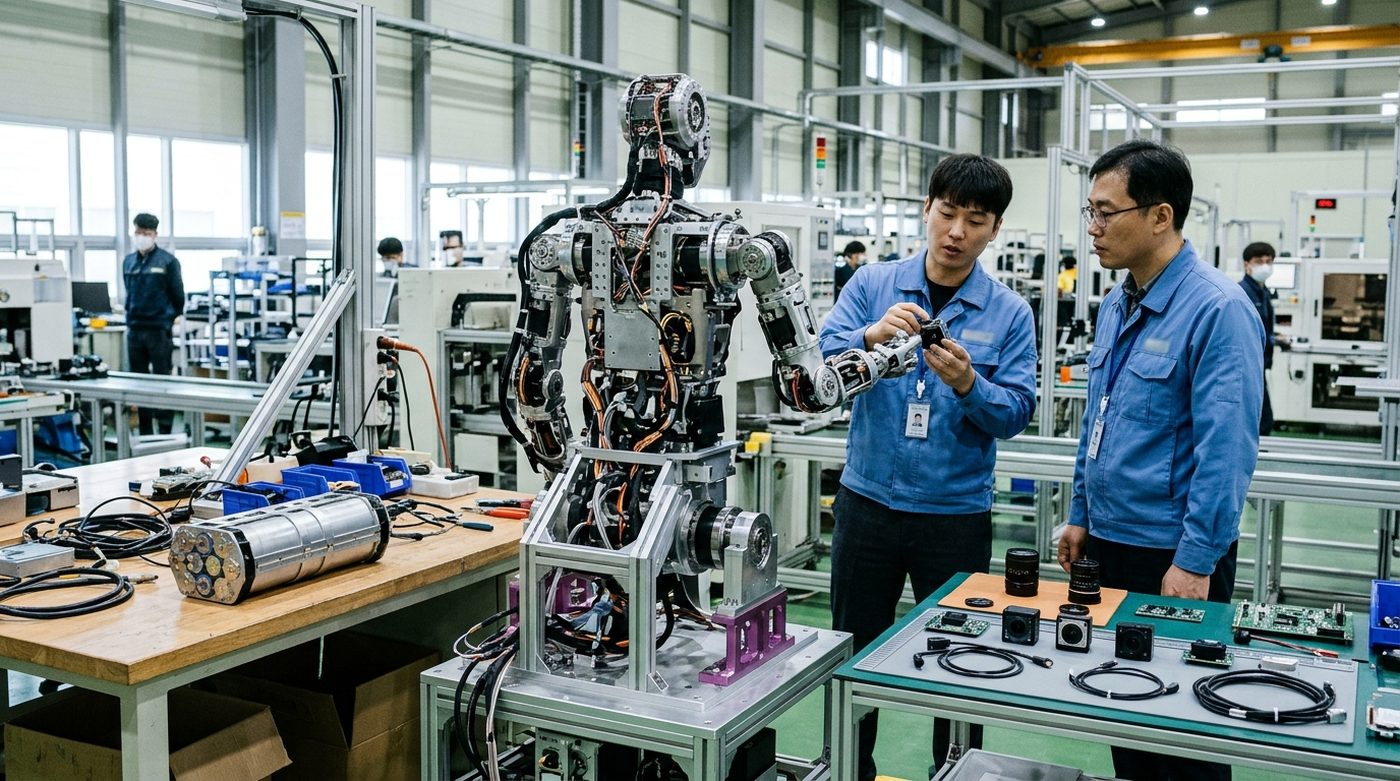
A Realbotix social robot is shown in the illustrative company photograph, not as documentation of a delivered Echo unit. Photo: Realbotix.
This analysis synthesizes company statements and public commercial information available at the time of writing.
This article is provided for general information purposes only and does not constitute investment, procurement, legal, or engineering advice. Product specifications reflect public company information available at the time of writing and may change without notice.