Comau's Answer to the Robot That Can't Survive a Washdown
Comau has introduced its cover-free Hygienic Oil robot family at CIBUS TEC 2026 in Parma, pairing with sister company Automha to pitch food and beverage manufacturers a single-source automation relationship spanning robots, exoskeletons and warehouse storage.

Comau's Answer to the Robot That Can't Survive a Washdown
A standard industrial robot arm, built for a dry automotive assembly line, generally cannot survive the daily high-pressure washdown and caustic cleaning chemicals a food or beverage plant requires without a protective cover that adds cost, slows cycle times and creates its own crevices for bacteria to hide in. Comau is trying to close that gap this week at CIBUS TEC 2026, the food and beverage technology show running October 27 to 30 at Parma's fair grounds, where the company and its sister firm Automha are presenting a combined automation offer spanning a plant's inbound material handling through its outbound distribution, under one group rather than as separately sourced robots and storage systems.
Comau is an Italian automation company headquartered in Grugliasco, near Turin, best known for the robotic welding and assembly lines it has long supplied to the automotive industry, including a growing e-mobility battery and EV-manufacturing business. Automha, a wholly owned company within the same group, builds automated storage and retrieval systems, and the two are appearing at the show alongside Invent, a third group company, as what Comau calls a single-source automation provider for food and beverage manufacturers, at Hall 2, Booth K038.
The Lubricant Problem Nobody Talks About
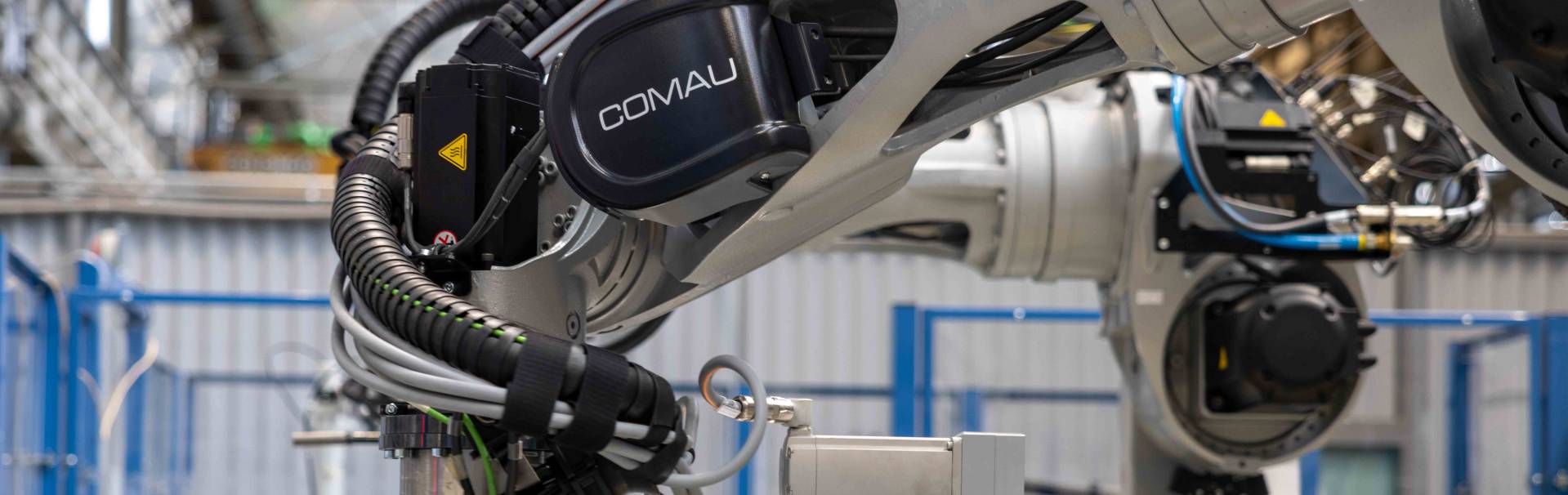
The product Comau is introducing for the first time at the show is its Hygienic Oil, or HO, family, a line spanning SCARA, articulated and palletizing robot configurations built specifically to run without the plastic or stainless-steel protective covers that food manufacturers currently bolt onto standard industrial arms. The HO robots use food-grade lubricants certified to the U.S. National Sanitation Foundation's H1 category, the designation for lubricants that can have incidental contact with food, which is the detail that actually lets Comau remove the cover rather than simply market around keeping it.
That distinction matters more to a plant engineer than it sounds. A covered robot arm is slower to clean thoroughly, because a cover creates seams and gaps a washdown crew has to inspect separately from the robot's own surfaces, and it adds mass and bulk that can slow the arm's cycle time on tight pick-and-place work. Comau is showing a 4-axis food-grade S-18-1.7 HO robot on the floor at CIBUS TEC alongside the broader HO line, giving visitors a specific model to evaluate rather than only a concept. Whether food manufacturers judge an uncovered, H1-lubricated arm trustworthy enough to replace a covered one at scale is a longer adoption question than a trade-show demo can answer, since food-safety auditors, not booth visitors, are the audience that decides whether a plant can run the HO line without a cover and still pass inspection.
The Competitive Backdrop in Hygienic Robotics
Comau is not creating the hygienic-robot category from nothing. Rivals including ABB, Stäubli and Yaskawa have each sold washdown-rated or food-grade robot variants for years, generally following one of two paths: a sealed, IP69K-rated arm designed to tolerate washdown while still wearing some form of protective housing, or a stainless-steel finish paired with food-grade grease at the joints. What Comau is arguing with the HO family is that H1-certified lubricant throughout the arm, rather than at isolated joints, is what finally lets a manufacturer drop the external cover entirely rather than simply make the covered version easier to hose down. Whether that argument holds up under third-party food-safety certification, rather than Comau's own marketing claim, is the detail a buyer's compliance team will need to verify before any purchase order follows a booth conversation.
CIBUS TEC itself is a meaningful venue for that argument to be tested. The Parma show sits inside Italy's food-processing-machinery cluster, an export-heavy industrial base that supplies packaging and processing equipment to food manufacturers well beyond Italy's own borders, so the audience walking Comau's booth is disproportionately likely to be engineers and buyers who already operate washdown-rated equipment from Comau's established rivals and can judge the HO pitch against direct experience with the alternative, rather than evaluating the uncovered-arm argument in the abstract.
The Real Cost Comparison a Plant Engineer Runs
The financial case for an uncovered, H1-lubricated arm rests on a comparison that is straightforward to model even if Comau has not published the numbers: the purchase premium, if any, for the HO line over a comparable covered arm, set against the recurring costs a cover imposes over the life of the robot, including the cover's own replacement cycle, the added washdown and inspection time the cover requires at every cleaning cycle, and any cycle-time penalty from the cover's extra mass on fast pick-and-place motions. A plant running three shifts a day with multiple washdowns between batches accumulates those recurring costs far faster than a single-shift operation, which means the HO line's economics will look very different to a high-throughput beverage bottler than to a smaller specialty-foods producer running one shift and a lighter cleaning schedule.
That same throughput variable applies to the exoskeleton and warehouse-automation parts of the group's pitch. MATE's back-support exoskeleton is a cheap intervention per worker relative to a robotic cell, which makes it a plausible first automation purchase for a smaller food plant not yet ready to commit capital to a robotic line, while Automha's Quaterways and AutosatGTR shuttle systems are capital-intensive warehouse investments that only make sense at a throughput and SKU count large enough to justify automated storage over conventional racking and forklifts. Comau and Automha showing both ends of that spectrum under one roof lets a single visitor find the entry point that matches their plant's actual scale, rather than being pitched a single product tier regardless of fit.
A Portfolio Built to Avoid a Second Integrator
The more strategically interesting part of Comau's pitch is not any single robot but the decision to show it alongside Automha's warehouse technology under one group banner. Automha is bringing its Quaterways multidirectional shuttle system, powered by its own AWMS warehouse management software, and the AutosatGTR shuttle for multi-depth pallet storage, products aimed at the automated storage and retrieval end of a food plant's operation rather than the robotic picking and processing end Comau's arms handle.
A food and beverage manufacturer building out automation today typically has to integrate robots from one vendor, a warehouse management system from a second, and storage hardware from a third, then manage the finger-pointing when something in that stack fails to perform as promised. Comau's pitch at CIBUS TEC is that a manufacturer can instead buy the robotic processing layer and the storage and retrieval layer from the same corporate group, with a single relationship accountable for both. "The combined capabilities give the group the scale to take on larger projects," said Francesco Allegra, who holds the dual role of Automha's chief executive and Comau's chief operational performance officer, a title pairing that itself signals how closely the group wants the two product lines to be understood as one offer rather than two companies sharing a booth.
What Else Is on the Floor
Beyond the HO line, Comau is showing MATE, a wearable back-support exoskeleton aimed at workers doing repetitive lifting and bending tasks that remain manual even in a heavily automated plant, a category of hybrid human-robot work that food and beverage logistics still relies on more than automotive assembly does. The company is also demonstrating a Racer-5 SE food-handling cell, built with partners Progea, supplying the Leonardo software layer, and Camozzi, supplying pneumatic components, and a packaged-product pick-and-place cell built around the MyCo collaborative robot, developed jointly with Innovision. Comau separately lists a Racer-5 model carrying food-contact certification under its Sensitive Environments line, suggesting the company is building out a family of food-qualified variants across its existing robot platforms rather than treating hygienic design as a one-off product.
That breadth, five distinct product lines across two group companies at a single booth, reads as a deliberate attempt to be evaluated as a platform rather than a point solution. A plant engineer who arrives at Booth K038 looking for a single hygienic robot arm will leave having also seen an exoskeleton, two warehouse shuttle systems and a cobot pick-and-place cell, all pitched as pieces of the same automation relationship rather than separate purchase decisions.
Why Food and Beverage Automation Still Lags
Food and beverage manufacturing has automated more slowly than automotive or electronics assembly for reasons that have little to do with robot capability and much to do with the operating environment: product variability from batch to batch, frequent line changeovers between SKUs, and hygiene requirements that most industrial automation was never designed around. A robot that can survive a caustic washdown without a cover, paired with storage software that can track lot numbers and expiration dates through a multi-depth shuttle system, addresses two of those constraints at once rather than one, which is the case Comau and Automha appear to be building toward with a joint show presence rather than two separate booths.
Whether that case converts into orders will show up less in show-floor foot traffic than in whether a food manufacturer chooses the combined Comau-Automha-Invent relationship over assembling its own stack from separate robot, software and storage vendors on its next capital project. For now, the clearest evidence of the strategy is the booth itself: a hygienic robot arm standing next to a warehouse shuttle and an exoskeleton, with one group's name over all three, on a trade-show floor in Parma through the end of the week.
This account draws on product and event materials issued by Comau and Automha for CIBUS TEC 2026.
This article is provided for general information purposes only and does not constitute investment, procurement, legal, or engineering advice. Product specifications reflect public company information available at the time of writing and may change without notice.