ANYbotics Clears a Decade-Old Barrier for Robots in Oil and Gas
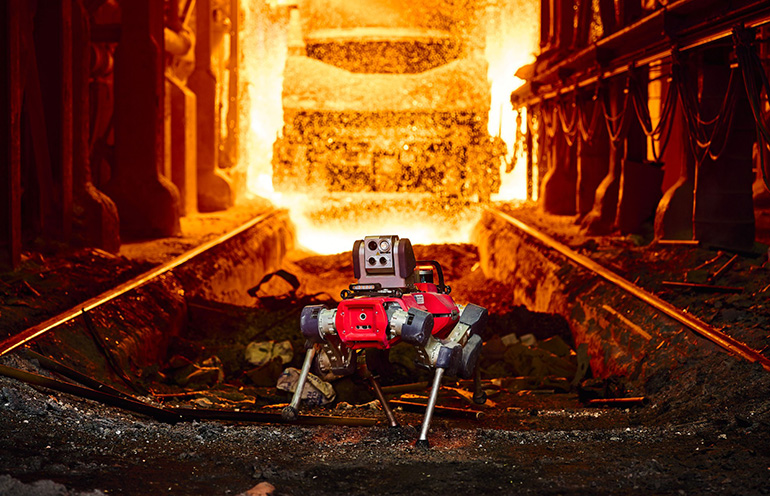
ANYbotics has begun shipping ANYmal X, the first legged inspection robot certified for explosive atmospheres, after a four-year certification push and an early-access program with BP, Shell, Equinor, PETRONAS, Petrobras, BASF and SLB.

ANYbotics Clears a Decade-Old Barrier for Robots in Oil and Gas
ANYbotics announced Tuesday that it has begun shipping ANYmal X, the first four-legged inspection robot certified to operate inside explosive atmospheres such as refineries, chemical plants and offshore platforms. The Zurich-based robotics maker, spun out of ETH Zurich in 2016 and backed by more than US$150 million in funding, says the certified machine follows four years of engineering work and more than ten patents, and it arrives with an early-access customer list that already includes BP, Shell, Equinor, PETRONAS, Petrobras, BASF and the oilfield services giant SLB.
ANYbotics employs roughly 200 people across Zurich, San Francisco and Barcelona, and until now its ANYmal line of walking inspection robots has been confined to facilities without a meaningful risk of gas or vapor ignition. ANYmal X changes that by adding explosion-protection engineering on top of the existing legged platform, opening a category of industrial sites that has been functionally off-limits to autonomous mobile robots since the inspection-robot market emerged.
The Economics Behind a Four-Year Certification Push
The pitch to procurement and operations teams rests on a specific, uncomfortable number: ANYbotics puts the global oil, gas and chemical sector at US$102 billion, and estimates that undetected equipment failures cost the world's 500 largest companies roughly US$1.4 trillion a year in preventable downtime. Siemens has separately estimated that unplanned downtime in oil and gas facilities can run as high as US$500,000 an hour. Those figures explain why operators tolerate the cost and engineering overhead of a robot built specifically to survive, and be legally permitted inside, a Zone 1 hazardous area rather than simply buying a cheaper machine and routing it around the riskiest equipment.
The other number ANYbotics leans on is a safety one. The company cites U.S. National Institute for Occupational Safety and Health data showing that extraction-sector workers face a fatality rate seven times the national average, the baseline risk that manual inspection rounds in hazardous zones are meant to address. A robot that can walk those rounds instead of a technician does not just save money; it removes a person from a statistically dangerous job, which is the argument operators will have to weigh against the robot's purchase price and the integration cost of connecting it to existing maintenance systems.
Four Years to Clear the Compliance Bar
Getting a battery-powered walking robot legally rated for an explosive atmosphere is a materially harder problem than certifying a fixed sensor or a wheeled cart, because every joint, cable run and battery cell is a potential ignition source that moves. ANYbotics says it pursued certification under the European Union's Equipment for Explosive Atmospheres directive (ATEX) and the global IEC System for Certification to Standards Relating to Equipment for Use in Explosive Atmospheres (IECEx), the two regimes that govern electrical and mechanical equipment in hazardous locations, and that the robot's twelve leg actuators and battery pack sit inside flameproof casings, with nitrogen-filled sealed chambers and dedicated energy barriers isolating the charging and data connections from the explosive environment outside.
"Four years of pioneering engineering with more than ten patents went into ANYmal X," said Péter Fankhauser, ANYbotics co-founder and chief executive. Andrea Corda, the company's chief technology officer, described the certification process as a component-by-component negotiation with regulators rather than a single design sign-off: "Working closely with the certification bodies, we answered that question component by component." Thierry Obédé, ANYbotics' chief revenue officer, was more blunt about what the certificate actually buys a customer: "A certified robot is only the entry ticket for inspecting oil, gas and chemicals facilities," he said, framing the hardware approval as table stakes rather than the finished product.
An Early-Access Fleet Already Doing the Work
ANYbotics has not been testing ANYmal X in a lab. Since 2023, the company has run an Early Access Program with BP, Equinor, Shell, PETRONAS, Petrobras, BASF and SLB, logging hundreds of onshore and offshore missions before the formal launch. That is a meaningfully different go-to-market motion than a robotics startup announcing a prototype and hunting for its first pilot customer afterward: by the time ANYmal X shipped, seven of the sector's largest operators had already put it through real inspection rounds on their own sites.
The robot runs on ANYbotics' Shift software platform, which schedules inspection missions, organizes the resulting sensor readings by physical asset rather than by robot run, and feeds that data into maintenance systems including SAP, Yokogawa and SLB's own software stack. That integration layer matters more than the certification to a plant's maintenance team in practice, because a hazardous-area robot that produces another disconnected dashboard does not reduce headcount or response time; one that writes directly into the work-order system an operator already uses can.
Separate from the explosion-protected line, ANYbotics says more than 50 customers in power, metals and materials industries are already running the broader ANYmal platform for more than 120,000 autonomous inspections a month, a scale that gives the company existing deployment and support infrastructure to extend into hazardous-area accounts rather than building that operational capability from zero alongside the new certification.
The Narrower Field ANYmal X Walks Into
Hazardous-area inspection has not been robot-free before ANYmal X; it has mostly been wheeled-robot territory. Companies such as ExRobotics and Taurob have sold ATEX- and IECEx-rated wheeled platforms into refineries and offshore installations for several years, and fixed gas detectors remain the default layer of protection on most sites. What a legged platform adds is the ability to climb stairs, step over cable trays and pipe runs, and enter valve rooms and pump skids that a wheeled chassis cannot reach without a ramp or a redesign of the walkway. That is a narrower advantage than ANYbotics' marketing implies: most of a refinery's hazardous-area assets sit on flat concrete decking that a wheeled robot handles perfectly well, and the legged platform's edge shows up mainly in the minority of inspection routes that involve stairs, ladders or irregular terrain.
The buying decision procurement teams actually face, then, is not legged robots versus no robots. It is whether to standardize on one certified platform that can cover both flat and irregular terrain, accepting a higher per-unit cost and a harder maintenance profile for the robot itself, or to keep running a cheaper wheeled fleet on the easy routes and leave the stairs and valve rooms to human technicians. ANYbotics is pricing ANYmal X as the former: a single hazardous-area asset that replaces the need to mix robot types, provided a site is willing to pay for the legs it will use on only part of its route network.
What the Software Layer Is Actually Worth
The Shift platform is where ANYbotics expects to make its recurring revenue, not the hardware sale. A certified robot that walks a fixed route and hands an inspector a spreadsheet of readings solves a staffing problem; one that writes directly into SAP or a Yokogawa distributed control system, organized by physical asset rather than by robot run, changes how a maintenance team schedules work orders in the first place. That is the harder sell to a plant's operations budget, because it requires integration work with systems the plant already runs, and it is also the part of the product that is difficult for a competitor to replicate quickly even if it fields a comparably certified robot.
For an operations leader comparing vendors, the practical question is less about ANYmal X's walking gait and more about how much engineering time a site will spend wiring Shift into its existing SAP or Yokogawa instance, and whether the resulting work-order integration actually shortens the gap between a detected anomaly and a dispatched repair crew. ANYbotics has not published a figure for that gap, and until it does, buyers evaluating the robot against a wheeled incumbent or an expanded contractor-inspection program will have to take the integration claim on faith, backed only by the early-access operators' decision to keep using the robot past their initial trial period.
What ADIPEC Will Actually Test
ANYmal X will make its public debut at ADIPEC 2026, the Abu Dhabi energy conference, where ANYbotics plans to show it alongside SLB and Kuwait Oil Co. The event matters less for publicity than for the private conversations it will generate among national oil companies and Gulf operators who have historically been slower than European and American majors to commit robotics budgets, in part because many of their largest assets sit in exactly the Zone 0 and Zone 1 hazardous classifications that ANYmal X is now certified against.
For a buyer evaluating the category, the near-term decision is not whether legged inspection robots work in principle; the early-access roster already answers that question. It is whether a single hazardous-area-certified platform, tied into existing maintenance software, is worth displacing a mix of fixed gas detectors, contractor walk-downs and point sensors that most large facilities have accumulated over decades. ANYbotics is betting that the US$1.4 trillion downtime figure and the elevated worker-fatality rate it cites will make that case on their own, and that the certification it spent four years securing is now the only credential a vendor needs to get in the door at a refinery gate.
This account draws on ANYbotics' own product materials, executive statements issued alongside the launch and the company's published customer and market figures.
This article is provided for general information purposes only and does not constitute investment, procurement, legal, or engineering advice. Product specifications reflect public company information available at the time of writing and may change without notice.