Xpanner's New Pile Driver Needs One Operator for an Entire Solar Field
Xpanner has launched the X1 Piling R6, a fully automated pile-driving machine for utility-scale solar and battery storage sites that needs only one supervising operator, extending the automation-as-a-service model behind its earlier retrofit kits.

Xpanner's New Pile Driver Needs One Operator for an Entire Solar Field
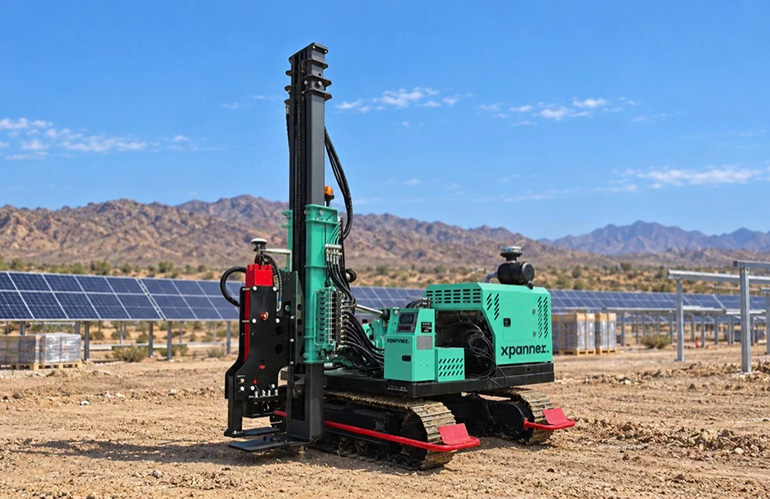
Xpanner introduced the X1 Piling R6 this week, a fully automated pile-driving machine built to install mounting posts across utility-scale solar and battery energy storage sites with a single operator supervising the work instead of running the machine directly. The system pairs a high-frequency hydraulic hammer, rated up to 1,260 joules of impact energy, with high-precision GNSS positioning and onboard sensors that let the machine find and drive each pile on its own once an operator has moved it into position for a given row.
Xpanner is a construction-automation company founded in South Korea in 2020 that expanded to the United States in 2023 and now runs its commercial operations out of Santa Fe Springs, California. The company builds retrofit automation systems for existing heavy equipment rather than designing new machines from scratch, a model it has applied previously to excavator-mounted solar-panel installation and, now, to pile driving. The R6 runs on Xpanner's own Everstar R6 crawler base rather than a retrofitted third-party machine, a shift from the company's original approach of adapting equipment customers already owned.
What One Supervisor Replaces
The workflow Xpanner describes starts with an operator uploading a site plan, then using remote control to move the Everstar R6 to the start of a pile row. From there, the machine drives to each subsequent pile location on its own, adjusting a guide rail that moves 300 millimeters fore-and-aft and 500 millimeters side-to-side, while the upper body rotates a full 180 degrees to line up each strike without repositioning the whole machine. The hammer can drive piles up to 7.0 meters, or about 23 feet, long, to a maximum depth of 4.8 meters, roughly 15.7 feet, and a multi-function mast on the same base also supports down-the-hole drilling, auger drilling and ground-screwing for sites where straight hammering will not work in the local soil.
Every pile the machine drives gets logged, by position, depth and plumb, to a live project map through Xpanner Connect, the company's web-based monitoring dashboard. That record matters as much to a solar engineering, procurement and construction contractor as the automation itself: utility-scale solar racking tolerances are tight enough that an out-of-plumb pile discovered after panel installation can mean a costly rework, and a documented, per-pile log gives a contractor a defensible record that each post met spec at the time it was driven, not just an attestation from whoever happened to be running the rig that day.
A Subscription, Not Just a Machine Sale
Xpanner is not simply selling the Everstar R6 as a piece of capital equipment. Customers can buy or rent the hardware, then pay a separate monthly software subscription for each automation capability they activate on it, an arrangement the company has already applied to its earlier X1 Kit and X1 Panel Lift products under what it calls an automation-as-a-service model. Xpanner handles installation, calibration, training and ongoing support; the contractor still supplies the on-site operator who supervises the machine and handles setup and troubleshooting, so the labor saving is in reduced skilled-operator headcount per machine, not in removing people from the site entirely.
That structure lowers the upfront capital a contractor has to commit to try the system, which matters in a construction sector where equipment purchasing decisions typically sit several budget cycles behind a specific project's needs. It also means Xpanner keeps a recurring revenue relationship with every deployed machine rather than a one-time hardware sale, which gives the company an incentive to keep improving the automation software on units already in the field rather than treating each sale as a finished transaction.
The Track Record Behind the New Machine
The R6 is not Xpanner's first attempt at automated piling. The company's original X1 Kit, a retrofit automation package launched in 2025 for pile drivers customers already owned, including the Vermeer PD10, was deployed by Black & Veatch, one of the largest engineering firms serving the U.S. utility-scale solar sector, according to industry trade coverage of that earlier rollout. Xpanner has said that kit cut labor needs on a piling process by roughly 80 percent and operation time by about half, figures that are the company's own and have not been independently verified, but which at minimum establish that a large EPC firm judged the earlier retrofit system reliable enough to deploy on real projects rather than keep it at the pilot stage.
The R6 extends that same automation logic to a purpose-built base machine instead of a retrofit kit, which should make the system more consistent across sites, since Xpanner controls the whole platform rather than adapting its software to whatever brand of pile driver a given contractor already owns. It should also make the R6 a harder sell to a contractor with an existing fleet of other-brand pile drivers it would rather automate in place; Xpanner's retrofit kit and its new purpose-built machine are not really competing products so much as two different answers to how much hardware control a customer is willing to hand over for how much automation in return.
The Field Xpanner Is Competing Into
Xpanner is not the only company trying to automate heavy construction equipment through retrofit kits rather than clean-sheet robot design. Built Robotics, a San Francisco-based company, has pursued a similar strategy on excavators and other earthmoving equipment for solar and other civil-construction sites, and a handful of smaller firms have targeted narrower niches such as automated rebar tying or concrete finishing. What distinguishes the pile-driving niche Xpanner has focused on is that it is a single, well-defined, highly repetitive task rather than the more open-ended excavation and grading work some competitors have chosen, which narrows the engineering problem but also narrows the addressable market to companies that specifically need piles driven at scale.
That narrower focus is likely why Xpanner built a purpose-made base machine for this specific task rather than staying purely in the retrofit-kit business: a company trying to automate many different equipment types across many contractors has to keep its software general enough to handle that variety, while a company solving one task extremely well can justify owning the whole machine and tuning hardware and software together. Whether that tradeoff proves right will depend on how large the pile-driving automation market turns out to be relative to the broader earthmoving automation market competitors are chasing instead.
What a Contractor Actually Has to Evaluate
For a solar EPC weighing the R6 against a conventional operator-driven pile driver, the real comparison is not automated versus manual pile driving in the abstract, but the R6's day rate, including its software subscription, against the fully loaded cost of an experienced pile-driver operator for the length of a project. A machine that lets one supervisor oversee driving work that would otherwise require a dedicated skilled operator only pencils out if the subscription cost, plus whatever productivity the single-operator model sacrifices on irregular or tightly clustered pile layouts, comes in below what that operator's wages, training and availability would have cost across the project's piling schedule. Skilled pile-driver operators are not abundant labor in the current U.S. construction market, which is the gap Xpanner, Built Robotics and similar companies are all betting will keep widening rather than closing.
The GNSS-based positioning the R6 relies on also means its accuracy is only as good as the site survey and GNSS coverage feeding it; a contractor evaluating the machine will want to know how it performs under tree cover, near large metal structures, or in regions with weaker satellite correction coverage than the U.S. solar belt the product was evidently designed around, since those conditions are common on sites outside Xpanner's core American market.
Why Solar EPCs Are the Test Case That Matters
Utility-scale solar and battery storage construction is a plausible proving ground for this kind of automation precisely because pile driving on those sites is repetitive at a scale that rewards it: a single large solar farm can require tens of thousands of driven piles across a flat, open site with relatively few of the obstructions that complicate automation on a cluttered urban job site. That repetition is also why the labor-saving pitch is specific and checkable rather than vague: a contractor bidding a solar project already knows roughly how many piles a site needs, so a credible claim about labor hours per pile translates directly into a bid-level cost comparison against a conventional operator-driven rig, which is a more concrete test than most construction-robotics pitches offer.
Xpanner raised an US$18 million Series B bridge round in May to scale its automation business, funding that the R6 launch suggests went at least partly toward building a purpose-made machine rather than continuing to rely solely on retrofitting other manufacturers' equipment. Whether that bet pays off will show up less in Xpanner's own marketing than in whether large EPCs like Black & Veatch, who already trusted the company's retrofit kit, choose to put the purpose-built R6 on their next utility-scale solar bid instead of a conventional crew-operated pile driver, one machine and one contract at a time.
This account draws on Xpanner's own product materials and prior reporting on the company's earlier X1 Kit and X1 Panel Lift deployments and funding.
This article is provided for general information purposes only and does not constitute investment, procurement, legal, or engineering advice. Product specifications reflect public company information available at the time of writing and may change without notice.