Atlas Has a Supplier List, Not a Confirmation
Electronic Times named Atlas mass-production suppliers. The companies have not confirmed the awards.

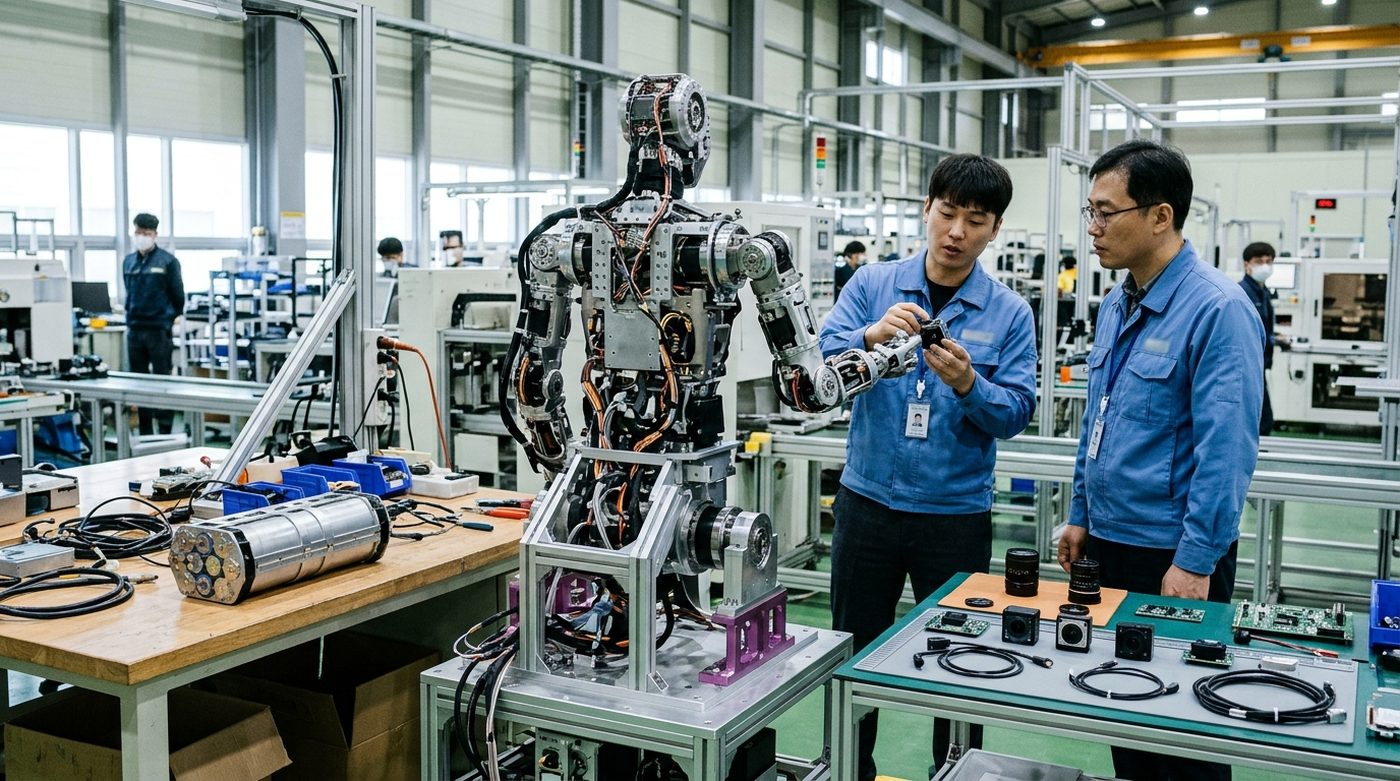
Hyundai's Atlas humanoid now has a supplier list. It does not yet have a supplier confirmation.
Electronic Times reported on 27 October 2026 that Hyundai Motor had, as of 26 October, lined up companies for a mass-production Atlas after running development projects with firms that already had the relevant technology. The newspaper attributed the list to information it obtained. It did not quote a Hyundai, Boston Dynamics, or supplier filing. Until those companies confirm the awards, the list is a reported selection, not a signed bill of materials.
The shape of the list is still the useful fact. It splits the robot into joints, power, eyes, and compute, and it puts most of those jobs inside Korea's existing auto and electronics chain.
Actuators are the expensive line. Electronic Times said Hyundai Mobis took the entire actuator order, the joints that move the robot, and that actuators account for more than half of a humanoid's production cost. The paper said Mobis is expected to build them in the United States and supply Boston Dynamics, the developer of Atlas. That is a continuation of a role already described in public, not a first appearance. Boston Dynamics said in January 2026 that Hyundai Mobis would supply Atlas actuators. What is new in the Electronic Times account is the claim that Mobis now holds the full mass-production order, plus a US build plan tied to Boston Dynamics.
Power is split. Samsung SDI and LG Energy Solution will supply the batteries, the paper reported, using cylindrical cells 21 millimeters in diameter. Samsung SDI is described as the primary supplier, with a larger share of volume, and is said to plan production in Malaysia. LG Energy Solution is said to plan production at its Georgia plant. Both are described as having begun to set up Atlas battery lines. BH EVS, a unit of PCB maker BH formed in 2022 after it acquired LG Electronics' automotive wireless-charging business, is reported to handle charging, using power-control technology from that auto business.
The camera awards are the surprise. Electronic Times said Hyundai Mobis will supply the main camera on Atlas's face, the sensor used to read the space ahead, detect obstacles, and identify a route. LG Innotek, which had worked with Boston Dynamics, had been treated as the likely supplier. The paper said that outcome was reversed, and that Mobis won the contract with camera specialist Namuga, a supplier of camera modules for Samsung Electronics phones. Hand cameras, an unusual placement on a humanoid, go to MCNEX and Cammsys. Those cameras are meant to recognize objects and support precision tasks. Compute stays with Nvidia. The robot will use Jetson Thor, a robotics processor built for low-latency AI. The Electronic Times copy available for this review names Hyundai Motor Group's executive chair in connection with that Nvidia supply and then cuts off. The chair's quoted remark is not included here because it was not readable in the retrieved text.
Read against earlier Electronic Times reporting, the list is a sourcing story sitting on top of a volume story the paper has already published. On 20 May 2026 it reported a plan to deploy more than 25,000 Atlas robots and to produce 350,000 robot actuators a year, with a US actuator plant targeted for 2028. On 23 September 2026 it reported a Boston Dynamics training center in Georgia and a US robot plant aimed at 30,000 robots a year. The 27 October piece does not restate those volume figures as new facts. It names who would feed that plan.
The industrial logic is ordinary automotive practice applied to a humanoid. Dual battery suppliers reduce the chance that one cell line stops the robot. A face camera and a pair of hand cameras separate walking perception from task perception. Putting actuators, the cost center, inside the group keeps the margin where Hyundai already builds at scale. Handing the brain to Nvidia avoids building a robotics processor in parallel with the body.
None of that is a purchase order. Electronic Times is a Tier 1 Korean electronics paper, and it dates the selection to 26 October. It also uses the language of a newsroom that has the list before the companies have announced it: "according to information obtained," "is expected," "is understood," "is believed." A buyer, a lender, or a competing supplier should treat every company name on this list as unconfirmed until Hyundai, Boston Dynamics, or the supplier says so.
The test, if the list holds, is narrower than a humanoid demo. It is whether a US actuator line, a Malaysia cell line, a Georgia cell line, and two camera specialists can deliver parts at a cost that makes a 30,000-unit robot plant rational. The paper has named the candidates. It has not shown the contracts.
This article is for informational purposes only and does not constitute professional advice.