Jiushi and Yutong Launch Driverless Truck for Factory Logistics
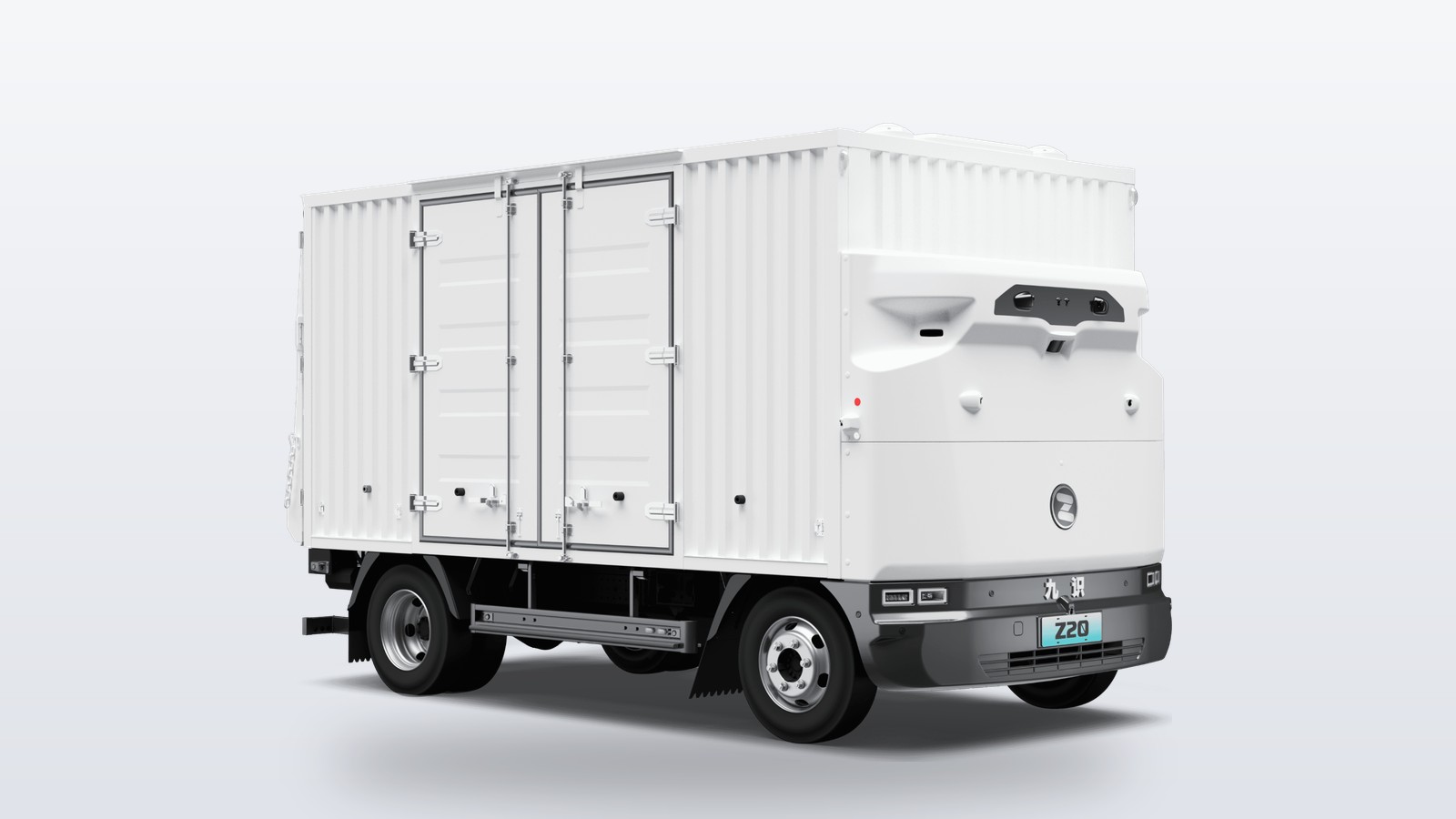
Autonomous-driving developer Jiushi Intelligence and manufacturer Yutong began production of the Z20, a 4.2-ton driverless truck built for factory and warehouse routes rather than public roads.

The Truck That Skips the Cab Entirely
A 4.2-ton driverless box truck began rolling off a production line outside Beijing this week, built jointly by autonomous-driving specialist Jiushi Intelligence and commercial-vehicle manufacturer Yutong. The Z20 carries 19.32 cubic meters of cargo, enough for six to eight standard pallets, and is designed for the repetitive shuttle runs between factory gates, warehouse docks and logistics parks that make up the bulk of China's industrial freight movement. Two battery configurations are offered, a 43.47 kWh standard pack and a 77.28 kWh long-range version rated for up to 320 kilometers, with 400V fast charging that restores 30 to 80 percent capacity in about 30 minutes.
Jiushi Intelligence, founded in 2021, built its name on what it calls the RoboVan category: compact, driverless delivery vehicles for last-mile parcel and grocery runs rather than passenger transport. The company has since scaled that model to more than 25,000 vehicles operating across over 300 cities in 20 countries, with cumulative Level 4 autonomous mileage exceeding 1.7 billion kilometers, and it has raised roughly US$400 million in venture funding, including a US$100 million Series B4 round led by Ant Group with participation from Baidu Ventures and Blue Lake Capital. The Z20 marks its first move into heavier-duty, higher-value freight, a segment where the economics and the liability exposure both scale up considerably from a delivery van doing sidewalk-adjacent stops.
That shift is the real story here. Autonomous last-mile delivery has spent the past several years proving itself in a forgiving environment: low speeds, short routes, and cargo that rarely exceeds a few hundred kilograms. A 6,950-kilogram gross weight vehicle moving through the gates of an active industrial park is a different risk category entirely, closer to the terrain long-haul autonomous trucking has struggled to clear at scale. Jiushi's answer is to shrink the operating domain rather than expand the vehicle's autonomy budget: the Z20 is built for closed or semi-closed routes inside industrial parks and between fixed logistics nodes, not open highways, which keeps the sensing and decision-making problem closer to what RoboVans already solve at the sidewalk.
Yutong's role sharpens that read. The Zhengzhou-based commercial-vehicle group is one of China's most established bus and truck manufacturers, and its willingness to attach its name to the finished Z20, handling chassis engineering, manufacturing and quality control while Jiushi supplies the autonomous-driving stack, functions as a production-grade endorsement that a software-only autonomy vendor cannot manufacture on its own. Fleet buyers evaluating a driverless truck are really asking two separate questions: can the software drive it safely, and will the vehicle itself hold up to years of industrial duty cycles. Pairing an autonomy specialist with a truck manufacturer answers both at once, and it is a template other Chinese autonomous-driving companies without their own vehicle manufacturing arm are likely to copy as they look to move beyond delivery vans.
Why Factory Logistics Is the Softer Target
The choice of factory and warehouse logistics over public roads is deliberate, and it explains why this launch matters more than its modest cargo capacity suggests. Industrial parks are private property with controlled access, predictable traffic patterns, and route repetition that autonomous systems handle far better than the open, adversarial conditions of public highways. A truck shuttling the same loading dock to the same warehouse gate dozens of times a day accumulates the kind of narrow, well-characterized driving data that makes Level 4 autonomy tractable years before it becomes safe on a provincial highway at night in the rain.
This is also where the labor case is most direct. Factory-to-warehouse shuttle runs are typically staffed by drivers doing short, repetitive routes for full shifts, work that is expensive to staff around the clock and does not require the judgment premium that makes long-haul trucking harder to automate. Replacing that driver with a fixed asset that can run three shifts without a rest break changes the unit economics of a distribution center's inbound logistics more than it changes the driving problem itself. That is the same task-displacement pattern already visible in warehouse picking and sorting, now extended to the yard and the road immediately outside it, and it is worth being precise about what has actually been proven: a production line has started, not a fleet contract. The distinction between a demo and a deployable system is exactly the gap Jiushi is trying to close by putting the Z20 through Yutong's manufacturing quality process rather than building it in-house.
Skeptics of Chinese autonomous-vehicle claims have a fair point that deserves a direct answer rather than a dismissal: production milestones announced at a launch event are not the same as signed fleet orders, and the industry has a well-documented habit of treating a single working prototype as if it were a market. What separates this announcement from a typical demo reel is the manufacturing partner. Yutong does not put its badge on a vehicle it has not run through its own production and quality-control process, which means the Z20 has cleared a bar that a software company showing off a modified pickup truck has not. Whether it also clears the commercial bar of paying fleet customers is a separate question, and one the companies have not yet answered publicly with order numbers.
The Component Supply Chain Behind the Badge
Underneath the Jiushi-Yutong partnership sits a broader shift in how China's autonomous-vehicle supply chain is organizing itself. Rather than each autonomy company building or acquiring its own vehicle manufacturing capacity, a division of labor is emerging where established truck and bus manufacturers supply the chassis, safety certification and manufacturing scale, while specialist software companies supply the perception and driving stack. That mirrors how the broader Chinese industrial-robotics sector has organized around component suppliers for servo motors, motion controllers and reducers rather than vertical integration, and it lowers the capital burden on autonomy startups that would otherwise need to become vehicle manufacturers to get their software into the field.
For buyers, that division of labor should change how a driverless-truck pitch gets evaluated. A fleet manager approached by an autonomy vendor without a named manufacturing partner is being asked to accept both an unproven software stack and an unproven vehicle platform in the same purchase decision. The Z20 structure separates those risks: the manufacturing risk sits with a company that has built commercial vehicles for decades, and the autonomy risk sits with a company that has 1.7 billion kilometers of real-world Level 4 operation behind it, even if that mileage was accumulated on lower-stakes delivery routes rather than heavy freight.
The remaining open question is pricing, which neither company disclosed at the launch. A driverless truck's total cost of ownership case rests on the delta between its purchase or lease price and the fully loaded cost of a human driver across the vehicle's service life, adjusted for uptime, and without a published number, the Z20 remains a proof of manufacturing readiness rather than a proof of purchasing logic. Fleet operators evaluating a shift to driverless yard and short-haul trucks should treat this launch as evidence that the vehicle exists and has cleared a real manufacturer's production line, not as evidence that the total cost of ownership case has already been made.
A Crowded Yard, Not an Empty One
Jiushi is not the only Chinese company chasing this segment. Low-speed autonomous delivery vehicles from operators such as Neolix have already logged years of service inside logistics parks and closed campuses, and several of China's passenger-robotaxi developers, including units under Baidu and WeRide, have discussed extending their driving stacks into commercial freight as a way to monetize sensor and mapping investments built for public-road robotaxi service. What distinguishes the Z20 is less the underlying autonomy, which follows the same closed-campus logic those competitors already use, than the choice to route it through an established truck manufacturer's production line instead of a smaller contract assembler. That choice raises unit costs relative to a stripped-down delivery vehicle but gives fleet buyers a manufacturer warranty and parts network that a pure-software vendor cannot offer on its own.
Regulatory exposure differs sharply by venue, and this is where the campus-first strategy pays off twice over. A driverless truck confined to private industrial property does not need the provincial road-testing permits, geofenced pilot-zone approvals, or public-liability insurance frameworks that have slowed China's open-road autonomous trucking pilots, because it never has to clear a public traffic authority in the first place. That regulatory shortcut is precisely why the industrial-park use case has moved faster than long-haul autonomous trucking, and it is also why the Z20's early metrics will be about vehicles delivered to specific factory campuses rather than route-miles logged on a public highway network.
Four rated tons of payload and 19.32 cubic meters of cargo space is not a large truck by industrial standards. It is, however, the first one built to a commercial manufacturer's quality bar rather than a software demo's, and that distinction is the number worth remembering from this launch.
This article is provided for general information purposes only and does not constitute investment, procurement, or engineering advice. Figures cited are drawn from public company statements and product disclosures as of publication and may change without notice.
This analysis synthesizes company statements, product specifications, and public market activity surrounding the Z20 launch.