Jiateng Raises Millions to Scale Embodied Robot Chassis
Guangdong Jiateng Robotics closed a tens-of-millions-of-yuan strategic round led by listed firm Holtek, with follow-on capital from industry funds, to scale omnidirectional chassis used under industrial robots and humanoids.

Guangdong Jiateng Robotics Automation Co., Ltd. completed a strategic financing round of tens of millions of yuan, disclosed on 18 August 2026, to expand the omnidirectional mobile chassis that sit under industrial robots and, increasingly, humanoid upper bodies. Listed controller maker Holtek (002402.SZ) led the round. Follow-on investors include Daocheng Fund, whose limited partners include Eastern Precision, Leju Robotics, and the firm’s own capital, plus Jinmu Capital. Yunxi Capital is exclusive financial adviser for later fundraising.
The company did not publish an exact RMB figure. Tens of millions of yuan is a range, not a price. At current conversion that is several million US dollars, not a unicorn round. The signal is the investor mix, not the missing digit. A listed motion-control company, a humanoid OEM’s affiliated fund, and a long-time industrial shareholder are buying a chassis supplier rather than another full-stack humanoid brand.
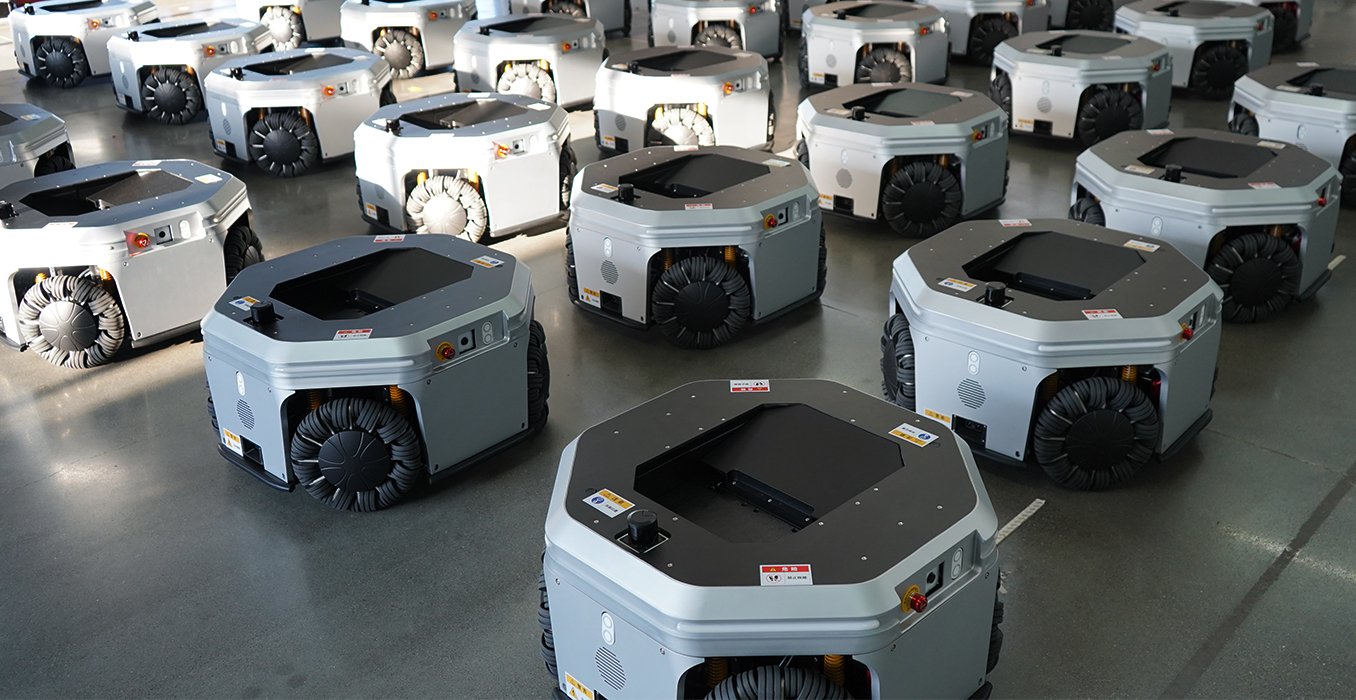
Jiateng, founded in 2002 and based in Guangdong, has spent two decades in automated guided vehicles and autonomous mobile robots. It says it has served nearly 100 Fortune 500 manufacturers, delivered more than 2,000 projects, and accumulated 270 million hours of on-site operating data. Core chassis products offer 360-degree motion and, the company says, can execute precise moves under vision-language-action or vision-language-model command. Monthly chassis deliveries are now 150 to 200 units, which Jiateng calls the start of batch shipment. Automated guided vehicle annual capacity is given as 10,000 units. Payloads across the mobile line run from 5 kilograms to 220 tonnes, with more than 500 stock-keeping units.
That is a supplier story. Humanoid headlines usually ignore the base that has to stop, turn, and hold a 15-kilogram dual-arm load without skating across an epoxy floor. Jiateng is selling that base, and the people writing the cheques already make controllers, precision equipment, or humanoid bodies.
The Money Is Going Into the Part Buyers Never Brand
Holtek’s public comment on the deal is more useful than the fundraising adjective. The listed firm said embodied intelligence is moving from technical trials to industrial landing, and that stable factory operation needs a chassis, a control system, perception, whole-machine engineering, and scene experience together. It also said Jiateng’s work complements Holtek’s own controllers, control-system research, scaled manufacturing, and global accounts in automotive, semiconductor, and energy plants.
Daocheng Fund made the same stack argument from the other side. Industrialization, it said, is not a single-point model breakthrough. It is components, bodies, mobile bases, algorithms, and real scenes maturing together. The fund explicitly linked Eastern Precision’s equipment base, Leju Robotics’ humanoid bodies, and Jiateng’s chassis into a “base plus body plus control plus scene” group. That is a supply-chain club, not a press-tour friendship.
Eastern Precision, a long-term Jiateng shareholder, said the company’s value is not that it chased a 2026 slogan. It is twenty years of reliability, repeat orders, overseas certification, and engineered delivery. The shareholder wants the same loop closed across research, volume production, scene landing, and export. In plain buying language: keep the vendor that already has CE and UL files and a service bench in Southeast Asia and Europe.
Jiateng’s own operating claims, if held to a factory audit, are the reason that argument can be made at all. More than 2,000 projects, including mixed human-vehicle flows and 220-tonne moves, are a different dataset from a warehouse pilot of ten AMRs. The company says those traces cut new-model adaptation from about six months to 15 days. It also says overseas revenue is about 40 percent, with factories in South China, Chongqing, and the United States and after-sales teams in Southeast Asia and Europe. Products have been exported to more than 30 countries.
The embodied-intelligence overlay sits on that installed base. Jiateng’s iCore industrial intelligence platform covers core components, navigation and control algorithms, large-scale AI dispatch, and multi-scene data collection. The company cites more than 700 patents and software copyrights, hundreds of delivery checklists, and 200 reliability-validation items. It is also running a proof of concept with Leju and other lead firms on a dual-arm humanoid with a 15-kilogram load in industrial scenes. Official product pages show omnidirectional bases, including a 100-kilogram-class chassis with 360-degree in-place turning, 720 by 720 by 375 millimeter dimensions, and claimed stop accuracy of plus or minus 10 millimeters, tightening to plus or minus 5 millimeters with secondary vision.
A Chassis Is Only as Good as the Hour It Can Repeat
The missing cheque size is a problem for valuation gossip and a gift for procurement. Without a headline number, the story cannot be inflated into a capital-markets event. It has to be read as a capacity and partnership event. 150 to 200 chassis a month is 1,800 to 2,400 a year if the rate holds. That is meaningful for a specialty base and tiny next to the humanoid shipment slogans circulating ahead of this week’s World Robot Conference. Anyone promising tens of thousands of mobile humanoids in 2026 still needs a base that can be certified, serviced, and replaced.
Jiateng’s 220-tonne to 5-kilogram span is also a warning. A vendor that builds both a 100-kilogram laboratory AMR and a 220-tonne carrier is either a genuine platform company or a catalogue company. Buyers should ask which cell actually makes money, which cell funds the humanoid proof of concept, and whether the 270 million operating hours are dominated by old magnetic-tape guided vehicles that teach a modern vision stack very little.
The 15-day adaptation claim is the one to pressure-test. If it means “we can retune a known chassis for a known customer’s known aisle,” it is a service metric. If it means “a new humanoid upper body can walk a new line in 15 days,” it is a research claim. Those are different purchases. The first belongs in a maintenance contract. The second belongs in a paid pilot with a kill criterion.
Export is the other hard edge. Forty percent overseas revenue and CE plus UL files are exactly what many Chinese humanoid startups still lack. They are also exactly what United States and European buyers now scrutinize for radio, safety, and origin rules. A Guangdong chassis with a United States factory is more sellable than a demo robot with no service depot. It is not automatically immune to procurement bans or local-content rules. Integrators should ask which legal entity invoices, which plant builds the safety-rated controller, and whether Holtek’s listed-company compliance extends to the joint stack.
There is a lunar-vehicle footnote in the Chinese coverage: Jiateng entered a 2023 review for a crewed lunar-vehicle concept and supplied a simulation vehicle to Xi’an Jiaotong University. Treat that as extreme-environment engineering color, not a product line. It does not change a factory request for proposal.
What Integrators Should Put on the Scorecard
If you are buying a humanoid cell, score the base as its own vendor. Ask for mean distance between failures, not a slogan about 270 million hours. Ask for the 150-to-200 monthly mix: how many units are 100-kilogram laboratory bases versus heavy carriers. Ask whether the Leju 15-kilogram dual-arm proof of concept has a named plant, a cycle time, and a date when the safety-rated stop is signed off. Ask Holtek what controller and safety programmable logic controller sit on the iCore stack, and whether that stack can be replaced.
Jiateng is raising money to be the unbranded layer under other people’s robots. That is usually where factory automation actually gets paid. It is also where projects die, when the pretty torso cannot turn in a 765-millimeter aisle or hold position while the arms pick. The 18 August round says industrial capital still prefers that unglamorous layer to another full-stack launch.
Price transparency is the other gap. Jiateng’s public pages list geometry and payload, not a list price. That is normal for industrial mobile robots and still unhelpful for a first-pass budget. A 100-kilogram omnidirectional base with secondary vision will not cost the same as a 220-tonne carrier, and neither will cost the same once CE documentation, spare wheels, and a local technician are added. Until a quote exists, treat the funding round as evidence of intent to scale, not as evidence that the landed cost has fallen. Integrators quoting ASEAN plants should also confirm whether spare drive modules ship from Guangdong, Chongqing, or the United States site, because that choice sets both lead time and origin documentation.
Humanoid integrators should also stop treating the chassis as a commodity caster. In-place rotation inside a 765-millimeter envelope, a 100-kilogram payload, and a plus-or-minus 5-millimeter secondary stop are the difference between a torso that can pick from a rack and a torso that needs the rack moved. If those numbers only hold on a polished showroom floor, the proof of concept with Leju will look fine in a video and fail beside a chip mounter.
The right follow-up is not another funding adjective. It is a line trial in which a named chassis, a named controller, and a named upper body complete a shift without a human dragging the base back to a charger.
-----
This article is for informational purposes only and does not constitute investment, legal, engineering, or procurement advice. Buyers should verify current specifications, commercial terms, safety certification, and regulatory status with the relevant companies and authorities before making purchasing or partnership decisions. Analysis synthesizes company statements and public market activity.