Haystack Robotics Raises US$3.95M Series A for Hospital Disinfection Robots
Portland's Haystack Robotics raised a US$3.95 million Series A led by an investment entity tied to healthcare utilization-management firm Agadia Systems, a payer-side backer betting its autonomous UV-C disinfection robot can cut infection-related claims, not just cleaning costs.

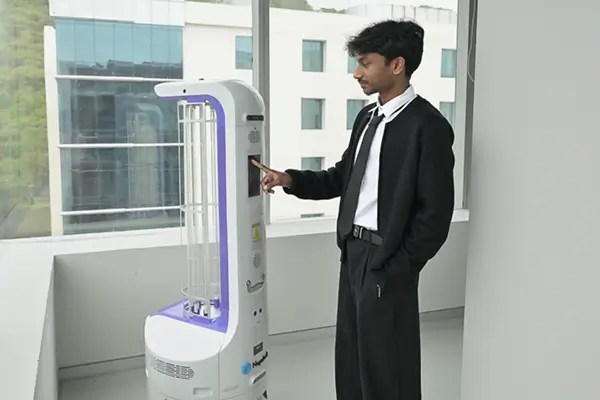
Haystack Robotics, a Portland, Oregon-based maker of autonomous ultraviolet disinfection robots, announced Monday a US$3.95 million Series A round led by an investment entity affiliated with Agadia Systems, a utilization-management software company that builds prior-authorization and formulary tools for health plans and pharmacy benefit managers. The round more than doubles Haystack's total outside funding since a US$2.7 million raise in 2024 and will fund continued engineering work on the company's AI navigation software and a broader push into healthcare, senior living, and hospitality accounts beyond its current customer base.
Founded in 2021 and led by chief executive Mahadev Eakambaram, Haystack builds Violet, a self-driving UV-C robot that navigates hospital rooms, gyms, and hotel corridors without a pre-built map, then delivers concentrated ultraviolet light calibrated to knock down bacteria, viruses, and spores on surfaces and in the air. The company says a hospital room takes as little as 15 minutes to clear, and that its own microbiology testing shows a greater than four-log reduction in bacterial load, translating to a claimed 99.99 percent effectiveness rate against pathogens on treated surfaces when the unit is used as directed.
Why a Prior-Authorization Company Is Underwriting a Disinfection Robot
The identity of Haystack's new backer says more about the deal's logic than the dollar figure does. Agadia's core business runs the utilization-management software health plans use to decide what care gets approved and paid for, which means the firm's economic interest sits squarely on the cost side of the healthcare ledger: hospital-acquired infections, denied or delayed care tied to outbreak-driven bed closures, and the downstream claims that follow both. A UV-C robot that can plausibly cut infection rates in a facility is not just a janitorial upgrade from that vantage point; it is a lever on the claims volume a payer eventually has to underwrite. That is a different calculus than a typical robotics-focused venture fund makes, and it suggests Haystack's pitch to this round emphasized outcomes data over unit economics on the sales floor.
It also changes what Haystack likely has to prove next. A venture fund wants growth in deployed units and gross margin per robot. A utilization-management company wants evidence that facilities running Violet see measurably fewer infection-related claims, readmissions, or extended stays, evidence that would double as the strongest sales material Haystack could hand a hospital system's infection-control committee. If that data materializes, it gives Haystack a case built on payer economics rather than a bet that housekeeping budgets will simply grow to accommodate a new robot line, which has proven a slower sales cycle for other disinfection-robot vendors than early demonstrations suggested.
The Infection-Cost Math That Makes a Payer Write This Check
The financial logic behind Agadia's participation becomes clearer against how US hospital reimbursement already treats infection outcomes. Under Medicare's hospital-acquired condition policy, facilities have for more than a decade received reduced payment for a defined set of conditions that develop during an inpatient stay rather than being present on admission, including specific categories of infection, which means a hospital that fails to prevent an infection is not simply absorbing a clinical setback but a direct hit to reimbursement on top of the added cost of treating it. A utilization-management vendor sits downstream of exactly that dynamic: every infection-related claim, extended length of stay, or readmission that a health plan has to adjudicate is a cost Agadia's own hospital and payer clients are trying to manage, which gives the company a direct commercial interest in whether Violet's disinfection claims hold up outside a lab. That interest is different in kind from a typical robotics investor's, and it means the metric this round is really underwriting is not units shipped but claims avoided.
The Real Competition Is a Cleaning Contract, Not Another Robot
Autonomous UV disinfection has been a commercially available category since the early 2020s, when a wave of vendors built robots around pulsed-xenon or continuous UV-C lamps for hospital terminal cleaning. What has kept the category from scaling faster than it has is not the physics, which is well established, but the sales motion: a hospital's environmental-services budget is typically negotiated as a fixed annual cleaning contract with an incumbent janitorial vendor, and a robot purchase or lease has to displace or supplement that contract without an infection-control department having independent budget authority to make the call unilaterally. Haystack's push into senior living, education, fitness, and general commercial facilities alongside healthcare reflects that same friction; those verticals often have simpler procurement paths and faster decision cycles than a hospital system's capital committee, even if the per-unit price point and total addressable spend are smaller.
Violet's pitch to that broader buyer set rests on the same two claims that matter to a hospital: cycle time and autonomy. A robot that needs 15 minutes per room and does not require a facilities team to pre-map a building before deployment removes two of the most common objections procurement teams raise about earlier autonomous cleaning hardware, which often demanded weeks of site surveying before a unit could operate independently. The emergency shutoff that halts UV output if a person enters the treatment zone addresses the liability question that has slowed hospital adoption of UV robots more than any efficacy debate: the lamps themselves can cause skin and eye damage on direct exposure, so a facility adopting the technology is also adopting a new safety protocol its staff has to trust.
A Try-Before-You-Buy Model Reveals the Sales Cycle Problem
Haystack's "Violet in Residency" program, which places a unit at a prospective customer's site before a purchase commitment, is itself evidence of how much friction remains in selling autonomous disinfection into risk-averse buildings. Hospitals, senior-living operators, and hotel chains have limited appetite to commit capital-equipment budget to an unproven category without seeing a unit operate in their own facility first, on their own floor plans and staff workflows, which is a materially slower and more expensive sales motion than shipping a unit against a signed purchase order. A residency-style program lowers the buyer's initial risk but raises Haystack's own cost of customer acquisition, since the company is effectively financing a pilot deployment for every prospect that has not yet decided to pay. The new capital gives Haystack more runway to keep running that model at the volume needed to build the reference-customer base a harder buyer, particularly a hospital system, will eventually demand before a larger fleet order.
What US$3.95 Million Actually Buys a Robotics Company at This Stage
By humanoid-robotics or autonomous-vehicle standards, a sub-US$4 million Series A is a modest number, and it is worth being precise about what it signals rather than reading it as evidence of either strength or weakness on its own. A round this size, layered on top of a US$2.7 million seed round, tells a buyer that Haystack has not yet needed the kind of capital-intensive manufacturing scale-up that pushes disinfection-robot competitors toward nine-figure raises; the company is still selling a single hardware platform into a services-heavy go-to-market rather than financing a factory. That is consistent with a business proving out unit economics and reference accounts before asking investors to fund volume production, and it means a procurement team evaluating Violet today should expect a company sized for pilot deployments and phased rollouts, not one with the balance sheet to guarantee same-week fleet delivery at scale.
The strategic-investor structure of this round carries its own signal for that same buyer. When a payer-adjacent firm writes the lead check instead of a robotics or healthcare-technology venture fund, it typically comes with fewer follow-on-round guarantees than a traditional venture syndicate provides, since strategic investors are optimizing for data and outcomes relevant to their own business rather than portfolio construction. A facility signing a multi-year service agreement with Haystack today is, in effect, betting that the company's next round arrives on the strength of infection-reduction evidence this capital is meant to generate, not on a predictable venture-fund timeline.
The Decision in Front of Buyers Now
For an infection-control director or facilities operator evaluating autonomous disinfection for the first time, Haystack's raise is a signal to ask for outcomes data rather than a reason to sign immediately. The company's own effectiveness claims are drawn from its own microbiology testing rather than an independent, peer-reviewed clinical trial tracking infection rates in a live facility, which is the harder and more expensive evidence that would actually move a hospital system's capital committee. Buyers with the leverage to negotiate a pilot should ask Haystack to structure it around infection-rate or environmental-culture data specific to their own facility rather than accepting the company's published lab results as a substitute, because that facility-specific evidence is exactly what a healthcare-payer-backed company now has every incentive to help generate.
Hero image credit: Haystack Robotics.
This analysis draws on Haystack Robotics' own public product and funding disclosures alongside independent reporting on the Series A financing and its lead investor. It is for general information purposes only and does not constitute investment, financial, or legal advice.