AutoStore Signs Amazon Supply Framework Without Purchase Commitments
AutoStore has created a global supply framework with Amazon, but the disclosure contains no purchasing commitments. The agreement matters as a procurement signal, not as confirmed revenue or deployment.
AutoStore has entered a global strategic supply agreement with Amazon.com Services LLC, creating commercial terms for future procurement of AutoStore products and solutions. The 13 August disclosure is strategically meaningful because it puts a major buyer and a fulfillment-automation supplier inside one contractual framework, yet it includes no purchasing commitment, confirmed deployment, order value, or delivery schedule.
AutoStore is a Norway-founded provider of intelligent-fulfillment systems that combines automation, software, and artificial intelligence for warehouse operations. The company says it has about 2,000 systems in 68 countries. That installed base gives the new agreement operational relevance, but the disclosure should be read as a route to future transactions rather than proof that Amazon has selected, installed, or ordered a specific AutoStore system.
An Agreement Without an Order Book
The central fact is unusually simple. AutoStore and Amazon now have a framework that governs how AutoStore products and solutions could be supplied globally. The equally important fact is what the announcement does not say. It does not identify an order, disclose a system count, assign a site, state a contract value, set a deployment timetable, or commit Amazon to buy anything.
For procurement teams, this distinction is not legal fine print. A framework agreement can remove friction from future purchases by aligning commercial terms, product scope, and supplier relationships before a project is ready to move. That can shorten the path from a business case to an order. It does not make the business case itself, and it does not turn a supplier’s future pipeline into current revenue.
The disclosure was classified as inside information under the European Union Market Abuse Regulation, an indication that AutoStore considers the agreement material to investors. That classification raises the event’s significance but should not be confused with an earnings forecast. The company chose to disclose a strategic relationship whose commercial upside remains conditional on subsequent procurement decisions.
This is a useful moment to separate three concepts that are often blended together in automation coverage. They are access, commitment, and deployment. Access means a supplier is positioned to compete or provide product within a customer’s purchasing framework. Commitment means the customer has agreed to spend money under defined terms. Deployment means equipment has been installed, accepted, and put into an operating process. AutoStore’s announcement establishes the first of those stages. The other two remain unconfirmed.
The Grid Is a Procurement Platform
AutoStore’s technology is built around high-density goods-to-person fulfillment. Products are stored in bins within a compact grid, and robots move across the grid to retrieve bins for operator workstations, known as ports. The logic is not to replace every warehouse process with a single machine. It is to make storage, retrieval, picking, and replenishment more predictable in operations where floor space, walking time, and order volume matter.
Put simply, a conventional warehouse often asks people or vehicles to travel to stock. A grid-based fulfillment system brings stock toward a controlled picking point. The analogy is a library that sends the requested book to the desk instead of asking the reader to walk every aisle. The value is not the movement alone. It is the ability to manage a dense, repeatable flow while connecting inventory, software, and workstations into a coordinated process.
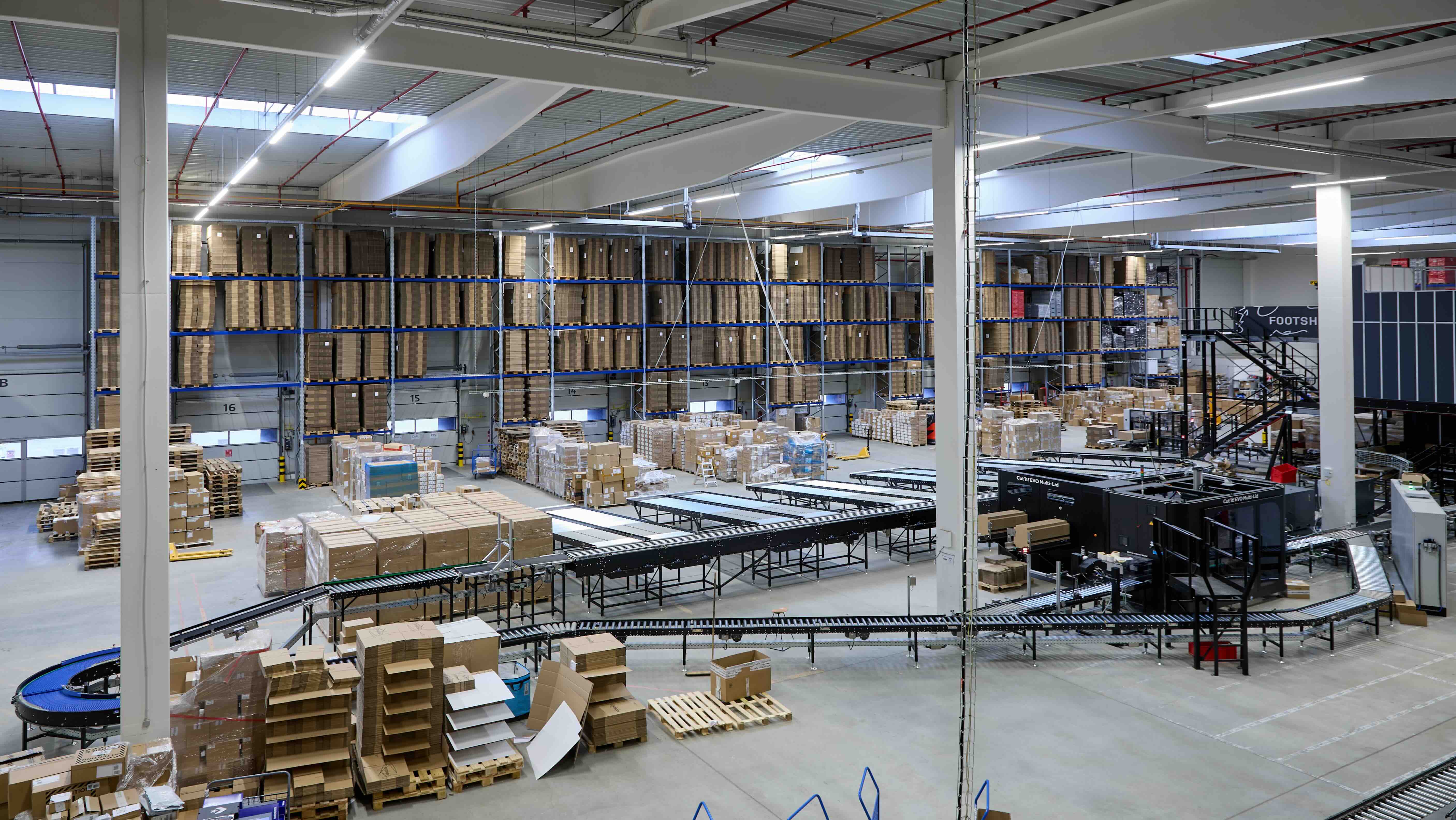
AutoStore’s own customer examples illustrate the type of operation its systems address, but they do not establish anything about Amazon’s intentions. In one Czech retail customer case, AutoStore describes a Footshop installation with 24 R5+ robots, 52,600 bins, and multiple port types. That example shows the operating model. Inventory is concentrated in a grid and selected bins are delivered to a workstation. It is contextual evidence about AutoStore’s system design, not evidence of an Amazon project.
For an automation buyer, the practical question is not whether a grid can be impressive in a demonstration. It is whether the product mix, order profile, peak pattern, building geometry, inventory velocity, maintenance model, and labor plan justify a fixed automated core. A supply framework matters because it may allow those questions to be addressed through a more structured supplier relationship. It does not answer them in advance.
A framework agreement is a procurement option, not a warehouse installation.
That distinction is the most useful reading of the announcement for operators. The agreement can make AutoStore more available to Amazon’s decision makers if and when a particular fulfillment problem reaches the point of procurement. It cannot reveal whether any specific site has passed the financial, technical, or operational threshold for deployment.
Scale Does Not Equal Near-Term Revenue
AutoStore says its systems are present in 68 countries and total roughly 2,000 installations. Such scale can matter in a global supply conversation because a customer evaluating multiple regions wants evidence that a vendor can support more than a single pilot. It may also make service, integration, partner coverage, and lessons from existing deployments more relevant than they would be for an early-stage supplier.
Yet installed-base scale has limits as an indicator. A warehouse system that fits one customer’s stock profile or building constraints may not fit another’s. E-commerce, grocery, spare parts, pharmaceuticals, fashion, and industrial distribution can all have very different item dimensions, temperature requirements, picking patterns, automation boundaries, and tolerance for downtime. A buyer must still test the economics at the facility level.
The hard truth is that the press release gives no basis for calculating potential revenue. There is no disclosed number of systems, no minimum purchase volume, no project pipeline, and no timeline. Treating the relationship as an immediate financial windfall would place assumptions on top of a disclosure that explicitly avoids them. The appropriate commercial reading is more disciplined. AutoStore has gained a formal route to pursue future business with Amazon, while the scale and timing of any business remain undisclosed.
This matters especially in fulfillment automation, where headline relationships can overshadow implementation work. The commercial outcome depends on factors that a framework cannot settle by itself. They include warehouse layout, integration with existing software, controls architecture, inventory data quality, construction sequencing, workforce design, safety approvals, site commissioning, and operating discipline after go-live. The strongest automation investments convert a validated operational problem into a stable process. A contract framework is only one step before that work begins.
A Different Kind of Automation Signal
The agreement also highlights a broader shift in the way large buyers can engage automation suppliers. Not every strategic movement appears first as a product launch or a new machine at a trade show. Sometimes the more telling development is the creation of a purchasing relationship that allows technical options to be evaluated within a shared commercial structure.
For supplier teams, this type of agreement can improve access and reduce repeated contracting effort. For buyers, it can preserve flexibility while creating a path to standardize products or terms across regions if the operating case becomes compelling. The buyer retains the ability to decide which sites, if any, proceed. The supplier gains a channel through which future requirements may be addressed.
That is why the absence of a purchase commitment is not a reason to dismiss the disclosure. It is the feature that defines the event. Amazon has not been presented as a completed AutoStore customer under this agreement. AutoStore has been placed into a formal global supply relationship from which concrete programs may or may not emerge. The difference is narrow in a headline and enormous in capital planning.
The strategic implication for warehouse-automation buyers is that vendor selection is becoming a system decision rather than a machine decision. A robot, storage grid, port, conveyor, and software layer can be individually capable while still failing to create a reliable operating model together. Procurement structures that give a buyer time to validate that model may become as important as the equipment catalogue itself.
Procurement Still Starts at the Facility
A serious buyer would now ask a second set of questions that the announcement cannot answer. Which inventory categories would be suited to an AutoStore grid? What order profile makes a compact goods-to-person design preferable to other forms of warehouse automation? How would the system connect to warehouse-management, order-management, and controls software already in use? What level of redundancy, service coverage, spare parts, commissioning support, and operator training would be required at each location?
Those questions are deliberately more concrete than the language of a strategic agreement. They are where an automation program succeeds or fails. A framework can help create repeatable commercial terms, but it cannot erase the differences between a brownfield site with constrained space, a greenfield facility designed around automation, a high-volume retail operation, and a slower industrial-parts operation. Each project needs its own throughput model, integration plan, safety review, and return-on-investment case.
That is also the useful counterweight to the instinct to treat a relationship with a large buyer as a verdict on technology. The agreement signals that AutoStore has gained a structured channel for future engagement. The technology still has to be matched to a real operating problem, and any future procurement decision must make that match visible in cost, service level, resilience, and implementation risk.
The Next Evidence Will Be Operational
The next meaningful signal will not be another broad description of the agreement. It will be evidence of execution, such as a named facility, a system order, a deployment program, a financial effect, a delivery timetable, or operating performance once a site is live. Until then, decision makers should distinguish this disclosure from a confirmed installation and treat it as an early commercial marker.
AutoStore’s release is a credible strategic development for fulfillment automation because it establishes a global relationship with Amazon under a regulated disclosure framework. Its immediate operational meaning, however, is deliberately limited. There is no purchase commitment to model, no Amazon site to assess, and no evidence that a deployment has begun. The agreement expands possibility; it does not yet establish demand.
This analysis synthesizes company statements and public market activity. It is intended for general informational purposes and does not constitute investment, legal, or procurement advice.