What Is an Industrial 6-Axis Robot Arm? A Plain-English Guide for Non-Engineers
A comprehensive guide for business leaders and non-technical buyers on the mechanics, operational logic, and strategic ROI of industrial 6-axis robot arms, focusing on their role as versatile, programmable assets for reducing production variance.

In the modern boardroom, "automation" is frequently discussed as a monolithic solution to labor shortages or rising operational costs. However, for the business owner standing on the factory floor, the reality is far more granular. The industrial 6-axis robot arm has emerged as the most versatile tool in the modern manufacturing arsenal, but its true value lies not just in its raw speed, but in its capacity to act as a strategic "hedge" against market volatility and production variance. This guide is designed for the non-technical leader who needs to understand the structural logic of 6-axis technology before committing capital to a large-scale automation project.
1. The Historical Context: From "Unimate" to the Modern Workhorse
To understand the current state of 6-axis robotics, one must recognize that this technology is not a new fad but a refined industrial standard. The first industrial robot, the Unimate, was installed in a General Motors plant in 1961. It was a massive, hydraulic machine designed for the dangerous task of die casting. Over the subsequent six decades, the industry transitioned from hydraulic power to high-precision electric servo motors, and the 6-axis articulated design became the dominant form factor. This evolution has resulted in machines that are now significantly faster, more precise, and—most importantly for the business owner—more affordable than ever before.
2. The "Digital Employee" for Your Production Line
Most leaders initially view robots through a science-fiction lens, imagining a direct humanoid replacement for a manual worker. In reality, a 6-axis arm should be viewed as a programmable general-purpose asset. Unlike specialized machinery that is designed for a single, unchangeable task—such as a dedicated bottle capper—a 6-axis arm can be rapidly repurposed as market demands shift. If your product line changes next year, you do not need to scrap the robot; you simply change the specialized tool at the end of its arm and update its operational software. In an era of shrinking product lifecycles, this inherent versatility is a primary defense against equipment obsolescence.
The primary Return on Investment (ROI) of a 6-axis arm is not merely labor replacement; it is the structural reduction of variance. While human performance is naturally variable, a robotic system is constant. In high-precision manufacturing, variance is the hidden tax that erodes margins, and the 6-axis arm is the primary tool for its elimination. By standardizing the output, business owners can stabilize their unit costs and significantly reduce the overhead associated with quality control and rework.
3. The "6-Axis" Concept: A Human-Centric Explanation
To a non-engineer, the term "6-axis" often sounds like technical overkill. However, six is the mathematical "magic number" required to fully mimic human dexterity in a three-dimensional workspace.
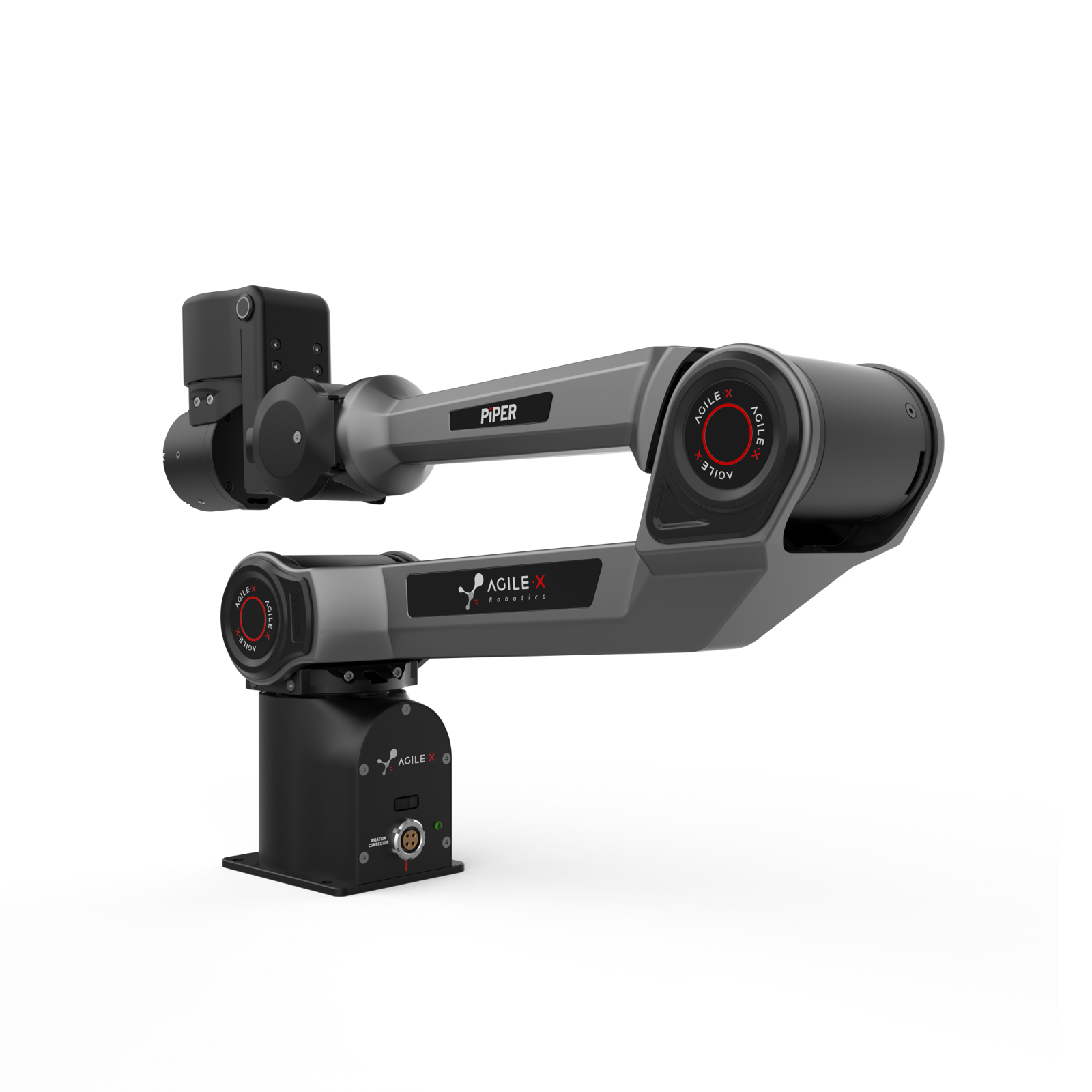
When visualizing how the robot operates, it is helpful to use the human arm as a reference. The robot is composed of three primary segments: a waist that rotates the entire base, a shoulder and elbow that provide the necessary reach and height, and a three-jointed wrist that provides the final orientation. These six joints collectively allow the robot to reach around physical obstacles, tilt a part at a highly specific angle, and rotate it simultaneously. This level of freedom is what distinguishes an articulated arm from a simpler machine that can only move in straight lines.
Furthermore, every robot operates within a defined "Work Envelope," which is the three-dimensional bubble of space it can physically reach. For a business leader, understanding this envelope is critical for facility planning. A common misconception is that a cramped workspace requires a smaller robot; in many cases, it actually requires a smarter "envelope" that lacks the internal "dead zones" where the arm’s own structure prevents it from reaching the target.
4. Operational Logic: How Do You Actually "Talk" to a Robot?
One of the most significant barriers for non-technical owners is the perceived "software wall." The assumption is that maintaining a robotic line requires a permanent team of elite software engineers.
In practice, most modern industrial robots utilize a Teach Pendant, which is essentially a ruggedized tablet interface. An operator "teaches" the robot by manually moving the arm to a specific point in space and saving that coordinate. This means your staff are not writing complex lines of code; they are recording a physical path for the robot to follow.
Before a single bolt is turned in your facility, your integration partner should provide a Digital Twin or a high-fidelity simulation. This allows you to witness the robot performing its tasks in a virtual version of your exact facility. By simulating the workflow first, you can identify potential collisions and cycle-time bottlenecks in a virtual environment where they cost nothing to fix, significantly reducing the risk of the final physical installation.
5. The Ecosystem: What Else Do You Need Besides the Arm?
Buying a robot arm in isolation is akin to purchasing a car without a steering wheel or tires; the arm itself is a general-purpose tool that requires an Ecosystem to be productive.
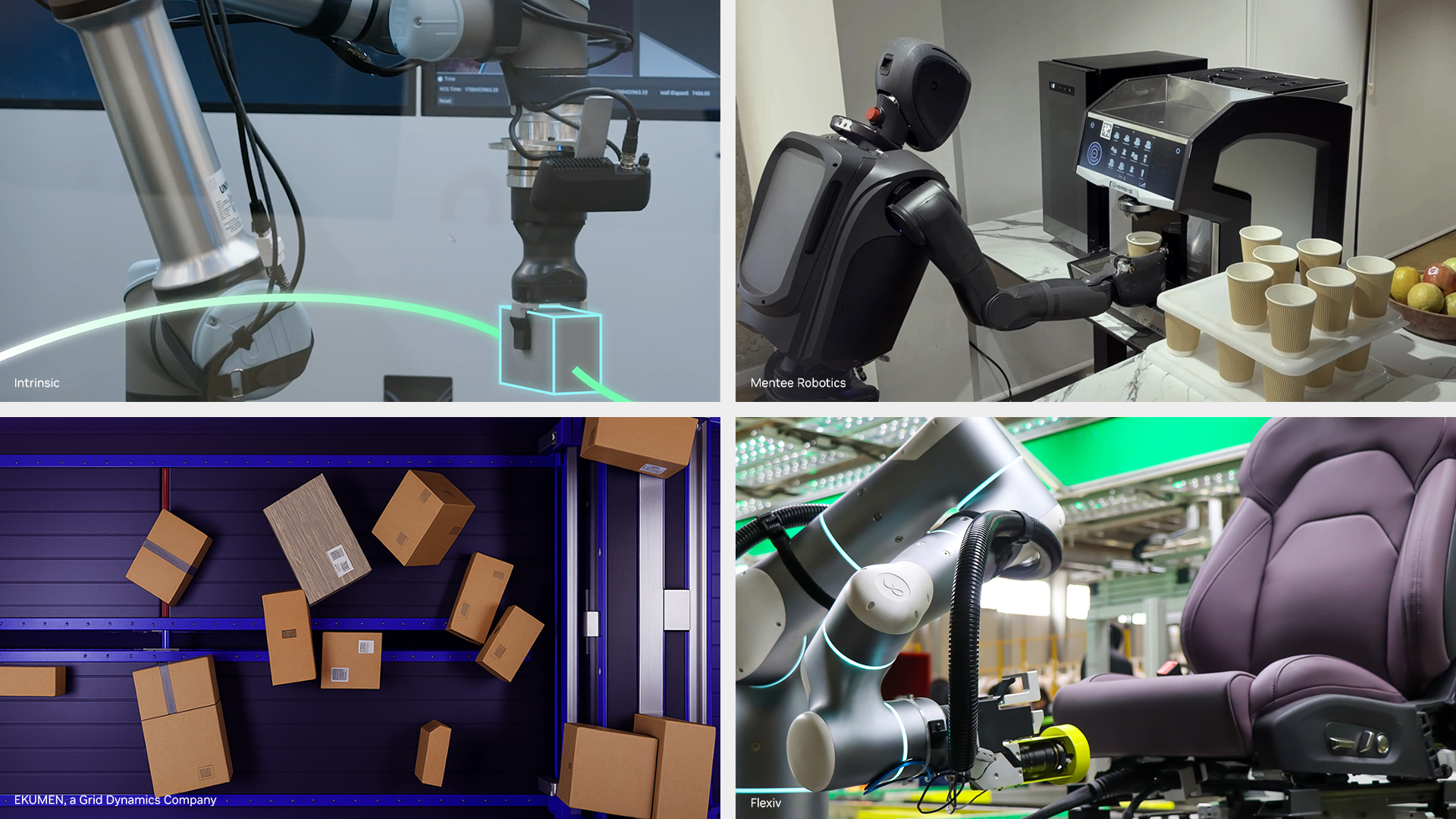
The most critical component of this ecosystem is the End-Effector, or the "hand" of the robot. Whether it is a mechanical gripper, a precision welding torch, or a vacuum suction cup, the end-effector is where the actual value-added work happens. Additionally, because robots exert massive physical forces, they require a Rigid Foundation. If the floor mounting is not perfectly stable, the robot will lose its precision over time as the base shifts. Finally, the robot requires a Peripheral Team of supporting hardware, including conveyors to bring parts into reach and sensors to tell the robot exactly when a part is ready to be handled.
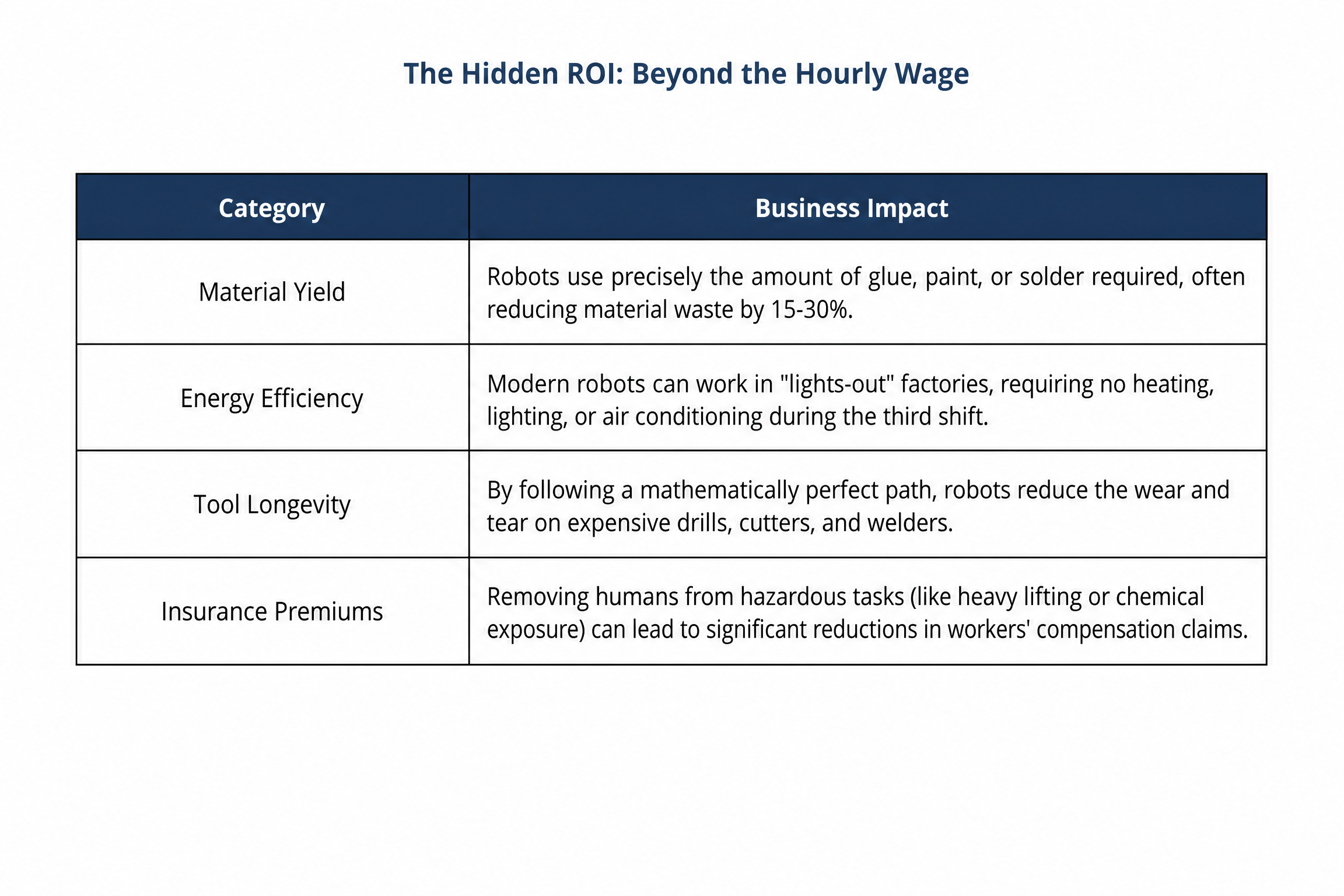
6. The "Hidden" ROI: Beyond the Hourly Wage
When calculating the ROI of a 6-axis arm, many business owners make the mistake of only looking at the displacement of hourly wages. The true economic value is often found in the "Hidden ROI" categories:
7. Quality Metrics: A Business Owner’s Guide to Performance
When reviewing a technical quote, a business leader must be able to distinguish between Accuracy and Repeatability.
Repeatability is the metric that truly drives profitability. It represents the robot's ability to return to the exact same coordinate tens of thousands of times without drifting by even a fraction of a millimeter. This consistency is what allows a business to virtually eliminate defective products from the line. While Accuracy represents the ability to hit a specific coordinate the very first time, it is the long-term repeatability that ensures a stable, high-quality output over years of operation.
8. Safety and the Modern Factory Floor
An industrial 6-axis robot is a powerful piece of machinery moving heavy loads at high speeds, meaning safety is a structural requirement rather than an optional add-on.
The most reliable safety method remains Physical Guarding, such as metal fencing that prevents human entry into the work envelope. For more flexible environments, Light Curtains create an invisible laser barrier that instantly halts the robot if a human breaks the beam. While "Collaborative Robots" (Cobots) that can work alongside humans without fences are a popular topic, they are often significantly slower to ensure safety. For high-volume industrial production, a fenced-in 6-axis arm remains the more profitable and predictable choice for most business owners.
9. Common Pitfalls for First-Time Buyers
Even with the best intentions, first-time automation projects can stall. Avoiding these common mistakes will protect your investment:
• Over-Automating: Do not try to automate the most complex 10% of your production first. Start with the most repetitive 90% to secure an early win.
• Ignoring the Staff: If your floor staff feels threatened by the robot, they may (consciously or unconsciously) sabotage its success. Involve them in the "naming" and "training" of the robot to build ownership.
• Underestimating Integration Costs: The robot arm is often only 30% of the total project cost. The remaining 70% goes to the end-effectors, safety systems, and the labor required to make everything work together.
10. Implementation: The 5 Stages of Your First Robot Project
Success in industrial automation is rarely about the hardware itself; it is about the implementation process.
The journey begins with a Strategic Audit, where you identify the "Dull, Dirty, or Dangerous" tasks that your human staff currently find repetitive or hazardous. Once a task is identified, the Simulation Phase proves the concept virtually to minimize capital risk. The Integration Phase is where the robot is physically installed and synchronized with your existing machinery, a process that requires a skilled partner to ensure all systems communicate correctly.
Crucially, the Staff Transition phase involves training your most experienced operators to become "Robot Managers," shifting their role from manual labor to high-value oversight. Finally, ensuring Long-Term Health through a disciplined maintenance schedule—much like maintaining a high-end commercial vehicle—will ensure your robotic asset has a productive lifespan of ten to fifteen years.
Conclusion: Taking the First Step Toward Automation
The transition to industrial robotics is a strategic shift in how a business handles its core production. By viewing the 6-axis arm as a versatile, constant, and programmable asset, a business leader can move past the technical hype and focus on the structural improvements to their bottom line. The most effective starting point is not the most complex task in the factory, but the one that currently produces the highest rate of defects or human turnover. Start there, prove the ROI, and then scale your automation strategy.
References:
[1] Vention: Complete Guide to Industrial Robot Arms & Cobots
[2] IFR: World Robotics 2025 - Topics and Definitions