The Fundamentals of Humanoid Robot Technology Explained
In July 2026 the International Organization for Standardization published a method for measuring how well a legged robot walks, and stated in terms that it is not intended for verifying safety. In the same month, the first safety standard written for machines that need active control to stay upright remained at close of comment period, unpublished and uncertifiable. A humanoid buyer in 2026 can benchmark walking performance against an international method and cannot certify safety against one. Post 1 of our humanoid series builds the foundations from the official record only: the standards bodies that define the machine, the exchange filing that defines its components under regulatory supervision, and the statistical apparatus that does not yet count it. The defining property comes from a standards body rather than a supplier. A machine with actively controlled stability requires active control in order to remain balanced and could become unstable in the absence of power. An industrial arm that loses power stops. A humanoid that loses power falls. Everything commercially distinctive about the asset class descends from that fact. The article asserts no market size, no unit forecast and no price, because no official source publishes one.
In July 2026 the International Organization for Standardization published a document setting out how to measure the way a legged robot walks. The standard describes test methods for evaluating locomotion performance and it states in terms that it is not intended for the verification or validation of safety requirements. In that same month, the first safety standard written for machines that need active control to stay upright remained at close of comment period, unpublished and uncertifiable. A buyer evaluating a humanoid robot in 2026 can therefore benchmark how well the machine walks against an international method and cannot certify that it is safe against one. Performance measurement arrived first. Assurance has not caught up.
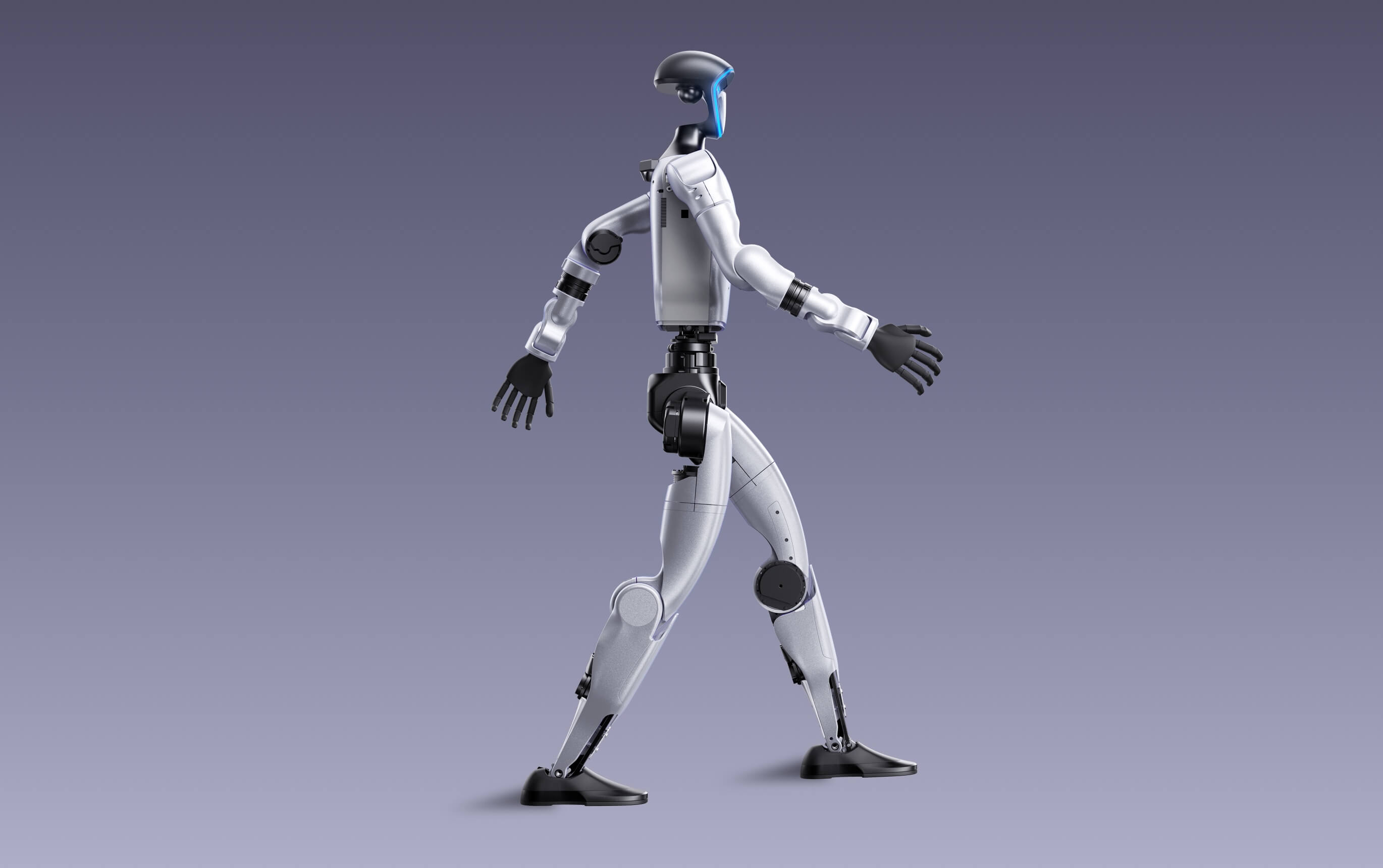
That sequence is the most useful thing a first-time buyer can understand about this asset class, and it follows directly from what a humanoid actually is. The international vocabulary standard for robotics defines a robot as a programmed actuated mechanism with a degree of autonomy to perform locomotion, manipulation or positioning. It defines an industrial robot more narrowly, as an automatically controlled, reprogrammable, multipurpose manipulator, programmable in three or more axes, which can be either fixed in place or fixed to a mobile platform for use in automation applications in an industrial environment. A bipedal humanoid is a poor fit for that second definition. It is not a manipulator fixed in place and it is not a manipulator mounted on a platform. It is a machine whose whole body is the mechanism.
The standards record supplies a more precise description and it is the one this publication recommends a buyer adopt. The draft safety standard covering this territory addresses industrial mobile robots with actively controlled stability, defined as robots that require an active control in order to remain balanced and could become unstable in the absence of power. The document notes that this category can include quadrupedal, bipedal, or wheeled balancing robots, and that such machines are sometimes referred to as self-balancing.
That definition does the work that marketing language cannot. A six-axis industrial arm that loses power stops moving. An autonomous mobile robot that loses power stops rolling. A bipedal humanoid that loses power falls over. Everything commercially distinctive about this asset class, the insurance treatment, site preparation, training burden, assurance gap descends from that single engineering fact, which a standards body states plainly and a product video never will.
Two boundaries in the same draft standard matter to a buyer reading vendor material. Machines whose travel speed and direction are solely under operator control, including human remote control fall outside its scope. So a teleoperated demonstration is not evidence about an autonomous product. The standard also excludes robots used in non-industrial environments, directing those elsewhere, and defines an industrial environment as a workplace where the public is excluded or restricted from access. A humanoid intended for a shop floor and a humanoid intended for a shopping centre sit under different standards regimes.
How It Works
The clearest available account of humanoid architecture in an official document comes from an unexpected place. On 31 July 2026 Unitree Robotics Co., Ltd. filed a prospectus with the Shanghai Stock Exchange for a listing on the STAR Market under stock code 688836, offering 40,446,434 shares representing ten percent of its post-issue share capital. Because an exchange filing must define its terms for investors who are not engineers, the document contains a glossary that functions as an authoritative description of how these machines are built. It is the first time a pure-play humanoid manufacturer has been obliged to define its own technology under exchange supervision.
That filing describes a three-part architecture. The body comprises the physical structure and actuators of a general-purpose robot, including structure, drives and communication bus. The brain handles cognitive intelligence: decision systems, task planning and the embodied large model. The cerebellum handles body intelligence, meaning the motion control systems that produce whole-body dexterous movement. The filing defines embodied intelligence itself as intelligence generated through real-time interaction with the physical world by way of a physical body.
The division matters more than it first appears, because these three layers fail differently and are sourced differently. A body problem is a mechanical engineering problem with a repair cost and a spare part. A cerebellum problem is a control problem that shows up as instability, and it is the layer the draft safety standard is concerned with. A brain problem is a model behaviour problem that may not be reproducible, may not be traceable to a specific input, and may change when the model is updated. A buyer who treats all three as one product is buying three risk profiles under one warranty.
The control layer deserves particular attention because it is where the asset class differs most sharply from everything preceding it. In an industrial arm, stability is structural. The machine is bolted down and its geometry holds it in place whether or not the controller is running. In a machine with actively controlled stability, balance is a continuous computational output. The controller is not supervising the machine's posture; it is producing it, several hundred times a second. Remove the computation and the posture ends.
For the model layer, the same prospectus supplies working definitions of the two model architectures a buyer will encounter in vendor material. A vision-language-action model performs unified modelling of vision, language and action output, providing end-to-end mapping from perception and instruction to control. A world-model-action model explicitly models the physical laws of robot-environment interaction. The filing also defines generalisation ability as a model producing reasonable results outside its training set, which in robotics means handling unseen objects and environmental change, and robustness as a control system maintaining performance under internal and external change. Those two properties are what a demonstration cannot establish and a pilot can.
Key Components
The same filing enumerates the physical subsystems, and its definitions are worth preferring over vendor descriptions precisely because they were written for a regulator rather than a customer.
The motor is described as an electromagnetic device converting electrical energy into drive torque, regarded as the robot's execution unit, installed at each joint to control joint motion, and directly determining robot performance. The reducer is a core transmission device that achieves precise control through the ratio of output to input torque, with the planetary type providing high precision, rigidity and efficiency. The encoder measures joint angle and position to ensure motion precision and stability. The lead screw converts rotary motion into linear motion. Linear and rotary actuators convert input energy into linear displacement and rotational motion respectively. The dexterous hand is defined as a high-degree-of-freedom end effector simulating the human hand, and the filing calls it a core component of humanoid robots.
Read that list against the assurance question and a pattern emerges that a buyer should carry into every supplier meeting. Encoders, reducers and motors are mature component categories with established metrology, because they are the same components that industrial robotics has used for decades. The dexterous hand is not. Neither is the whole-body balance function, nor the model layer. The subsystems that make a humanoid humanoid are precisely the subsystems with the least developed assurance infrastructure.
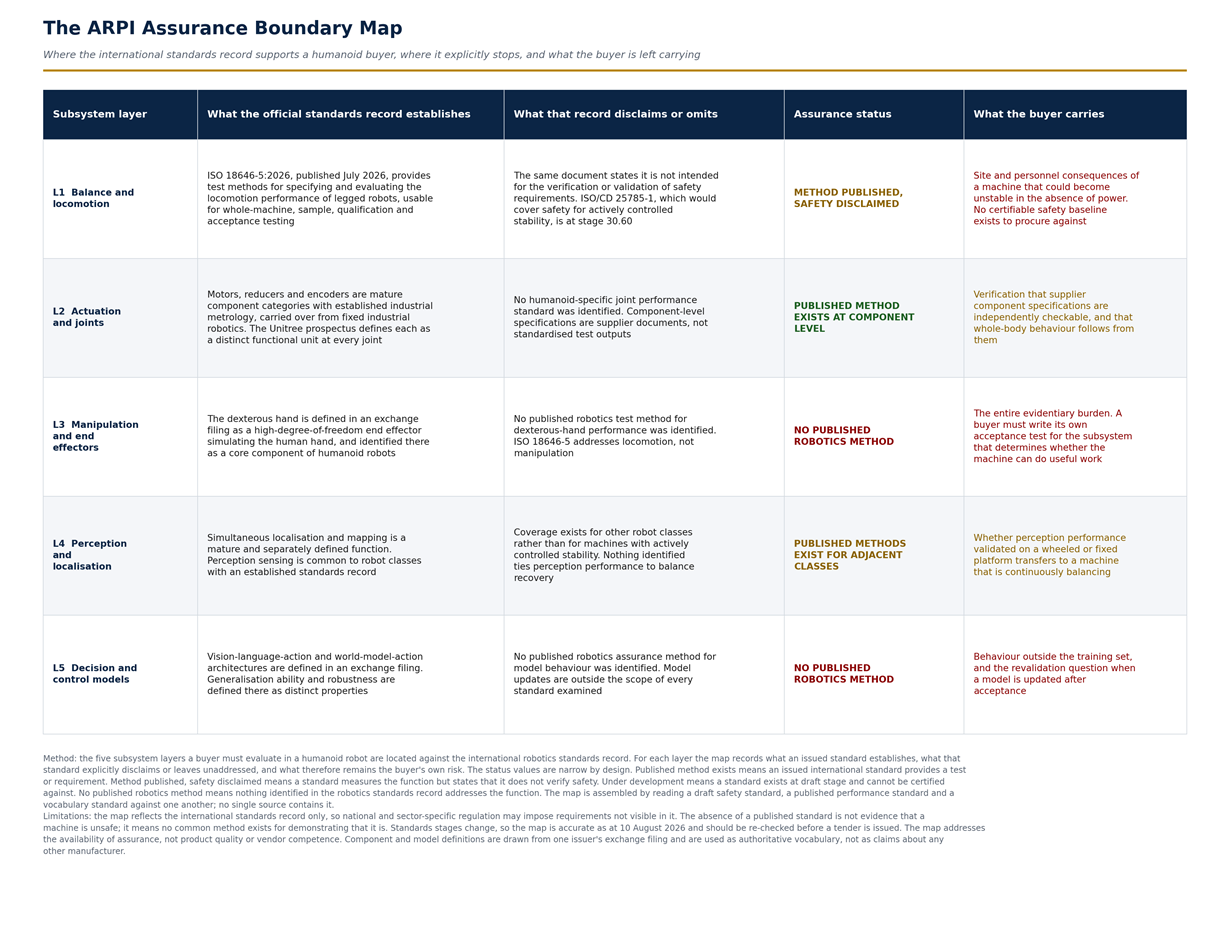
This publication's Assurance Boundary Map, set out below, formalises that observation. For each subsystem layer it records what the international standards record establishes, what that record explicitly disclaims or omits, and what consequently remains the buyer's own risk. The status values are deliberately narrow. Published method exists means an issued international standard provides a test or requirement. Method published, safety disclaimed means a standard measures the function but states that it does not verify safety. Under development means a standard exists at draft stage and cannot be certified against. No published robotics method means nothing in the robotics standards record addresses the function.
Four limitations apply and should travel with the map. It reflects the international standards record only, so national and sector-specific regulation may impose requirements not visible in it. The absence of a published standard is not evidence that a machine is unsafe; it means no common method exists for demonstrating that it is. Standards stages change, so the map is accurate as at the date of publication and should be re-checked before a tender is issued. And the map addresses the availability of assurance, not product quality or vendor competence.
Table 1: The ARPI (AI Robotics Pricing Intelligence) Assurance Boundary Map
Where It Sits in the Robotics Ecosystem
The humanoid does not sit inside the existing robotics taxonomy. It sits across its seams, and the seams are institutional rather than conceptual.
Robot standards are prepared by International Organization for Standardization Technical Committee 299, which handles robotics. Driverless industrial trucks and automated guided vehicles are handled by a different committee, Technical Committee 110. Safety standards already exist for industrial robotics and for non-industrial service robotics, addressing fixed manipulators and personal care robots respectively. The humanoid arrives as a machine that manipulates like an arm, travels like a mobile robot, and balances like neither, and the standard being written for it is organised around a property, actively controlled stability, rather than around a form factor.
The statistical consequence is more concrete, and buyers should understand it before they read any market figure. Members of the International Federation of Robotics use the international vocabulary definitions when compiling national industrial robot statistics. Those definitions describe an industrial robot as a manipulator programmable in three or more axes. A bipedal humanoid does not answer that description naturally, and the federation's published installation statistics do not break out humanoids as a category. Its most recent preliminary results reported that industrial robot installations in the United States rose eleven percent year on year to 38,000 units in 2025, with automotive reaching 13,500 units, one percent below the prior year. There is no equivalent line for humanoids, because the statistical apparatus that produces those numbers was not built to count them.
This has a direct practical consequence. When a buyer encounters a confident figure for global humanoid shipments or market value, that figure did not come from the official statistical system. It came from a commercial estimate. This publication's Disclosure Asymmetry Table, below, states plainly which questions about this asset class the official record can answer and which it cannot, and names the source of each boundary. Its limitation is important: a single issuer's audited disclosure is official about that issuer alone and must never be generalised to the asset class.
Table 2: The Disclosure Asymmetry Table
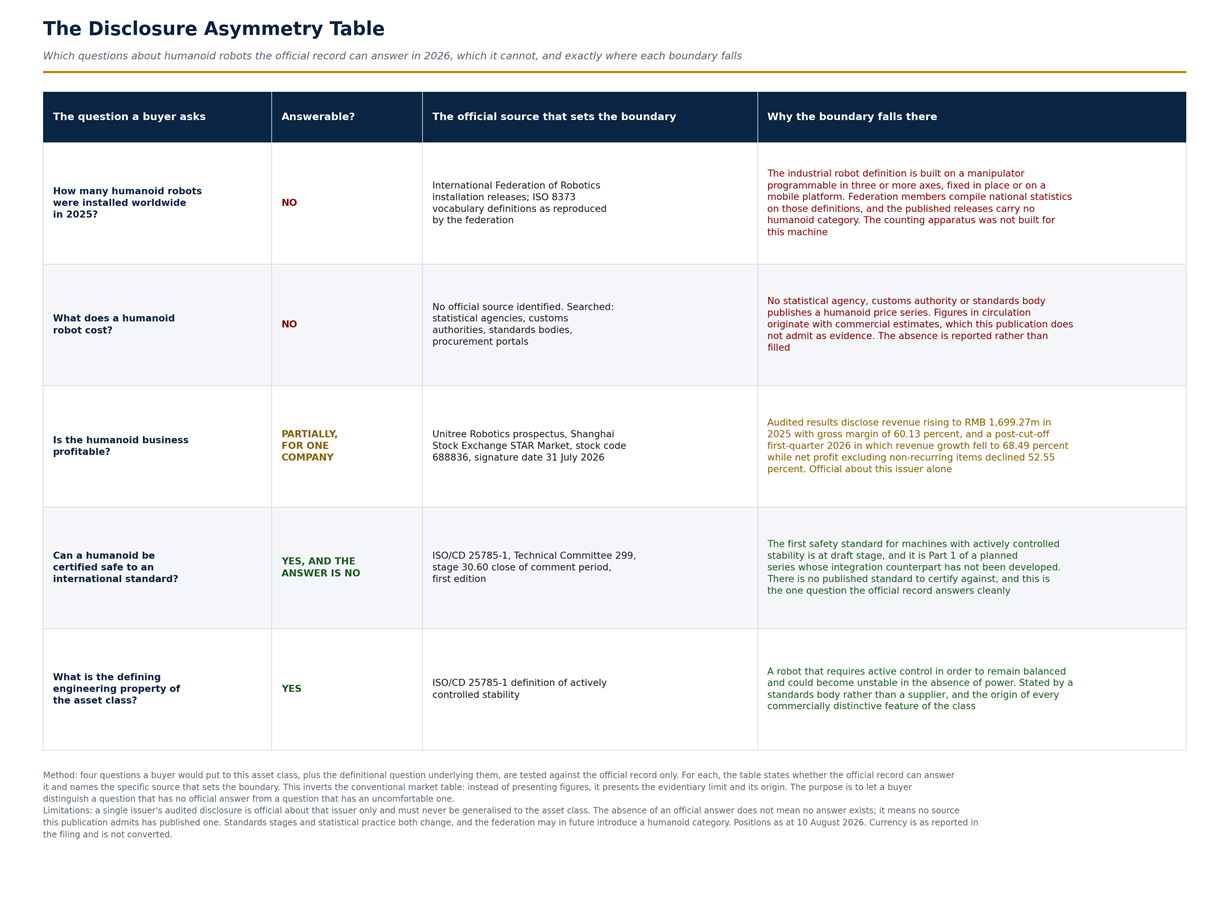
The federation's own institutional position is worth noting for a first-time reader, because it is more measured than the surrounding discourse. Its position paper on humanoid robots is titled Vision and Reality, and the federation describes its purpose as separating the two. It states the case for the form factor conditionally, observing that to the extent our environments are optimised for the human body, a general-purpose robot based on human motion mechanics and form factor could have an advantage. It attributes the present enthusiasm to funding announcements by large technology companies and a growing number of start-ups, and it uses the word hype to describe the result. When the industry's own statistical authority frames an asset class that way, a buyer is entitled to ask suppliers for evidence rather than demonstrations.
Why It Matters Now
Two things changed in the second half of 2026, and neither is a product launch.
The first is that the assurance apparatus began to be built, visibly and incompletely. The safety standard for machines with actively controlled stability reached close of comment period as a first edition, and it is explicitly the first part of a series: a second part addressing safety requirements for the integration of applications is to be developed separately and does not yet exist. So the standard that would tell an integrator how to build a compliant humanoid workcell has not been written. In parallel, the locomotion performance standard was published, giving buyers a common method for evaluating walking performance while stating that it is not intended for verifying safety. A buyer in 2026 is operating in the gap between those two documents.
The second is that the asset class acquired audited financial disclosure for the first time. The Unitree prospectus reports revenue rising from RMB 159.13 million in 2023 to RMB 1,699.27 million in 2025, a compound annual growth rate the filing states as 226.78 percent, with main business gross margin improving from 44.22 percent to 60.13 percent and research and development expense rising to RMB 144.97 million. The company moved from a loss excluding non-recurring items of RMB 18.02 million in 2023 to a profit on the same basis of RMB 590.75 million in 2025.
The more instructive disclosure is what the filing says about the period after its audit cut-off. The company reports that as its revenue base substantially increased, industry enthusiasm gradually moderated and market competition intensified, its reviewed first-quarter 2026 revenue growth rate fell to 68.49 percent year on year, and that owing to rapid growth in period expenses its net profit excluding non-recurring items declined 52.55 percent year on year. The filing also discloses the risk that if short-term demand enthusiasm, including robot leasing, declines, this may transmit upstream and produce price competition in industry products, and that its own selling prices may fall either actively or passively.
Read carefully, that is a market leader stating in an audited exchange filing that growth is decelerating sharply and profitability has inverted while revenue is still rising. It is a company disclosure about one company, and it must not be read as a statement about the sector. But it is the only audited window into humanoid unit economics that exists, and it points the opposite way from the surrounding enthusiasm.
The policy backdrop has also hardened into something a buyer should factor into supplier due diligence. China's fifteenth five-year plan outline names robotics within its enumerated emerging industries, the near-term pillar track, and names embodied intelligence separately under future industries, the longer-horizon cultivation track. The Chinese industry ministry has published guidance on the innovative development of humanoid robots and, as the robotics federation records, expects humanoids to become a disruptive technology comparable to computers or smartphones. Whatever a buyer concludes about timing, supply for this asset class is being shaped by industrial policy rather than by demand alone.
Questions to put to a humanoid supplier
· Which international standards do you claim conformity to, and for each, is the standard published or at draft stage? Ask for the stage code.
· Was the capability in your demonstration produced autonomously or under operator control, in whole or in part?
· What happens to the machine when power is lost, and what does that imply for the site around it?
· Which locomotion performance figures have been measured using a published international test method, and which are internal measurements?
· For the dexterous hand and the model layer, what method do you use to demonstrate performance, given that no published robotics test method covers either?
· What is your model update policy, and does an update revalidate or invalidate our acceptance testing?
· Are the joint-level components, motors, reducers and encoders, sourced from suppliers with published specifications we can independently verify?
The ARPI Position
The defining question about humanoid robots in 2026 is not capability. It is assurance.
Capability is advancing quickly and is easy to observe. Assurance is advancing slowly and is easy to overlook because its absence looks like nothing at all. Every robot class this publication has examined in previous weeks arrived with an assurance apparatus already in place: a safety standard to procure against, a test method to measure claims with, a statistical series to size the market from, and in the case of mobile robots, a mature body of national regulation. The humanoid arrives with none of those complete. One safety standard is at comment stage with its integration counterpart unwritten. One performance standard is published and disclaims safety. The statistical series does not count these machines. And exactly one manufacturer has audited financials in the public record.
The commercially useful reading is neither dismissal nor enthusiasm. The machine is real, the engineering is genuine and the buyer is currently carrying assurance risk that in every other robot class is carried by the standards system. That is a manageable position for an organisation that knows it is in it and an unmanageable one for an organisation that assumes the usual infrastructure exists. A buyer entering this asset class in 2026 should expect to write its own acceptance criteria, insist on evidence rather than demonstration and treat the absence of a certifiable safety standard as a commercial term to be negotiated rather than a technicality to be waived.
Disclaimer
This article is published by RobotAIGeek for informational and educational purposes only. It does not constitute procurement advice, engineering advice, safety advice, legal advice, investment advice, or a recommendation to buy, specify, or deploy any product, system, or security. References to international standards, including their titles, edition numbers, development stages, publication dates, and scope statements, are provided for general orientation only, are stated as current at the information cut-off date, are subject to change as standards progress through their development stages, and do not substitute for reading the standard itself or for conformity assessment by a competent body. The absence of a published standard covering a function is not a statement that any machine is unsafe, and the presence of a published standard is not a statement that any machine conforms to it. This article deliberately asserts no market size, no unit forecast, no market share, and no price for this asset class, because no official source publishes one, and readers should treat any single such figure encountered elsewhere with corresponding caution. Financial figures are drawn from one issuer's own regulatory filing, are stated in the currency, periods, and reporting scope used in that filing, are not converted between currencies, have not been independently audited by RobotAIGeek, and are official with respect to that issuer alone rather than to any other company or to the asset class. A securities offering referred to in that filing had not been completed as at the information cut-off date and nothing here should be read as a characterisation of its outcome or as an offer, solicitation, or recommendation in relation to any security. Characterisations of competitors appearing in that filing are the issuer's own statements and not the disclosure of the companies described. The analytical frameworks presented here are judgements about the availability of assurance evidence rather than statistical tests, safety assessments, product evaluations, or predictions of future performance. Readers should conduct their own due diligence and obtain independent professional advice before making any procurement decision. Information cut-off: 10 August 2026.