Global Ex China Embodied AI and Humanoid Robotics Market Report 2026
The global humanoid robotics market outside of China is bifurcating into hardware and intelligence platforms. While China dominates physical unit shipments, Western nations are competing aggressively on artificial general intelligence for the physical world through Vision Language Action models.

The global humanoid robotics and embodied AI market outside of China is experiencing an unprecedented acceleration in 2026, driven by breakthroughs in Vision Language Action foundation models, massive capital inflows, and the transition from laboratory prototypes to active commercial pilots [1]. While Chinese manufacturers currently dominate global unit shipments, accounting for roughly 87 percent of the 13,317 units shipped globally in 2025 [2], Western and allied nations are competing aggressively on a different vector: artificial general intelligence for the physical world.
Venture capital funding for robotics surged to an annualized run rate of over 40.7 billion USD by early 2026 [3]. The market is increasingly bifurcating into two distinct layers: hardware platforms, which are the physical robots, and intelligence platforms, which serve as the AI brains. Valuations for pure play AI foundation model companies have skyrocketed, with Figure AI reaching 39 billion USD [4], Skild AI at 14 billion USD [5], and Physical Intelligence at 5.6 billion USD [6].
Simultaneously, governments across the US, Europe, and Japan are heavily subsidizing domestic robotics ecosystems. The US Pentagon has allocated 13.4 billion USD for autonomous systems in FY2026 [7], while the European Union Horizon Europe program and Japan NEDO Moonshot Program are actively funding domestic champions to counter Chinese hardware dominance [8] [9].
Market Sizing and Competitive Landscape
The most critical dynamic in the 2026 global humanoid market is the stark contrast between valuation and actual production volume. According to Omdia and Forbes [2], the global shipment reality check reveals a significant disparity.
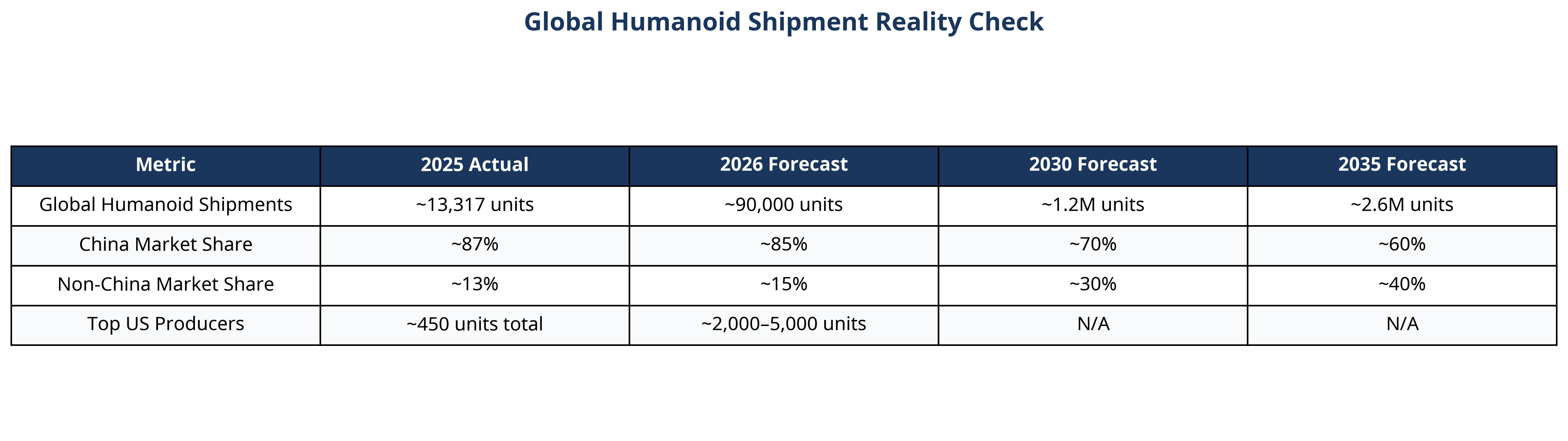
In 2025, Figure AI, Agility Robotics, and Tesla each shipped approximately 150 units, compared to China AgiBot which shipped over 5,100 units [2].
The ex China market is highly regionalized, with distinct competitive advantages in different geographies. North America dominates the brain layer of embodied AI. Companies like Physical Intelligence, Skild AI, Figure AI, and Apptronik are leveraging the concentration of large language model talent in Silicon Valley and Seattle. The strategy here is not to compete on hardware cost, but to build general purpose models that can learn new tasks in hours rather than months [1]. Amazon strategy of acquiring a majority stake in Agility Robotics and buying Fauna Robotics represents the most aggressive commercial deployment push [10].
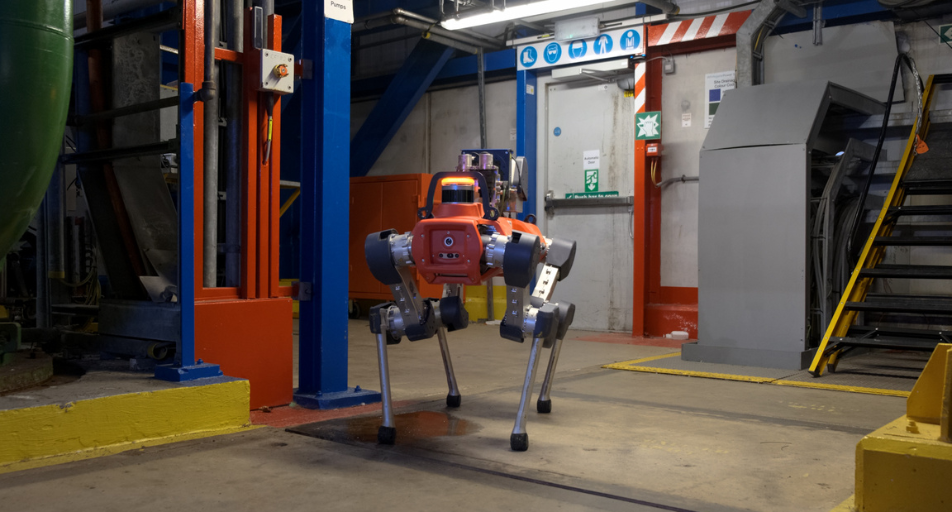
Europe has quietly built a formidable cluster of embodied AI companies. Germany Neura Robotics recently secured a 1.53 billion USD Series C for its cognitive robotics platform [11]. Switzerland is emerging as a critical hub, home to Flexion Robotics, ANYbotics, and Mimic Robotics. BMW deployment of the Hexagon AEON humanoid at its Leipzig plant marks a major milestone for European industrial automation [12].
Japan and South Korea are leveraging decades of legacy robotics research and integrating modern AI. South Korea is particularly aggressive, with Hyundai owning Boston Dynamics, Samsung investing in Apptronik and Rainbow Robotics, and startups like WIRobotics securing major funding [13].
Technology Trends and Bottlenecks
The industry is currently in what analysts call the GPT 2.5 moment for robotics [1]. The architectural breakthrough is the Vision Language Action model. Rather than hardcoding specific routines, models like Physical Intelligence pi 0.7 and Skild AI omni bodied model allow robots to receive a natural language command, interpret the physical environment, and execute the task [6].
Because robots require physical interaction data which does not exist on the internet, companies are turning to World Models [1]. NVIDIA GR00T Dreams and Google DeepMind Gemini Robotics utilize advanced physics simulators to train robots synthetically, reducing the need for massive physical robot fleets during the training phase [14] [15].
The primary bottleneck for Western companies remains the supply chain and hardware cost. Chinese competitors like Unitree are pricing their G1 humanoids at 16,000 USD [2]. To compete, Western firms must either drastically reduce actuator and component costs or demonstrate AI capabilities so superior that they justify a massive price premium in commercial return on investment calculations.
Strategic Conclusions
The high valuations of pure play AI robotics firms are pricing in a software like monopoly. If the simulation to real world gap proves harder to cross than anticipated, these valuations will face severe corrections. Amazon vertical integration provides the clearest path to scale, as whoever controls the deployment environment controls the real world data exhaust.
As Chinese firms drive the cost of hardware platforms toward zero, Western firms must ensure their proprietary AI models remain hardware agnostic, allowing them to run their brains on cheap imported bodies if necessary. If commercial returns take longer to materialize, government and defense contracts will become the critical bridge funding for Western humanoid manufacturers.
References
[1] KraneShares. Humanoid Robotics In 2026: The Race From Pilot To Platform. May 12, 2026.
[2] Forbes. Top 10 Humanoid Robot Companies By Shipments Revealed. January 9, 2026.
[3] McKinsey and Company. Robotics Supply Chain Constraints. April 2026.
[4] TechCrunch. Figure AI valuation reaches 39B. 2026.
[5] Crunchbase News. Robotics Startup Skild AI Lands 1.4B, Tripling Valuation To 14B. January 14, 2026.
[6] The Information. Robotics Startup Physical Intelligence in Talks to Raise at 5 Billion. September 2025 / March 2026.
[7] Granted AI. AI Grants for Autonomous Systems and Robotics. February 24, 2026.
[8] European Commission. European approach to artificial intelligence and Robotics Funding. 2026.
[9] IEEE Robotics. Japan NEDO Moonshot Program Goal 3 Update. December 2025.
[10] GeekWire. Amazon hires Covariant founders, inks AI licensing deal. August 30, 2024.
[11] CNBC. Humaniod robotics company Neura raises up to 1.4 billion. June 10, 2026.
[12] BMW Group Press. BMW Group to deploy humanoid robots in production in Germany for the first time. February 27, 2026.
[13] PR Newswire. WIRobotics Secures Approximately KRW 100 Billion Series B Funding. May 14, 2026.
[14] Google DeepMind. Gemini Robotics 1.5 brings AI agents into the physical world. September 25, 2025.
[15] NVIDIA. Project GR00T Foundation Model for Humanoid Robots. 2025.