Future Trends: The Next 3 Years of Collaborative Robot Innovation
The next three years of cobot progress will be defined less by arm mechanics than by safer integration, perception, retasking, and bounded AI workflows. This buyer roadmap separates practical procurement priorities from research-stage claims.
The next three years of collaborative robot innovation will be decided less by the next arm specification than by how reliably a complete cell can perceive variation, recover from exceptions, and be reconfigured without a long integration project. That is a commercial distinction. A cobot can be affordable and technically safe, yet still produce a poor investment if operators cannot change tasks, validate a new fixture, or resolve a vision failure without specialist support.
The demand backdrop is meaningful, but it should not be overstated. The International Federation of Robotics, or IFR, reports that cobots represented 10.5% of 541,302 industrial robots installed worldwide in 2023. It also reported 542,076 industrial robot installations in 2024, while projecting 575,000 in 2025 and more than 700,000 by 2028. Those latter totals describe the entire industrial robot market, not cobots alone. 1 2 The World Artificial Intelligence Conference (WAIC) held in Shanghai in July 2026 provided a clear signal of where the industry intends to capture more of that market: by shifting focus from the robot arm to the end effector and the AI model driving it. 3
Current Technology Ceiling
Today’s cobots are strongest where product families change, human access is frequent, and the task is bounded enough to standardise. Hand guiding, tablet programming, plug and play peripherals, and a lighter footprint have lowered the entry barrier for machine tending, assembly, inspection, dispensing, welding, and end of line handling. 1 Yet a collaborative label is not a blanket permission for unrestricted human proximity. ISO 10218-1:2025 covers the robot as partly completed machinery, while ISO 10218-2:2025 addresses integration and applications. Risk assessment, end effector design, workpiece hazards, validation, and safety functions remain cell-level responsibilities. 4
The mechanical ceiling also matters. IFR notes the speed and payload trade-offs that remain inherent in many cobot deployments. 1 A buyer should therefore avoid using a cobot to force-fit a high-speed, high-payload task better served by conventional automation with engineered safeguarding. The near-term opportunity is not to erase that boundary. It is to make more variable, lower-volume work economically automatable on the right side of it.
Key R&D Directions
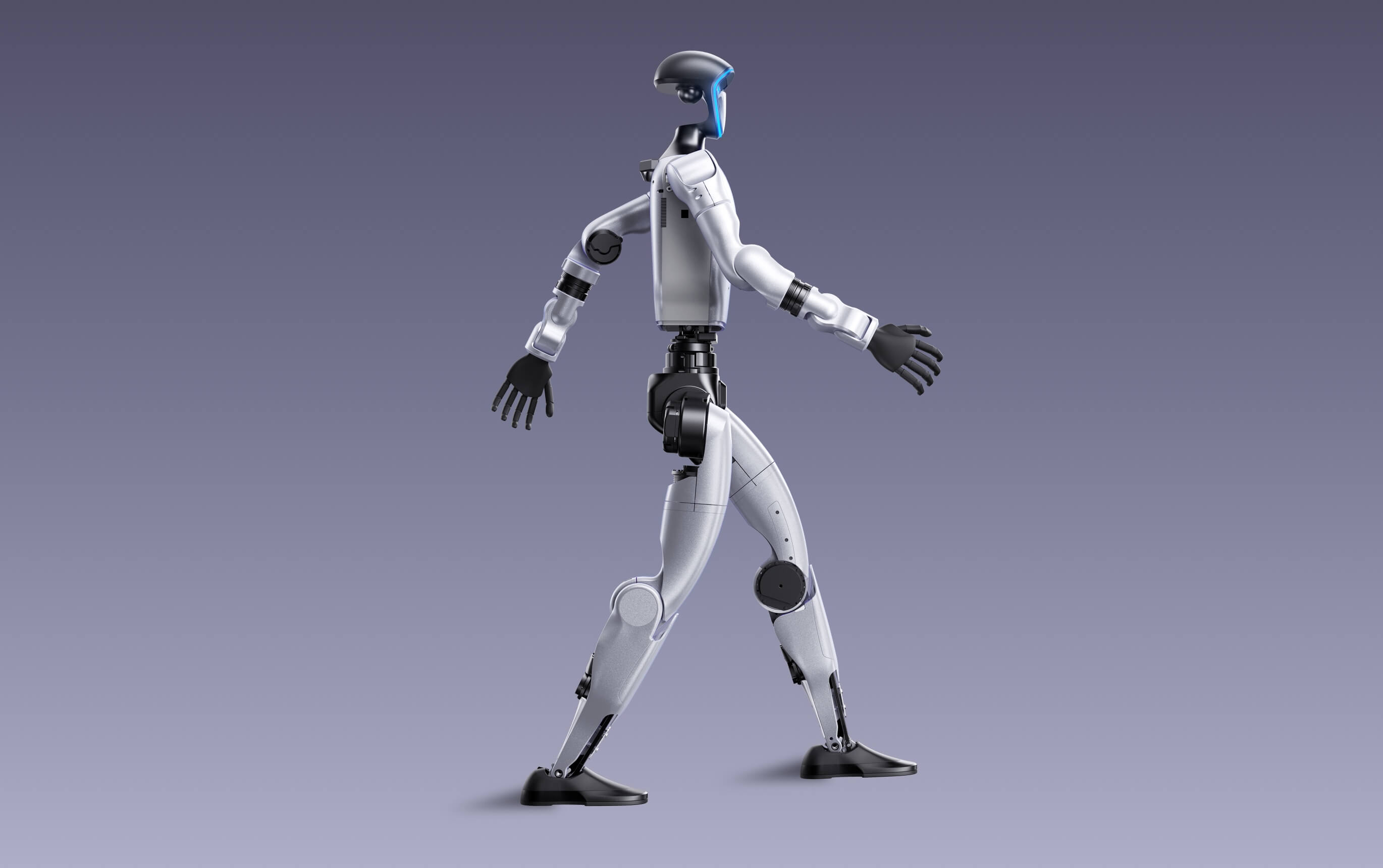
The most material research direction is repeatable flexibility, which is increasingly focused on the robot’s "hands." At WAIC 2026, the industry signalled a transition from static hardware displays to task-oriented demonstrations. 5 Dexterous hands are emerging as the final interaction layer between the robot and the physical world. For example, Guangzhou Daily reported that the vendor behind the Std16A industrial dexterous hand demonstrated handling of differently sized boxes, apparel packaging, and express soft packs, and had placed a dexterous hand into a warehouse sorting operation during the 2026 "618" shopping festival. 6 AGIBOT announced its OmniHand 3 Ultra-M, a direct-drive hand with 20 active degrees of freedom and tactile sensing, aimed at embodied-AI training and contact-rich manipulation. 7
This points to a future where the prize is a cell that can identify a part, select a proven task recipe, adapt its grasp to variable shapes, and demonstrate that a new configuration still meets operational requirements. A second direction is coordinated automation. The European Commission funded COROB through September 2026 to develop AI, monitoring, inspection, control, and cooperative multi-robot systems for flexible welding and wire arc repair pilots. 8 The current value of such projects is to show where validation effort is concentrating: flexible process control, inspection feedback, and controlled coordination between machines.
AI and Software Integration
AI will be useful first as a bounded layer around the robot, not as a replacement for industrial engineering. IFR points to machine learning, sensors, vision, and AI as enablers of more responsive operation. 1 NIST’s program describes the supporting need in less promotional terms: common metrics, test methods, information models, and interfaces that help manufacturers assess whether a system will perform in a changing environment. 9
For a buyer, the practical question is whether an AI feature or a dexterous hand has an approved operating envelope, a data trail, a failure-recovery process, and a clear owner when confidence is low. Will dexterous hands enter cobot deployments? Yes, but selectively. They are unlikely to displace simple parallel, vacuum, or magnetic end effectors for stable, high-volume tasks. Their value lies in mixed-SKU packaging, delicate assembly, or unstructured sorting where the cost of avoiding frequent tooling changes justifies the added complexity.
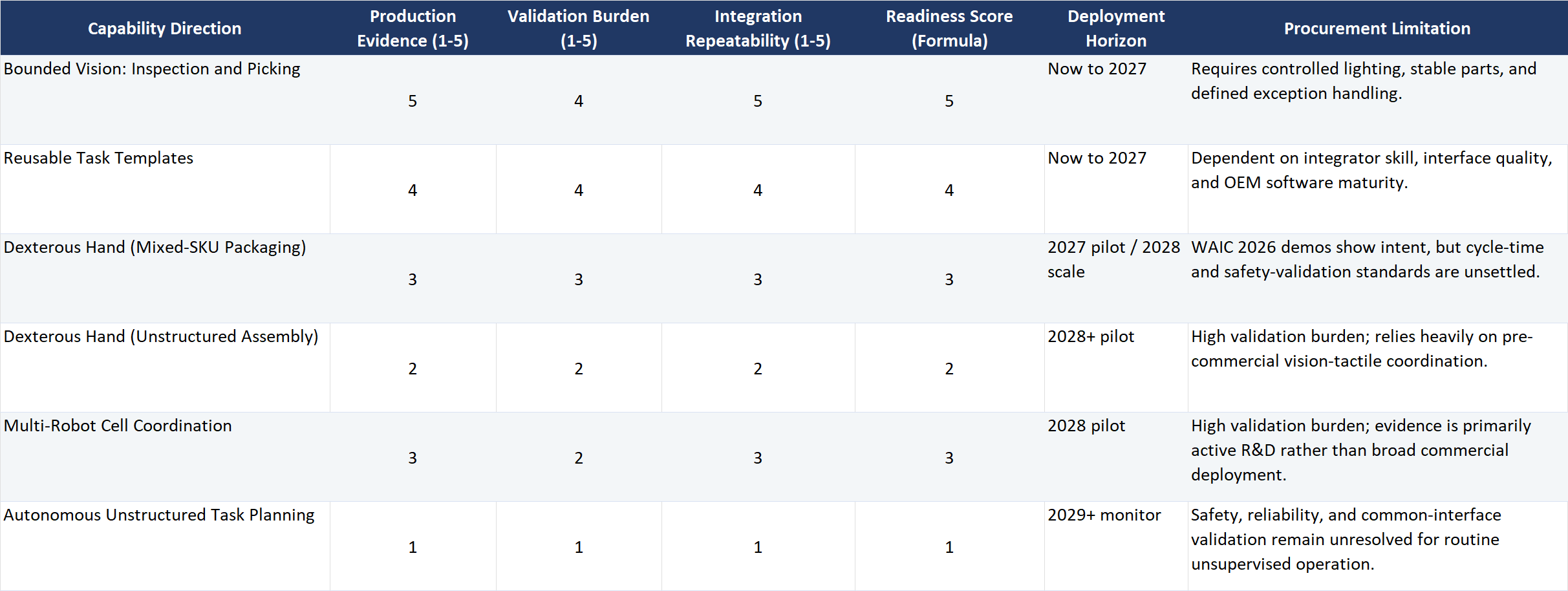
The original Buyer Readiness Matrix below converts that evidence into a procurement screen. A score of 5 means the direction is suitable for production evaluation now, 3 means a supervised pilot is more appropriate, and 1 means research monitoring is the prudent action. The scores synthesize the maturity signals in IFR, ISO, NIST, and WAIC 2026 rather than measuring a vendor or forecasting market share. Its limitation is that evidence quality varies by application, supplier, and local integration capability.
Cost Reduction Trajectory
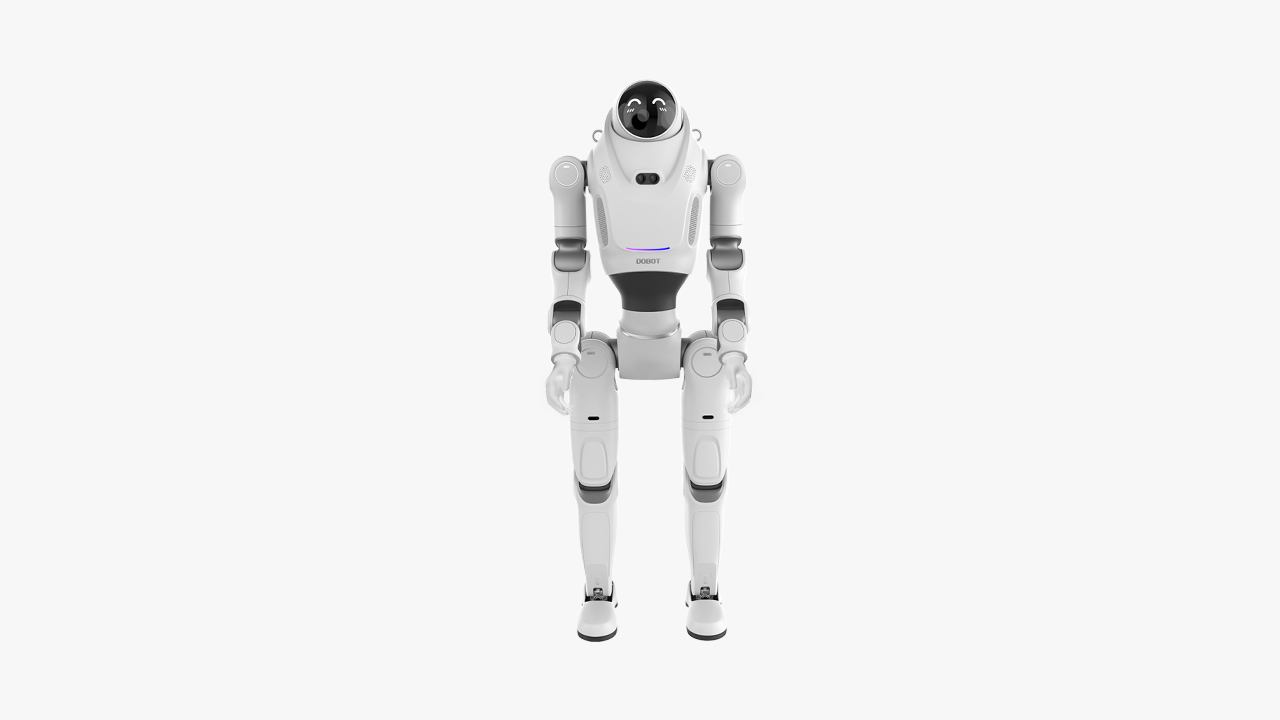
Lower arm price should not be treated as the primary 2026 to 2029 cost story. A public Dobot filing showed that its six-axis cobot average selling price declined from RMB65.9 thousand in 2021 to RMB56.6 thousand in 2023, and was RMB47.1 thousand in the first half of 2024. 10 This is one manufacturer’s product mix, not a universal price curve.
Similarly, while WAIC 2026 showcased advanced dexterous hands, the verified manufacturer announcements did not publish an acquisition price for these flagship models. 7 Buyers should treat them as quote-based purchases. The relevant commercial logic is a three-year total deployed cost comparison. A dexterous hand wins only when its avoided tooling, avoided changeovers, and recovered exceptions are greater than its added hardware, integration, validation, service, and downtime risk. Procurement teams must model the total deployed cost: arm, end effector, tactile sensing, safety validation, integration, training, maintenance, and expected changeovers.
Timeline Milestones
From now through 2027, buyers should pursue one bounded workflow with stable parts and a measured baseline for cycle time, quality, recovery time, and operator intervention. For dexterous hands, this means a supervised pilot on a mixed-object workflow to document successful-grasp rates and fault modes.
By 2028, the goal should be repeatable redeployment across similar products, supported by documented safety validation and interface standards. Production evaluations for dexterous hands should be considered in high-mix packaging or delicate assembly, provided there is a verified total-cost case and a clear spare-parts plan. No single supplier dominates this space; buyers must evaluate vendors based on interoperability, local service, and application ownership, not just degree-of-freedom counts.
Into 2029, the highest value deployments are likely to link perception, task recipes, inspection data, and supervised recovery across a family of cells rather than to promise a general purpose autonomous factory. The investment thesis remains straightforward: acquire cobots and advanced end effectors for verified workflow flexibility, not for an abstract AI narrative.
References:
[2] International Federation of Robotics, World Robotics 2025 report, 2025
[3] Xinhua, State Council Information Office briefing on WAIC 2026, 8 July 2026
[4] International Organization for Standardization, ISO 10218-1:2025
[6] Guangzhou Daily / Dayoo, What Dexterous Hands Compete On: Stable Work, 20 July 2026
[7] AGIBOT, AGIBOT Unveils Four New Products at WAIC 2026, 18 July 2026
[9] National Institute of Standards and Technology, Robotic Systems for Smart Manufacturing Program
[10] Shenzhen Dobot Corp Ltd, Global Offering, 13 December 2024
Disclaimer: The information provided in this article is for informational purposes only and should not be construed as financial, investment, or strategic advice. RobotAIGeek does not endorse any specific company or product mentioned.