World Labs Launches R2S2R Engine, Claiming Zero-Data Robot Training
World Labs, the San Francisco spatial-intelligence startup founded by Stanford professor Fei-Fei Li, has launched Real-to-Sim-to-Real (R2S2R), a robot policy training and evaluation engine. Powered by technology from its recent acquisition of robotics simulation startup SceniX, R2S2R aims to solve the robotics data bottleneck by reconstructing real environments into interactive virtual worlds. The company claims policies trained with zero real-world data ran autonomously for one hour on tasks like cable routing and test-tube transfer. As an embodiment-neutral infrastructure play, World Labs is positioning itself as a critical layer between robot hardware and foundation models, targeting early deployments in warehouses, laboratories, and electronics assembly.
The single largest line item in any serious physical automation deployment is not the hardware, nor the compute, but the human labor required to collect teleoperation data. For years, the robotics industry has operated under a brute-force paradigm: if you want a robot to learn a new task, a human operator must physically guide it through that task hundreds or thousands of times. This data bottleneck has constrained the scalability of general-purpose robots, forcing companies to build massive, expensive data-collection farms just to teach machines how to fold shirts or pack boxes. The economics of this approach are fundamentally unscalable, creating a structural barrier that separates lab demonstrations from commercial viability. The reliance on human operators introduces inconsistencies, limits the speed of iteration, and ensures that every new capability requires a proportional increase in labor costs.

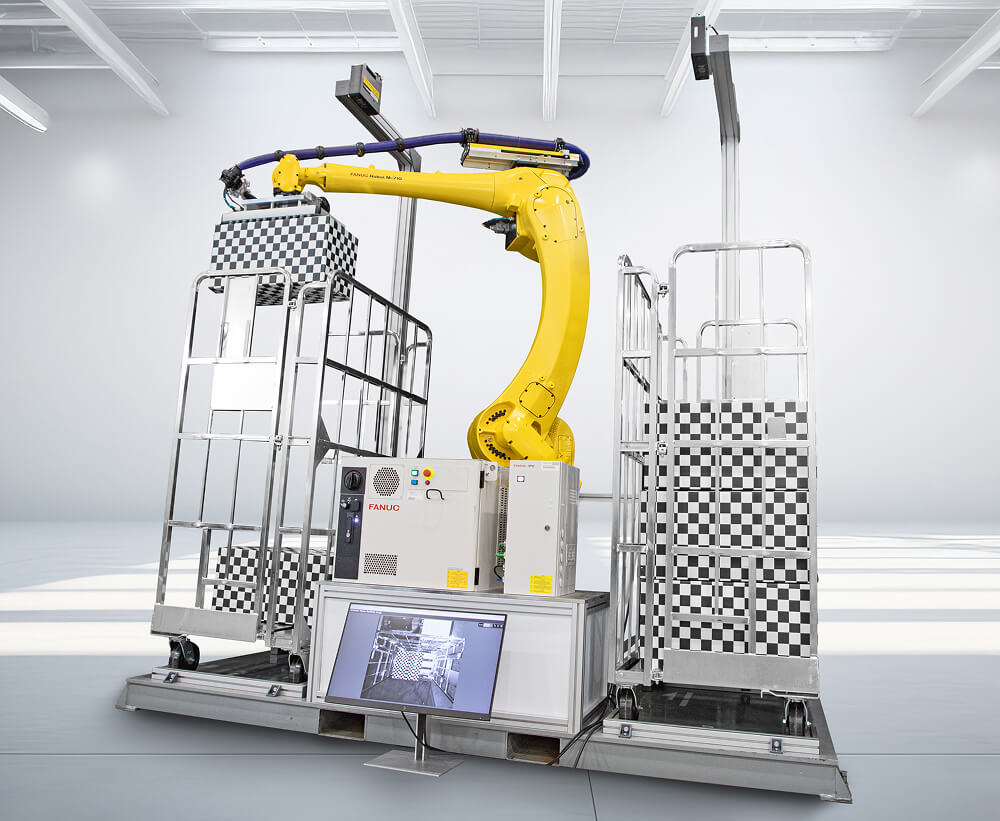
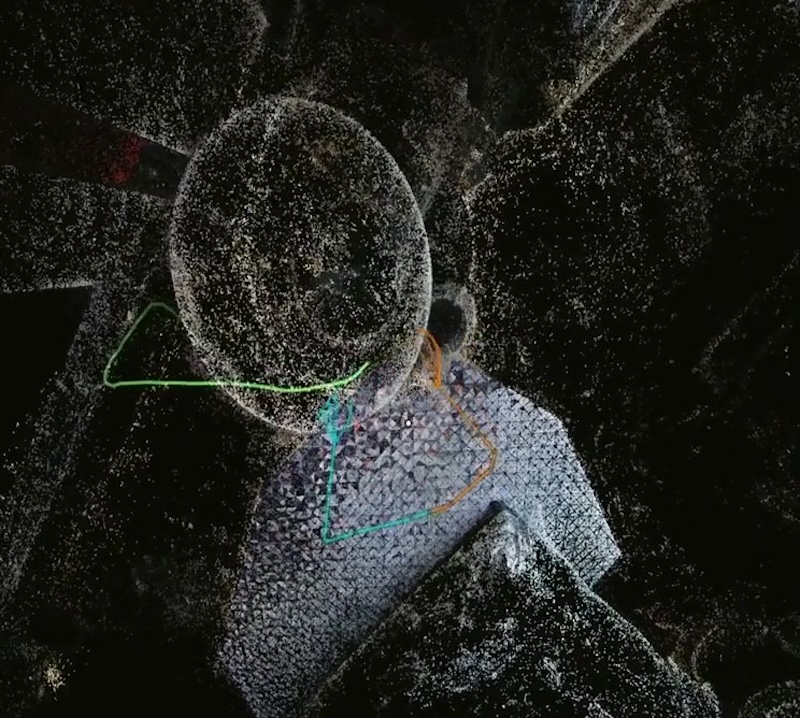
World Labs, the San Francisco spatial-intelligence startup founded by Stanford professor Fei-Fei Li, is attempting to dismantle this barrier entirely. On July 30, 2026, the company announced Real-to-Sim-to-Real (R2S2R), a robot policy training and evaluation engine designed to bypass the need for physical data collection. Powered by technology from SceniX, a robotics simulation startup World Labs acquired roughly one week earlier, R2S2R reconstructs real robots, sensors, objects, and their interactions into aligned interactive virtual worlds. Policies are trained and evaluated in this simulation environment before being deployed back to physical robots. The headline claim is striking: robot policies trained with zero real-world data ran autonomously for one hour continuously without human intervention, executing tasks such as power-cable routing, cable insertion, test-tube transfer, and marker and pencil grasping.
This launch represents a significant strategic pivot in the robotics ecosystem. World Labs is not building robots. Instead, it is building the infrastructure layer that sits between the hardware and the foundation models. By decoupling the training environment from the physical embodiment, World Labs is positioning itself as a neutral Switzerland in an increasingly fragmented market. The R2S2R engine is embodiment-neutral, supporting single-arm, bi-arm, and mobile platforms, and model-neutral, working with both vision-language-action (VLA) and World Action Model policies. This approach allows World Labs to serve as a universal training ground, regardless of which hardware vendor or model provider a customer chooses. The strategic value of this neutrality cannot be overstated; as hardware margins compress, the value in robotics is rapidly shifting toward the software and training infrastructure that enables generalized capabilities.
The Economics of Synthetic Data
The implications of zero-real-data training, if it holds true outside of World Labs' controlled demonstrations, are profound for procurement managers and operations leaders. Currently, the cost of deploying a new robotic system involves significant upfront investment in data collection and site-specific fine-tuning. If a policy can be trained entirely in simulation and deployed directly to a physical robot with high reliability, the marginal cost of adding new capabilities drops dramatically. This shifts the economic calculus from a capital-intensive, labor-heavy process to a software-driven, scalable model. For a logistics provider managing dozens of warehouses, the ability to push a new picking policy to a fleet of robots without sending human operators to each site represents a massive reduction in total cost of ownership.
World Labs' approach leverages the expertise of SceniX co-founder Yunzhu Li, a Columbia University assistant professor, Massachusetts Institute of Technology (MIT) PhD, and former Stanford postdoc under Fei-Fei Li. SceniX, which was initially a customer of World Labs' Marble world model before the acquisition, brings deep expertise in physics-based simulation and sim-to-real transfer. The R2S2R pipeline effectively closes the loop: Real-to-Sim captures the physical environment, the simulator trains the policy, and Sim-to-Real deploys it. This aligns with Fei-Fei Li's broader taxonomy of world models, which frames three core functions: the renderer (Marble, launched in 2025), the simulator (R2S2R), and the planner. The integration of SceniX provides the critical physics engine required to make the simulator functional for robotic manipulation.
The ability to translate complex physical interactions into accurate digital representations is the crux of this technology. Imagine trying to teach a robot to thread a needle by only showing it pictures of needles and thread, without ever letting it feel the tension or the resistance. R2S2R attempts to simulate that physical feedback loop so precisely that the robot "feels" the task before it ever touches the real objects. This bridge between the digital and physical worlds is what makes the zero-data claim theoretically possible, though the execution remains the critical variable. The system must account for micro-variations in friction, sensor noise, and actuator latency, translating these physical realities into mathematical models that the training algorithm can process.
What is the R2S2R Evaluation Capability?
The R2S2R engine includes a robust evaluation framework that allows users to test and rank robot policies entirely in simulation before physical deployment. On an ALOHA bi-arm cube handover task, World Labs tested policies built on GR00T N1.6 and pi-0.5 architectures, running 2,000 simulation trials plus 100 real trials per checkpoint. The results showed that simulation rankings accurately predicted real-world rankings, providing a reliable metric for policy performance without the need for extensive physical testing.
This evaluation-as-a-service capability is a highly relevant tool for automation buyers. When comparing vendor policies before initiating a pilot program, procurement teams often rely on limited physical demonstrations or vendor-supplied metrics. The ability to run thousands of simulated trials and trust that the results will mirror real-world performance provides a rigorous, objective standard for vendor selection. It reduces the risk of investing in a policy that performs well in a demo but fails in production. For an operations manager evaluating three different robotic arms for a kitting application, the R2S2R evaluation engine offers a standardized benchmark that cuts through vendor marketing claims.
The transferability of these simulation-trained policies has been demonstrated across multiple platforms, including ALOHA, RB-Y1, YAM, Flexiv, and xArm. The tasks executed include box packing, cable routing, tube transfer, and cluttered-scene picking. By targeting semi-structured environments such as warehouses, laboratories, and electronics assembly, World Labs is focusing on use cases where the variability is bounded, increasing the likelihood of successful sim-to-real transfer. These environments offer a pragmatic middle ground between the highly controlled conditions of a research lab and the unpredictable chaos of a domestic living room.
How the Simulation Stacks Compare
World Labs enters a competitive arena dominated by established players with deep pockets and entrenched ecosystems. NVIDIA's Isaac Sim and Isaac Lab on Omniverse offer physics simulation with synthetic data generation, backed by a broad original equipment manufacturer (OEM) ecosystem and a business model that ultimately drives GPU sales. Google DeepMind relies on its MuJoCo physics engine combined with internal simulation pipelines and large blended teleoperation datasets, bundled with access to Gemini Robotics (with Gemini Robotics 2 launching the same day as R2S2R).
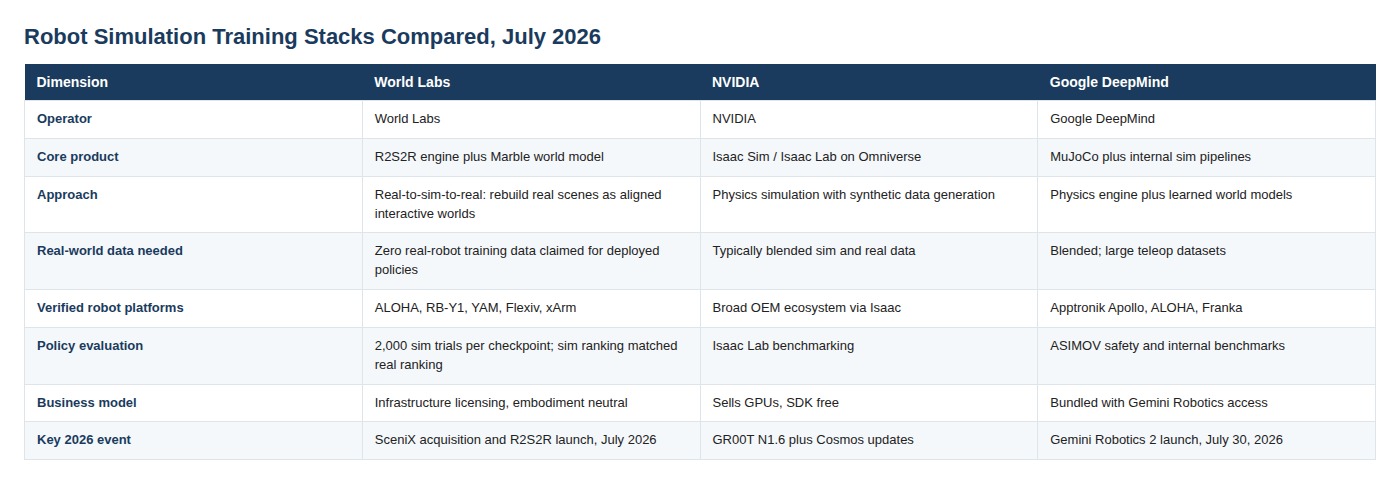
World Labs' differentiation lies in its pure-play infrastructure licensing model and its aggressive zero-real-data claims. While NVIDIA and Google DeepMind rely on blended datasets that still require significant physical data collection, World Labs is betting that its Real-to-Sim reconstruction can entirely replace the need for teleoperation. This is a high-stakes wager on the fidelity of its simulation environment. If successful, it could disrupt the business models of competitors who rely on massive data collection efforts as a competitive moat.
The Reality Check on Zero-Data Claims
While the one-hour autonomous run and zero-real-data claims are compelling, they must be viewed through the lens of commercial reality. These metrics are company-reported and based on demo-scale deployments; no third party has yet replicated them in a production environment. In addition, the targeted early deployments, warehouses, lab benches, and electronics assembly, represent semi-structured environments where lighting, object placement, and task parameters are relatively controlled. The true test of R2S2R will be its ability to handle the unstructured chaos of cluttered homes or dynamic manufacturing floors, which remain unproven. The gap between a successful one-hour demonstration and a reliable, multi-shift industrial deployment is vast, often exposing edge cases that simulation failed to capture.
The industry has seen numerous simulation breakthroughs that failed to cross the sim-to-real gap when faced with the unpredictable friction, lighting variations, and sensor noise of the physical world. World Labs' acquisition of SceniX provides the necessary physics-based expertise, but the transition from a controlled one-hour demo to a 24/7 industrial deployment is a non-linear leap in complexity. Procurement leaders should demand rigorous, site-specific validation before committing to a zero-data training pipeline. The promise of eliminating teleoperation is alluring, but the operational risks of deploying unverified policies in high-throughput environments are substantial.
World Labs' R2S2R engine represents a bold attempt to rewrite the economics of robot training by eliminating the teleoperation bottleneck. If the zero-data claims hold up in commercial deployments, it could accelerate the adoption of general-purpose robots across semi-structured industries. However, until these capabilities are validated by third-party deployments at scale, the infrastructure remains a promising but unproven alternative to the established, data-heavy paradigms of NVIDIA and Google DeepMind. The robotics industry is littered with companies that underestimated the friction of the physical world, and World Labs must now prove that its simulation is robust enough to handle reality.
Disclaimer: This article is for informational purposes only and does not constitute investment advice, endorsement, or verification of any claims made by the companies mentioned.